
D
Oct 13, 2025 at 07:35 AM
Trump 'Breaks Defense': Not Just TACO, Will There Be a Revaluation of Chinese Assets?
 I'm LongbridgeAI, I can summarize articles.
Originally, during the mid-September Madrid negotiations, the U.S.-China talks resolved the long-standing major conflict over TikTok. However, Trump's emotional essay on a 100% tariff seemed to have set back the bilateral relations overnight.
But following Trump's press inquiries, Vance's statements, and press conferences from the Chinese Ministry of Commerce, the TACO deal was almost unanimously expected. In this article, Dolphin Research will elaborate on how this TACO deal differs from previous ones and what insights can be drawn beyond TACO.
1. This TACO: Faster Pace, Shorter Window
TACO is no stranger to everyone—Trump Always Chickens Out, abbreviated as TACO. The core strategy is to exert extreme pressure before negotiations to gain bargaining chips, amplify the perception of confrontation, create a tough image, and give an impression of going all in, while actually managing expectations and engaging in extreme bargaining during the negotiations.
However, the problem is that after the April Liberation Day, the market, including opponents at the negotiating table, have already figured out this routine. This time, there are traces of this script in the timing choices.
Here are a few key time points:
1) After the mid-September Madrid negotiations, at the end of October and early November, South Korea is set to hold the APEC summit, with both the U.S. and China as core members. The market originally expected a possible meeting between the U.S. and China.
2) The legality case of Trump's IEEPA emergency powers to impose universal tariffs globally, which the Supreme Court has promised to expedite, is currently scheduled for oral arguments on November 5, where both parties' lawyers will present their views and answer questions from the judges. This is a necessary procedure. The market currently expects the highest probability is to uphold the lower court's ruling, making the judges' statements crucial.
3) Trump set the new 100% tariff to take effect on November 1; this period is precisely the concentrated procurement phase for Christmas and New Year supplies in the fourth quarter.
Among these three important time nodes, if the IEEPA ruling is unfavorable to the U.S. government, it means the 100% "tariff banner" it has raised again loses its legal basis, thereby weakening the negotiation momentum.
Therefore, the opportunity to "retract" in early November is very important. Conversely, if the 100% tariff is implemented, combined with the current tax rates, it would effectively freeze U.S.-China trade again. The last time the market believed such a thing would happen, there were signs of panic buying in U.S. supermarkets.
But this time, the U.S. is about to enter the fourth-quarter holiday season, and now is the time for holiday procurement replenishment to cope with the upcoming Thanksgiving, Black Friday, Christmas, New Year, etc. If the tariff takes effect on November 1, adding a "ship docking tax" on transportation, and with the domestic Double Eleven transportation also being quite busy, American citizens may not be able to enjoy the holidays properly, and the experience would be very poor.
Putting this information together, Dolphin Research believes a relatively reasonable judgment is:
This time, the pace of the TACO negotiations will be significantly compressed into the remaining time of October. Even if not fully negotiated by November, Trump should also resort to extensions, industry exemptions, quotas, etc.
In terms of pace, not only will spectators enter the TACO state faster this time, but the efficiency of contact and communication between the two sides is also different from the inefficiency and chaos when the U.S. and China had not yet established a communication mechanism in April; and in terms of scope, it is more limited to the U.S.-China game, with tariff negotiations with other countries basically settled.
Therefore, this TACO, whether for insiders or outsiders, should have a faster pace, a shorter window period, and due to the shortness of the window period, the market impact of harsh words during the middle of the game will also be weaker.
Therefore, Dolphin Research suggests that for U.S. stock investments, it is still advisable to look for U.S. stock assets with safer valuations that can benefit from interest rate cuts during declines, as the pit created by TACO may not be very deep.
Note—IEEPA:
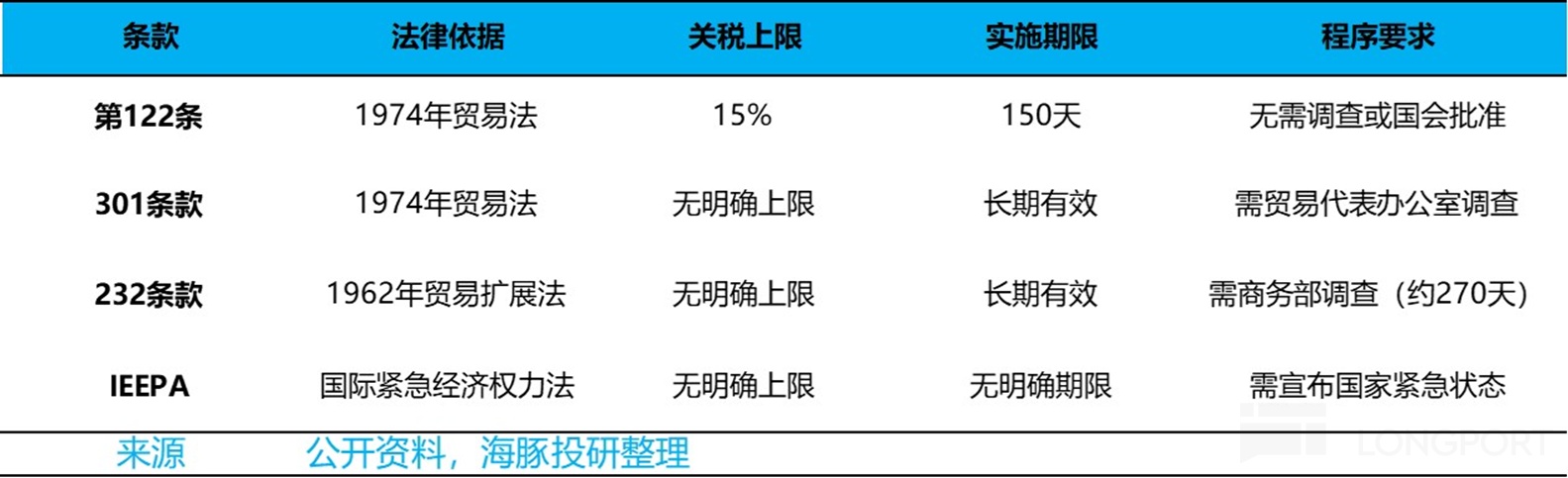
The International Emergency Economic Powers Act (IEEPA) is a 1977 legislation that authorizes the President to manage foreign economic activities under "unusual and extraordinary threats," including freezing assets, restricting transactions, controlling imports and exports, and capital flows. However, this authorization does not explicitly state whether universal tariffs can be established.
According to previous cases, when encountering ambiguous violations, "institutional interpretation" is no longer respected, but the "best interpretation" is given independently; secondly, major economic and political issues generally require congressional authorization; historically, Congress has set clear limits and timeframes for the President's taxation authority, such as the 10% comprehensive tariff imposed by Nixon under Section 122 of the 1974 Act, which has not been used by any President since.
From the current situation, the market expects a high probability of Trump losing the case, with more entanglement over tax refund amounts and whether the use of alternative tools is restricted. The Trump administration is likely to use Section 122 to extend, but this section has a limited tax rate cap, unlike the deterrent rates of Sections 301 and 232, so using Section 122 to extend provides a buffer for the institutional investigations required by Sections 301 and 232.
2. Beyond TACO, This Logic Also Deserves Attention!
In this TACO, aside from Trump's emotional essay, Dolphin Research is actually more concerned about the moves from both sides. The Madrid trade negotiations were the most pragmatic and goodwill-releasing communication between the two sides this year, and after sorting out the behavior list of both sides since the Madrid trade negotiations, let's take a look:
1) U.S.:
a. The U.S. Department of Commerce's entity list, especially the adjustment of control rules, directly includes some named companies' equity-related companies through 50% equity penetration;
b. The U.S. Trade Representative's office imposes special port fees on Chinese ships (including those made in China, flying the Chinese flag, and operated by Chinese entities);
c. The U.S. Department of Transportation recommends banning Chinese airlines from flying over U.S.-China flight routes.
d. 100% tariff, effective November 1; key export restrictions.
2) China:
a. In response to ship port fees, China implements reciprocal countermeasures. However, since the current shipbuilding capacity is mainly occupied by China and South Korea, with U.S. shipbuilding capacity being negligible, the countermeasure effect is weak.
b. The State Administration for Market Regulation launches an antitrust investigation into Qualcomm's acquisition of an Israeli chip company.
c. Rare earth export control: Imitating the U.S. control of semiconductor technology exports to China, China controls rare earth exports. Rare earths are mainly involved in key strategic industries that Trump focuses on, such as U.S. semiconductors, electric vehicle engines, defense, etc.
Comparing both sides, in the new round of extreme bargaining, the U.S. seems to be advancing as originally planned, without slowing down due to the Madrid negotiations, while China's countermeasures seem to be based on the U.S. situation, as if drawing a few planned cards from an already arranged deck.
Trump's 100% tariff seems like a reactive move after the precise control of rare earth exports, with the strength and routine of the move being previously used. The additional means—"key software" list may not yet be fully sorted out.
In this round of China's game, the quick, precise, and ruthless move is clearly the more detailed rare earth export control, which seems to be a move that was well-prepared and now unleashed.
What Dolphin Research is more curious about is why such a well-prepared "killer move" was not used in 2018, not used during the U.S. tariff liberation day, but instead used during the U.S.'s several conventional decoupling policies with China?
Dolphin Research provides a few clues to try to reasonably infer and focus on the core areas of current technological competition—the recent changes in the semiconductor sector;
1) China
a. The domestic lithography machine R&D unit Shanghai Microelectronics will split the front-end lithography machine (deep ultraviolet) assets into Yuliangsheng in 2025; the latter is a wholly-owned subsidiary of Shanghai Science and Technology Venture Capital Group, and an entity jointly controlled by Kechuangwei, a wholly-owned subsidiary of Shanghai Science and Technology Venture Capital Group, and New Kailai, which is closely related to HW.
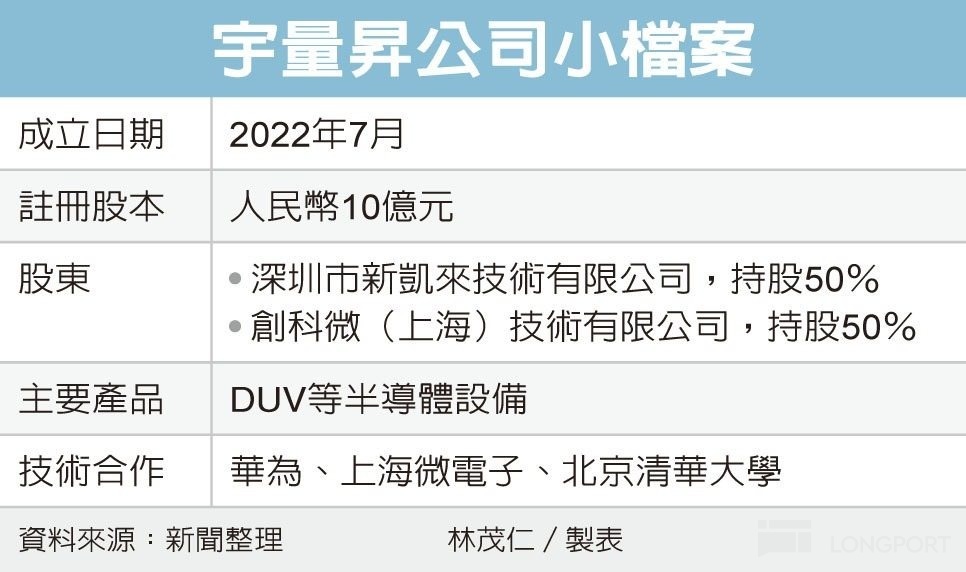
b. At the same time, according to media reports, SMIC recently began testing the DUV developed by Shanghai Yuliangsheng, which is an immersion lithography machine, comparable to ASML's Twinscan NXT:1950i in 2008, capable of producing 28nm and 14nm chips, and even pushing 7nm and barely 5nm chips with multiple exposures.
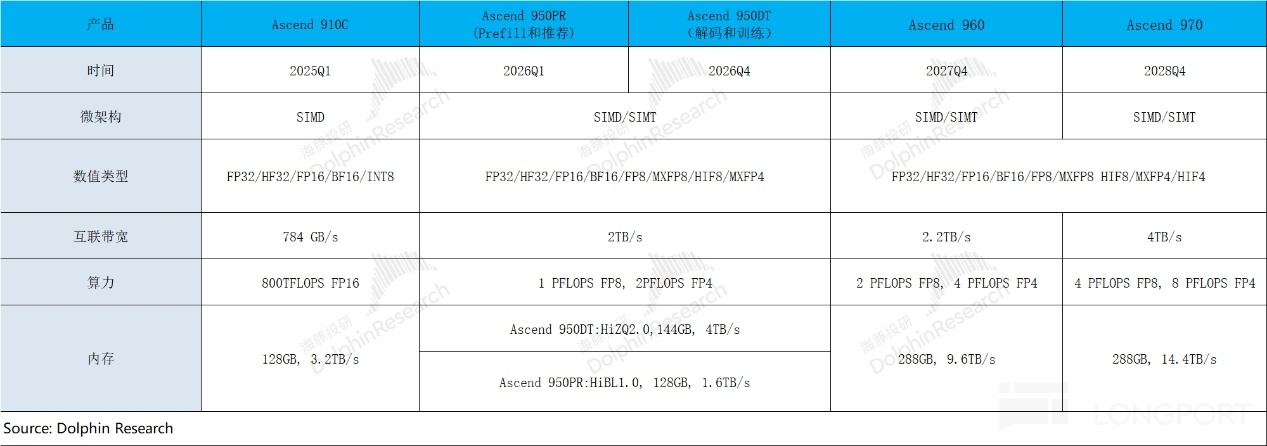
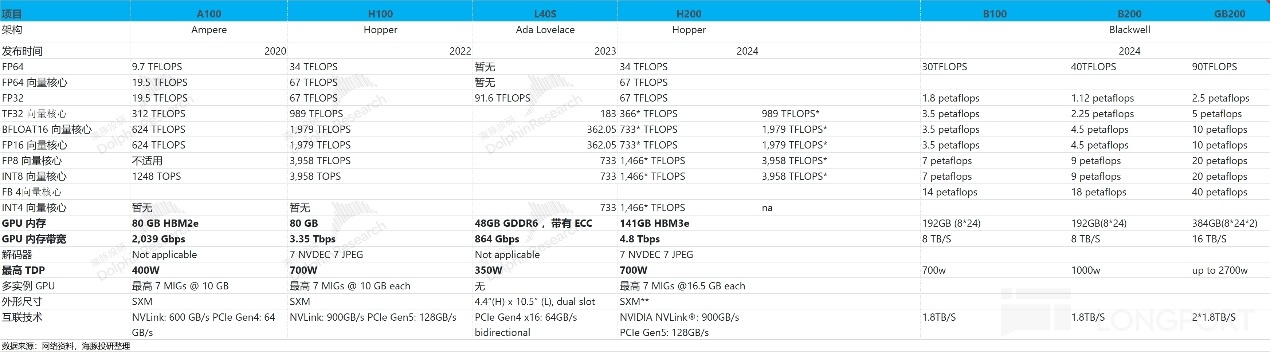
c. Huawei recently updated its chip design roadmap at a press conference: the Ascend 960 planned for launch in the fourth quarter of 2027 has a computing power index of 2PFLOPS (FP8), already comparable to NVIDIA's H200 (FP8—1.5PFLOPS), and the Ascend 970 is planned for annual updates a year later. Note, NVIDIA's H200 is manufactured using TSMC's 4nm process.
d. According to media reports, this year, major domestic cloud service providers have begun to be significantly restricted in purchasing NVIDIA's H20 and RTX 6000, with one confirmation being Jensen Huang's statement in a September 17 interview, "We can only be in service of a market if a country wants us to be."
These four points together seem to point in one direction, China seems to have gradually made some progress in the semiconductor and AI industry chain, especially if Huawei's product roadmap, if ultimately mass-produced without issues, offers hope for China's situation in the AI industry chain (note that AI chip processes can use high-end mobile phone process lines).
2) U.S.
According to multiple industry reports, in the rare earth industry, China's leading core barriers are mainly in midstream separation, smelting processes, patents, and compliance certification barriers. The U.S. semiconductor industry is expected to take 5-10 years to break free from dependence on Chinese capacity and technology.
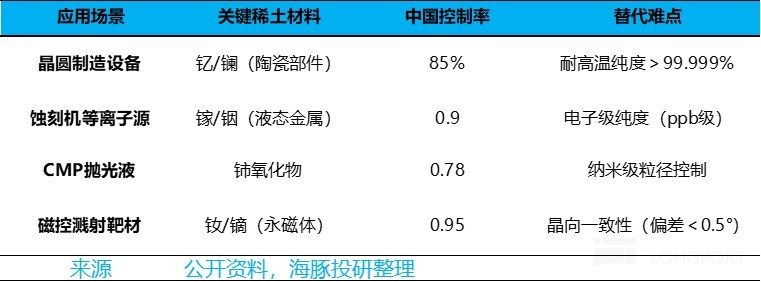
Comparing these two, China's "precise point strike" in rare earth control was not used in 2018, not used during the most intense times at the beginning of the year, but instead used when the U.S. has no particularly extraordinary actions. Dolphin Research believes it is reasonable to speculate that there seems to be a subtle confidence in the "time difference" behind China's actions:
In the strategic track of mutual competition, the core competition essence—U.S. high-end manufacturing capacity (5-10 years of capacity rebuilding time) vs. China's bottleneck breakthroughs (H200-level AI chips in 2027-2028), could the balance of time advantage be starting to tilt slightly?
In the traditional market perception, the U.S. uses long-arm jurisdiction and technological monopoly to precisely choke China's semiconductor development, and after China adopts similar reciprocal countermeasures on U.S. rare earth policies, should the market need to price in that China also has such a hidden "weapon" at the top of the industry chain? This weapon could even affect not only semiconductors but also the U.S.'s highly valued defense industry.
Of course, the U.S. previously used technological monopoly to repeatedly "precisely control" China, and as the recipient, naturally knows that once this knife is thrown out, it will inevitably be a double-edged sword, prompting the opponent to achieve industrial chain independence more quickly and at any economic cost, thereby accelerating the speed of self-supply.
It is also because of this that throwing out such a double-edged sword at this node, to some extent, indicates that China is more confident in the future timeline of semiconductor independence compared to its competitors.
So the key question is: behind such timing choices, is it worth a deeper cognitive reevaluation of Chinese assets after this round of game turbulence? Therefore, Dolphin Research suggests that after this TACO deal, it might be worth paying attention to the logic of Chinese asset reevaluation implied by the new cards played by China.
3. Portfolio Returns
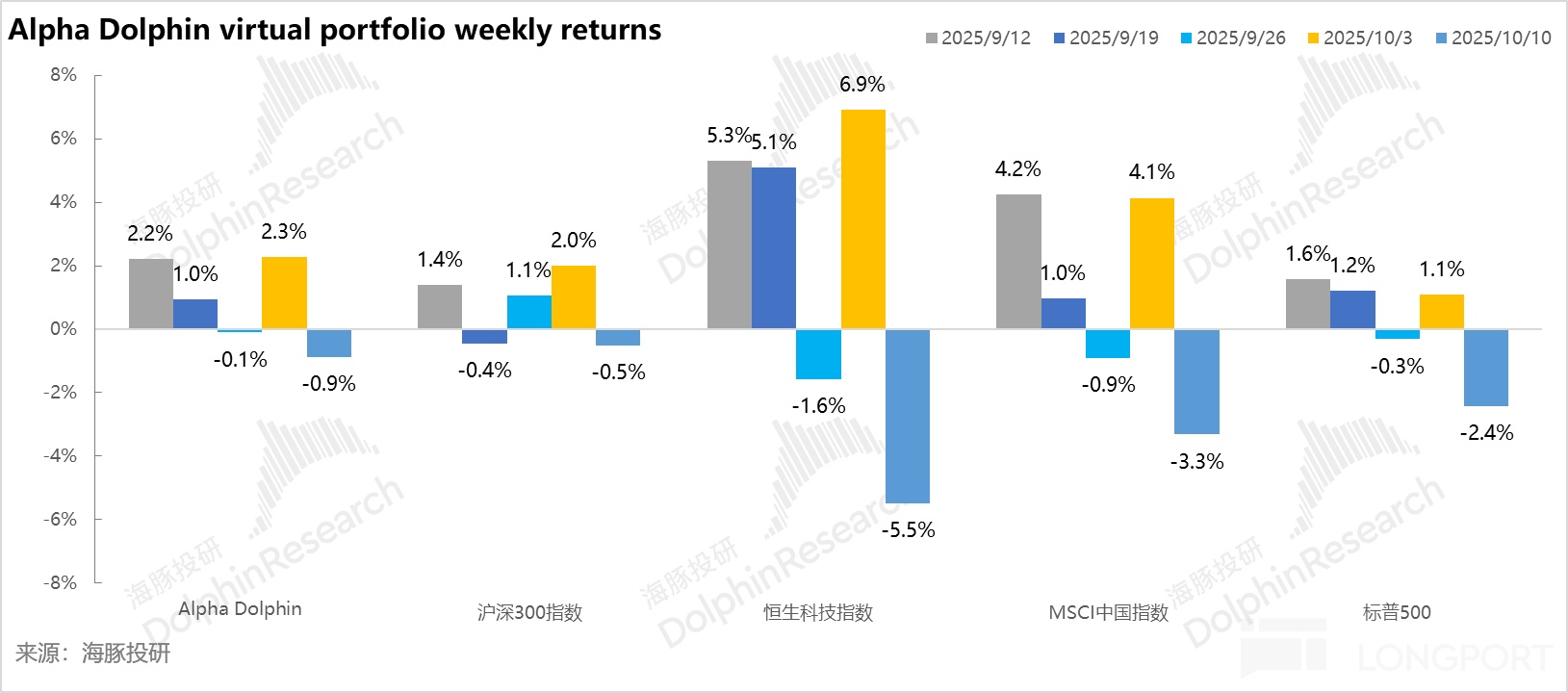
Last week, Dolphin Research's virtual portfolio Alpha Dolphin did not adjust its positions. It fell by 1% during the week, underperforming the CSI 300 (-0.5%), mainly due to the A-shares not opening during the National Day holiday. However, it outperformed the MSCI China Index (-3.3%), the Hang Seng Tech Index (-5.5%), and the S&P 500 Index (-2.4%).
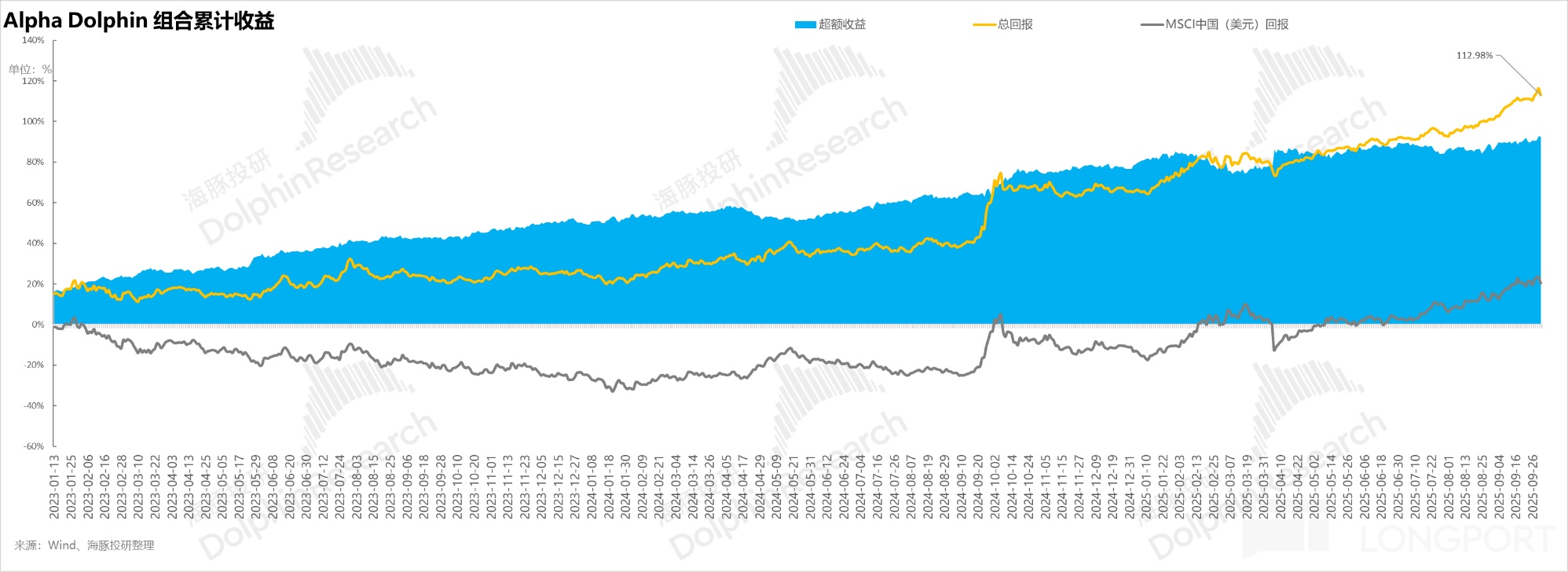
Since the portfolio began testing (March 25, 2022) until last weekend, the portfolio's absolute return is 113%, with an excess return of 92.6% compared to the MSCI China. From an asset net value perspective, Dolphin Research's initial virtual asset of $100 million exceeded $216 million by last weekend.
4. Individual Stock Gains and Losses Contribution
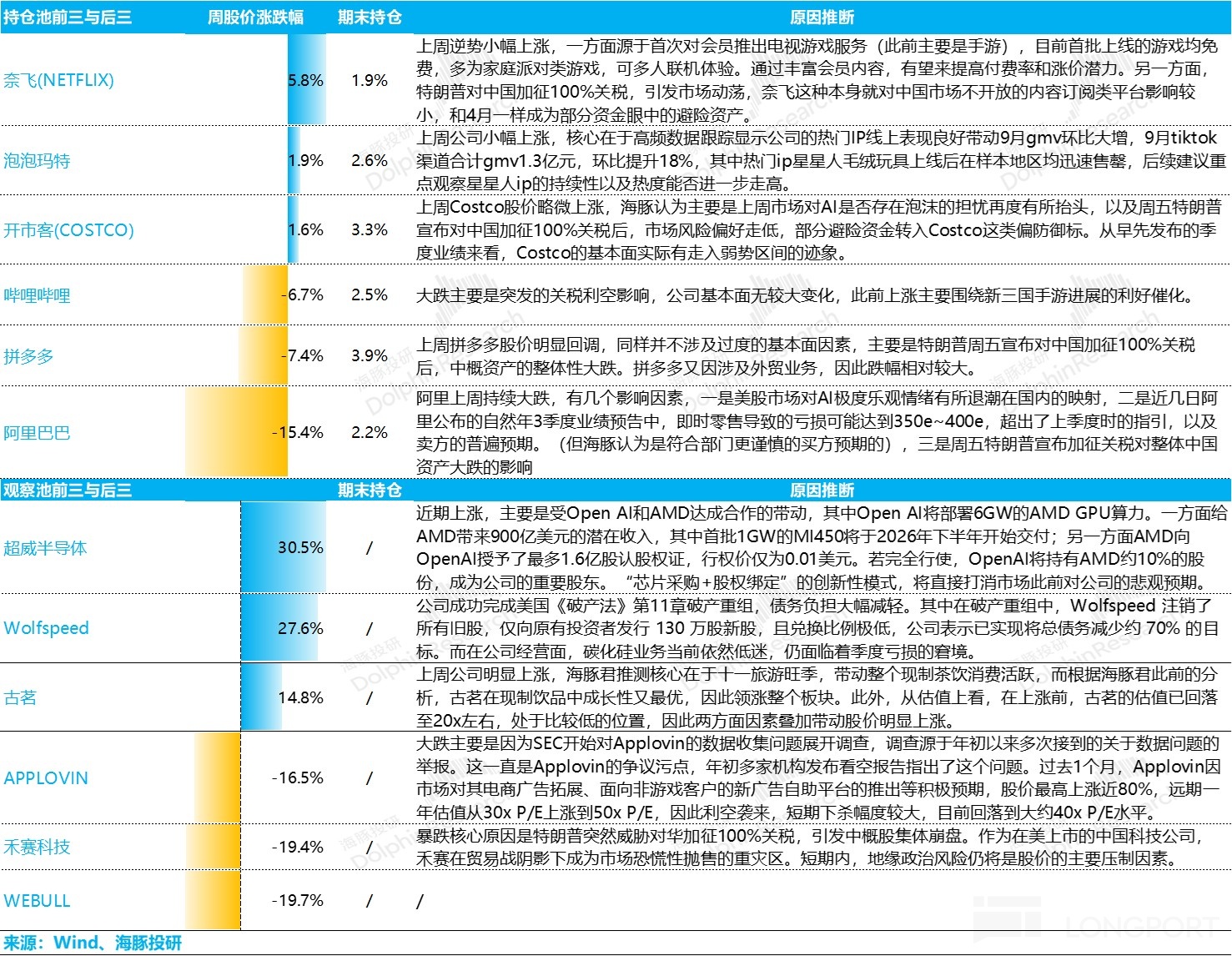
Last week, Dolphin Research's virtual portfolio Alpha Dolphin fell mainly due to Trump's threat to impose an additional 100% tariff on China, leading to a general market pullback, with Chinese concept stocks and semiconductor assets experiencing significant declines. However, the gold holdings provided some hedging effect.
The main explanations for the specific stock price fluctuations are as follows:
5. Asset Portfolio Distribution
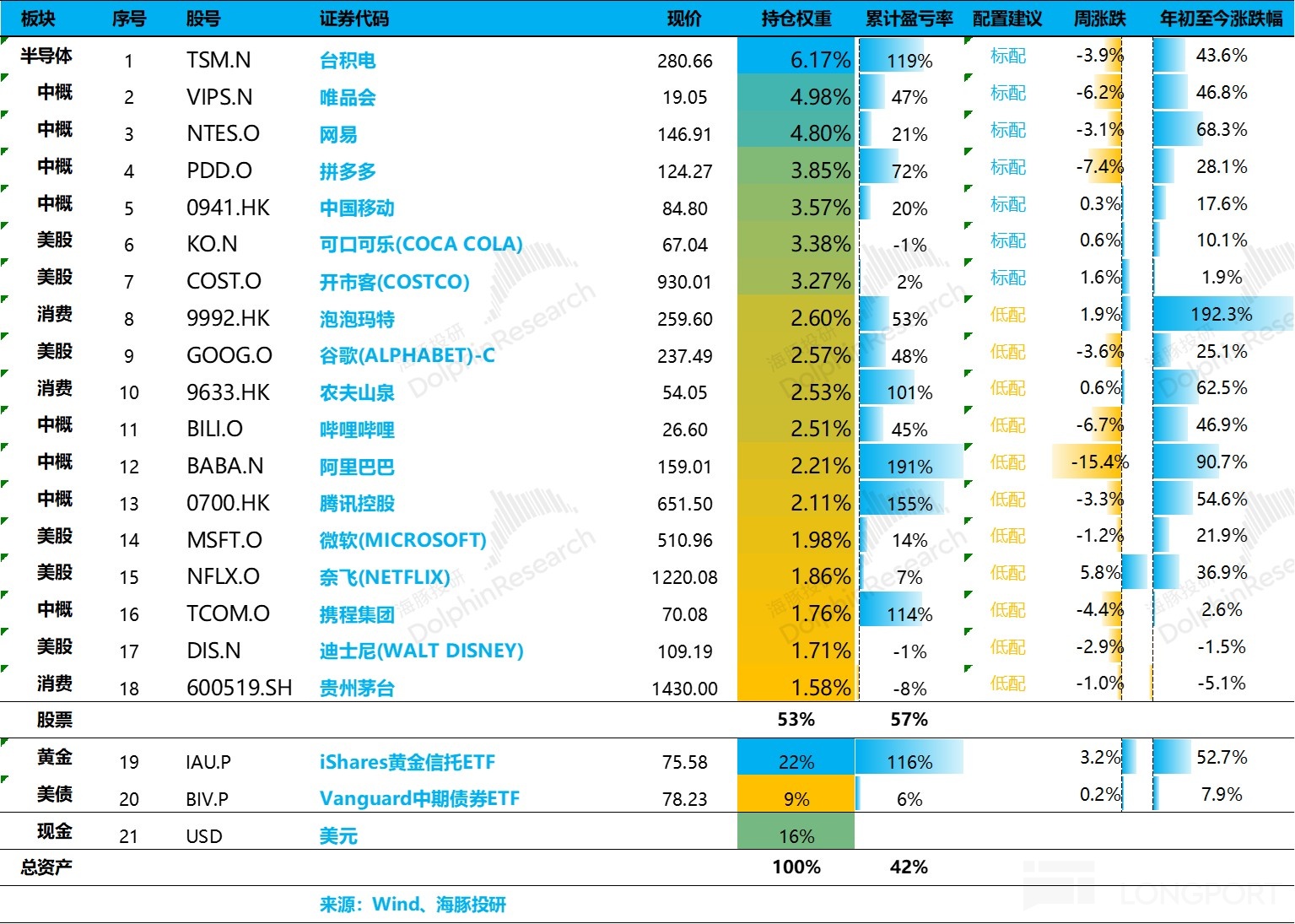
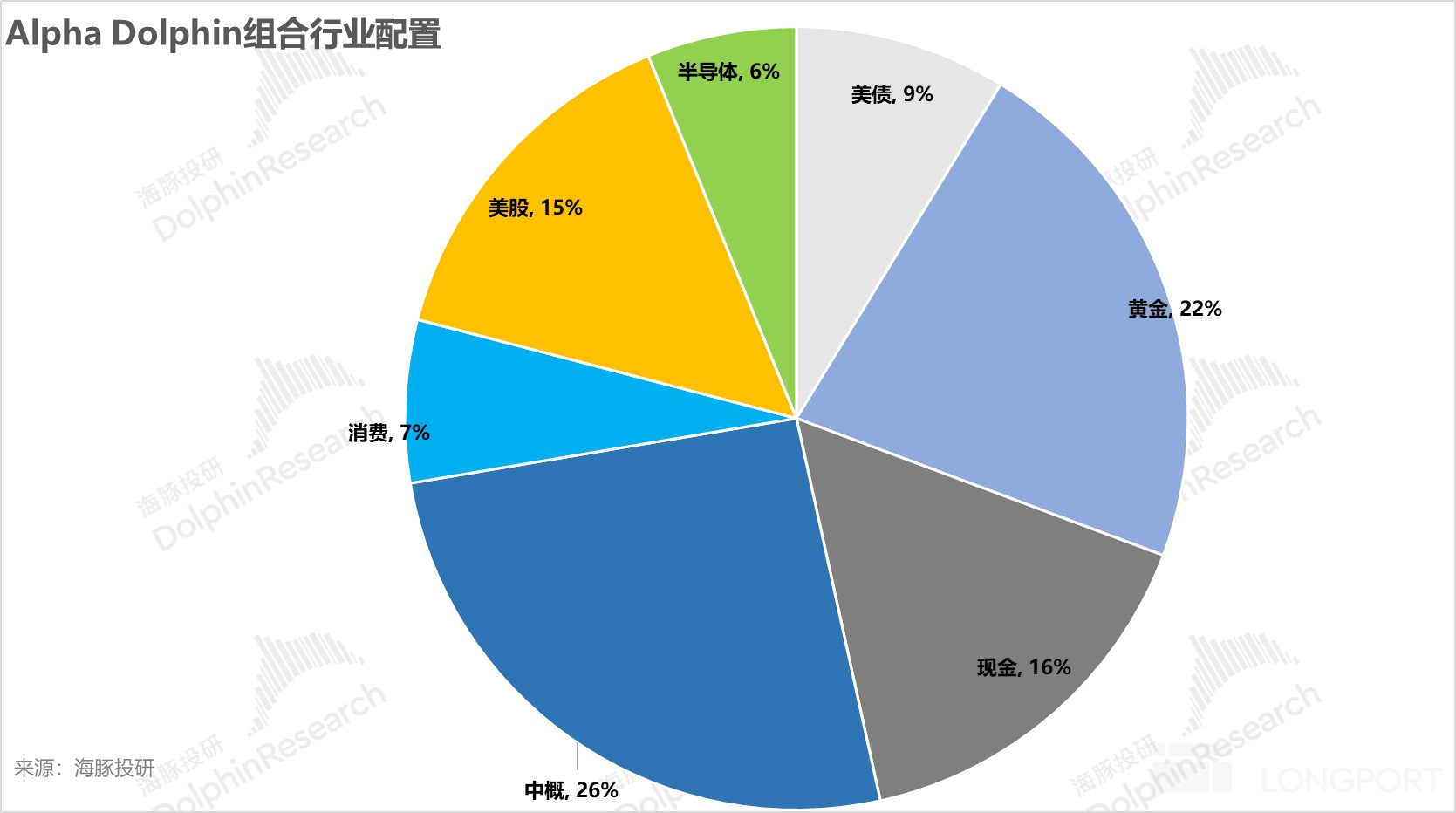
The Alpha Dolphin virtual portfolio holds a total of 18 individual stocks and equity ETFs, with 7 standard allocations and the rest underweight. Assets outside of equities are mainly distributed in gold, U.S. bonds, and U.S. dollar cash, with the current ratio of equity assets to defensive assets like gold/U.S. bonds/cash being approximately 55:45.
As of last weekend, the Alpha Dolphin asset allocation distribution and equity asset holding weights are as follows:
6. Key Events Next Week
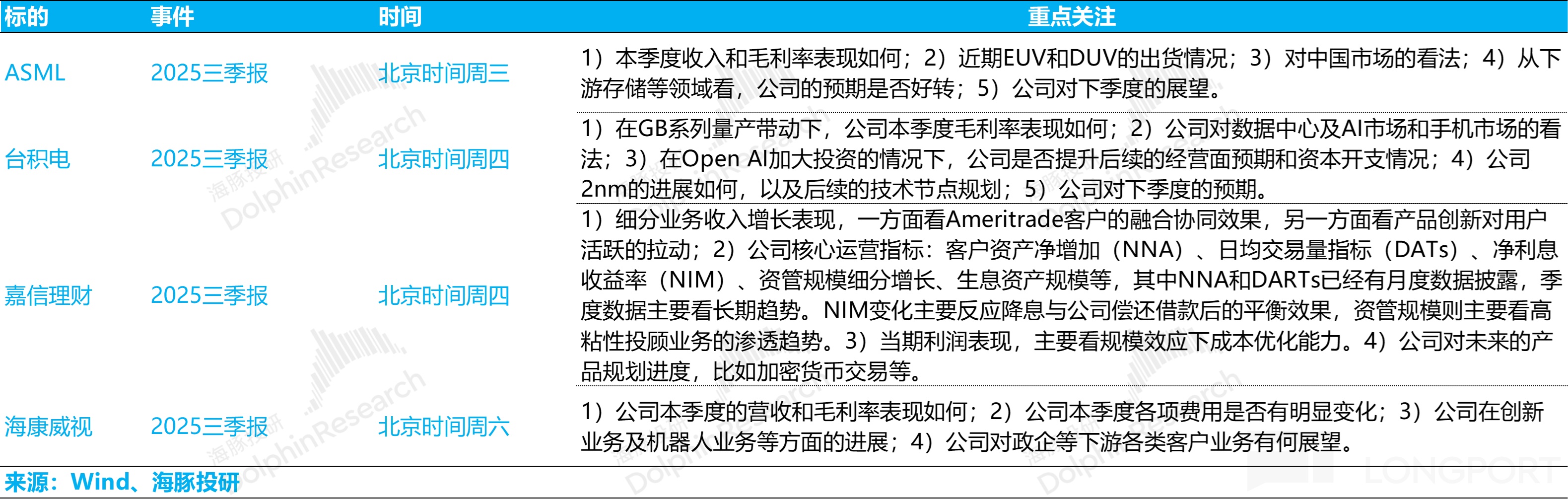
Starting this week, U.S. semiconductor companies begin entering earnings season, with ASML and TSMC leading the way. It is important to pay attention to these two upstream companies' impact on the industry chain, including the logic of traditional semiconductors, and look for signals of whether traditional semiconductors are warming up or when they might warm up from conference calls and guidance.
<End of Text>
Risk Disclosure and Statement of This Article:Dolphin Research Disclaimer and General Disclosure
For recent articles on Dolphin Research's portfolio weekly reports, please refer to:
"A Fierce Toss Like a Tiger, Trump Ultimately Can't Escape 'Inflation Debt'?"
"This is the Most Down-to-Earth, Dolphin Investment Portfolio Starts Running"

Phunware
USPHUN

Trump Media & Tech
USDJT

American Bitcoin
USABTC

Trump Media & Tech - CW28
USDJTWW

Berto Acquisition
USTACO

RUM
USRUM

Midea Group
SZ000333

Allstate
USALL

Outfront Media
USOUT

CHINA MOBILE
HK00941

Disney
USDIS

Microsoft
USMSFT

NTES
HK09999

NETEASE MUSIC
HK09899

Costco Wholesale
USCOST

Vipshops
USVIPS

Alphabet - C
USGOOG

Alphabet
USGOOGL

Taiwan Semiconductor
USTSM

Berto Acquisition - Unit
USTACOU

BERTO ACQUISITION CORP C/WTS 01/05/2030(TO PUR COM)
USTACOW

RUM GROUP INC C/WTS 16/09/2027 (TO PUR COM)
USRUMBW

MIDEA GROUP
HK00300

ALLSTATE CORP 5.1% PREF 15/01/2053
USALL-B

ALLSTATE CORP DEP SHS REP 1/1000 NON CUM PER PRF SER H
USALL-H

ALLSTATE CORP 4.750% DEP SHS REP 1/1000TH PRP PFD SR I
USALL-I

ALLSTATE CORP DEP SHS REPSTG 1/1000TH NON PERP PFD SER
USALL-J

CHINA MOBILE-R
HK80941

China Mobile
SH600941

NetEase
USNTES
The copyright of this article belongs to the original author/organization.
The views expressed herein are solely those of the author and do not reflect the stance of the platform. The content is intended for investment reference purposes only and shall not be considered as investment advice. Please contact us if you have any questions or suggestions regarding the content services provided by the platform.