

ASML: AI Capex adds a buff, the worst period is over!

ASML released its Q3 2025 financial report (ending September 2025) before the U.S. stock market opened on October 15, 2025, Beijing time. Key points are as follows:
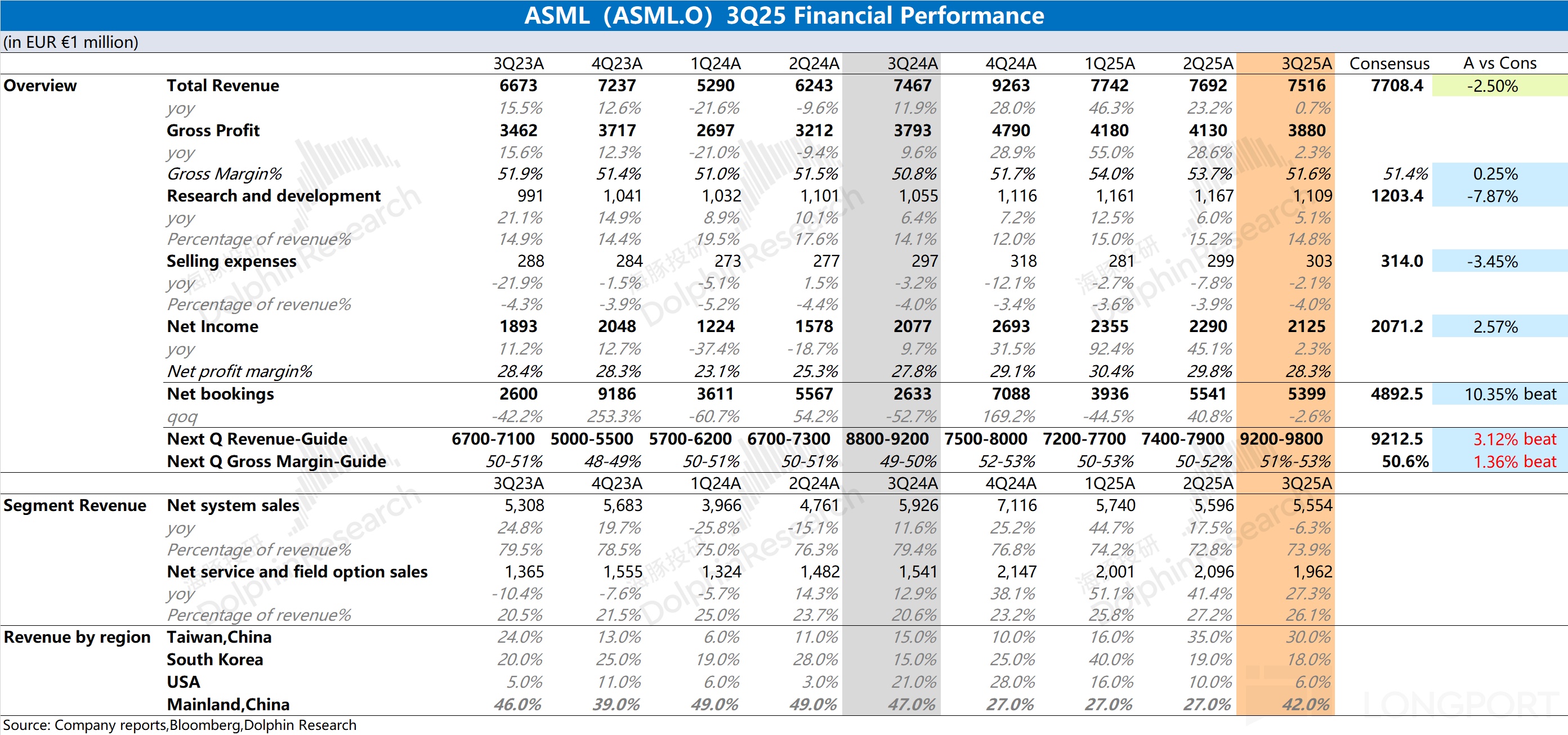
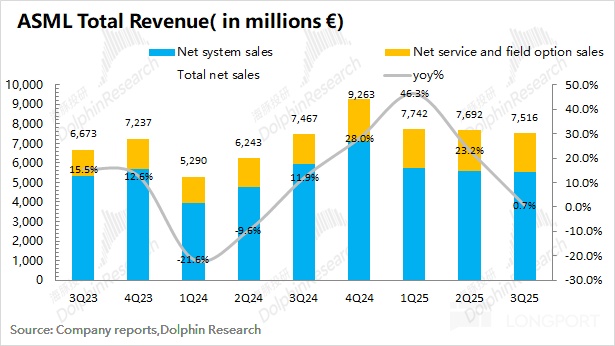
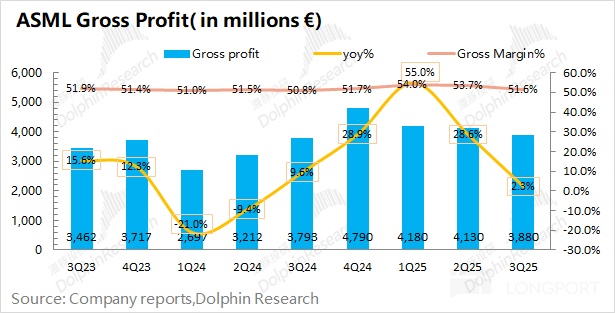
1. Revenue & Gross Margin: a) $ASML(ASML.US) reported revenue of 7.5 billion euros this quarter, a year-on-year increase of 0.7%, below market expectations (7.7 billion euros). The company's revenue this quarter mainly came from contributions by TSMC and customers in mainland China. b) The gross margin for this quarter was 51.6%, near the upper end of the company's guidance range (50-52%), primarily due to an increase in the proportion of service-related revenue, which structurally boosted the overall gross margin.
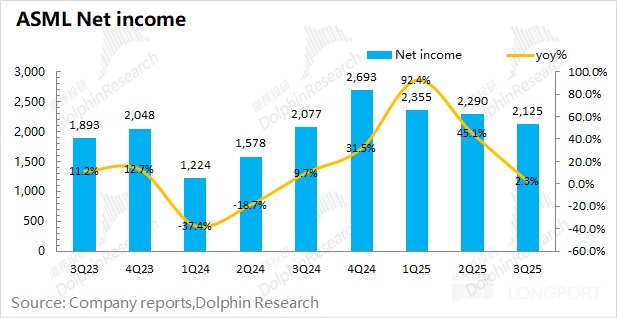
2. Expenses and Profit: The company's R&D and SG&A expenses remained relatively stable, with a net profit of 2.13 billion euros this quarter, a year-on-year increase of 2.3%, mainly driven by the improvement in gross margin. The net profit margin for this quarter was 28.3%.
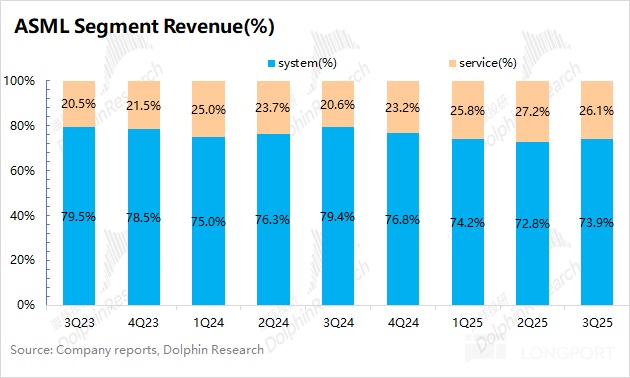
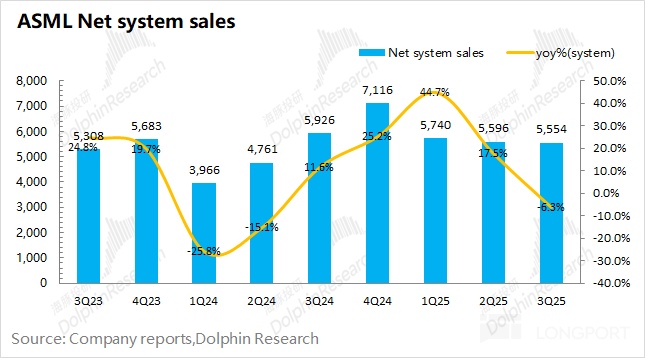
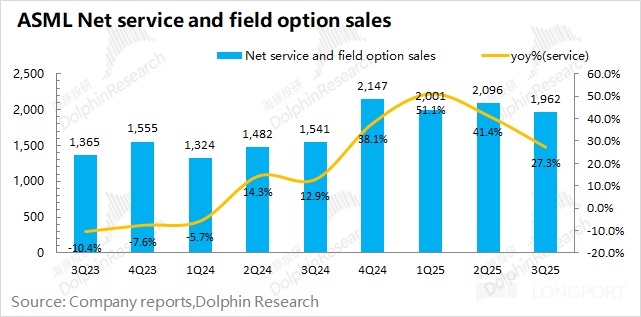
3. Specific Business Conditions: Lithography system revenue was 5.55 billion euros, down 6.3% year-on-year; service revenue was 1.96 billion euros, up 27.3%. The ratio of the two businesses is approximately 7:3. Although service-related business was the main driver this quarter, lithography systems remain the core part of the company's performance.
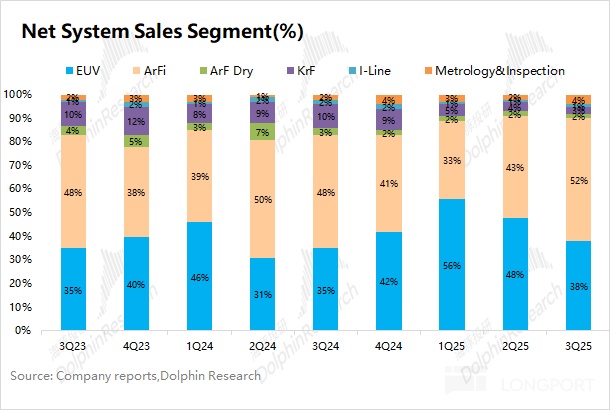
1) Lithography System Revenue: EUV and ArFi are the main sources of revenue in lithography systems, accounting for nearly 66% combined. EUV revenue this quarter was approximately 2.11 billion euros, and ArFi revenue was about 2.89 billion euros;
2) Lithography System Shipments: ArFi shipments this quarter were 38 units, still the highest in the company's shipments. The company shipped 9 EUV units this quarter, with a slight decline in shipments, mainly due to Samsung and Intel cutting capital expenditures.
3) Lithography System Average Price: The average price of EUV is significantly higher than that of ArFi. Dolphin Research estimates that the average price of EUV this quarter remained around 235 million euros, while the price per ArFi unit was approximately 76 million euros, with a price ratio of about 3:1.
4. ASML Core Focus:
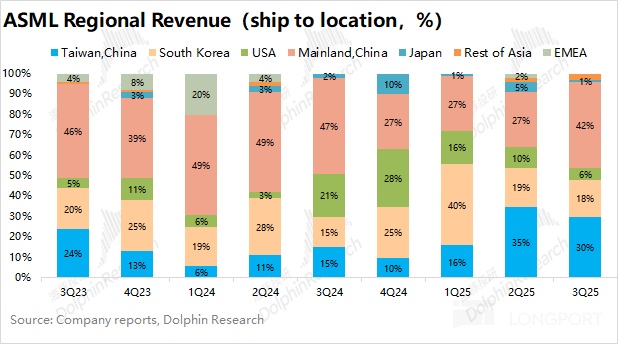
a. Regional Revenue: Mainland China was the main source of revenue this quarter (42%), contributing approximately 3.16 billion euros. This far exceeded the company's previous expectation of a 25% share, mainly due to accelerated shipments of ArFi and other equipment in mainland China. Taiwan contributed approximately 2.26 billion euros in revenue this quarter, accounting for 30%, mainly reflecting TSMC's shipment performance.
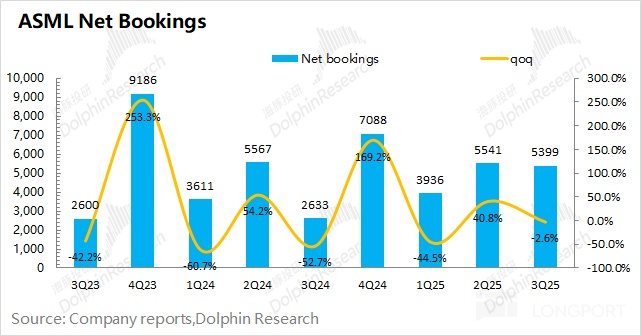
b. Order Metrics: The company's net order value this quarter remained at 5.4 billion euros, a decrease of 140 million euros quarter-on-quarter, better than market expectations (4.9 billion euros). The quarterly net order value remaining above 5 billion euros indicates a significant improvement in downstream customer expectations.
5. ASML Performance Guidance: For Q4 2025, expected revenue is 9.2-9.8 billion euros (market expectation 9.21 billion euros) and gross margin (GAAP) is 51-53% (market expectation 50.6%).
Dolphin Research's Overall View: "The Worst Period" is Over, Focus on the Hot AI Capex
Although ASML's financial report this time is decent, with revenue and gross margin meeting the company's guidance, the market's focus is more on order conditions and future operational guidance.
① Order Metrics: ASML's net order value this quarter remained at 5.4 billion euros, better than market expectations (4.9 billion euros). After experiencing a "flash crash" in order data at the beginning of the year, the company's quarterly net order value has remained above 5 billion euros for two consecutive quarters, reflecting the weakening impact of tariffs and the recovery of downstream confidence;
② Next Quarter Guidance: The company expects Q4 revenue to reach 9.2-9.8 billion euros, better than market expectations (9.2 billion euros). Q4 is often the peak season for product delivery, and from the guidance given by the company last quarter, the market was even worried about a possible year-on-year decline in Q4. This quarter's guidance directly provided a "reassurance" for Q4 performance, which also basically aligns with the company's adjusted full-year guidance (approximately 15% year-on-year growth).
From ASML's performance in Q3 and Q4, the company is currently in a transitional phase of "improving from a downturn". Recent multiple favorable factors have directly driven the improvement of market expectations and the rise in the company's stock price:
a) Driven by the Memory Cycle: Driven by increased capital expenditures by major manufacturers and AI demand, various storage demands for HBM, traditional DRAM, and NAND have significantly increased, and storage prices have also seen a significant rebound.
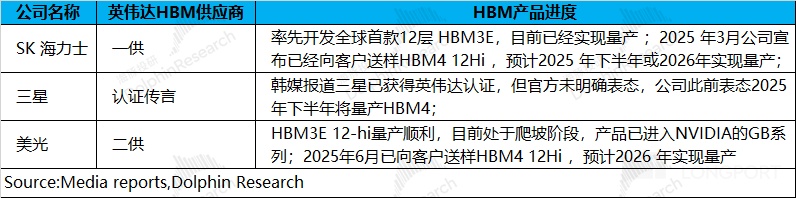
Driven by the memory cycle, major memory manufacturers such as Micron and Samsung are expected to increase their confidence in expansion. Especially Samsung, which significantly cut its annual capital expenditure plan at the beginning of the year, and if Samsung's HBM products can also be certified by Nvidia, it will significantly increase capital investment in the future.
b) Intel's "Rebirth Outlook": Recently, the U.S. government's "stake" and strategic cooperation with Nvidia have allowed the market to see Intel's "rebirth" opportunity again.
Before this, Intel faced multiple "dilemmas", and the company's market value once fell to a "break-even" state. After the U.S. government took a stake and strategic cooperation with Nvidia, Intel has become an important state-owned enterprise under the U.S. "manufacturing return" policy, which can prevent the company from falling into a "bankruptcy valuation" again.
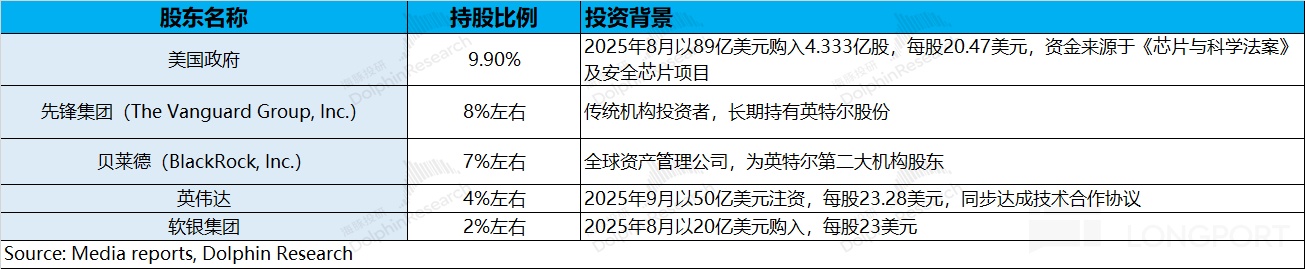
In the face of operational difficulties, Intel also cut its annual capital expenditure target at the beginning of the year. With the help of the U.S. government, Nvidia, and others, market expectations for Intel's subsequent capital expenditures have also significantly improved.
c) TSMC's Technological Iteration: The company's most important major customer. Currently, TSMC's 2nm is progressing smoothly, with plans to achieve mass production by the end of 2025 and expected large-scale shipments to Apple, Qualcomm, etc., in 2026. With further iteration of process technology, the market expects TSMC to have larger-scale capital investment in the future.
Overall (a+b+c), TSMC, Samsung, and Intel are all major customers of the company. Although TSMC's capital expenditure will exceed $40 billion this year, the reduction in annual capital expenditure by Samsung and Intel at the beginning of the year directly affected ASML's performance this year. With the recent recovery in the memory industry, Intel receiving assistance, and other favorable factors, the market's outlook for Samsung and Intel's subsequent capital expenditures is optimistic, which will directly drive the company's performance recovery.
Based on the current relatively optimistic market expectations for wafer fab capital expenditures, Dolphin Research has slightly raised the company's 2026 operational expectations. Combined with ASML's current market value (387.2 billion USD), it roughly corresponds to a PE of about 31 times the company's 2026 net profit (assuming revenue +6%, gross margin 53.7%, tax rate 17.4%, EUR/USD=1.16:1). From the company's historical valuation range (26xPE-40xPE), the current valuation level is at the lower end of the range. If downstream capital expenditures and the company's operations continue to develop optimistically, there is still room for valuation to rise.
Overall, ASML is the world's only EUV lithography system provider, still occupying more than 80% of the lithography machine market share. As long as this market monopoly position remains stable, ASML's core investment logic has not changed.
On the basis of monopolizing the EUV market, the company has further launched High-NA EUV (200 million euros/unit -> 400 million euros/unit), mainly targeting process nodes of 2nm and below. This not only consolidates its dominant position in the lithography field but also further raises the price range of the company's EUV products.
In the current upward memory cycle, Intel's "hope" regained, and TSMC's 2nm progress smoothly, dispelling the market's previous view of "depression" in wafer fab capital expenditures and semiconductor equipment. Among them, TSMC, Samsung, and Intel themselves are three heavyweight customers of ASML. If Samsung and Intel can both increase capital investment in the future, ASML will directly benefit.
The heat of the AI battlefield has eventually spread to the upstream equipment end of the semiconductor industry chain. Among them, Micron, which was the first to release its financial report, has directly raised its 2026 capital expenditure target to 18 billion USD. In this round of AI Capex boom, ASML and TSMC are still the most monopolistic companies in the current semiconductor industry chain. If TSMC can subsequently clarify the increase in capital investment, ASML will also benefit again. The company's management will also communicate during today's U.S. stock market session, and Dolphin Research and subsequent minutes are welcome to follow.
The following is Dolphin Research's specific analysis of ASML:
I. Core Data: Frequent Downstream Benefits, "The Worst Period" is Over
1.1 Revenue: ASML achieved revenue of 7.52 billion euros in Q3 2025, basically flat year-on-year, market expectation (7.7 billion euros). This quarter's revenue mainly came from contributions by TSMC and customers in mainland China.
Although TSMC's capital expenditure continues to grow at a high rate (annual increase of 10 billion USD), the reduction in capital expenditure by Samsung and Intel directly suppressed the growth of the company as a core upstream supplier.
1.2 Gross Profit and Gross Margin: ASML achieved a gross profit of 3.88 billion euros in Q3 2025, a year-on-year increase of 2.3%. In terms of gross margin, the company's gross margin for this quarter was 51.6%, near the upper end of the company's guidance range (50-52%), mainly due to the increase in the proportion of service revenue.
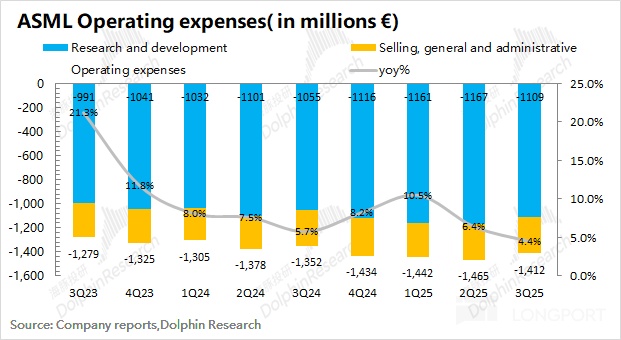
1.3 Operating Expenses: ASML's operating expenses in Q3 2025 were 1.41 billion euros, a year-on-year increase of 4.4%.
Specifically:
1) R&D Expenses: R&D expenses this quarter were 1.11 billion euros, a year-on-year increase of 5.1%, with the company's R&D investment remaining stable. The R&D expense ratio for this quarter was 14.8%;
2) SG&A Expenses: SG&A expenses this quarter were 300 million euros, a year-on-year increase of 2.1%; as the company's customers are mainly B-end, sales expenses are relatively stable, with an SG&A expense ratio of 4% this quarter.
1.4 Net Profit: ASML's net profit in Q3 2025 was 2.12 billion euros, a year-on-year increase of 2.3%. The company's operating expenses were relatively stable, and the year-on-year growth in net profit was mainly driven by gross margin. The net profit margin for this quarter was 28.3%.
Based on the company's order situation and guidance data, ASML's current operational situation has significantly improved compared to the first half of the year. With the recovery of the memory industry, Intel's "hope" regained, and the progress of Samsung's HBM, downstream capital expenditures are expected to increase.
Overall, ASML's "worst period" is over. The heat of AI Capex will also spread to the semiconductor equipment end where the company is located, driving the company's operations to continue to improve.
II. Detailed Data: Mainland China Accelerates ArFi Shipments
ASML's business consists of system sales revenue and service revenue. Although lithography system sales revenue is the company's most core revenue source (accounting for about 3/4), the increase in service business revenue, such as installation and upgrades, is also an important driver of the company's performance this quarter.
2.1 Business Conditions
1) System Sales Revenue
ASML's system sales revenue in Q3 2025 was 5.55 billion euros, down 6.3% year-on-year. Although EUV and ArFi revenue still showed slight growth, other equipment such as ArF Dry and KrF experienced varying degrees of decline.
Based on the company's order situation this quarter and next quarter's guidance, the company will enter the peak season in Q4. With the recovery of downstream demand, the company's quarterly net order value remains above 5 billion euros.
The system sales revenue corresponds to the lithography machines we are familiar with, with the largest revenue coming from EUV and ArFi, accounting for 90% combined.
Specifically:
a) EUV: Revenue this quarter was 2.11 billion euros, a year-on-year increase of 1.8%. EUV sales this quarter were 9 units, with an average price of approximately 235 million euros per unit. With the increase in High-NA EUV shipments, the average price of the company's EUV products is expected to continue to rise;
b) ArFi: Revenue this quarter was 2.89 billion euros, a year-on-year increase of 1.5%, with this revenue coming from mainland China. ArFi sales this quarter were 38 units, with an average price of approximately 76 million euros per unit, remaining stable.
Overall, ASML's current sales of ArFi lithography systems are the highest, with target customers concentrated in mainland China due to semiconductor friction and other factors; EUV quarterly shipments remain around 10 units, and due to the relatively high average price, EUV revenue accounts for about 40% of total lithography system revenue.
From the application field perspective, the company's current system revenue is still mainly driven by demand in the logic field: the logic field accounts for about 70%, and the storage field accounts for about 30%.
2) Service Revenue
ASML's service revenue in Q3 2025 was 1.96 billion euros, a year-on-year increase of 27.3%. ASML's service revenue mainly includes equipment maintenance and other projects, which are less affected by industry cycles. Previously, due to uncertainties such as tariffs, downstream customers were cautious about equipment procurement, but equipment upgrade services continued to advance, being one of the main sources of revenue growth.
Historically, the company's equipment orders have been greatly affected by industry cycles and other external environments, while service revenue is relatively stable and overall shows a growth trend.
2.2 Regional Revenue
ASML's revenue this quarter mainly came from Taiwan, mainland China, and South Korea, with the combined revenue of the three accounting for 90%.
This quarter, mainland China was the company's main source of revenue, accounting for 42%, significantly better than the "25%" share mentioned in the company's management's order structure, mainly due to downstream customers accelerating shipments of ArFi equipment.
On the other hand, revenue from Taiwan also showed significant growth this quarter, driven by TSMC's shipments. Driven by AI demand, TSMC raised its annual capital expenditure from last year's 30 billion USD to around 38-42 billion USD.
In addition, revenue from South Korea and the United States was relatively low, mainly due to Samsung and Intel cutting capital expenditures. With the spread of AI Capex to the storage field, Intel's "hope" regained, and other favorable factors, the market's outlook for Samsung and Intel's future capital expenditures is also optimistic.
Overall, as ASML is located at the very upstream of the semiconductor industry chain, it is affected by the capital investment of multiple major customers. Although TSMC significantly increased its capital expenditure this year, the reduction in investment by Samsung and Intel directly suppressed the company's performance growth.
Recently, with the gradual release of multiple pressures, ASML's "worst period" is over. As the absolute leader in the lithography field, the company will also benefit from this round of AI Capex "heat wave".
<End Here>
Dolphin Research on ASML
ASML
July 16, 2025, Conference Call Minutes "ASML (Minutes): Committed to Improving Equipment Efficiency, Not Quantity"
July 16, 2025, Financial Report Commentary "ASML: Hot Nvidia, Can't Warm Up the Cold Lithography Machine?"
April 16, 2025, Conference Call Minutes "ASML (Minutes): Even if Tariffs Land, It Shouldn't Be the Main Bearer"
April 16, 2025, Financial Report Commentary "ASML: Order Decline "Alarm", Will Tariffs Strike Again?"
January 29, 2025, Conference Call Minutes "ASML: Mainland China Revenue Will Fall to Around 20% (4Q24 Conference Call)"
January 29, 2025, Financial Report Commentary "ASML: The Leader Returns, The Stabilizer Arrives"
October 15, 2024, Conference Call Minutes "ASML: Mainland Business Will Fall to Around 20% (FY24Q3 Conference Call Minutes)"
October 15, 2024, Financial Report Commentary "ASML: "Fracture-Level" Embarrassment, Again the AI's First Killer?"
July 17, 2024, Conference Call Minutes "ASML: Expected EUV Shipments Similar to Last Year (FY24Q2 Conference Call Minutes)"
July 17, 2024, Financial Report Commentary "ASML: High Expectations, Slow Landing, Can't Catch Up with the Market "AI Dream""
April 17, 2024, Conference Call Minutes "ASML: 2024 Transition, 2025 Rise (FY24Q1 Conference Call Minutes)"
April 17, 2024, Financial Report Commentary "ASML: Performance Collapse, AI Wind Can't Reach Lithography Machines?"
January 24, 2024, Financial Report Commentary "ASML: Explosive Orders, Is the Semiconductor Going Up?"
October 18, 2023, Financial Report Commentary "ASML: The Jewel in the Crown, Can't Escape the Cycle Curse"
July 21, 2023, Financial Report Commentary "ASML: Outstanding Ability, Still Subject to the Cycle's Face"
September 21, 2023, In-depth "ASML: The Lithography King with a Valuation of Less Than 30 Times, Is It Expensive?"
July 14, 2023, In-depth ""Ultimate Faith" ASML"
Risk Disclosure and Statement of This Article: Dolphin Research Disclaimer and General Disclosure
The copyright of this article belongs to the original author/organization.
The views expressed herein are solely those of the author and do not reflect the stance of the platform. The content is intended for investment reference purposes only and shall not be considered as investment advice. Please contact us if you have any questions or suggestions regarding the content services provided by the platform.
