

 Likes Received
CNQQ-China Technology Innovation ETF, "China's version of the Nasdaq 100 ETF"

Chat-GPT leads the AI wave, DeepSeek reshapes Chinese people's confidence in technology. From passive inventory reduction to active restocking cycles, the market is often dominated by technology. This year marks the first year of the explosion of Chinese equity assets, with technology as the vanguard. $Rayliant-ChinaAMC Trnsfrmtv Chn Tech ETF(CNQQ.US)
Investors can trade the STAR and ChiNext markets during the day and the CNQQ-China Technology Innovation ETF during the night, enabling 24-hour trading of Chinese tech stocks. What kind of ETF is CNQQ?
CNQQ-China Technology Innovation ETF is the "Chinese version of the Nasdaq 100 ETF." Through CNQQ, investors can access outstanding Chinese tech companies listed in Hong Kong and mainland China, which can be considered the Chinese counterparts of Google, Meta, Tesla, Apple, and OpenAI.
At the same time, based on factor stock selection and non-traditional market-cap weighting methods, i.e., smart weighting, it breaks through the limitations of traditional market-cap weighting. By dynamically adjusting weights through quality factors (ROE) and growth factors (R&D investment), it avoids valuation bubble risks and sets a cap of 10% for the weight of a single constituent stock. It can be said that CNQQ has created a higher-quality growth stock portfolio, providing investors with a forward-looking, comprehensive, and long-term effective investment solution. The top ten holdings of this ETF include Alibaba, Tencent Holdings, CATL, Xiaomi Group, Meituan, InnoLight, NetEase, Cambricon, NAURA, and BYD, among other Chinese tech giants. $BABA-W(09988.HK) $TENCENT(00700.HK) $Cambricon(688256.SH) $XIAOMI-W(01810.HK) $MEITUAN(03690.HK) $BYD(002594.SZ) $Zhongji Innolight(300308.SZ) $CATL(300750.SZ)
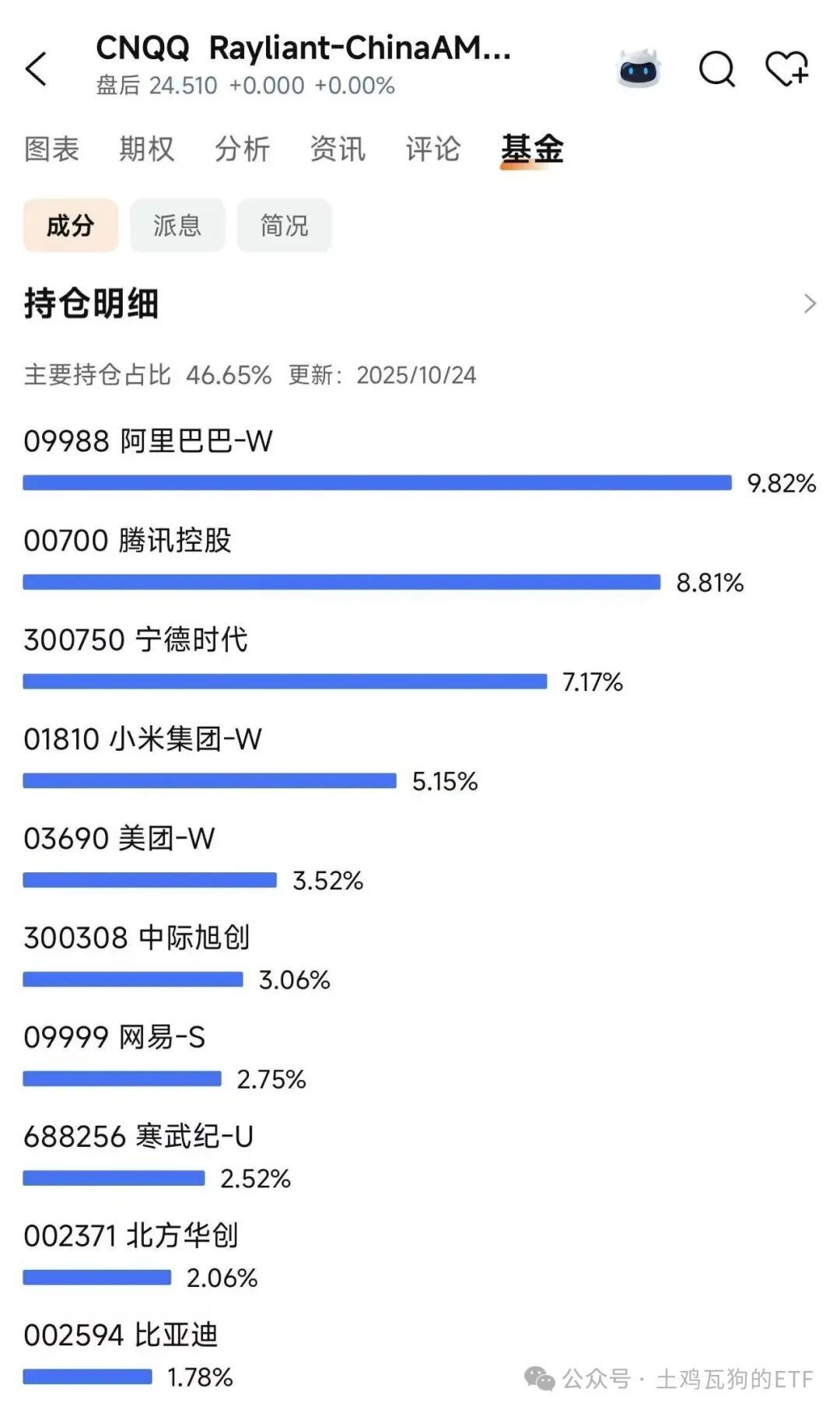
Looking ahead, DeepSeek's breakthrough achievements are driving China's technology industry chain—including computing chips, cloud services, edge-side intelligence, and 2B/2C applications—into a new cycle of innovation. These companies are expected to become core assets of China's technology sector, covering key areas such as hardware manufacturing, cloud computing, semiconductors, smart terminals, and local services. Details are as follows:
Alibaba: Leveraging the Alibaba Cloud Intelligence system, it builds AI large models (Tongyi Qianwen) to empower core businesses such as e-commerce, cloud computing, and finance, promoting industrial intelligent upgrades.
Tencent Holdings: The Hunyuan large model is deeply integrated with the social ecosystem (WeChat/QQ), driving growth in gaming, advertising, and enterprise services with AI, and deploying full-stack AI solutions.
CATL: AI accelerates battery material R&D and intelligent manufacturing, improving energy density and safety, consolidating its leading position in global power batteries.
Xiaomi Group: The AIoT ecosystem (smartphones × cars × smart homes) synergizes, with large models empowering smart terminals to create an interconnected scenario of people, cars, and homes.
Meituan: AI optimizes local life services (delivery/recommendation systems), with unmanned delivery technology reducing costs and improving efficiency, strengthening the barriers in instant retail.
InnoLight: A global leader in optical modules, its 800G/1.6T products benefit from the explosion in AI computing demand, directly serving chip giants like NVIDIA.
NetEase: AI reshapes game development (Fuxi large model) and education (Youdao AI), improving content production efficiency and user experience.
Cambricon: An "all-stack player" in AI chips, covering cloud/edge/terminal with a core positioning: the first AI chip stock on the STAR Market, and one of the few companies globally mastering general-purpose AI chips + foundational software.
Core advantages: Technological leadership—the cloud-side Siyuan 590 chip delivers 256TOPS (INT8), supporting large model training; edge-side Siyuan 370 and terminal IP licensing cover scenarios like autonomous driving and security.
Full-stack layout: Beyond chips, it provides the MLU-OPS development platform, reducing customer algorithm adaptation costs and building a "chip + software" ecosystem.
Explosive demand: In 2024, revenue reached 1.174 billion yuan (up 65.56% YoY), with surging procurement from large model manufacturers and autonomous driving companies, narrowing losses (R&D expense ratio declined).
Investment highlights: Significant room for domestic substitution in AI chips, with deep technical reserves and long-term growth potential yet to be unleashed.
NAURA: A core player in the localization of semiconductor equipment, AI chip expansion drives growth in etching/thin-film equipment orders.
BYD: Intelligent driving (Xuanji architecture) + AI factories (intelligent vehicle manufacturing), accelerating technological iteration as a leader in new energy vehicles.
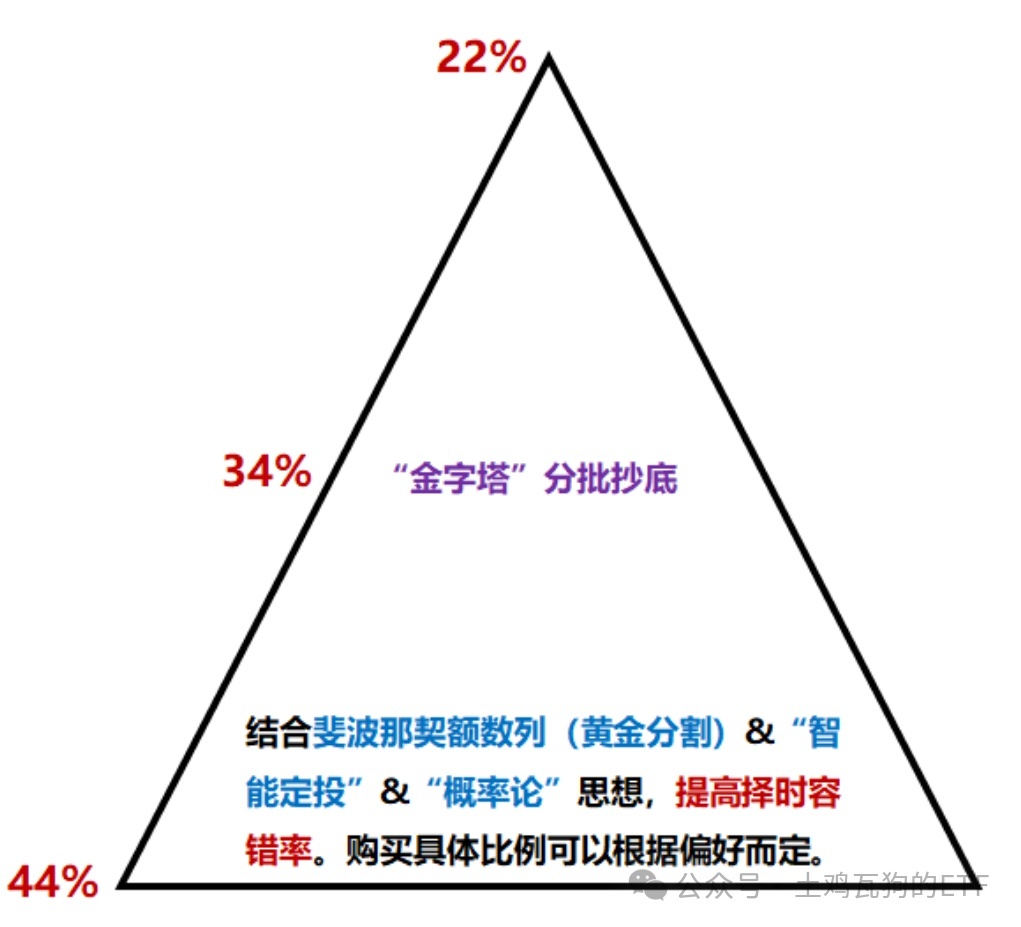
The Year of the Fire Snake (2025) is destined to be a bull market for tech stocks, and it is also the year when the Shanghai Composite Index is expected to hit 4,000 points. The tech sector is the most promising and capable of absorbing large capital flows.CNQQ-China Technology Innovation ETF,can adopt the "pyramid" strategy for bottom-fishing in batches, combiningFibonacci sequence (golden ratio)&"smart fixed investment"&"probability theory" to improve timing fault tolerance. Stock market investment is inherently probabilistic analysis. For most ordinary people, the "pyramid" strategy for bottom-fishing may turn portfolio returns from -2-3% to +2-3%.
The copyright of this article belongs to the original author/organization.
The views expressed herein are solely those of the author and do not reflect the stance of the platform. The content is intended for investment reference purposes only and shall not be considered as investment advice. Please contact us if you have any questions or suggestions regarding the content services provided by the platform.
