D
Oct 29, 2025 at 11:24 PM
Meta (Minutes): Computing power is ready to use, no worries about excess
The following is compiled by Dolphin Research regarding$Meta Platforms(META.US) 3Q25 earnings call minutes. For earnings interpretation, please visit"Meta: AI Investment 'Risky Racing', Is the Faith in Funding Going to Be Exhausted?"
I. Financial and Supplementary Operations
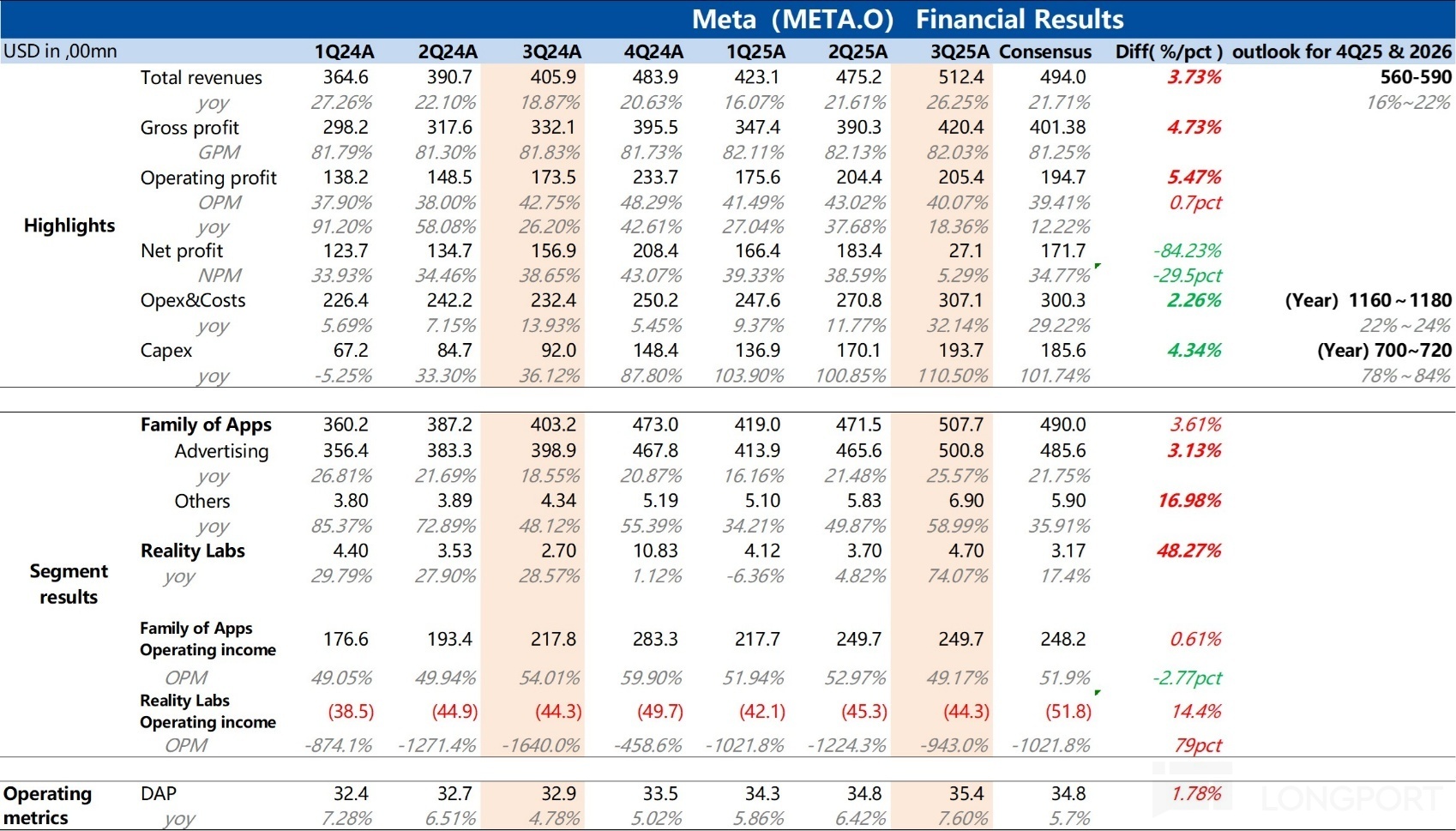
1. Global daily active users exceed 3.5 billion, Instagram monthly active users exceed 3 billion, Threads daily active users 150 million.
2. Strong growth in video content, Instagram video watch time increased by 30% year-on-year, Reels annualized revenue exceeds $50 billion;
3. Automated advertising tools annualized run rate exceeds $60 billion.
3. Capital expenditure for the quarter was $19.4 billion (including lease payments), mainly for servers, data centers, and network infrastructure construction. Meta continues to advance the construction of computing power reserves to support the development of Frontier AI and Meta Super Intelligence Labs.
4. The company repurchased $3.2 billion in stock and distributed $1.3 billion in dividends. End-of-period cash and marketable securities were $44.4 billion, with debt at $28.8 billion, maintaining a robust financial structure.
5. Outlook: Meta also highlighted potential risks from EU advertising regulations and US youth litigation but emphasized sufficient cash flow and a robust financial structure to support long-term AI strategy.
II. Detailed Content of the Earnings Call
2.1 Executive Statements of Core Information
1) Meta is accelerating the construction of leading-level computing power, laying out in advance for future super-intelligent models, and gradually integrating Facebook, Instagram, and advertising recommendation systems into a unified AI architecture to enhance cross-platform efficiency.
2) Meta AI monthly active users exceed 1 billion, with usage rates continuously rising. The company is advancing the next-generation Frontier model to enhance reasoning, creation, and recommendation capabilities. Meta expects to launch the next-generation Frontier model within the next year, continuously strengthening AI technology and commercialization capabilities.
2.2 Q&A Session
Q: Regarding AI advertising and computing power investment in 2026, can you specifically explain the early results of internal A/B testing? How do these developments support your investment return expectations under high CapEx input?
A: We have continuously achieved significant results in AI advertising models, with advertising conversion rates weighted by value showing a noticeable year-on-year increase. Since the introduction of the unified architecture Lattice in 2023, it has helped integrate about 100 small models into a more efficient general model. Expanding Lattice to application advertising in Q3 improved conversion rates by about 3%. Such improvements indicate that even in the context of rapidly growing CapEx, AI infrastructure investment can yield clear ROI.
Looking ahead to 2026, efficiency improvements in the advertising recommendation system will remain the main growth driver.
Additionally, we adopt a "preemptive" strategy for Compute investment to ensure sufficient resources when AI models expand. As the AI advertising system continues to iterate, we expect strong momentum in advertising performance over the next two fiscal years.
Q: The company mentioned "preemptive construction" of computing power. How do you balance the rapid growth of CapEx and expenses, profitability, and free cash flow?
A: We are currently in the 2026 budget formulation stage. The company indeed hopes to lay out computing power in advance to meet the potential needs of AI models. Although CapEx growth is significant, we believe this will become an important foundation for driving long-term revenue growth.
We expect that even with high computing power investment, the return cycle will remain within a controllable range. When we add new computing resources, they can almost be effectively utilized for advertising optimization and model training in the short term.
From historical experience, preemptive construction of computing power is more cost-effective than passive waiting. Even if there is a temporary surplus, we can apply computing power to external API services or new product incubation, so the overall risk is controllable.
Q: At the user level, how is the feedback on Meta AI usage? How will more powerful models change user behavior and the AI ecosystem?
A: Currently, Meta AI monthly active users have exceeded 1 billion, and we observe a direct positive correlation between model performance improvement and user activity. With the introduction of higher-level Frontier models, we expect Meta AI to bring deeper changes in content creation, recommendation, and commercial interaction.
Besides assistant functions, AI will also drive the emergence of new product forms such as video, image, and creative content. Meta has a unique scale advantage, able to quickly push AI products to billions of users and embed AI capabilities into core applications. In the future, AI will simultaneously improve user experience and advertising performance.
Q: How sustainable is future advertising improvement? Is the release of new models from Super Intelligence Labs scheduled for 2026?
A: We adopt a "knowledge transfer" method in the advertising system, allowing large training models to guide lightweight inference models, thereby achieving performance improvement while ensuring cost control.
Even single-digit percentage performance improvements can bring considerable revenue given Meta's advertising scale. We will simultaneously advance new model and new product development but will not disclose specific timelines.
The overall direction is to continue enhancing the intelligence level of AI systems in recommendation, creative generation, and advertising matching.
Q: What impact do AI products have on profit margins? Is it possible to compress the company's overall profit space?
A: It is too early to judge, as different AI products have varying profitability characteristics. But our goal is to maximize user value and overall profitability, rather than pursuing short-term profit margins. As AI advertising, creative tools, and commercial services advance in commercialization, we expect the profit structure to gradually stabilize.
Q: Does Meta Super Intelligence Labs pursue a goal similar to AGI (Artificial General Intelligence)? How does its research focus balance long-term science and short-term commercial value?
A: Our focus is on developing broadly applicable intelligent capabilities rather than solely pursuing AGI. AI reasoning, content generation, advertising optimization, and business assistants are core landing scenarios.
These capabilities will be embedded in advertising systems, business AI, and content recommendations, bringing direct commercial value to the company. Meta hopes to maintain leadership in key technology directions and scale the application of results to billions of users.
Q: What is the commercialization path for Meta AI? Will direct monetization be considered in the future?
A: We are currently focused on improving model quality and user scale. Meta AI usage and model improvement show a positive feedback relationship. In the future, AI capabilities will permeate advertising creation, material generation, customer interaction, and delivery optimization.
The ultimate goal is for advertisers to only need to input business goals and budgets, and the system can automatically generate advertising materials and delivery plans, achieving end-to-end automation.
Q: How is the adoption of the Advantage Plus automated advertising solution? Can you share advertiser feedback?
A: Advantage Plus has been fully promoted to sales and potential customer advertising series, achieving end-to-end automation. Advertisers can automatically complete audience selection, budget allocation, and delivery timing optimization through the system.
The number of advertisers using this solution increased by 20% quarter-on-quarter, and the system's annualized revenue run rate has exceeded $60 billion. Additionally, we have introduced AI-generated music and video extension functions, making the match between advertising content and brand tone higher, with overall conversion performance continuously improving.
Q: Can you explain the future spending arrangements for AI infrastructure investment pace and CapEx management over the next two years?
A: Capital expenditure in 2026 is expected to be significantly higher than in 2025, mainly for GPU cluster expansion and next-generation data center construction. We have entered multiple construction phases, with some projects expected to be operational in the second half of 2026.
Although the investment scale is expanding, it is expected to maintain healthy free cash flow, thanks to strong growth in advertising business and improved operational efficiency.
Expansion of AI infrastructure is part of a long-term strategy, aiming to ensure Meta has leading computing power reserves to support future Frontier models and business-level AI products.
Q: What is the future strategic focus of Reality Labs? How does the product roadmap balance long-term investment and commercialization?
A: We believe mixed reality (MR) and wearable devices will become the next-generation computing platform. Reality Labs' work focuses on building smart glasses and spatial computing experiences with AI capabilities.
Current main products include the Quest series headsets and Ray-Ban Meta smart glasses, which perform excellently in visual, voice, and generative interaction.
In the short term, this segment is still in the investment stage, but in the long term, it will form a strong moat, supporting the integration of social, creative, and work scenarios.
Q: How frequent is the update of Meta AI models and the improvement in user engagement?
A: We plan to continuously iterate Meta AI models, with regular releases of enhanced versions of the Frontier series in the future. Each improvement in model performance can bring higher user engagement and interaction time.
Currently, Meta AI monthly active users have exceeded 1 billion, and improvements in reasoning, creation, and multimodal interaction in new models will further enhance user stickiness and the precision of the advertising system.
We expect the 2026 upgrade to be a major leap, with significant performance improvements in AI assistants, advertising recommendations, and creative generation tools.
<End here>
Risk Disclosure and Statement of this Article:Dolphin Research Disclaimer and General Disclosure
Login to unlock10,592characters for free
This content is only available to signed-in users. Sign in to your Longbridge account to read the full post.