

Dell DELL: Storage Price Increase Adds to Troubles? AI Guidance Provides Support

Dell Technologies (DELL.N) released its Q3 FY2026 financial report (ending October 2025) in the early morning of November 26, Beijing time, after the U.S. stock market closed:
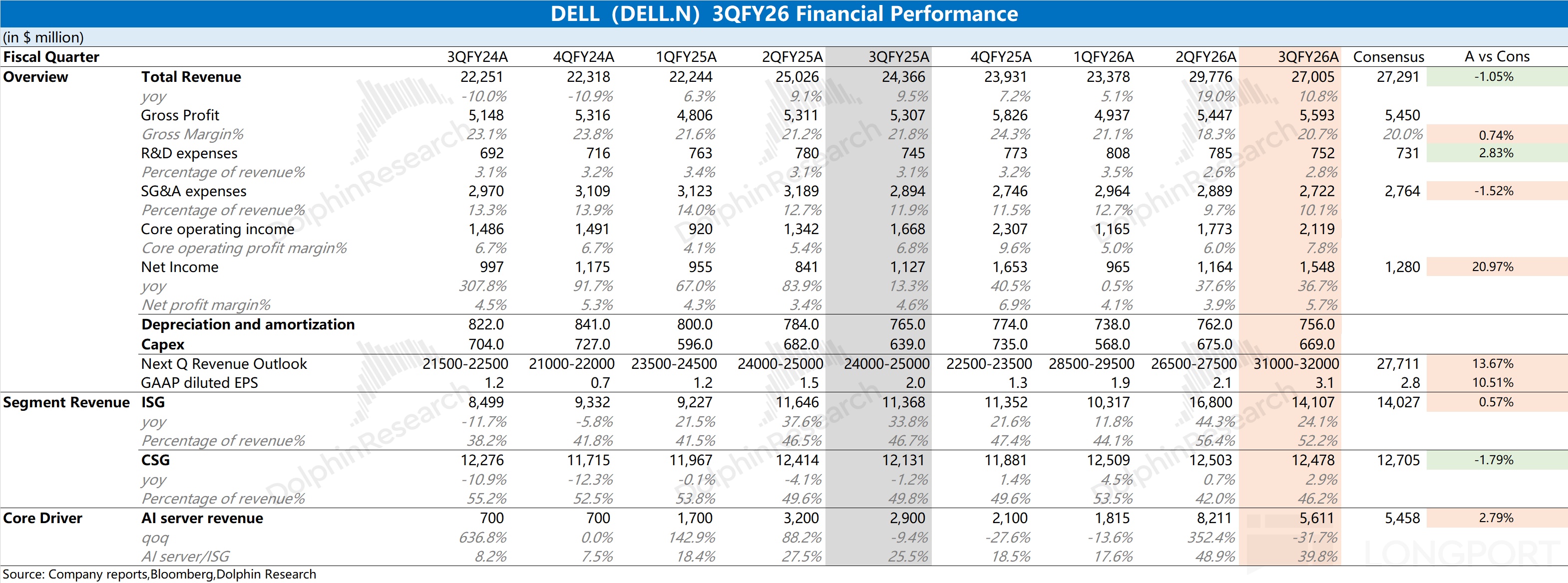
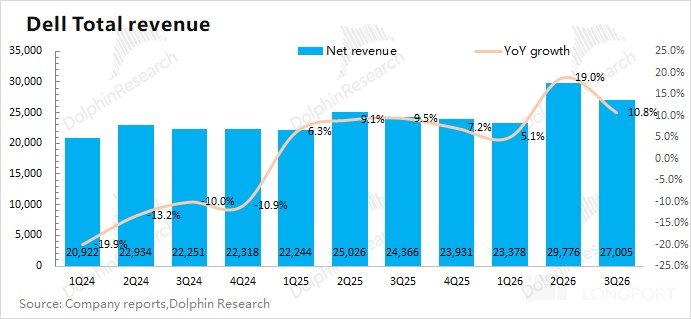
1. Core Performance:$Dell Tech(DELL.US) This quarter's revenue was $27 billion, up 10.8% year-on-year, close to market expectations ($27.3 billion). The company's revenue growth of nearly $2.7 billion this quarter was primarily driven by AI server shipments. The company's gross margin this quarter was 20.7%, down 1.1 percentage points year-on-year, slightly better than market expectations (20%). Compared to service revenue, AI servers and related products have relatively lower gross margins, which structurally lowered the overall gross margin as AI server-related revenue increased.
2. ISG Business (Infrastructure Solutions Group): This quarter's revenue was $14.1 billion, a sequential increase of $2.7 billion, in line with market expectations ($14 billion). The sequential increase this quarter was driven entirely by AI servers.
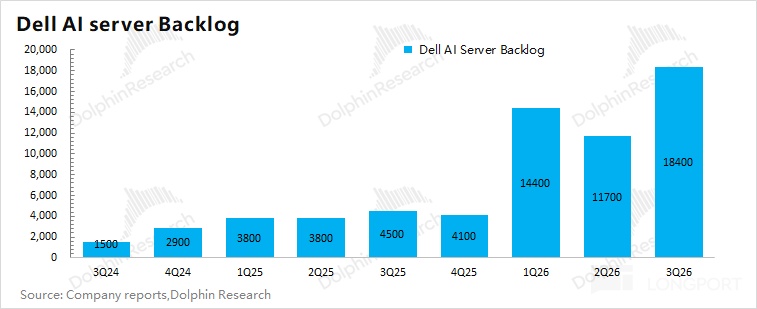
① AI Server Segment: The company's AI server revenue this quarter was approximately $5.6 billion, basically in line with market expectations ($5.5 billion). The company's backlog of AI server orders at the end of this quarter reached $18.4 billion, and Dolphin Research estimates that the company's AI server revenue next quarter will reach approximately $9.4 billion, significantly better than market expectations ($5.3 billion), making it the biggest "highlight" of this quarter.
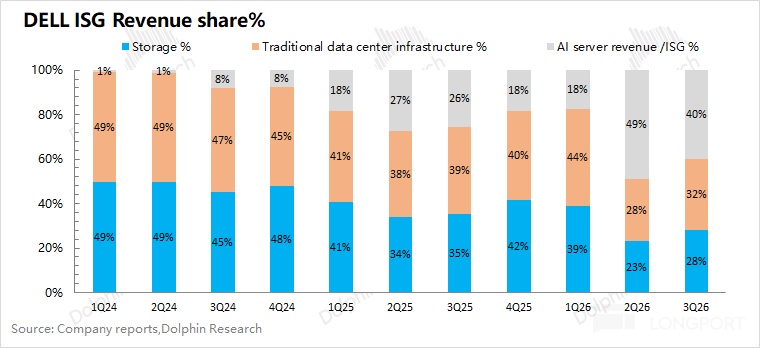
② Other Segments: Apart from AI servers, other segments remained relatively stable. Traditional server-related businesses contributed approximately $4.5 billion in revenue, up 1% year-on-year; storage business contributed approximately $4 billion in revenue, down 1% year-on-year.
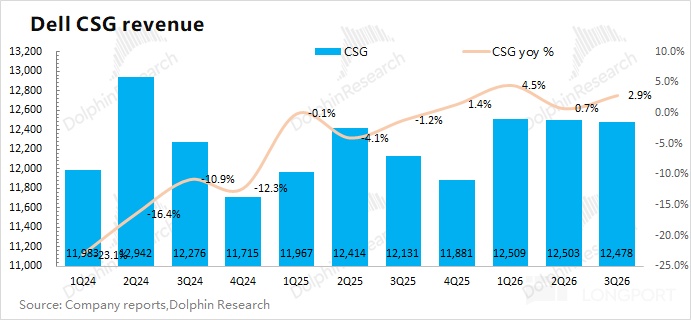
3. CSG Business (Client Solutions Group): This quarter's revenue was $12.5 billion, up 3% year-on-year, below market expectations ($12.7 billion). Specifically, Dell's client business remains primarily focused on commercial customers. This quarter's commercial customer revenue was $10.6 billion, up 5% year-on-year; while revenue from the personal consumer segment was only $1.86 billion, down 7% year-on-year.
4. Dell's Guidance for Next Quarter: The company expects fourth-quarter revenue of $31-32 billion, a significant upward revision (previous guidance was below $29 billion). Considering the company's backlog of nearly $18.4 billion this quarter, the upward revision in guidance is mainly driven by the AI business (estimated sequential increase of approximately $3.8 billion). The company's next quarter EPS (GAAP) is expected to be $3.1, a sequential increase, mainly driven by the growth of the AI business.
Dolphin Research's Overall View: Traditional business remains flat, AI injects confidence again
Dell's revenue this quarter increased by $2.7 billion year-on-year, entirely driven by the AI server business. Excluding the AI business, the company's traditional business is flat year-on-year, with the main focus still on the AI business.
Compared to this quarter's data, next quarter's guidance is even more of a "surprise." The company has raised its next quarter guidance to $31-32 billion (previous guidance was below $29 billion). The company's backlog of orders this quarter has significantly increased to $18.4 billion, and Dolphin Research estimates that the company's AI server revenue next quarter will increase to approximately $9.4 billion (a sequential increase of $3.8 billion), which is the main reason for the increase in next quarter's guidance.
At the investor conference in early October, Dell raised its long-term revenue guidance for FY2026-2030 from "3-4%" to "7-9%," which at the time pushed the company's stock price to a high of $165.
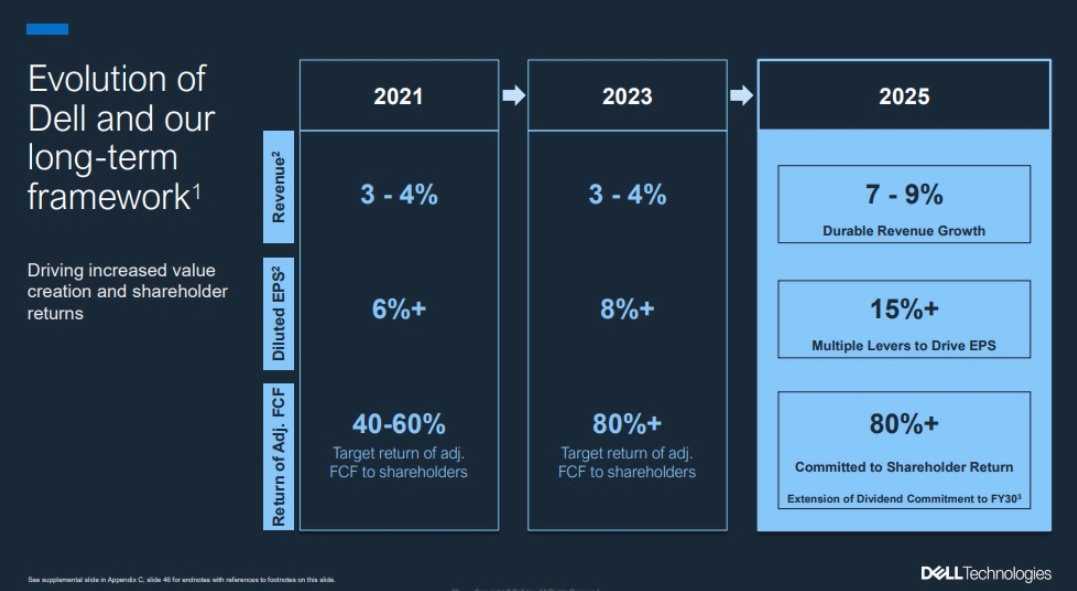
Although Dell raised its long-term guidance, the company's stock price continued to decline thereafter, mainly due to concerns in the following two areas:
a) Storage Price Increase, Cost Pressure: Due to increased demand for traditional storage from servers, the storage market price has seen a sharp rise since September. As storage prices rise, it has somewhat affected downstream market expectations for mobile phones, PCs, etc.
Previously, SMIC's management also mentioned that, in the current situation of rising storage prices, terminal manufacturers have not been able to provide relatively clear guidance for next year, and expectations are relatively cautious.
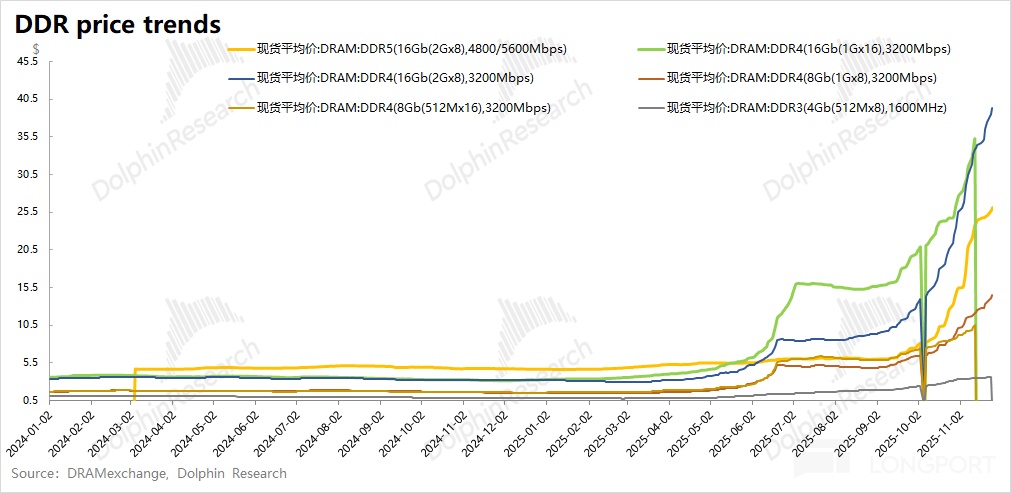
In the current situation where storage price increases have not shown signs of falling back, it will also impact Dell's PC business. If the company does not raise product prices, it will directly affect the company's gross margin; if the company chooses to raise prices, the cost increase will be passed on to consumers, directly affecting next year's terminal demand performance.
In the current cycle of rising storage prices, market expectations for the company's CSG business (Client Solutions Group) are relatively cautious.
b) AI Servers: Outside of "lackluster" traditional businesses, the market's main focus on the company is the performance of AI servers, which is also the company's main growth point in the future.
Previously, the increase in capital expenditure by major core cloud providers and the "crazy cooperation" with Open AI drove the "hot" AI Capex, and the company's stock price reached nearly $170. However, with the emergence of events such as "circular trading," market concerns about the "AI bubble theory" increased, driving the company's stock price down.
Recently, the market has also begun to worry that the "Google + Broadcom" camp poses a challenge to NVIDIA, as cost-effectiveness is an important consideration for downstream customers. If Google TPU signs large external orders and starts supplying externally, it will undoubtedly weaken NVIDIA's market competitiveness.
NVIDIA is a core partner of Dell's AI servers. If NVIDIA's competitiveness declines, the market is concerned about the growth performance of Dell's AI servers (the feasibility of long-term guidance). The relatively good point is that Dell is relatively more focused on enterprise customers and sovereign/government customers, which can help the company achieve guidance and maintain a good profit margin to some extent.
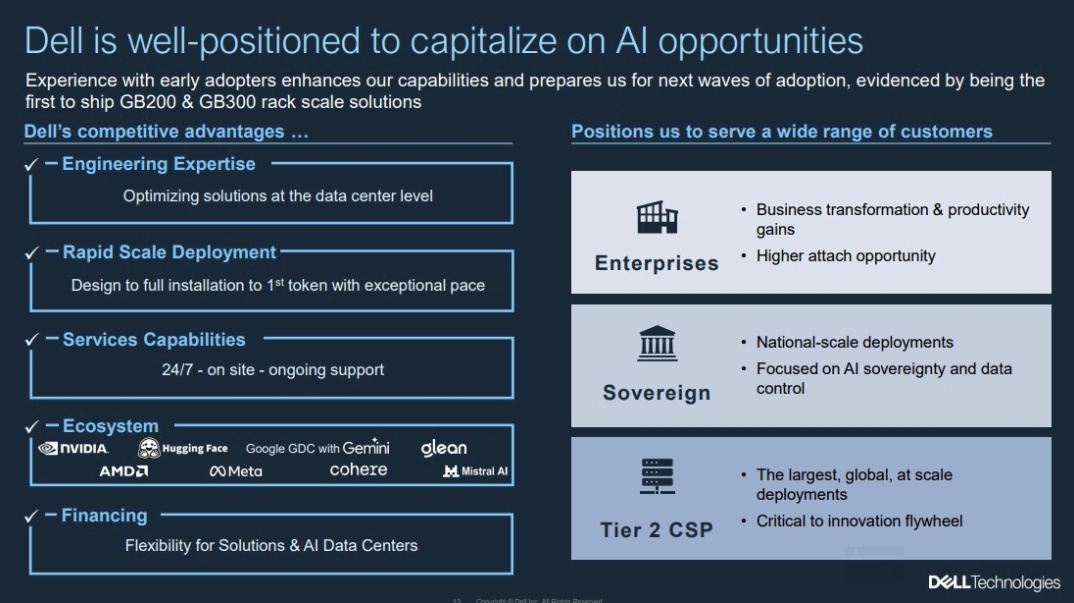
Considering Dell's current market value ($85.5 billion), it corresponds to approximately 11 times PE of core operating profit after tax for FY2027 (assuming revenue growth of +12.5%, gross margin of 20%, tax rate of 18.1%). Referring to Dell's historical valuation range, it can be seen that the company's valuation mostly falls between 10-20x PE.
Under the influence of continuous storage price increases, AI market divergence, and the NVIDIA industry chain, the company's valuation has fallen back again. The company is currently at a position of nearly 11 times PE, which basically corresponds to the valuation of traditional businesses. Although the company previously raised its guidance for FY2026-2030, the stock price's decline again shows that the market is more concerned about the feasibility of the guidance (especially the pressure on traditional businesses and the sustainability of AI business growth).
In the relatively certain situation of storage price increases squeezing traditional businesses, the progress of the company's AI business is an important focus. The company has provided an AI server order performance of $18.4 billion this time, which is quite good and will directly drive the growth of AI revenue next quarter. Although it cannot completely eliminate market concerns at present, the "eye-catching" performance of AI servers can still inject confidence into the company again in the short term. In addition to traditional businesses, the company still possesses AI attributes.
The following is detailed content from Dolphin Research on Dell Technologies (DELL.N):
I. Overall Performance of Dell DELL
1.1 Revenue Side
Dell DELL achieved revenue of $27 billion in Q3 FY2026 (i.e., 25Q3), up 10.8% year-on-year, close to market expectations ($27.3 billion). The company's year-on-year growth of $2.7 billion this quarter was entirely driven by the increase in AI server shipments.
1.2 Gross Profit Side
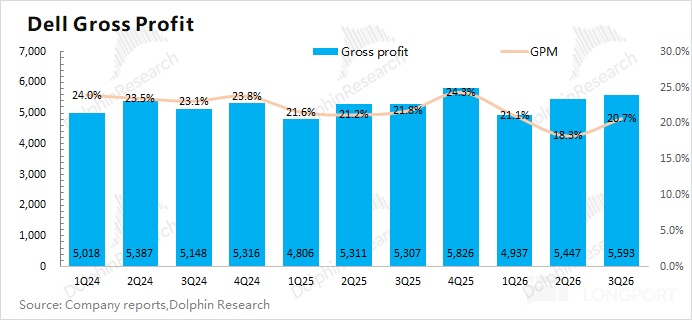
Dell DELL achieved a gross profit of $5.6 billion in Q3 FY2026 (i.e., 25Q3), up 5.4% year-on-year.
The company's gross margin this quarter was 20.7%, down 1.1 percentage points year-on-year, slightly better than market expectations (20%). The increase in the proportion of ISG business, which has a relatively lower gross margin, had a structural dilution effect on the overall gross margin.
1.3 Operating Expenses
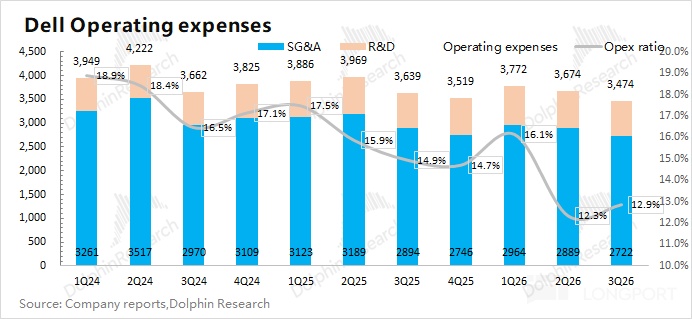
Dell DELL's operating expenses in Q3 FY2026 (i.e., 25Q3) were $3.47 billion, down 5% year-on-year. In the context of relatively sluggish traditional businesses, the company implemented layoffs, and the operating expense ratio this quarter fell to 12.9%.
Among them, 1) R&D Expenses: The company's R&D expenses this quarter were $750 million, up 1% year-on-year, and the company continues to maintain a growth trend in R&D expenses; 2) Sales and Management Expenses: The company's sales and management expenses this quarter were $2.72 billion, down 6% year-on-year, affected by the sluggishness of traditional businesses such as PCs, the company mainly reduced sales-related costs.
1.4 Net Profit
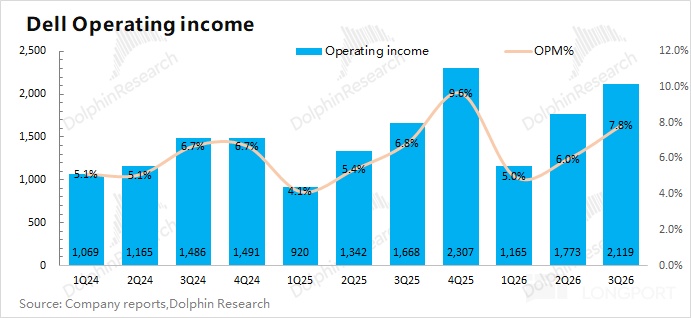
Dell DELL's core operating profit in Q3 FY2026 (i.e., 25Q3) was $2.12 billion, up 27% year-on-year, and the core profit margin this quarter increased to 7.8%. The growth in profit this quarter was mainly driven by the growth of the AI business and the reduction of operating expenses.
II. Core Business Situation of Dell DELL
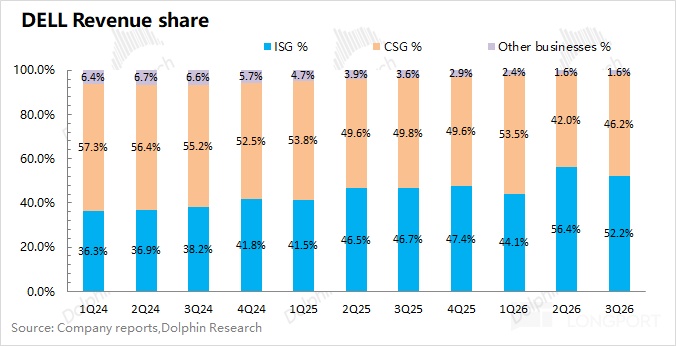
From the perspective of Dell DELL's business segments, driven by the growth of AI servers, the company's ISG business (Infrastructure Solutions Group) shows an upward trend, accounting for 52% this quarter, surpassing the traditional CSG business (Client Solutions Group).
Combining the growth guidance previously provided by the company, the compound growth of ISG business between FY2026-FY2030 (11-14%) will be significantly higher than that of CSG business (2-3%), and the proportion of ISG business will continue to rise.
ISG business is the most important part of the company, specifically:
2.1 ISG Business (Infrastructure Solutions Group)
Dell DELL's ISG business achieved revenue of $14.1 billion in Q3 FY2026 (i.e., 25Q3), up 24% year-on-year, in line with market expectations ($14 billion).
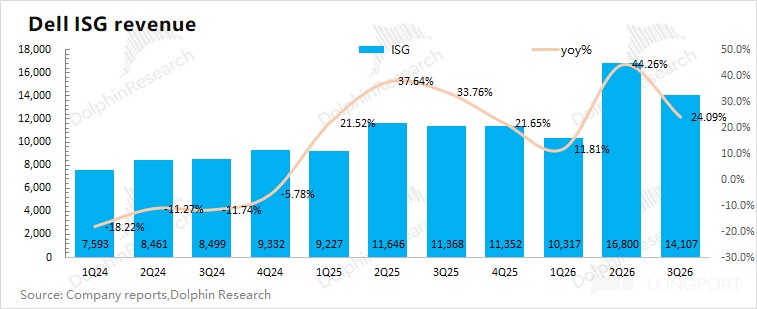
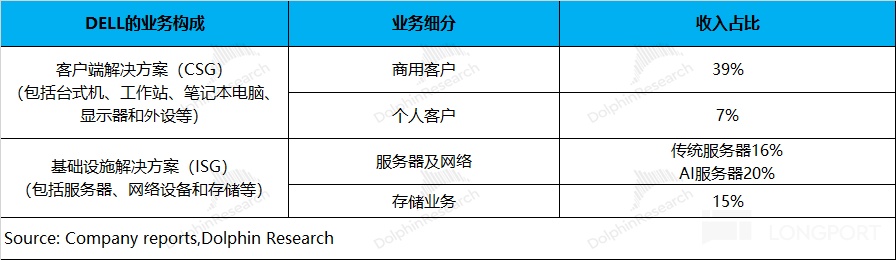
Specifically: ① AI server business revenue this quarter was approximately $5.6 billion, up $2.7 billion year-on-year, contributing the entire revenue increase for the company this quarter; ② Traditional server and related business revenue this quarter was $4.5 billion, up 1% year-on-year; ② Storage business revenue this quarter was $4 billion, down 1% year-on-year.
The current growth of the company is driven by AI servers, with traditional businesses being relatively flat. As the AI business grows, the current proportion of AI business in ISG business has increased to 40%.
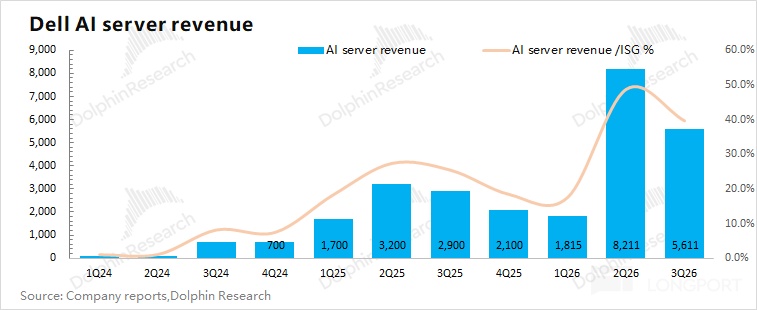
AI business is the company's main focus, although the company's AI business revenue this quarter was only $5.6 billion, it provided quite good order data. The company's current backlog of orders has reached $18.4 billion, and Dolphin Research expects the company's AI server revenue next quarter to reach approximately $9.4 billion, a sequential increase of $3.8 billion.
In fact, before this earnings report, the market was somewhat concerned about the company's AI business: a) Under the influence of events such as "circular trading," the market is worried about the sustainability of subsequent AI capex; b) NVIDIA and Dell are core partners, and in the case where the "Google + Broadcom" camp may weaken NVIDIA's competitiveness, Dell, which is in the NVIDIA chain, also faces indirect potential impacts.
Although the company previously raised its long-term guidance expectations, the market still worries about the realization of long-term guidance, which also led to a further decline in the company's stock price. The company provided relatively "eye-catching" AI order data this time, which can inject AI "confidence" into the company again.
2.2 CSG Business (Client Solutions Group)
Dell DELL's CSG business achieved revenue of $12.5 billion in Q3 FY2026 (i.e., 25Q3), up 3% year-on-year, slightly below market expectations ($12.7 billion).
Specifically, Dell's client business remains primarily focused on commercial customers. This quarter's commercial customer revenue was $10.6 billion, up 5% year-on-year; while revenue from the personal consumer segment was only $1.86 billion, down 7% year-on-year.
Combining global PC market data, global PC shipments in Q3 2025 were 75.9 million units, up 10.3% year-on-year, showing some recovery. Dell DELL's shipments were 10.1 million units, up 3% year-on-year, performing below the industry average, which also led to the company's market share in the PC market falling to 13%.
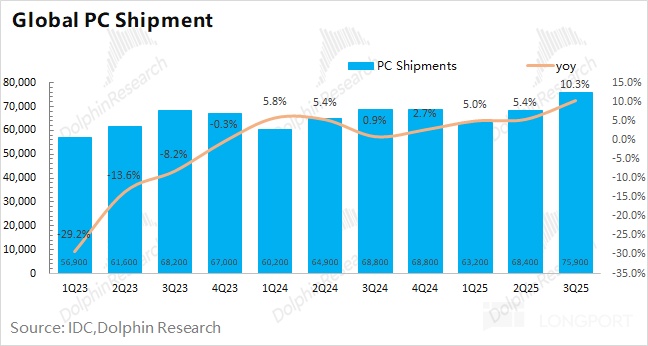
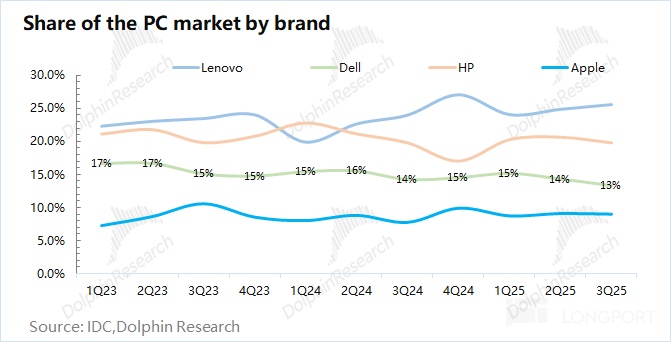
Since Dell's CSG business revenue and Dell PC shipments both grew by about 3% year-on-year this quarter, it can be inferred that the company's PC average price this quarter was basically flat year-on-year. However, it should not be overlooked that storage price increases are still ongoing, and under cost pressure, the company may also raise the prices of some PC products, which will to some extent affect the growth expectations of the CSG business next year.
<End Here>
Dolphin Research's retrospective articles on Dell Technologies (DELL.N):
Earnings Report
August 29, 2025, Conference Call "Dell (Minutes): AI Servers, Balanced Shipments in H1 and H2"
August 29, 2025, Earnings Report Commentary "Dell Technologies: AI Servers "Crazy Orders," Just a "Flash in the Pan"?"
In-depth:
July 11, 2025, Company In-depth "AI Double Buff, Dell to Welcome "Spring" Again?"
July 9, 2025, Company In-depth "Dell: AI Wave, Old Factory to Make a Comeback?"
Risk Disclosure and Statement of this Article: Dolphin Research Disclaimer and General Disclosure
The copyright of this article belongs to the original author/organization.
The views expressed herein are solely those of the author and do not reflect the stance of the platform. The content is intended for investment reference purposes only and shall not be considered as investment advice. Please contact us if you have any questions or suggestions regarding the content services provided by the platform.
