
D
Nov 26, 2025 at 10:39 AM
Why did Didi also fall when the food delivery war didn't reach it?
 I'm LongbridgeAI, I can summarize articles.
The leading ride-hailing company $DiDi(DIDIY.US) announced its Q3 2025 earnings before the U.S. stock market opened on the evening of November 26. In early November, Didi indicated in a limited communication that the domestic business's profit margin would decline this quarter, while overseas losses would significantly expand due to investments in Brazilian food delivery. Subsequently, Didi's stock price adjusted by nearly 20%, largely absorbing this bad news, and the actual performance was generally in line with the new guidance. Specifically:
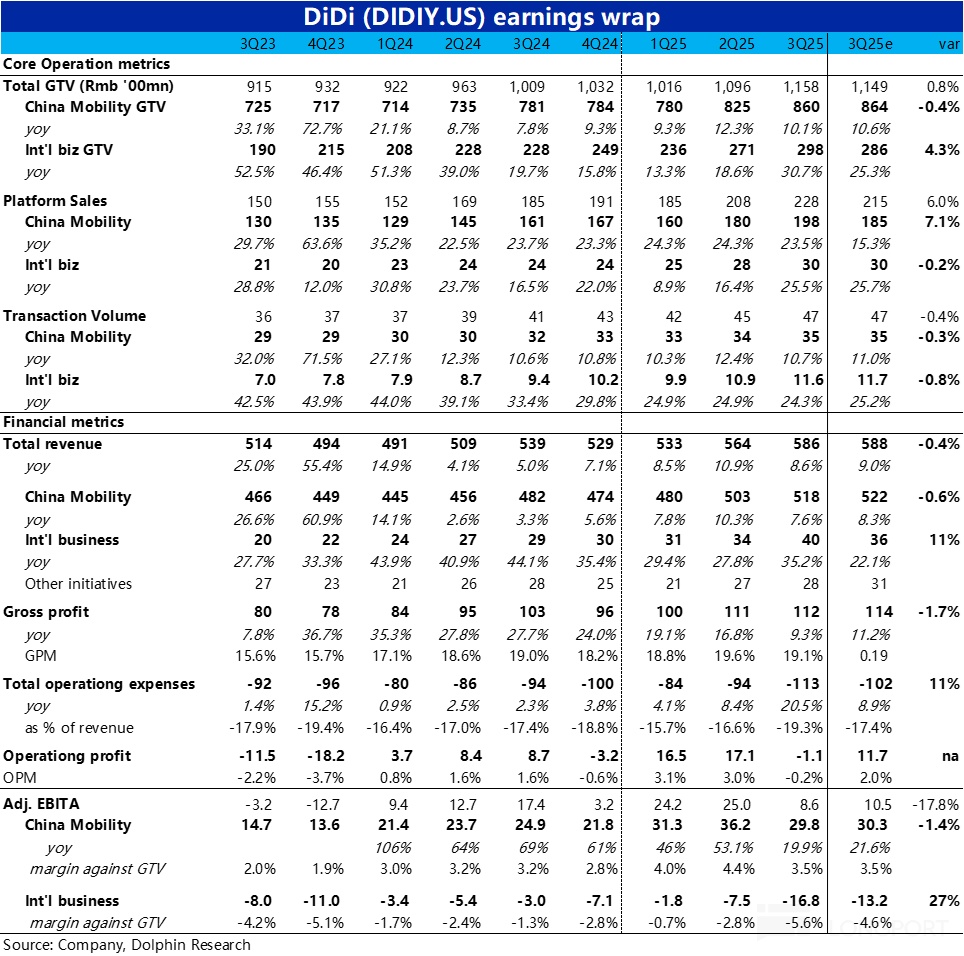
1. Domestic travel demand slightly weakened but remained stable: Didi's domestic business GTV growth rate slowed slightly to 10.1% year-on-year this quarter, roughly in line with Bloomberg's expectations. In terms of price and volume drivers, Didi's domestic travel order volume grew by 10.7% year-on-year, also slightly decelerating quarter-on-quarter, and the decline in per capita price expanded slightly to -0.5% year-on-year. In other words, both price and volume factors showed a slight weakening trend, but the magnitude was not large, remaining stable.
According to the Ministry of Transport's data, the overall domestic ride-hailing order volume's year-on-year decline expanded from 18%-19% in April-May to 22%-23% in June-August. Therefore, Dolphin Research believes that Didi's growth slowdown should be dragged down by the overall industry weakening, prompting Didi to increase subsidies and other investments to maintain domestic business growth.
2. Domestic net monetization rate remained stable: Based on the domestic business GTV growth rate of about 10%, this quarter's domestic revenue grew by approximately 8% year-on-year, while platform sales increased by about 23.5% year-on-year. Both trends were consistent with GTV changes, with a slight deceleration of about 1-2 percentage points quarter-on-quarter.
From the perspective of growth rate differences, platform sales growth > GTV growth > revenue growth, and the growth rate gap between each pair slightly widened compared to the previous quarter.
In other words, the proportion of subsidies given to consumers (recorded as a deduction from revenue) continued to increase, while the proportion of driver commissions decreased. With these two factors offsetting each other, this quarter's domestic business net monetization rate should not have changed significantly compared to the previous quarter.
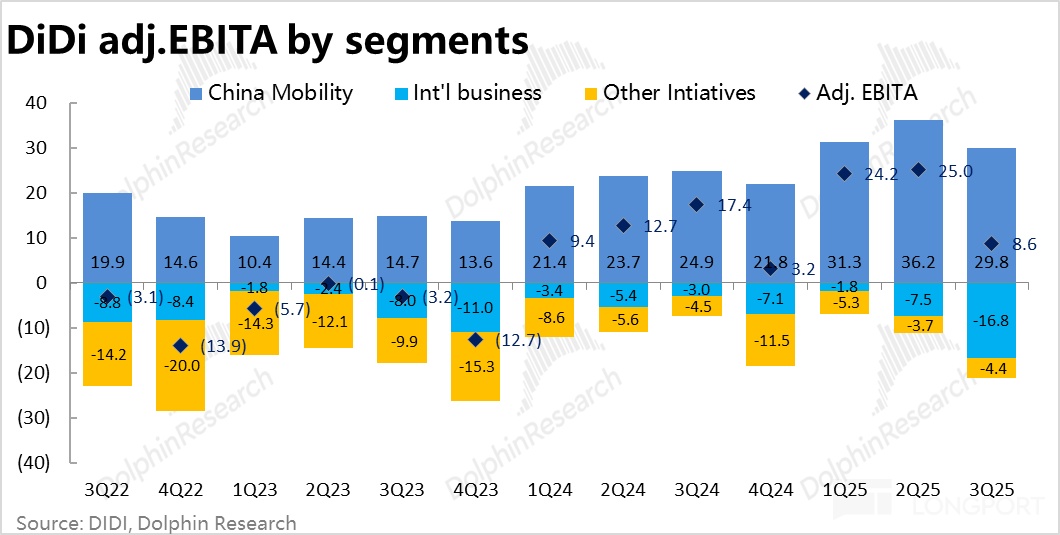
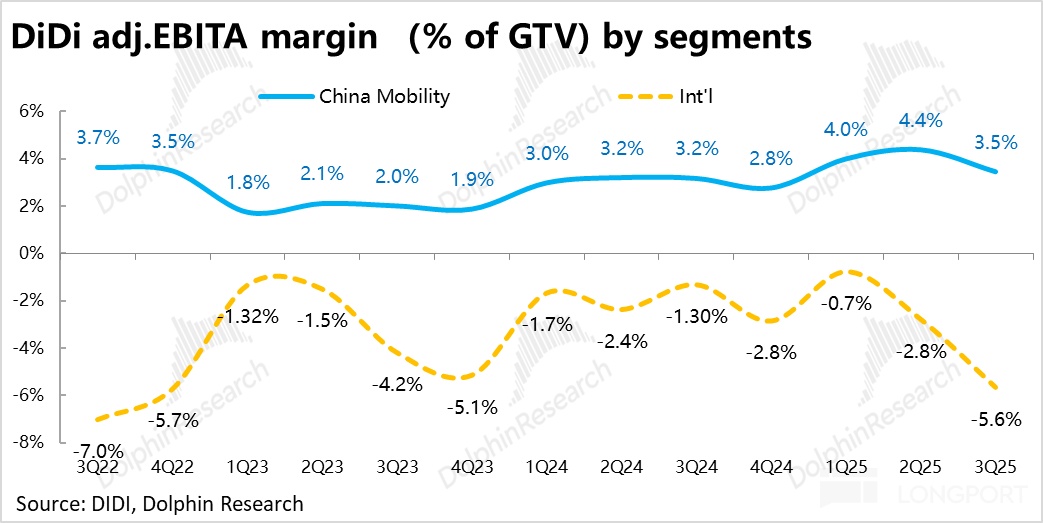
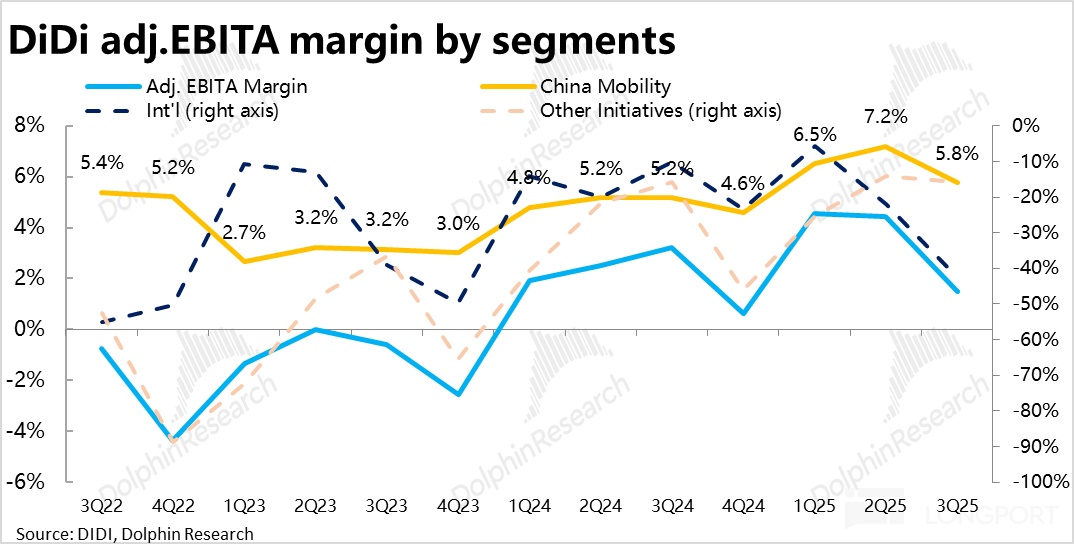
3. Domestic profit margin narrowed significantly quarter-on-quarter: Dolphin Research believes that due to the overall weakening of domestic demand, Didi correspondingly increased subsidies and customer acquisition investments domestically (mainly reflected in the surge in marketing expenses), resulting in adjusted EBITA profit for domestic business at 2.98 billion, significantly lower than the previous quarter's 3.6 billion, with profit as a percentage of GTV at 3.5%, also significantly down from the previous quarter's 4.4%. However, it did not perform worse than the guidance of 2.7-2.8 billion.
4. Overseas growth slightly accelerated, investment-driven growth not fully released: This quarter, Didi's overseas business GTV grew by approximately 29.3% at constant exchange rates, accelerating by 1.6 percentage points compared to the previous quarter.
Overseas business growth remained strong and accelerated slightly under the influence of investments in Brazil, but the magnitude was not very large. The order volume growth rate, which was basically flat compared to the previous quarter, also reflected the same signal.
Overseas platform sales grew by 25.5% year-on-year, with a significant increase in growth rate, mainly due to favorable exchange rate effects. Platform sales were lower than the corresponding GTV growth rate, also because increased incentive expenses offset it, with the calculated comprehensive monetization rate for overseas business remaining at 10.2%, down 0.4 percentage points year-on-year. This reflects the impact of increased overseas investment.
5. Domestic + overseas profit deterioration, overall profit halved year-on-year: As for overseas business, due to increased investments including Brazilian food delivery, this quarter's loss more than doubled quarter-on-quarter to 1.68 billion, with the loss rate doubling from -2.8% last quarter to 5.6%. However, it did not perform worse than the previous guidance of 1.7-1.8 billion loss.
However, in terms of trend, coupled with approximately 440 million losses from other businesses, Didi's total adjusted EBITA for this quarter was 860 million, halved year-on-year, which is certainly not a good performance, excluding the expectation gap.
7. Marketing expenses surged, the (only) biggest culprit for profit decline
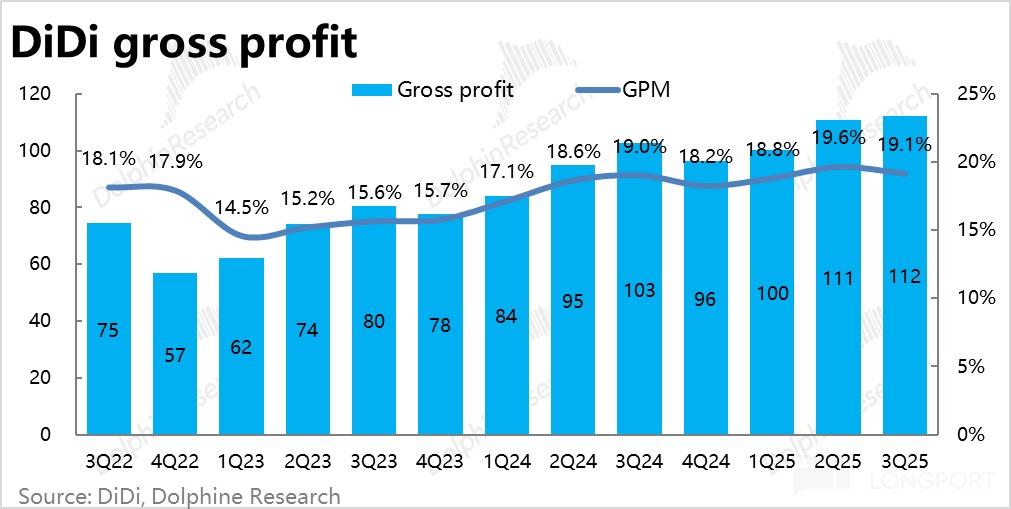
Didi's gross margin this quarter was 19.1%, with a quarter-on-quarter decline of 0.5 percentage points. This quarter's domestic gross margin should not have significantly deteriorated, mainly affected by the increase in overseas business revenue proportion and the dual impact of increased investment and declining overseas business gross margin.
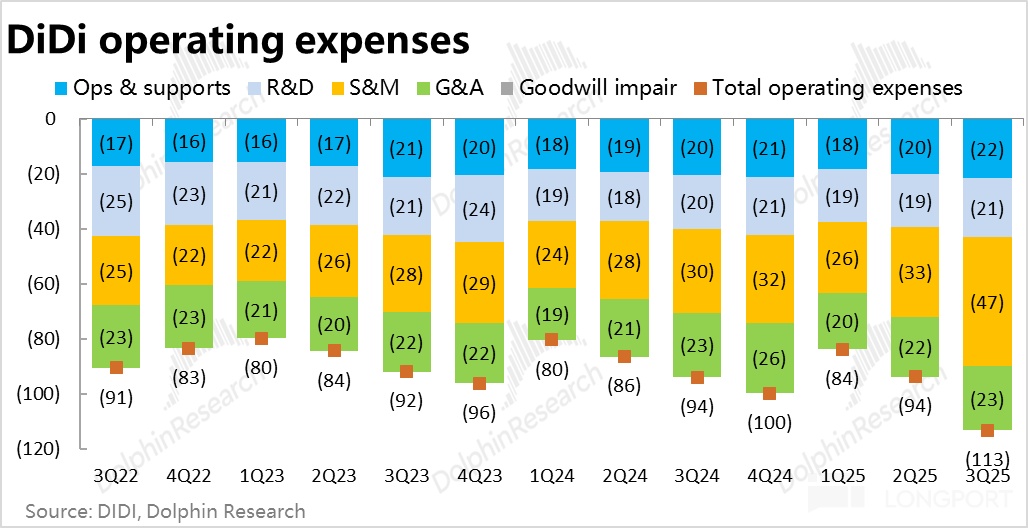
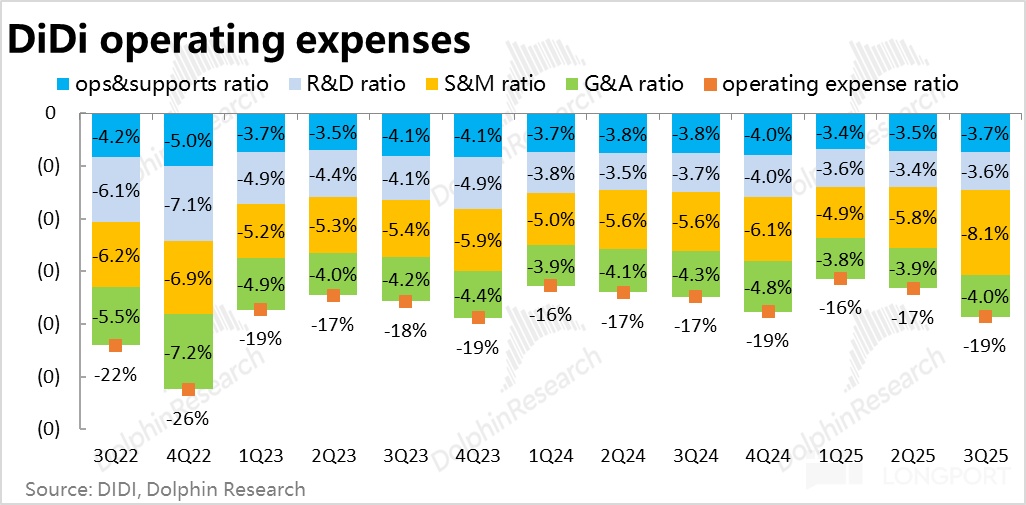
In terms of expenses, this quarter's total operating expenses reached 11.3 billion, significantly growing by 21% year-on-year.
Among them, sales expenses surged by 55% year-on-year, eroding approximately 1.7 billion in profit year-on-year, reflecting the substantial increase in subsidies and customer acquisition investments.
Meanwhile, R&D, operational support, and management expenses growth remained relatively limited, with growth rates not exceeding single digits.
8. Shareholder returns: According to company disclosures, since announcing a total of $2 billion buyback plan in March this year, as of the financial report release date, $1.29 billion has been repurchased this year.
Considering the recent decline in buyback intensity (increased overseas and domestic investments), the total buyback amount for the year may be within $1.4 billion, corresponding to approximately 5.6% of the current market value. This is considered a good level of shareholder return.
Dolphin Research's View:
As analyzed above, the main point of Didi's quarterly report is the simultaneous deterioration of domestic and overseas business profit margins, dragging down the group's overall profit by half, which can be considered a rather negative signal. Fortunately, the company had already communicated sufficiently, and after the market learned of the new guidance for this quarter's performance, the company's stock price had adjusted by 20%, so it can be said that this bad news was fully absorbed. Therefore, it is reassuring that the actual performance this quarter did not further worsen under the bad guidance.
In other words, this performance is generally in line with expectations.
So how should we understand the significant deterioration of Didi's profit, and what should we expect for the future? Although both domestic and overseas profit margins deteriorated, the stories and logic behind them are not the same.
1) Firstly, for the core domestic ride-hailing segment, Dolphin Research believes that Didi's increased investment in the second half of the year led to a decline in profit margin compared to the high point in the first half, mainly due to the overall weakening of domestic demand (as disclosed by the statistics bureau with expanded order volume decline), and not due to a worsening competitive landscape domestically. On the contrary, Didi's market share and leading position should have become more stable.
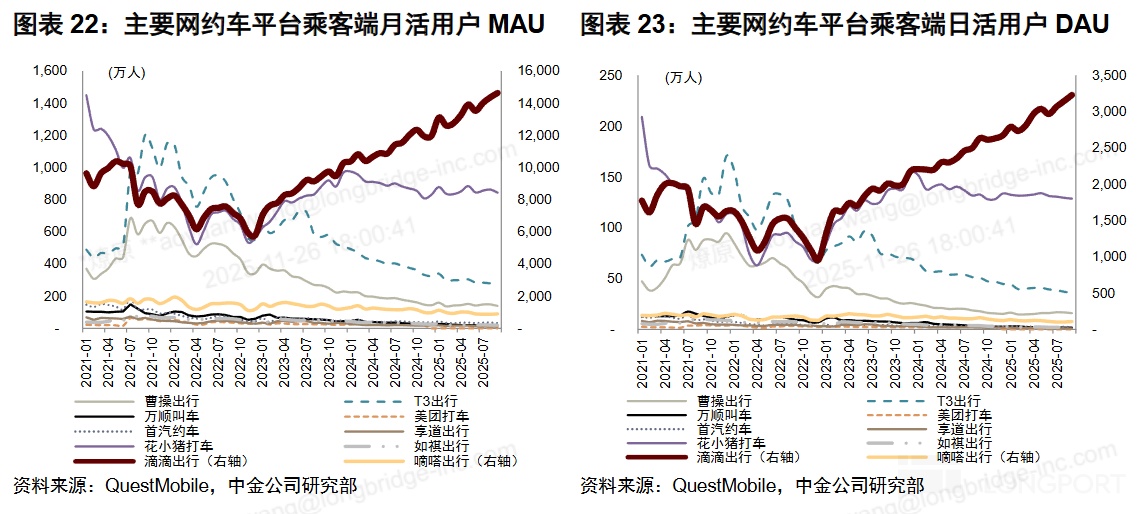
This can be seen from Didi's relatively stable domestic business order volume and GTV growth, and from the chart below, among major ride-hailing platforms, Didi's active user count is the only one that continues to rise, while others, except for Gaode, are declining (Gaode, being primarily a map, also includes other functions and is not entirely ride-hailing users).
It is evident that users are further concentrating on Didi. Moreover, from recent dynamics, competitors like Gaode and Meituan clearly do not have the energy or intention to increase investment in ride-hailing.
Therefore, to counteract the weakening macro cycle of the industry, Didi increased subsidies to smooth growth, which indeed affects short-term profits. However, since Didi's leading position is further solidified, this is not a long-term negative impact that "hurts the bones."
In the future, when the macro cycle improves, a stronger leader will also have the ability to release stronger performance elasticity. In other words, unless the macro environment continues to deteriorate, it is a short-term negative but long-term positive impact.
2) As for the expansion of international business losses, the logic behind it is also quite simple: to preempt Keeta in Brazil (and possibly other Latin American countries later) by significantly increasing investments in food delivery and other businesses.
This is a simple story of increased investment and losses for new business and potential future larger TAM opportunities.
Since business investment drags down current profits, it will certainly be punished by the market in the short term; but relatively, without new business investment and losses, it is impossible to create new growth points. Whether Didi can truly achieve success in the Latin American food delivery business is currently still uncertain.
Dolphin's view on trying new businesses has always been that as long as the core business is not problematic, losses from new businesses can be "looked through" without paying too much attention to how much loss they incur, and correspondingly, no valuation is given. After all, the company always has the option to exit unsuccessful new businesses (provided the core business is not problematic).
3) From a valuation perspective, due to the narrowing of profits this quarter, the current domestic business adj.EBITA for FY25 has been revised down from the previous 15 billion to 12 billion, after deducting approximately 2 billion in stock-based compensation expenses (the company's other non-operating income far exceeds tax expenses, so no tax is deducted), corresponding to a current market value of about 17.6x.
For a leading company with near-monopoly competitive status in its main business, a GTV growth rate of around 10%, profit growth this quarter still reaching 20%, and expected future growth of 15%-20%, it can be said to be at a neutral or slightly high level.
However, the above calculation does not account for Didi's nearly 38 billion RMB in net cash, accounting for about 22% of market value, and the company currently also has about 5%-6% shareholder return, indeed starting to release its cash value.
Therefore, as long as overseas investment is not overly aggressive, Dolphin's view on Didi is that it is a mature value stock with relatively high barriers and a stable competitive environment in the Chinese concept field. When the stock price adjusts significantly, it is a target that can be confidently bought on dips.
Below are key charts and comments on performance:
I. Business Growth: Domestic Stability, Overseas Acceleration with Investment
1. Domestic growth is generally stable: The most important operating indicator, Didi's domestic business GTV this quarter was 86 billion, with year-on-year growth slowing slightly to 10.1%, roughly in line with Bloomberg's consensus expectations. Although the Ministry of Transport no longer regularly publishes monthly ride-hailing industry data, from the disclosed data, the overall domestic ride-hailing order volume's year-on-year decline expanded from 18%-19% in April-May to 22%-23% in June-August. From this data, domestic overall ride-hailing demand in Q3 compared to Q2 has declined.
Didi's domestic GTV growth rate's quarter-on-quarter slowdown may be following industry trends. Breaking down price and volume, Didi disclosed domestic travel order volume (including ride-hailing, carpooling, and chauffeur services) grew by 10.7% year-on-year, also slightly decelerating quarter-on-quarter. Meanwhile, the decline in per capita price expanded slightly to -0.5% year-on-year. Overall changes are not significant, but both price and volume indicators suggest signs of weakening domestic demand.
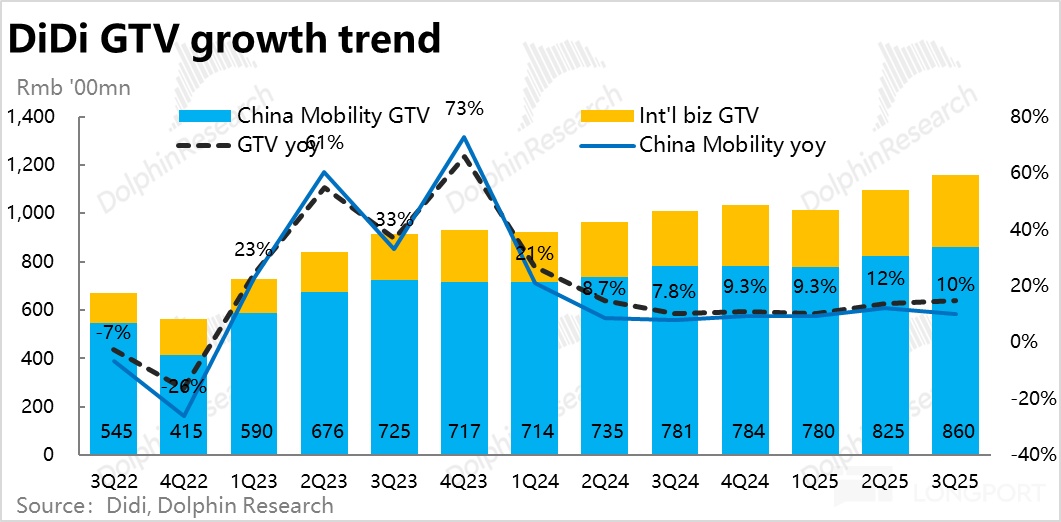
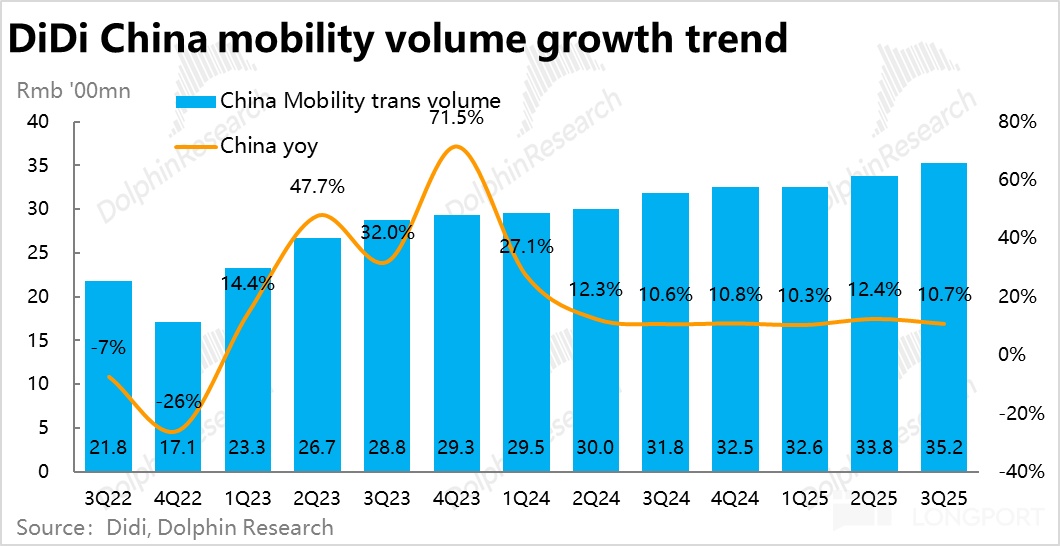
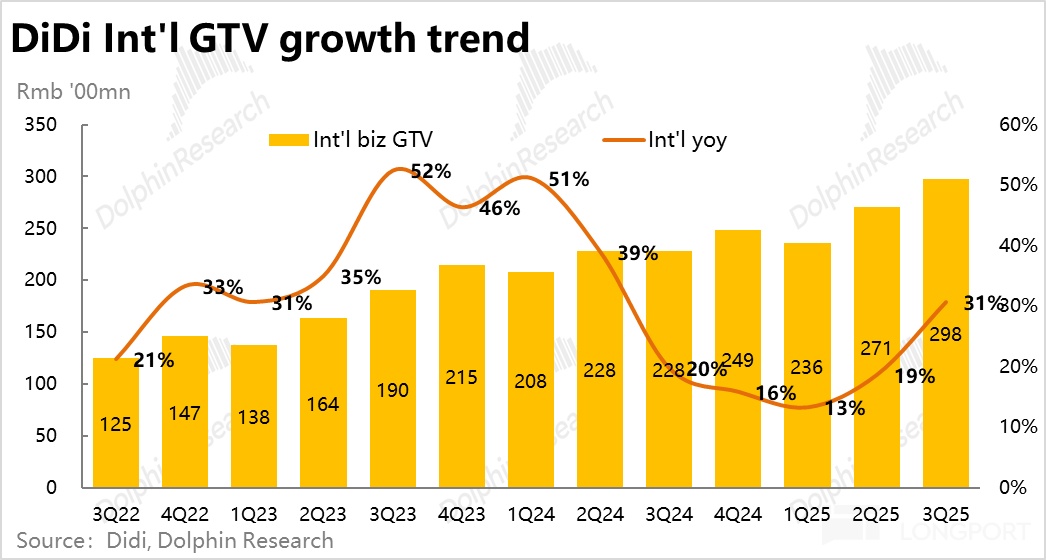
2. Overseas accelerated growth: Due to Didi's recent restart of overseas business in Brazil (to seize first-mover advantage before Keeta enters), this quarter's total overseas GTV growth accelerated significantly to 31% year-on-year. Even excluding favorable exchange rate effects, growth accelerated by 1.6 percentage points compared to the previous quarter, reflecting limited acceleration in business growth driven by increased overseas investment, although not as strong as the growth rate under variable exchange rate conditions.
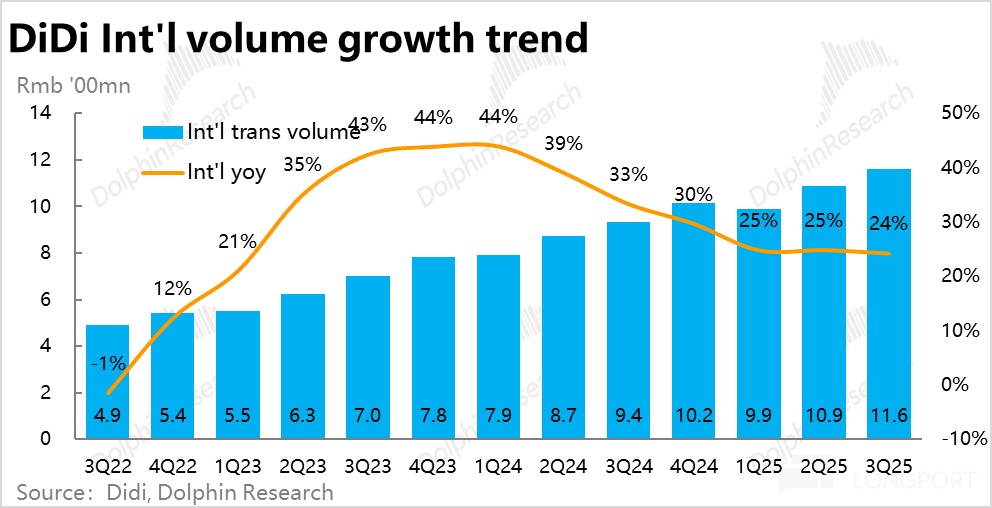
Meanwhile, this quarter's order volume growth was 24.3%, roughly flat compared to the previous quarter, also indicating that the incremental orders brought by the newly launched Brazilian food delivery business in early Q3 should still be relatively limited.
II. Domestic net monetization rate continues to rise, overseas subsidies increase
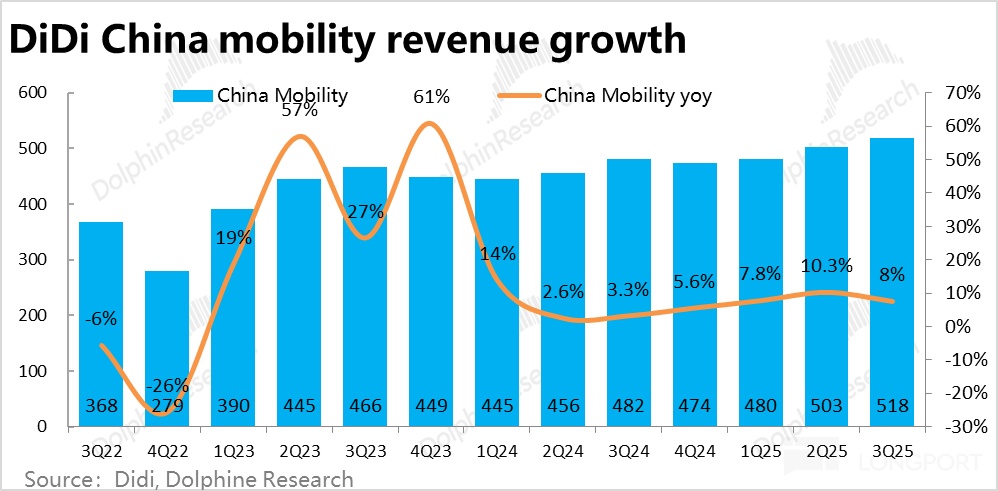
1. Domestic business: In terms of revenue, Didi's domestic travel segment revenue this quarter was 51.8 billion, growing approximately 8% year-on-year, with a slight slowdown in trend, consistent with GTV growth rate changes. From the growth rate difference between GTV and revenue, revenue still underperformed GTV, and the growth rate gap widened quarter-on-quarter. This reflects Didi's increased subsidy efforts for consumers this quarter, partially explaining the decline in domestic segment profit margin.
Conversely, Didi's domestic platform sales (reflecting platform retained earnings) grew by 23.5% year-on-year this quarter, also slightly slowing compared to the previous quarter (less than 1 percentage point), still significantly outperforming GTV and revenue growth, with the growth rate gap widening. According to the calculation method "platform sales = GTV - driver commissions/incentives - taxes, etc.," the net monetization rate retained by the platform remains in an upward trend.
According to the company's disclosed platform sales/GTV calculation, the domestic business platform overall monetization rate (excluding driver commissions but not consumer subsidies) also indeed rose by 1.2 percentage points quarter-on-quarter.
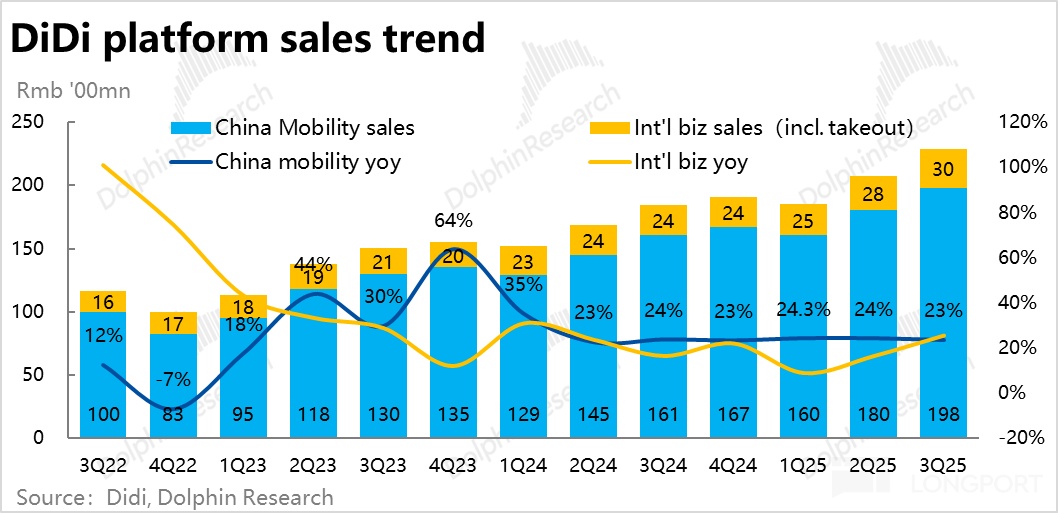
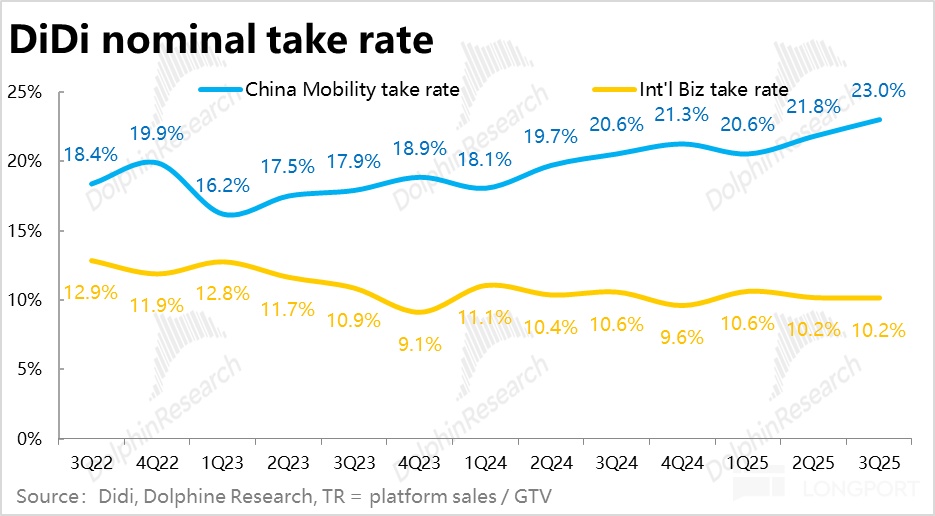
2. Overseas business: This quarter, overseas platform sales grew by 25.5% year-on-year, with a significant increase in growth rate, but like the variable exchange rate GTV growth rate, it should be more influenced by favorable exchange rate effects. Platform sales still underperformed the corresponding GTV growth rate, explained by part of GTV being offset by increased incentive expenses, with the calculated comprehensive monetization rate for overseas business remaining at 10.2%, down 0.4 percentage points year-on-year.
As for overseas business revenue, it grew by 35% year-on-year, higher than both GTV and platform sales growth rates, partly because financial and other business income is not reflected in GTV and platform sales. Additionally, different business revenue criteria vary (some are gross revenue, others are net revenue criteria). Therefore, as the company suggests, excluding partner commissions (drivers, riders), adjusting to net revenue criteria for platform sales can more accurately reflect the company's profit growth situation.
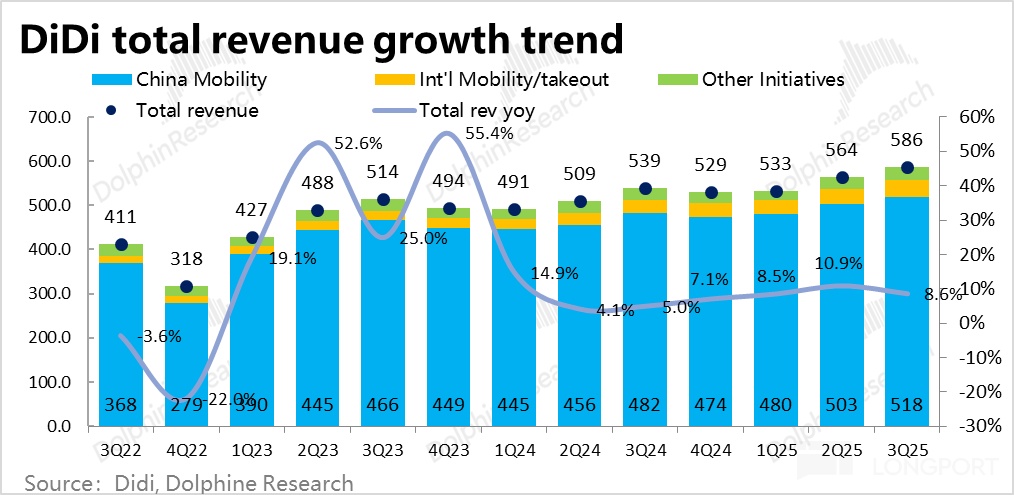
Summarizing the above businesses along with other innovative businesses, Didi's total revenue this quarter was approximately 58.6 billion, growing 8.6% year-on-year, as domestic revenue still accounts for nearly 90% of the absolute majority, following the domestic business trend, with a slowdown in growth rate.
III. Domestic and overseas profit margins both deteriorated
As mentioned earlier, the biggest issue for Didi this quarter is the simultaneous weakening of domestic and overseas business profit margins.
Firstly, Didi's domestic business adj.EBITA profit was 2.98 billion, significantly lower than the previous quarter's 3.6 billion, with profit as a percentage of GTV at 3.5%, also significantly down from the previous quarter's 4.4%.
Combining the analysis above, Dolphin believes it is mainly due to the weakening domestic ride-hailing demand starting in the second half of the year, prompting Didi to increase investments, including consumer subsidies, thereby significantly narrowing the profit margin improvement for domestic business.
However, fortunately, Didi had previously lowered guidance to 2.7-2.8 billion, and the actual performance did not exceed expectations.
As for overseas business, due to increased investments including Brazilian food delivery, this quarter's loss more than doubled quarter-on-quarter to 1.68 billion, with the loss rate doubling from -2.8% last quarter to 5.6%.
Due to the simultaneous deterioration of domestic and overseas business profit margins, coupled with approximately 440 million losses from other businesses, Didi's total adjusted EBITA for this quarter was 860 million, halved year-on-year.
IV. Marketing expenses surged by 55%, the biggest reason for profit decline
From the perspective of costs and expenses, the reason for the decline in profit margin, Didi's gross margin this quarter was 19.1%, with a quarter-on-quarter decline of 0.5 percentage points. Since this quarter's domestic business platform sales/GTV ratio remained flat compared to the previous quarter, it should mainly be affected by the increase in overseas business revenue proportion and the dual impact of increased investment and declining overseas business gross margin.
In terms of expenses, this quarter's total operating expenses reached 11.3 billion, significantly growing by 21% year-on-year, compared to growth rates of less than 10% since 2024. Among them, sales expenses surged by 55% year-on-year, eroding approximately 1.7 billion in profit year-on-year, mainly due to increased subsidies and general promotional expenses, primarily overseas but also domestically.
As for R&D, operational support, and management expenses growth remained relatively limited, with growth rates not exceeding single digits, and lower than total revenue growth. Therefore, it can be said that the decline in profit is entirely due to the growth in subsidies and customer acquisition investments.
<End of text>
Past [Didi Chuxing] Analysis by Dolphin Research:
Earnings Commentary
August 28, 2025 Earnings Commentary "Not Involved in Food Delivery, Didi is Still Doing Well?"
June 5, 2025 Earnings Commentary ""Food Delivery War" Didn't Burn, Didi Quietly Makes Big Money"
March 19, 2025 Earnings Commentary "Didi: Domestic is Mature but Still Needs Defense, Overseas Story Unfolds Slowly?"
November 29, 2024 Earnings Commentary "Didi: Domestic Has "Lied Flat," Overseas Not Fast Enough"
August 23, 2024 Earnings Commentary "Squeezing Profits, Does Didi Have a Sunset Glow?"
May 30, 2024 Earnings Commentary "Didi: Finally Regained the Dignity of Making Money"
In-depth Research
July 1, 2021 "Seven Hundred Billion Didi: Worth or Not?"
June 24, 2021 "Unveiling Didi's Travel "Utopia" | Dolphin Research"
Risk Disclosure and Statement of this Article: Dolphin Research Disclaimer and General Disclosure

The copyright of this article belongs to the original author/organization.
The views expressed herein are solely those of the author and do not reflect the stance of the platform. The content is intended for investment reference purposes only and shall not be considered as investment advice. Please contact us if you have any questions or suggestions regarding the content services provided by the platform.