


Meituan 2025Q3: The Most Hurt in the Food Delivery War, Wang Xing Believes Losses Have Peaked

Source: Dongge's E-commerce Insights
Author: Jin Shan
Among the three major food delivery giants, Meituan's financial report has finally been released. The food delivery war has pushed Meituan into losses, making it undoubtedly the most affected company among the three.
After the Hong Kong stock market closed on November 28, Meituan released its earnings announcement. In Q3 2025, Meituan's total revenue was 95.5 billion yuan, a slight year-on-year increase of 2%; its profit for the period turned from a profit of 12.9 billion yuan in the same period last year to a loss of 18.6 billion yuan.
Due to the need for subsidies to maintain market share, expected revenues were not collected, and Meituan's take rate is actually declining.

Performance Overview: First Quarterly Loss in Three Years
In Q3 2025, Meituan's total revenue was 95.5 billion yuan, a slight increase of 2.0% compared to 93.6 billion yuan in the same period in 2024.
In terms of the performance of its two major segments, core business declined while new business grew strongly. Core local commerce, including food delivery, in-store services, and flash sales, generated revenue of 67.4 billion yuan, a year-on-year decline of 2.8%. Among them, delivery services accounted for 23.0 billion yuan, down 17.1% year-on-year; commissions were 26.4 billion yuan, up 1.1% year-on-year; online marketing services were 14.2 billion yuan, up 5.7% year-on-year; and other services and sales were 3.9 billion yuan, up 84.9% year-on-year.
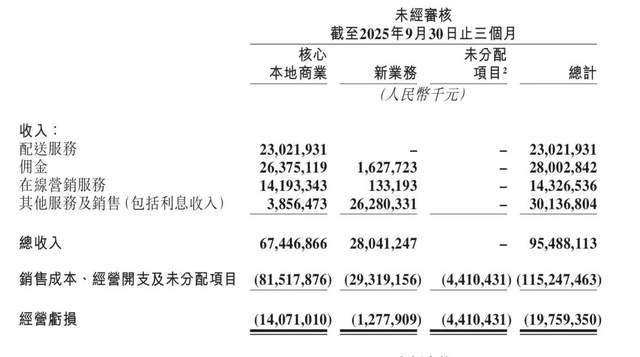
New businesses, including Xiaoxiang Supermarket and KeeTa, generated revenue of 28.0 billion yuan, a year-on-year increase of 15.9%, of which commissions were 1.6 billion yuan, up 101.0% year-on-year; online marketing services were 100 million yuan, up 15.3% year-on-year; and other services and sales were 26.2 billion yuan, up 12.9% year-on-year.
The main reason for the shift to losses was the significant increase in costs and expenses.
Cost of sales increased by 23.7% year-on-year to 70.3 billion yuan, accounting for as much as 73.6% of revenue. The increase was mainly due to higher rider subsidies, an increase in instant delivery orders, and overseas business expansion.
Sales and marketing expenses surged by 90.9% year-on-year to 34.3 billion yuan, accounting for 35.9% of revenue. This was mainly due to the fierce competition in the food delivery industry, prompting the company to significantly increase spending on promotions, advertising, and user incentives. R&D expenses increased by 31.0% year-on-year, mainly due to increased investment in artificial intelligence (AI) and higher employee compensation costs. General and administrative expenses were 3.0 billion yuan, up 5.7% year-on-year.
However, while revenue saw a slight increase, the company's profitability deteriorated significantly. Operating profit turned from a profit of 13.7 billion yuan in the same period last year to a loss of 19.8 billion yuan. Similarly, profit for the period turned from a profit of 12.9 billion yuan in the same period last year to a loss of 18.6 billion yuan. This reflects the enormous profit pressure the company faced during the quarter.
Overall, Meituan fell into the dilemma of "increasing revenue without increasing profits" in Q3 2025. Although new businesses and some core businesses continued to grow in transaction volume, the exceptionally fierce market competition, especially in the food delivery sector, forced the company to invest heavily in subsidies and marketing expenses to maintain its market position and user stickiness, directly eroding profit margins and turning core businesses from profit to loss. The company expects that due to the continued intensification of market competition, the trend of operating losses in Q4 2025 will continue.

Heavy Subsidies to Maintain Market Share
Meituan faces heavy pressure in its food delivery and in-store services businesses.
Core local commerce revenue, including food delivery and flash sales, actually experienced negative growth. This means that in order to maintain market share, the company had to significantly increase subsidies, particularly by making concessions on rider delivery income.
Dolphin Research estimates that, assuming flat per-order delivery revenue, the implied shipping fee waivers for core local commerce cost over 9.0 billion yuan.
According to data released in the earnings call, Meituan has currently maintained its market share in the mid-to-high-end segment. However, it is foreseeable that JD.com and Alibaba have taken a significant portion of the low-end market through subsidies.
From October to November, industry subsidy levels declined compared to the summer peak, especially after the Double 11 promotions ended. Recent market share and order volume have rebounded, maintaining a leading position in the mid-to-high average order value segment. Orders with an average order value of over 15 yuan accounted for more than two-thirds of GTV, while orders over 30 yuan accounted for about 70%, with the average net order value higher than other platforms.
"The food delivery price war is essentially a low-quality, low-level vicious competition, and we firmly oppose it," Meituan's management said, adding that scale expansion relying solely on subsidies is unsustainable.
Losses have peaked, but the food delivery business remains under pressure in the fourth quarter. "We will make the necessary investments to maintain our leadership position, but we will not participate in the price war. We will dynamically adjust resources based on the competitive landscape and continue to strengthen our service experience and operational efficiency advantages," management said.
Advertising revenue in core local commerce also slowed, indicating that Meituan's in-store services business is facing growth pressure. Taobao has also launched the Gaode Street Sweeping List. It is speculated that Meituan may have also offered discounts in its in-store services, reducing fees charged to merchants.
From Meituan's perspective, its in-store services business is significantly different from its competitors. Gaode Map is primarily a navigation tool, making it difficult to cultivate users' proactive search mindset.
Meituan's countermeasures mainly include three aspects: first, increasing high-quality lists, including "Must-Eat List" and "Black Pearl," and adding vertical lists to attract high-quality traffic; second, pursuing genuine reviews, using big data to deduplicate and filter out abnormal reviews; and third, improving the consumer experience by launching products such as "In-Store Appointment."
Overseas, after 29 months, KeeTa achieved its first monthly profit in October this year.
JD.com started the food delivery war, originally to drive traffic to its e-commerce business, but unexpectedly, Alibaba ended up benefiting the most. Meituan incurred huge losses to protect its market share. If Alibaba reduces subsidies, Meituan may lose less.
Meituan is the most severely affected company in the food delivery war. JD.com's current scale is much smaller compared to the other two. Alibaba was already losing money and has spent a lot, so losing a few billion more now has little impact.
The entire war took place in Meituan's core business, so the impact was very significant. After the negative factors have been fully reflected, Meituan may further consolidate its advantages and regain its market share, but this will inevitably take some time.
Reference: 1. Wall Street News: Meituan Earnings Call: Losses Have Peaked, Necessary Investments Will Be Made to Maintain Leadership, But Will Not Participate in Price War
The copyright of this article belongs to the original author/organization.
The views expressed herein are solely those of the author and do not reflect the stance of the platform. The content is intended for investment reference purposes only and shall not be considered as investment advice. Please contact us if you have any questions or suggestions regarding the content services provided by the platform.
