
D
Dec 2, 2025 at 10:09 PM
Marvell (Minutes): AWS is the first to become Celestial AI's 'core leading customer'
The following are the minutes of Marvell Technology's 2026 fiscal year third-quarter earnings call. For an interpretation of the financial report, please refer to "Marvell: Acquisition to Fill Gaps, Is the NVIDIA Alternative Path Becoming a Reality?"
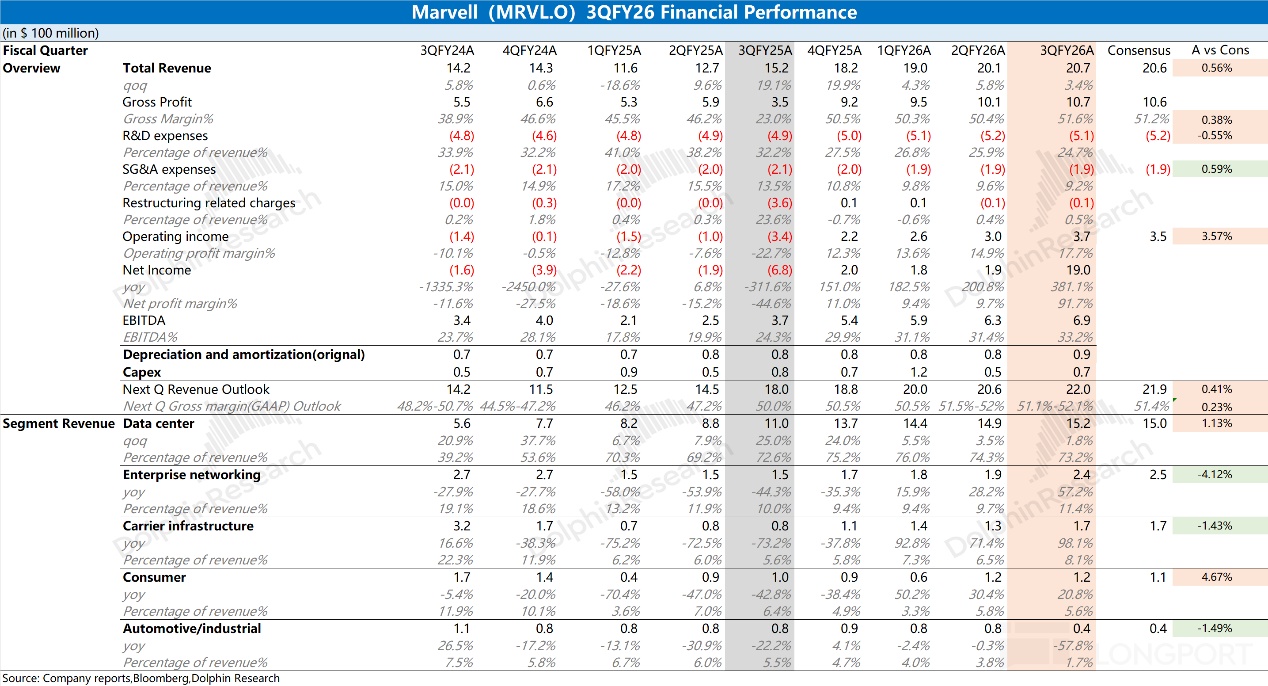
I. $Marvell Tech(MRVL.US) Review of Core Financial Data
Revenue: Achieved a record $2.075 billion in the third quarter, a 3% increase quarter-over-quarter and a 37% increase year-over-year. Excluding the divested automotive Ethernet business, core business revenue grew approximately 6% quarter-over-quarter and 41% year-over-year.
Earnings: Non-GAAP earnings per share were $0.76, exceeding the midpoint of guidance.
Performance of Major End Markets:
Data Center revenue reached $1.52 billion, up 38% year-over-year, accounting for 73% of total revenue.
Communication and Others: Revenue reached $557 million, up 34% year-over-year. Excluding the automotive Ethernet business, the year-over-year growth rate was close to 50%.
Profit Margin: Non-GAAP gross margin was 59.7%, up 30 basis points quarter-over-quarter; Non-GAAP operating margin reached 36.3%, up 150 basis points quarter-over-quarter.
Cash Flow: Operating cash flow reached a record $582 million. Repurchase: Repurchased $300 million in stock through a continuous repurchase plan in the third quarter and executed a $1 billion accelerated stock repurchase plan.
Fourth Quarter (2026 Fiscal Year Q4) Performance Guidance
Revenue: Expected to be $2.2 billion, with a fluctuation range of ±5%.
Gross Margin: GAAP gross margin expected range: 51.1% - 52.1%; Non-GAAP gross margin expected range: 58.5% - 59.5%.
The scale of quarterly total revenue and product mix structure are expected to be the core factors determining gross margin.
Operating Expenses: GAAP operating expenses expected to be approximately $741 million; Non-GAAP operating expenses expected to be approximately $515 million, an increase from the previous quarter, mainly due to ongoing business investments and increased employee bonuses.
Others: GAAP and Non-GAAP other income and expenses (including debt interest) are expected to total approximately $30 million.
Tax Rate: Non-GAAP tax rate expected to be 10%. Shares: Basic weighted average shares outstanding expected to be 850 million shares, diluted expected to be 857 million shares.
Earnings Per Share: GAAP diluted earnings per share expected range: $0.31 - $0.41; Non-GAAP diluted earnings per share expected range: $0.74 - $0.84.
2027 Fiscal Year Outlook
Operating Expenses: Non-GAAP operating expense growth is expected to be about half of revenue growth. Typically, first-quarter operating expenses grow at a mid-single-digit rate quarter-over-quarter. This forecast does not include the additional portion from the Celestial AI acquisition.
Tax Rate: Non-GAAP tax rate for the next fiscal year is expected to decrease to approximately 12%.
Financial Notes on the Celestial AI Acquisition
Expense Impact: Upon completion of the transaction, Celestial AI is expected to bring about $50 million in annual operating expense increase.
Revenue Contribution: Celestial AI is expected to begin generating significant revenue in the second half of the 2028 fiscal year, contributing to Non-GAAP earnings.
Financing Method: The acquisition plan is financed through a combination of stock and cash, with no intention to increase additional debt. The company will continue to return capital to shareholders through dividends and repurchases while paying the acquisition cost.
II. Detailed Information on Marvell's Earnings Call
2.1 Key Information from Executive Statements
1. Strategic Acquisition and Long-term Opportunities
Announced the strategic acquisition of Celestial AI, expected to be completed in the first quarter of the 2027 fiscal year.
Significance of Acquisition: Introducing a disruptive dedicated photonic architecture platform aimed at capturing the significant opportunities in the scale-up interconnect field. The company believes this technology has the potential to reshape the market similar to Inphi's PAM technology in the early years for the scale-out market.
Market Expectations: Industry forecasts predict that by 2030, the commercial market revenue for scale-up switches will be nearly $6 billion, while the associated optical interconnect module market opportunity will double, indicating a total market opportunity exceeding $10 billion.
Technical Advantages: Celestial AI's photonic structure technology platform provides high-bandwidth, low-latency, low-power optical solutions, with energy efficiency more than twice that of copper interconnects, and enables direct optical connection access to XPU internals (3D co-packaging), freeing up chip edge space to increase HBM capacity.
Products and Customers: The first-generation product is the photonic structure chip (PF chip), with a single-chip bandwidth of 16Tbps. A major design collaboration has been reached with one of the world's largest hyperscale enterprises for its next-generation scale-up architecture.
Financial Contribution: Celestial AI is expected to begin contributing significant revenue in the second half of the 2028 fiscal year, with a base forecast of annualized revenue reaching $500 million in the fourth quarter of the 2028 fiscal year (single quarter $125 million), and doubling to $1 billion in the fourth quarter of the 2029 fiscal year (single quarter $250 million).
2. Data Center Business: Strong Growth and Multiple Engines
Overall Outlook: The next fiscal year (2027 fiscal year) data center business revenue is expected to grow over 25% year-over-year, and the growth rate in the 2028 fiscal year is expected to significantly exceed this level.
Outlook for Each Sub-business:
Interconnect Business (accounts for about 50% of data center revenue): Growth is expected to continue to exceed cloud capital expenditure growth. 800G demand continues to accelerate, 1.6T products have started shipping in the second half of this fiscal year, with strong demand next year. The next-generation 3.2T technology has been demonstrated.
Custom ASIC Business (accounts for about 25% of data center revenue): Expected growth rate of at least 20% next fiscal year (previously expected 18%+), with accelerated growth in the second half, and no revenue gap period. A new generation XPU project from a major customer has been secured, covering all procurement orders for the next fiscal year. The design project pipeline continues to increase, with over 10% new orders won since June, accounting for over 10% of the original $75 billion lifecycle opportunity pipeline.
Switching, Storage, and Others: Revenue next fiscal year is expected to grow at least 15% (previously expected 10%), mainly due to demand for switch products. Switch business revenue is expected to exceed $300 million this fiscal year, and $500 million next fiscal year. The 100T product roadmap is being advanced, and the development of scale-up switches (such as the UALink solution) is being accelerated.
Emerging Growth Drivers:
XPU Adjacent Market: Over 15 design orders have been secured, focusing on custom smart NICs and CXL-based memory expansion/acceleration products. Based solely on the won NIC and CXL designs, it is clearly foreseen that revenue will exceed $2 billion in the 2029 fiscal year.
AEC (Active Electrical Cable) and Retimers: AEC DSP has won major customer orders; PCIe Gen6 retimers are collaborating with over 30 customers. Combined revenue for both is expected to double next year.
Coherent and LPO: 1.6T coherent lightweight solutions are expected to start shipping next year; LPO interface orders have been secured from multiple hyperscale enterprises.
3. Communication End Market: Continuous Recovery
Strong performance in the third quarter, with actual quarter-over-quarter growth close to 20% and year-over-year growth of 50% when excluding the automotive Ethernet business.
Outlook: Revenue is expected to grow by a low single-digit percentage quarter-over-quarter in the fourth quarter, with year-over-year growth of approximately 25% (excluding automotive Ethernet business, year-over-year growth close to 40%).
Enterprise network business is expected to reach an annualized revenue run rate of approximately $1 billion in the fourth quarter, and will grow in sync with enterprise IT spending thereafter. Carrier business continues to recover.
Q&A Session
Q: Does your description of the next fiscal year imply that revenue will be around $10 billion? How does this align with your long-term goals given in June, especially regarding AI business?
A: Yes, $10 billion is within a reasonable range. This is based on organic growth plans. We expect quarter-over-quarter growth in every quarter of the next fiscal year, with stronger growth in the second half, and significant growth by the end of the year.
Regarding the long-term path: Custom ASIC business is expected to grow about 20% next fiscal year, and double from 2027 fiscal year to 2028 fiscal year. Interconnect business growth is expected to continue to exceed capital expenditure. Other parts of the data center (storage, switching, etc.) are expected to grow 10% in the 2028 fiscal year. Overall, data center business growth rate in the 2028 fiscal year will be close to 40% (about 45% this fiscal year, 25% target next fiscal year). From the current cycle since 2023, the compound growth rate of data center business is about 50%.
If assuming communication and other businesses grow at GDP growth rate, Marvell's total revenue growth rate in the 2028 fiscal year is about 30%. Growth drivers like Celestial AI will start contributing from the 2028 fiscal year and further exert force in the 2029 fiscal year and beyond. The outlook is bright.
Q: Regarding the release of new generation 3nm and 2nm XPU products by leading AI customers, are you involved? Can you update on the design project pipeline below 3nm (including XPU and XPU adjacent projects) and the mass production timeline?
A: Customer product transition has been included in all the forecast numbers we provided, and we have secured orders with high visibility. Regarding 2nm, we are advancing multiple projects, which will be key process technology. The design pipeline continues to grow, with significant energy efficiency benefits. We expect strong product ramp-up during this period, especially in the 2028 fiscal year, when some 2nm products will start ramping up. The team is performing excellently in execution.
Q: Regarding Celestial AI's $500 million and $1 billion revenue targets, is this only for PF Link products, or does it also include potential businesses like memory?
A: These revenue targets (and corresponding performance commitments) are based on Celestial AI's overall business. From actual progress, PF small chips will generate revenue first. All potential businesses are included in the targets, but revenue build-up at the end of the 2028 fiscal year and the end of the 2029 fiscal year will mainly come from PF small chips.
Q: Regarding Celestial AI's revenue ramp-up at the end of the 2028 fiscal year/early 2029 fiscal year, how broad is the customer base? Is the revenue source diversified?
A: The scope of cooperation is broad, but it takes truly large companies to drive stable mass production of products. We have deep cooperation with various parties and are fortunate to have a tier-one hyperscale customer as a partner and leading customer. Celestial joining Marvell is exciting because we have a strong internal silicon photonics technology team and expertise, which will form synergy.
Having a leading customer driving the first wave of development is very critical. This is just the first stage, but there is strong interest from the entire industry. We see a huge opportunity for transformation to photonics within data centers. We believe that combining our internal team and a leading customer will be a successful integration. After this, we expect broader adoption.
Q: Regarding custom business, you mentioned at least 20% growth next year, which seems like a certain number. Can you explain what the normal growth rate for custom business might be in the 2027 fiscal year if everything goes well?
Additionally, you provided long-term guidance up to the 2028 fiscal year, which is different from the usual practice of only providing next-quarter guidance. How confident are you in achieving these long-term revenue targets and visibility?
A: Regarding custom business, you can absolutely use 20% as a base forecast. This is a good and solid base. We have a strong order reserve. The growth rate in the second half, especially at the end of the year, will be much higher than the current level, as we are building momentum for the 2028 fiscal year.
Regarding providing long-term guidance, this is due to the multi-year cycle of AI infrastructure construction we face, and we value investors' concerns about how to achieve long-term goals. What I share is based on actual situation benchmark assumptions, not fantasies. For example, the custom business forecast is based on known projects; interconnect business growth usually exceeds capital expenditure growth; other parts like switching and storage also have upside potential. These forecasts are also closely linked to customers' long-term planning, providing multi-year visibility for construction, which forces us to plan R&D, capacity, and ramp-up rhythm 6 to 8 quarters in advance, enhancing our confidence in the outlook. This sharing also aligns with the timing of Celestial's acquisition, whose contribution will mainly be seen after the 2028 fiscal year.
Q: The submitted 8-K document shows the company granted Amazon 1 million warrants to purchase products related to the photonic architecture Photonic Fabric. Does this mean Amazon is the company's leading customer? Can you talk about this expanded partnership?
A: Yes, the 8-K document we submitted is about the expansion of the existing warrant agreement, essentially adding a new cooperation area—Photonic Fabric. A year ago, we announced a warrant and strategic cooperation with AWS, mainly covering AI custom products and network products, and this time it's an additional cooperation scope. Each cooperation has significant potential. We are positive about this expansion and are also pleased to receive strong support from AWS in the acquisition press release.
All this information points to our direction and who is jointly driving the development of this technology. We are very excited about the prospects of this technology, especially with our top-tier hyperscale customer, and other market participants expected to follow closely after our full commitment. This warrant agreement, along with the team's efforts towards the $2 billion performance commitment target by the end of the 2029 fiscal year, together form a strong incentive system, driving everyone to fully execute and bring the product into mass production.
Q: Why is the optical business associated with cloud capital expenditure rather than the faster-growing AI accelerator? Is the 20% baseline growth in custom business due to the addition of a second customer or following the growth of the first customer?
A: Associating the optical business with cloud capital expenditure is just to provide a common reference benchmark for the investment community. The optical business is actually driven by AI and AI acceleration, so its growth rate exceeds capital expenditure every year. Next year's growth is mainly driven by existing business, including the generational transition of leading customers' products, and the contribution of XPU adjacent devices starting in the second half (which will bring revenue in the 2028/2029 fiscal year). The next larger XPU customer should not be expected to contribute much next year, with its contribution mainly reflected in the doubling growth from the 2027 fiscal year to the 2028 fiscal year. We are currently setting a rational and achievable base plan.
Q: Given that major competitors have shifted to providing entire racks rather than just chips, and the complexity increases after acquiring Celestial AI, will the company also shift to providing system-level or rack-level solutions? Does it have the relevant capabilities?
A: We indeed view it as an overall rack-level solution, covering various optical interconnect technologies (such as AEC, traditional DSP, retimers, LPO, Photonic Fabric, vertical/horizontal expansion switches, XPU adjacent slots and circuits). We are a one-stop supplier and work closely with customers to achieve end-to-end enablement. We absolutely have a rack-level vision, which is also the fit point of Celestial AI. However, in the future two-year forecast I mentioned, no system-level revenue is included. From a strategic perspective, we must enter the market in a comprehensive way rather than a single-point solution, able to provide all basic components from the largest XPU chip to board-level retimers.
Risk Disclosure and Statement of this Article: Dolphin Research Disclaimer and General Disclosure
Login to unlock17,029characters for free
This content is only available to signed-in users. Sign in to your Longbridge account to read the full post.

Bio-Techne
USTECH

NVIDIA
USNVDA

NVDA 2X Long ETF
USNVDL

XL2CSOPNVDA
HK07788

XI2CSOPNVDA
HK07388

YieldMax NVDA Option Income Strategy ETF
USNVDY

Direxion Daily NVDA Bear 1X ETF
USNVDD

T-Rex 2X Long NVIDIA Daily Target ETF
USNVDX

T-Rex 2X Inverse NVIDIA Daily Target ETF
USNVDQ

Marvell Tech
USMRVL

Hudbay Minerals
USHBM

Pampa Energia SA -SPON
USPAM

Ategrity Specialty Holdings LLC
USASIC

Cambria Global Asset Alloc
USGAA

Pro Ultra 7-10Yrs
USUST

Outfront Media
USOUT