
D
Dec 8, 2025 at 03:19 AM
NFLX breaks its own rules, makes an RMB 80bn bet to become No.1 in film & TV
 I'm LongbridgeAI, I can summarize articles.
On Dec 7, the long-running sale of $Warner Bros. Discovery(WBD.US) largely reached its endgame. $Netflix(NFLX.US) won out, agreeing to buy all WBD assets excluding linear TV for $72bn and assume $10.7bn of WBD debt. The deal still requires regulatory approval given potential antitrust concerns.
Several core questions are worth discussing. They include:
1) What are the deal specifics?
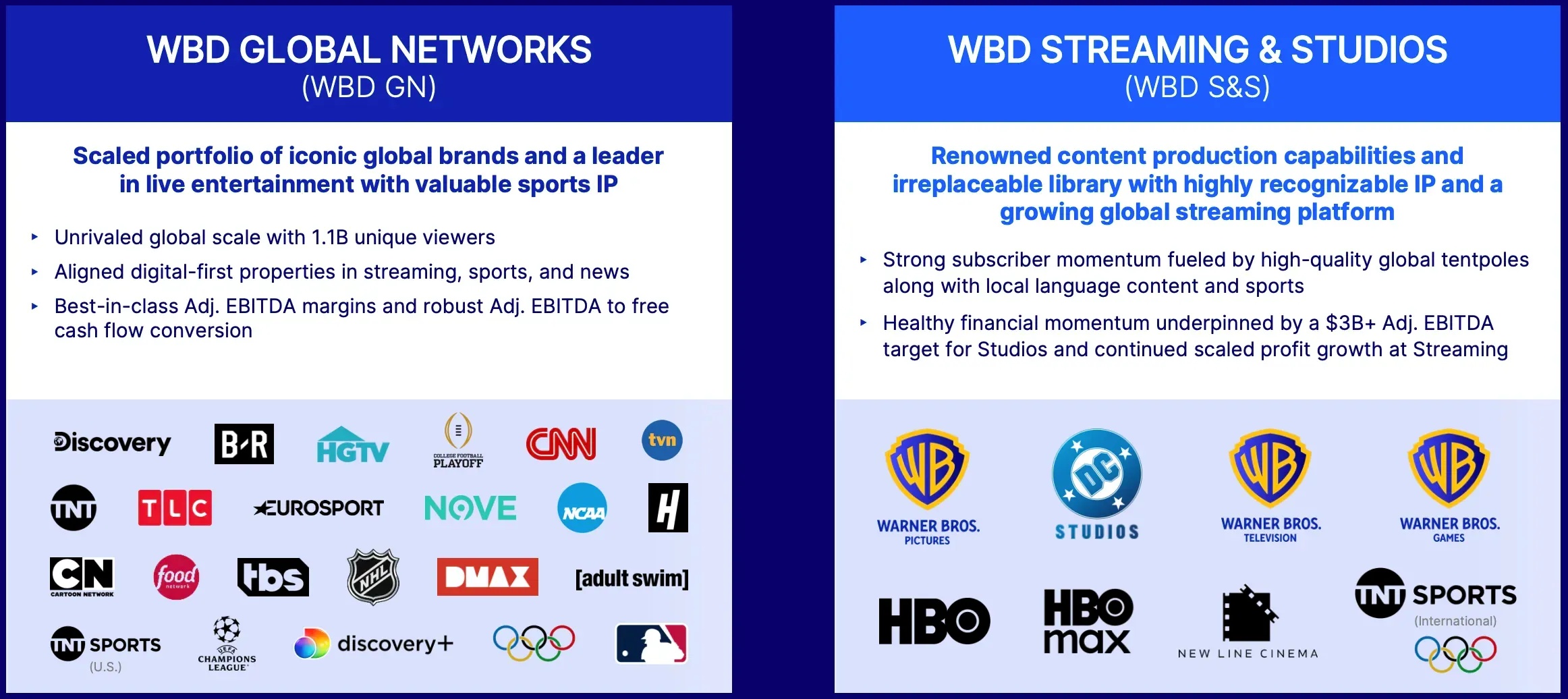
(1) Assets purchased: WBD's streaming service HBO, Warner Bros. studios, and the underlying IPs (including but not limited to Harry Potter, DC Universe, The Lord of the Rings, Game of Thrones, and Friends).In Jun this year, WBD said it would split into WBD Streaming & Studios and WBD Global Networks, meaning Netflix is effectively buying Streaming & Studios. Note that sports assets fall under Global Networks, so sports IPs in the U.S. such as TNT Sports are not included.
(2) Consideration: Equity value of $72bn, plus assumption of $10.7bn debt, totaling $82.7bn. Netflix will pay $27.75/share for WBD, with $23.25 (84%) in cash and $4.50 (16%) in Netflix stock.Under WBD's prior split plan, Streaming and Studios targeted combined Adj. EBITDA > $3.3bn in 2025. On that basis, the $72bn equity value implies ~22x EV/Adj. EBITDA, which is not cheap given Netflix trades around ~30x.
Netflix has less than $10bn cash on hand and under $16bn including revolvers, while carrying $14.4bn of long-term debt. As a result, Wells Fargo, BNP, HSBC and others are providing a $59bn bridge loan for the cash portion.
That tops Paramount Skydance’s two bids, one at $23.5/share and another at $30/share for the entire WBD including cable networks.
(3) Timing: Closing would occur after WBD completes the split, i.e., post 3Q26. Approval is uncertain due to antitrust issues that are more pronounced upstream in the value chain than on the consumer side, so the timeline is highly uncertain.
(4) Key risk: Antitrust clearance is the biggest swing factor, and Trump objected to the deal yesterday.In streaming, Netflix has ~320mn users and HBO Max ~120mn; in the U.S., they have ~90mn and ~24mn, respectively. Combined, they account for ~34% of U.S. subscriptions (MNTN estimates U.S. streaming subs at 340mn in Q2 2025).
While U.S. user overlap is high (street est. >60%, with the Avg. U.S. household subscribing to 3.8 services and both Netflix and HBO Max in the first tier), regulators could still balk at a combined share above 30%. The risk of a block cannot be ruled out.
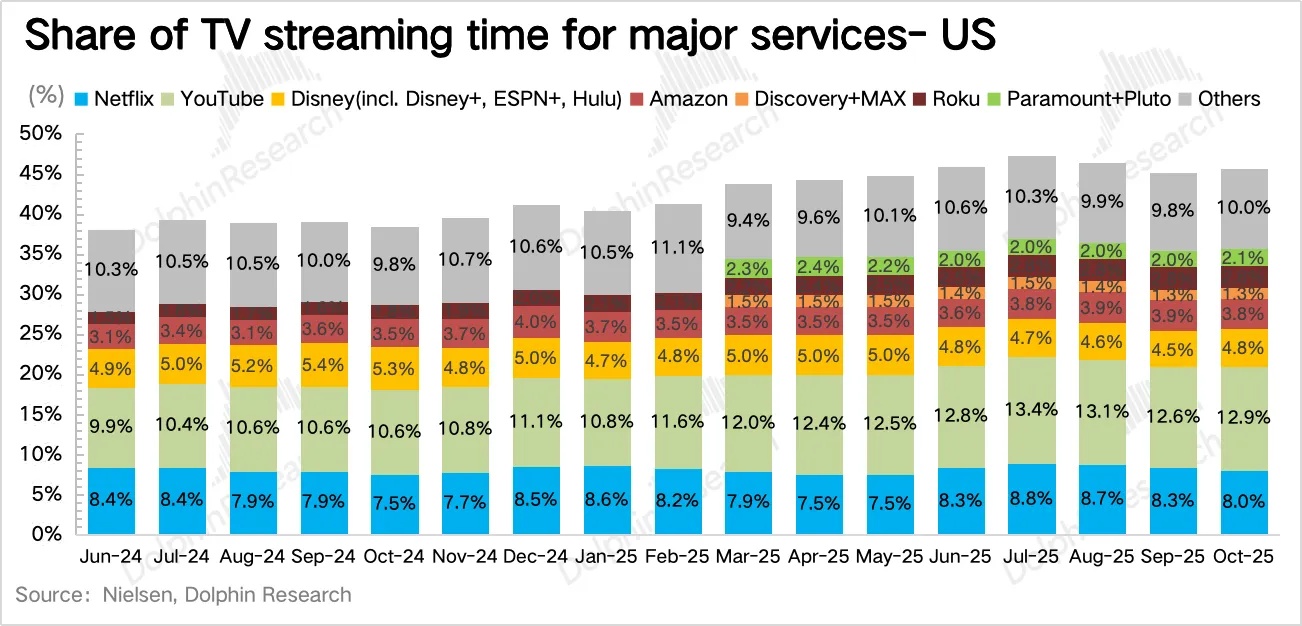
Netflix may argue for a broader market definition by including online video platforms like YouTube, to dilute concentration. On viewing share, Netflix + HBO Max would be roughly ~20% (=9.3%/45.7%), below typical merger red flags.
Choosing Paramount Skydance, which has a better rapport with Trump, might have enjoyed a 'green light'. But WBD still preferred Netflix for its stronger platform and footprint, and because Netflix agreed to a $5.8bn reverse break fee — if the deal fails, Netflix will pay a $5.8bn termination fee.
Beyond user-side antitrust, upstream content producers are likely to push back hard. Consolidation among top distributors weakens their pricing power on licensing.
2) Why did Netflix pivot from its 'be more builders than buyers' stance?
This is likely the market’s top question. In short: growth anxiety is the main driver, tariffs are the catalyst, and post-succession management style is the final push.
(1) Growth anxiety — the rising 'cost' of creating new IP
By year-end, Netflix is at the tail end of the current content cycle. While there have been highlights, only a few S-tier IPs emerged over the past three years, notably Squid Game and Wednesday.Other breakouts were largely sequels to legacy IPs, such as Stranger Things, You, Bridgerton, and Money Heist.
With users above 300mn and rising audience expectations, sustaining ~20% revenue growth and 30%+ profit growth to support a 30–40x PE is getting harder. The password-sharing crackdown was a one-off, and ads still contribute modestly.Fundamentally, growth needs more high-quality content to serve broader tastes, plus more monetization avenues like games, parks, and other IP extensions.
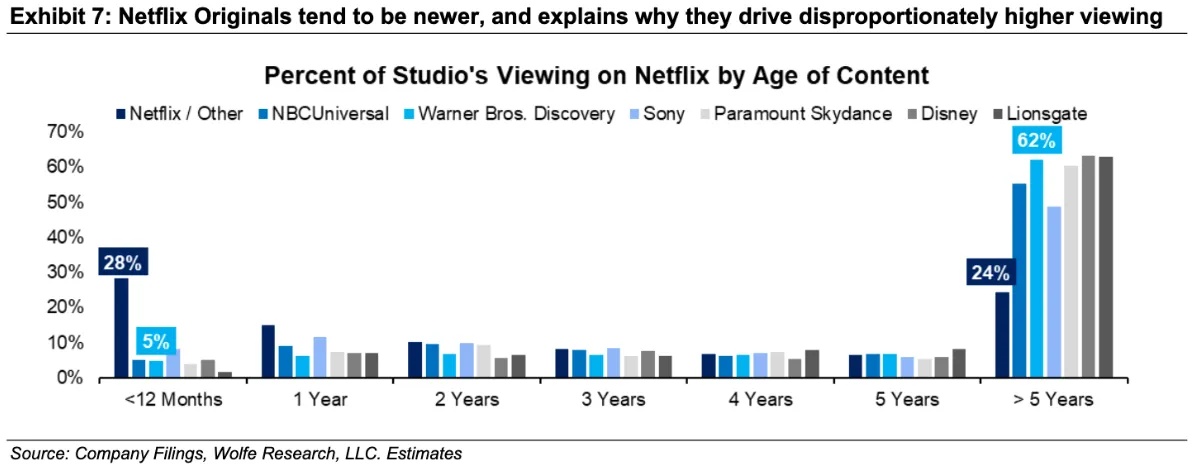
Intl growth is critical, and the success of Squid Game, Money Heist, and Lupin validates the strategy. But Trump's proposed 100% tariff on 'foreign-produced film/TV content' — with roughly 50% of Netflix's originals budget spent outside the U.S. — would constrain that playbook.This pressures content innovation further. Buying external IP licenses does not fully solve the problem, especially since fresh originals are rarely licensed out; most licensed content on Netflix skews to 5+ years old.
From an IP monetization lens, buying ready-made, iconic IPs was less appealing to Netflix in the past, but now looks pragmatic. Irreplaceable, era-defining franchises not only deepen the library but also unlock non-video monetization opportunities.On extensions, WBD has executed well, arguably better than Netflix. For example, PC/console title 'Hogwarts Legacy' surpassed 30mn units sold globally, with a sequel under development.
(2) Management style shift — from cautious idealism to pragmatic realism
Rumors of a WBD bid swirled even before the Q3 print, but most dismissed them, citing the founder’s mantra of 'build, don’t buy'. Over the past five years, M&A waves swept the industry, and management repeatedly showed little enthusiasm.Even on the Q3 call, when asked directly about acquiring WBD, they dodged, reiterating a preference for in-house production and little interest in legacy media.
Perhaps the call was a smokescreen, but the real pivot signal came when founder Reed Hastings sold a sizable block in early Dec. A staunch advocate of self-produced content, Hastings sold 140k shares (~$40mn) on Dec 1 despite holding less than 0.5% — implying no voting roadblock.He also sold another ~$40mn in late Oct during a key negotiation window.
His selling indirectly suggests misalignment with the current direction. The leadership team that took over after Hastings stepped down in 2023 — two co-CEOs, one with Hollywood content roots and one from product/monetization — is more cool-headed and pragmatic than the founder’s idealism.
3) How to assess the deal?
Frankly, this move surprised us. Despite the noise, as of mid-Nov in our Q3 review, Dolphin Research still expected Netflix to hold the line or walk on price.
Investors are split. Leaving approval aside, the $5.8bn reverse fee could be sunk if blocked; if approved, the combined footprint strengthens the moat, but near-term P&L and cash flow headwinds are obvious before synergies kick in.
As noted, user overlap with HBO Max is high, so net-new subs may be limited. Netflix says the deal could save $2–3bn/yr in content costs, likely tied to prior licensing of WBD content.The $59bn bridge will be refinanced with $25bn in bonds, $20bn in delayed-draw term loans, and a $5bn revolver. Assuming a 6–9% rate typical for high-grade bridges, annual interest would exceed $4bn, above the projected content savings, so synergies must do the heavy lifting.
At ~30x 2026E PE (ex-WBD impact), Netflix is near the opportunity zone we previously highlighted at Dolphin Research, but the added uncertainty and near-term cash flow strain are unwelcome for value investors.Overall, until the deal’s fate is clear — and given a likely prolonged regulatory tug-of-war — the stock may face a transition period of pressure.
In the interim, regardless of the final outcome, we may see value investors rotate out while growth investors wait to step in and ride along with Netflix on this $80bn bet.
Risk disclosure and statement for this article: for details, see Dolphin Research disclaimer and general disclosures

Disney
USDIS

Warner Bros. Discovery
USWBD

Netflix
USNFLX

Amazon
USAMZN

AMZN 2X Long ETF
USAMZU

Dutch Bros
USBROS

BROS
SH601339

Paramount Skydance Corporation - CL B
USPSKY

Alphabet - C
USGOOG

Alphabet
USGOOGL

MediaAlpha
USMAX

GOOGL 1X Short ETF
USGGLS

GOOGL 2X Long ETF
USGGLL

Banzai
USPARA

Roku
USROKU

Wells Fargo
USWFC

MNTN
USMNTN

HSBC HOLDINGS
HK00005

HSBC
USHSBC

WELLS FARGO & COMPANY DEP SHS REP 1/1000TH INT PFD SR AA (CLA)
USWFC-A

WELLS FARGO & COMPANY DP SHS REP 1/1000TH INT NCUM PFD CL A CC
USWFC-C

WELLS FARGO & COMPANY DP SHS REP 1/1000TH INT NCUM PFD CL A DD
USWFC-D

WELLS FARGO & COMPANY 7.5% PERP CONV PRF CLS 'A' SERIES 'L'
USWFC-L

WELLS FARGO & COMPANY DEP SHS REP 1/1000 INT PER PFD SER Y A
USWFC-Y

WELLS FARGO & COMPANY 4.75% DEP SHS 1/1000 NCUM PFD CL A SR Z
USWFC-Z

HSBC HK SDR 5to1
SGHSHD
The copyright of this article belongs to the original author/organization.
The views expressed herein are solely those of the author and do not reflect the stance of the platform. The content is intended for investment reference purposes only and shall not be considered as investment advice. Please contact us if you have any questions or suggestions regarding the content services provided by the platform.