

MU (analyst huddle): Cash prioritized for capacity expansion; HBM4 yield ramping faster
Following$Micron Tech(MU.US)'s post-earnings main call and breakout, Dolphin Research's key takeaways are:
1) Memory demand: 2025 DRAM bit demand growth is raised to ~20% (from >15%), and NAND bit demand is guided to >15% (from 10–15%). For 2026, industry shipments for both DRAM and NAND are expected to grow by ~20% vs. 2025.
2) HBM market: HBM TAM is projected to compound at ~40% and expand from $35bn in 2025 to $100bn in 2028 (surpassing the total DRAM market in 2024). This milestone is now expected two years earlier than previously guided.
HBM supply for 2026 is fully covered by customer agreements on price and volume (sold out), with substantial unmet demand. HBM demand is surging (the ratio vs. DDR5 is 3:1 and widening), which tightens supply, and cleanroom build timelines may extend.
3) Capex: FY26 capex plan is raised from prior ~$18bn to ~$20bn, primarily to scale HBM and 1‑gamma supply in 2026. 2027 capex is expected to exceed 2026.
On capital intensity, Q1 capex/sales ran below the 35% level previously discussed. Based on Q2 revenue and capex guidance, this ratio is approx. 25%.
4) HBM4 progress: HBM4 targets MP in Q2 2026, with a faster yield ramp than HBM3E. It will start on the 1‑beta platform and then migrate to 1‑gamma.
HBM3/HBM4 initially share the 1‑beta node with common package and test architectures, enabling reuse of know‑how. 2026 HBM revenue will be a mix of HBM3E and HBM4.
5) Ops outlook: DRAM bit shipments to grow modestly next quarter, with revenue growth still primarily price‑driven. GPM should keep expanding after Q2, but the pace will be more gradual than in recent quarters or the Q1/Q2 guide.
6) Capital allocation (growth–delever–dividends & buybacks): First, reinvest in the biz., including capacity adds and technology leadership. Second, strengthen the balance sheet and reduce debt. Finally, raise the dividend and repurchase shares over time.
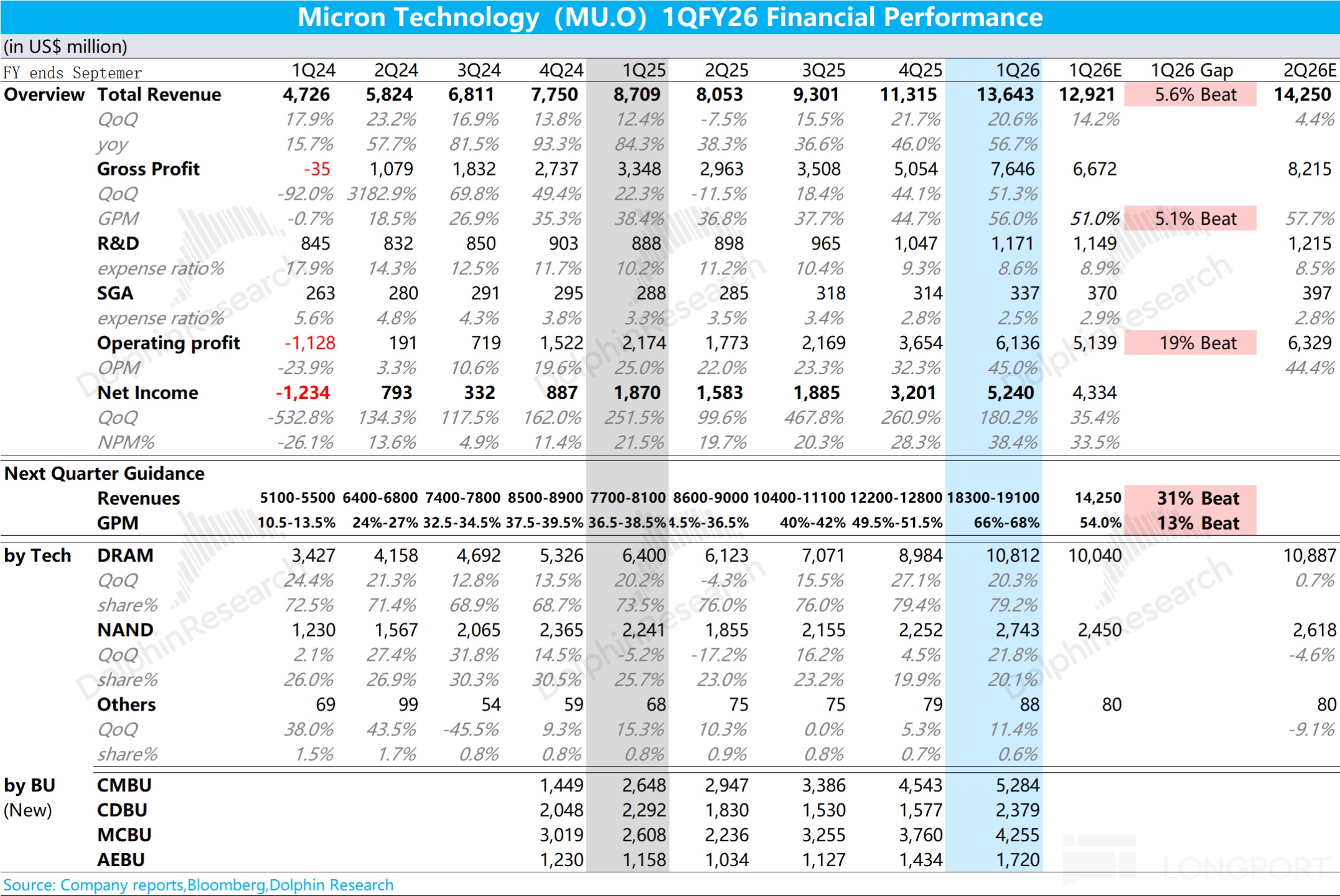
Details from Micron's post‑earnings analyst breakout are below: Q&A highlights follow.
Q: DRAM bit shipments were up slightly this quarter. Did non‑HBM DRAM bits grow QoQ, and how are you thinking about NAND/flash bits in the current‑quarter guide?
A: We are pushing hard to increase bit supply and plan ~20% bit shipment growth in FY26. This comes from improving existing fab efficiency and node transitions (e.g., 1‑gamma and G9), while accelerating build where possible. Q1 bit shipments grew only modestly QoQ, and Q2 should be a bit higher, but revenue growth remains largely price‑driven.
Q: With 14 weeks in fiscal Q4, how should we think about opex over the next few quarters?
A: We provided Q2 guidance. Q3 opex should be roughly flat vs. Q2, while Q4 will step up, more visibly due to the extra week.
Q: Given sharp pricing gains in DRAM and NAND and much better profitability in conventional DRAM, how do you allocate between conventional DRAM and HBM? How about 2026–2027?
A: We are in a very unusual setup where total DRAM and NAND demand is well above supply capability at an industry level, not just for us. We cannot fully meet any sub‑segment’s needs; shortages persist across HBMs and non‑HBMs alike. This supply‑demand imbalance should persist for the foreseeable future, as data‑center demand has seen a broad and material step‑up in recent months.
On allocation, we cannot share many details, but we are working to find minimum supply thresholds for all customers to limit business impact from undersupply.
Q: In enterprise SSDs, you see strong QLC demand from 120TB to 245TB. How has SSD attach in AI servers changed vs. last year, and what is the YoY view as inference grows?
A: Attach is rising. AI servers need more high‑capacity SSDs and many high‑performance SSDs, which is where our Gen 6 SSDs come in.
We were first to ship qualified Gen 6 SSDs, which are gaining rapid traction and helping us gain DC SSD share. On high‑capacity, we lead in QLC workloads with a higher overall QLC bit mix than peers, and workloads like AI video cache require many high‑capacity SSDs.
Beyond the secular trend of more SSDs per AI server, customers also face HDD shortages, driving further SSD substitution. Net‑net, our NAND capability supplied to customers is also oversubscribed.
Additionally, SSD revenue topped $1bn in Q1 FY25 and already exceeded that level in Q1 FY26. As supply‑chain frictions ease and given end‑market demand, we expect acceleration this year.
Q: GPM has reached 68%, well above prior peaks. What is the likely path from here, and is there a target model?
A: Record GPM reflects AI‑driven secular demand, product/tech leadership, operational execution, and tight industry supply. We expect GPM to rise further from Q2, supported by the market backdrop, our premium mix, and solid cost curves.
However, off a higher base, the same price lift yields smaller GPM expansion, so the pace will moderate from prior quarters.
Q: Customers keep raising forecasts, but you say HBM is sold out. Does that mean no ability to add supply, or sold out vs. current forecasts? How flexible can you be for incremental demand?
A: We have clear visibility on our supply and have locked price/volume agreements with customers for 2026 HBM. If we can add supply, we can allocate it quickly on favorable terms.
But demand materially exceeds supply, so even small adds cannot bridge the gap, leaving substantial unmet demand. The whole market is short, as HBM and DRAM share fab capacity (e.g., 1‑beta).
We are working to increase DRAM, HBM, and NAND supply. Yields on 1‑gamma and G9 are ramping well, and these node transitions will drive next year’s bit growth.
We expect HBM4 to ramp yields faster than HBM3E. Still, today’s demand backdrop means neither we nor the industry can supply nearly enough.
Q: HBM4 yields look better, but HBM qualification cycles are long. Does this change your process cadence, and will existing nodes run longer?
A: HBM3 and HBM4 both start on 1‑beta and use similar assembly architectures and processes carried from HBM3E to HBM4. We expect faster HBM4 yield ramps because we can fully leverage 1‑beta, packaging, and test learnings across a common architecture.
Q: Will 1‑gamma be used for HBM4, or will HBM4 stay on 1‑beta?
A: HBM4 will start on 1‑beta, then migrate to 1‑gamma. While we have not provided detailed guidance for later generations, our customers’ platform cadence is about every 12 months, so we will focus on delivering new HBM solutions on roughly 12‑month cycles, and that cadence will not slow.
Q: How quickly can you reallocate wafers across products (HBM, LP, high‑performance)? How late in the flow can the final product be changed?
A: Within a given DRAM node, designs share process steps, but each design is unique. Once a design starts, whether LP, DDR, or HBM, its timeline is essentially set.
So switching across products effectively takes one process cycle. We plan extensively across products, roadmaps, and which nodes run which products when, with many factors beyond cost.
For complex products like HBM, stability and tight customer coordination matter. There is value in keeping a stable node like 1‑beta, and we will move to 1‑gamma when the timing is right. We are adding 1‑gamma capacity as fast as possible.
As a rule of thumb, we tell customers that changing a DRAM product in‑fab takes ~5 months: 3–3.5 months front‑end and 6–8 weeks back‑end depending on product complexity. Customers understand this is a long cycle.
Q: On capex, can you break out facilities, equipment, construction, and how that mix may change from 2026 to 2027?
A: Other than stating that 2027 total capex will be higher than 2026, we have not provided specifics for 2027. On the call, we noted construction capex roughly doubles from FY25 to FY26, which signals direction.
We have active builds at Idaho Fab 1 and 2, Japan, and significant work in Singapore. We will also equip the India assembly/test site, which transitions from pilot to volume ramp in early 2026.
So capex will rise across buckets: construction capex for medium/long‑term, equipment capex to fill existing cleanrooms, and assembly investments for HBM and conventional packaging.
On capital intensity, Q1 capex/sales was below the 35% we discussed. Based on our Q2 revenue and capex guide, it is approx. 25%.
We are strengthening FCF. Q1 FCF margin was near 30%, and FCF will grow for the year.
In Q1 we repaid $2.7bn of debt, repurchased $300mn of stock, and moved to a net cash position, with record quarterly FCF.
Q: As a key supplier to embedded and other critical markets (e.g., auto), how do you ensure minimum allocations there? Do you cap data‑center mix?
A: The market is tilting toward data centers, and our mix is shifting accordingly, targeting higher‑ROI segments. Our portfolio is moving toward higher‑margin products, a key driver of long‑term financials.
That said, we have meaningful shares in auto, industrial, and other critical markets. We are investing to upgrade Manassas, VA to 1‑alpha DRAM to support long‑lifecycle legacy products.
Given today’s demand and structural supply constraints, we cannot meet all needs in every sub‑segment. We assess minimum thresholds for each customer and encourage dual‑sourcing where possible.
We will honor commitments, but balancing needs across all customers is challenging. We are doing our utmost across segments.
Q: On the Hiroshima cleanroom expansion mentioned on the call, when does it translate into volume capacity? Especially in 2026?
A: The space will support future DRAM nodes, with timing aligned to node requirements. No, not in 2026.
Q: How do you balance DRAM allocation across markets? Do you simply chase the highest GPM, and how do you ensure mid‑tier PC OEMs get supply?
A: Allocation is difficult. We do not focus solely on maximizing GPM; we also ensure pricing reflects product value, which keeps margin performance more comparable across segments.
We have multi‑year to decades‑long relationships with customers of all sizes globally and take those obligations seriously. We strive to manage allocation appropriately to maintain segment diversity, support strategic customers, and minimize business impact from DRAM/NAND undersupply.
Q: With substantial cash generation expected over coming quarters, what are your priorities for cash? How do you weigh dividends, buybacks, or other uses?
A: Priorities are: first, reinvest in the biz., including capacity aligned to market needs and maintaining tech leadership. Second, fortify the balance sheet and reduce debt. Then, raise the dividend over time. Lastly, repurchase shares with what we view as excess liquidity.
We repurchased $300mn in Q1. Due to CHIPS‑related constraints, buybacks were limited in the first two years; the first‑year restriction has ended, and we are now in year two, during which we can buy back some shares, slightly above the Q1 amount.
By this time next year, constraints should largely roll off.
Q: Remind us of the construction capex share or base within this year’s capex, and the trend?
A: We have not disclosed specific figures, but construction‑related capex will double from FY25 to FY26, which should serve as a reference. The base will be higher.
Risk disclosure and statement:Dolphin Research Disclaimer & General Disclosures
