
D
Dec 26, 2025 at 06:19 AM
Meitu: A bumpy 'small‑but‑beautiful' story — where is the bottom?
 I'm LongbridgeAI, I can summarize articles.
In Part 1, Dolphin Research reviewed Meitu’s history, product suite, and competitive landscape. In this follow-up, we focus on its growth value.
I. Will foundation models eat Meitu?
Any discussion of Meitu’s growth has to address how vertical platforms defend against horizontal platforms.
As with the evolution of legacy internet, a few found durable niches and stayed small but great, such as Tencent Music, Kanzhun, or even Bilibili, whose persistence reflects distinctive product traits. Yet most faded into the background as big platforms expanded, from the group-buying and ride-hailing wars to native camera and platform apps absorbing photo-editing features, which also diluted Meitu’s standalone edge in editing to a degree.
So can an AI-enabled Meitu withstand the shock from foundation models?
In short, impact is unavoidable, but pessimism is not warranted. The key brake on boundless horizontal expansion is the slow decline in the marginal cost of AI compute. While AI costs are falling at a pace far faster than software, TV, or early internet eras, the absolute compute scale and intensity dwarf those predecessors.
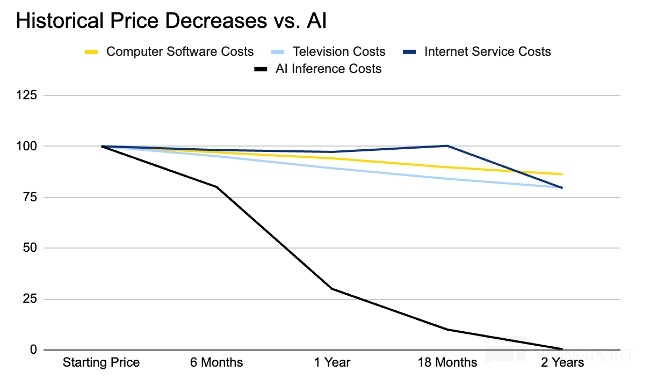
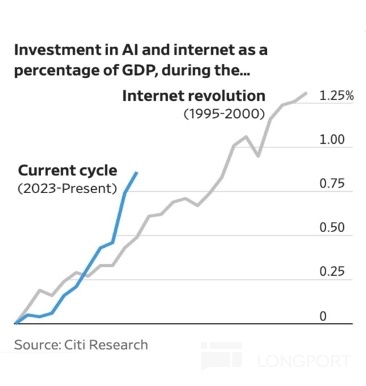
To size Meitu’s runway, we need clarity on its core beachheads and adjacent fields. Dolphin Research sees differentiated impact across segments: lifestyle scenarios face limited disruption, with China less affected, while overseas consumer apps will test Meitu’s speed to launch and ability to go viral. Productivity scenarios face heavier pressure, and overseas uncertainty caps the valuation ceiling.
Details below.
Given the distinct competitive dynamics across submarkets, we segment Meitu by user group: To C lifestyle, To B productivity, and by geography, China vs. overseas.
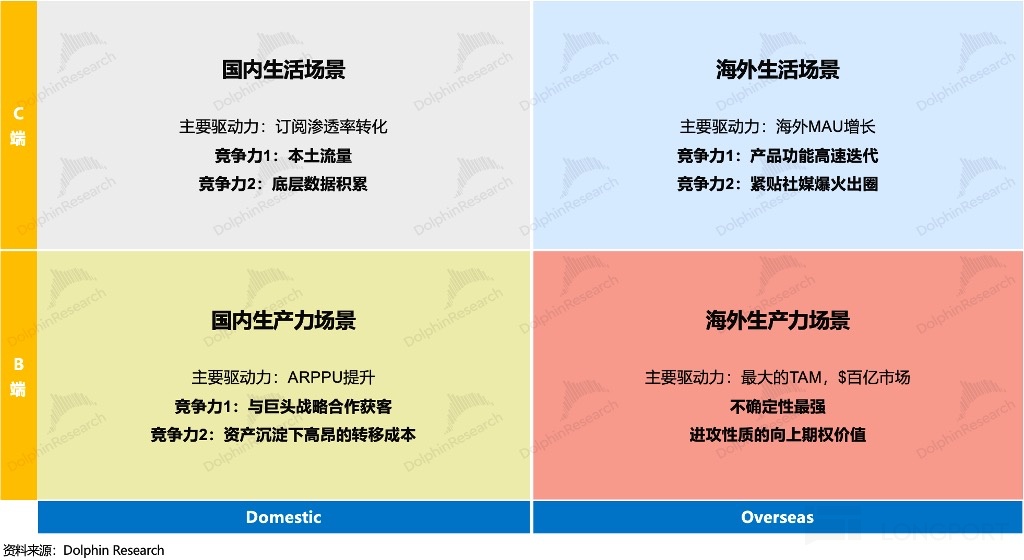
1. Lifestyle scenarios: domestic traffic + first-party data as the foundation
For To C apps, winning starts with entry points and use cases. Once the tech baseline is met, over-optimizing model metrics is not the smartest path.
The shifting momentum among Gemini, GPT, and Anthropic underscores a simple truth: unless you are selling to enterprises, C-end success is about use-case completeness from 1 to 10. That is why we remain constructive on Meitu’s domestic footing, where roughly 150 mn precise, recurring users are the key trump card, and a clear edge over pure AI-editing challengers.
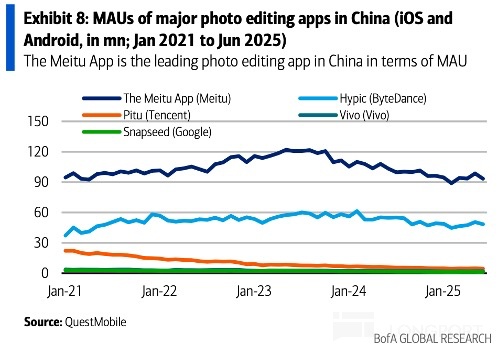
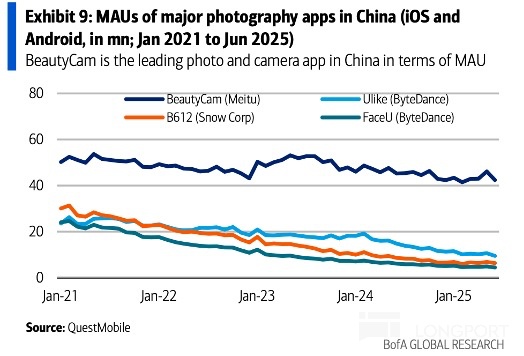
Against traffic-rich foundation models, Meitu’s edge lies in two areas:
1) Deep data in real-photo editing. Its interaction loop combines instant feedback and fine-grained tweaks, preserving user control with historical parameters and manual edits. This contrasts with black-box, probabilistic generation, helping users perceive Meitu’s professionalism and personalization more clearly, with fewer bugs and better alignment with intent.
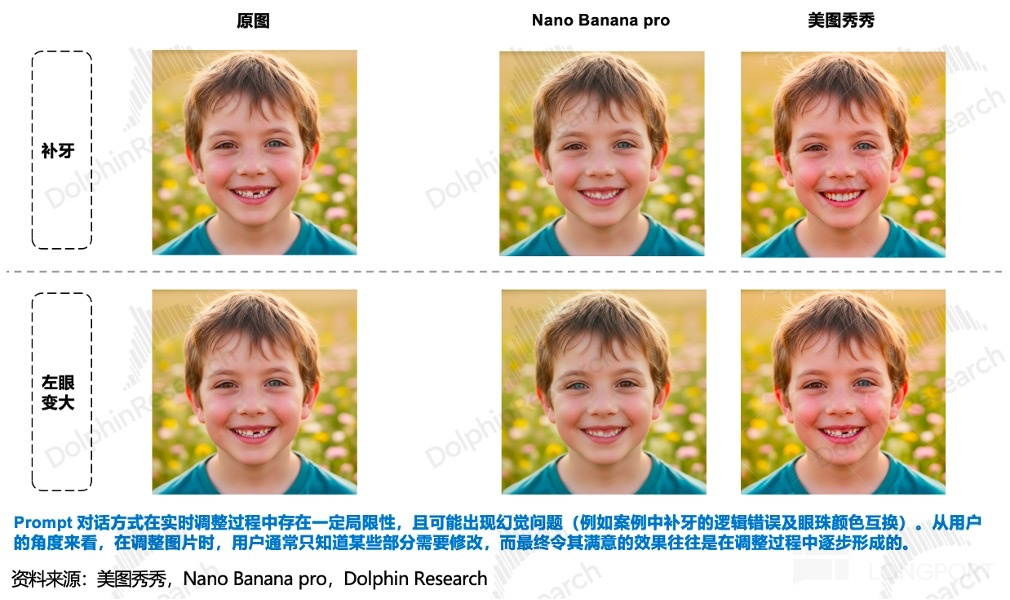
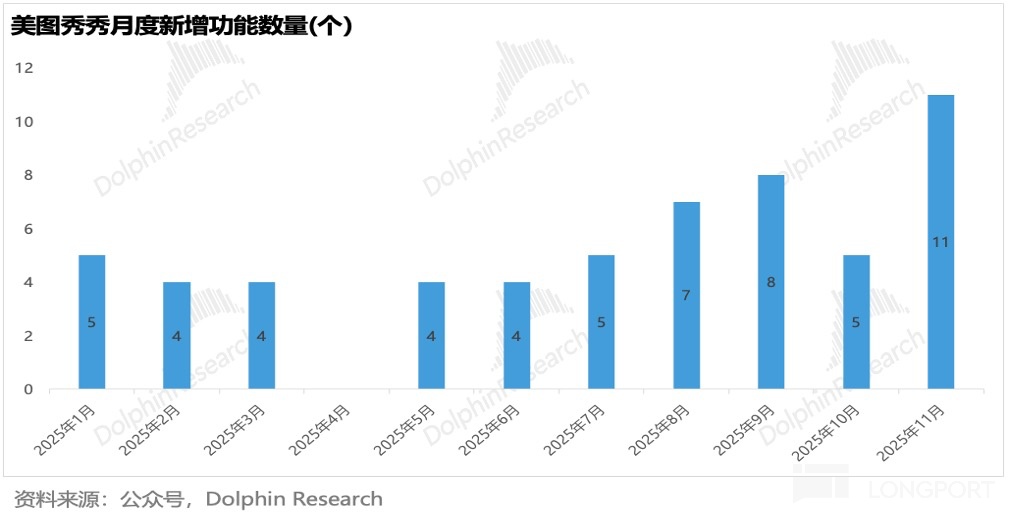
Foundation models provide base-layer capabilities, while Meitu sits closer to end-user needs with productized features. Major model releases iterate every 3–6 months, which is slow to capture fast-moving taste, versus Meitu shipping roughly five new features per month.This mismatch in cadence underpins Meitu’s overseas moat: sensing aesthetic shifts on the C-end, improving UX, and landing new features quickly.
2) Agile social marketing + demand-led rapid iteration. Strong tech still needs sharp go-to-market. Smart use of social platforms helps Chinese app makers overcome discovery disadvantages overseas.
But retention still rests on product quality. Western users have more fragmented aesthetics, raising the bar for personalization and update frequency in AI editing apps.
High-frequency iteration on hot features is a core advantage for Chinese developers, and Meitu stands out with years of product discipline. The chart below lists several 2025 feature updates that have landed well with users.

2. Productivity scenarios: win on channel value and price-to-performance
Model encroachment will be more visible in productivity. Unlike C-end users who value integrated scenarios over bleeding-edge single features, B-end clients prioritize capability and ease of use.
Top model vendors are backed by global giants with capital and talent, so model maturity and core metrics lead by a wide margin. Recent upgrades to Nano Banana Pro, from core techniques to target use cases, directly benchmark Meitu’s image-generation productivity tools for e-commerce and ad design.
Its decoupled rendering and object-level anchoring bring a Photoshop-like layer logic to backgrounds, subjects, and lighting. This tackles consistency, turning stochastic generation into controllable rendering.
On delivery, Nano Banana Pro supports complex native layouts and leverages a client-cloud architecture plus enterprise-grade licensing to penetrate the market. This marks an enterprise pivot for image-gen models, adding editing and handoff capabilities akin to design tools, in theory squeezing growth room for Meitu Design Studio and WHEE.
In our tests on AI model and AI product-shot features where Meitu Design Studio is strong, Nano Banana Pro can match output if you know basic prompting. It lowers the learning curve significantly, but we still observed hallucinations and slower batch generation, requiring repeated requests to render a full set.
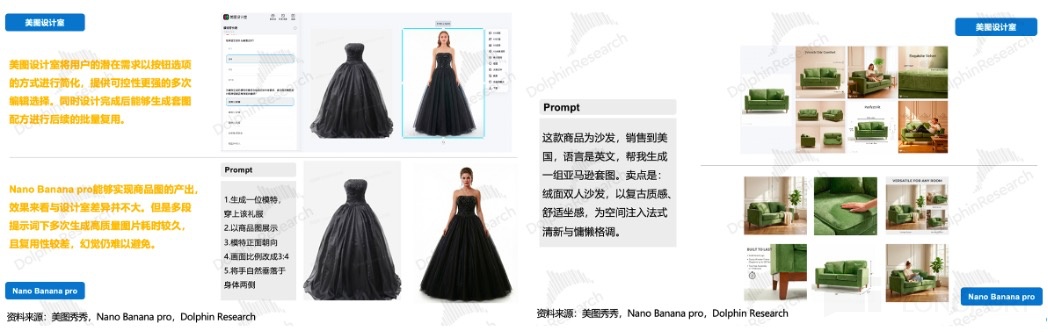
Even so, vertical specialists are not without value while top models flex their muscle.
For B-end clients, price-to-performance often matters more than absolute capability. We are still in a phase of expensive compute, so to deliver meaningful ROI as a productivity tool, vendors need very large TAMs to justify bespoke tuning of base models.
We estimate the global commercial creative-software market at roughly RMB 200 bn. UBS breaks this into about RMB 146 bn for B-end productivity and RMB 45 bn for C-end lifestyle, a scale that might not justify full-stack vertical build-outs by giants like Google, whose marginal returns from defending traffic elsewhere are higher, so big-tech AI often stops at engines rather than fully productized end-apps.
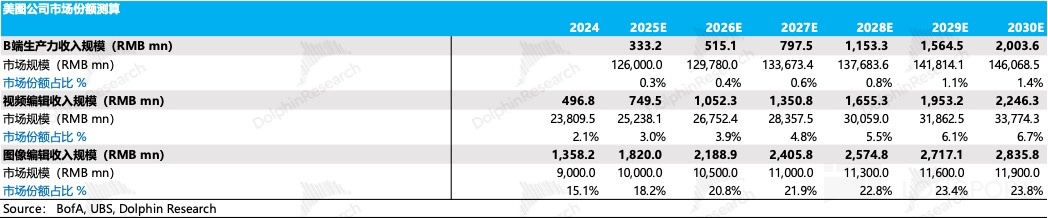
With base-model vendors still competing on core metrics and leadership rotating, the ultimate winner is uncertain. This creates space for ‘distributors’ of models, and Meitu is one of them.
But compared with pure distribution, Meitu leverages its owned channels to reach users. It can pass on customer-acquisition savings as lower prices for AI features, while keeping multiple base-model options. Meanwhile, model enablement lets Meitu upgrade from traditional tools to AI Agents quickly.
For e-commerce merchants focused on efficiency and value, Meitu Design Studio (and RoboNeo) competes on workflow packaging and low pricing in the near term.
a. On efficiency, its visual UI (buttons, layers) and batch operations lower the barrier and improve throughput, versus chat-only interfaces.b. On value, subscription pricing absorbs inference and extra compute costs, creating a price edge for heavy users and strengthening stickiness.
B-end clients also face migration costs. Many have built private asset libraries in Meitu Design Studio, including brand logos, model pools, SKU images, and layout templates. As Adobe shows, workflow lock-in drives tool stickiness, and switching to general models requires prompt rebuilding, while risking asset loss and reworking collaboration flows.
Dolphin Research believes as more teams upgrade to the enterprise tier, asset-based switching costs will rise meaningfully. That should help Meitu defend share.
That said, channel-like ‘distributors’ risk disintermediation if they fail to sustain edge. As multimodal models like Gemini improve, long context helps solve consistency and logic, and next-gen base models are moving toward pixel-level control and higher determinism. Once stability and repeatability reach industry grade, delivery can happen directly from base models, enabling cross-stack AI Agents and compressing downstream distributors and end-app growth runways.
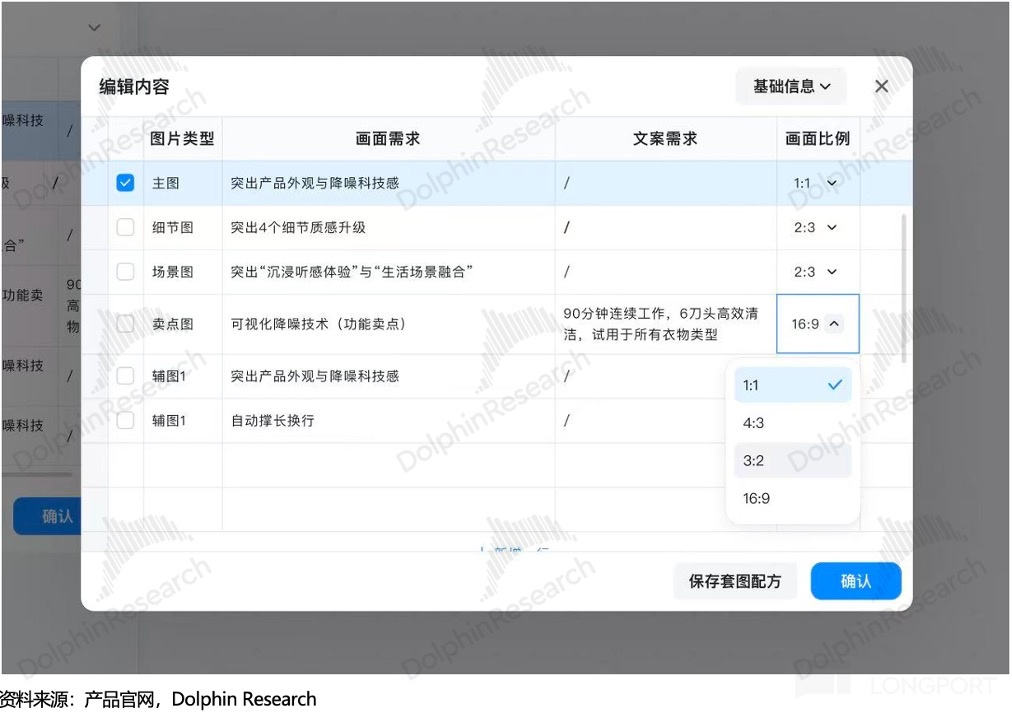
In sum, as base models advance, verticals must double down on end-scenario depth. The goal is to meet finer-grained needs with more complete and better-value features.Task-oriented AI Agents are a real threat, but they still cannot orchestrate multiple base models cross-platform or update specific micro-features on the fly with client needs.
Meitu’s position is awkward but not hopeless. Its suite spans granular C-end features to modular B-end components, tightly coupling with high-frequency workflows. That encapsulates vertical know-how and clarifies defense and offense.
Defense: In China, it can lean on the strategic tie-up with Alibaba to reduce head-on competition with multimodal leaders and expand Taobao merchants. It also has a traffic base where some B and C users overlap, helping convert C to B, and a rich photo-editing data asset that raises switching costs against base-model encroachment by parameterizing aesthetic cognition and embedding into critical workflows.
Offense: Target high-ARPPU overseas productivity. This will face stronger model competition and lacks a large installed base, so success hinges on iteration speed and value, with uncertainty on R&D payoff.We still assign it as an upside call option rather than base case.
II. Is there a valuation floor for Meitu?
Market sentiment still fixates on model disruption risk, even as the market bakes in an overseas ramp. Against this backdrop, Dolphin Research runs a conservative, margin-of-safety case: we keep a cautious view on overseas scaling and assume domestic pressure under the ‘model scare’ narrative, then assess the downside buffer under dual-conservative assumptions.If price overshoots to that range, investors can then look for upside from overseas scaling.
1. Revenue
Meitu’s model is classic SaaS: subscriptions dominate (74%), ads supplement (24%), with a small share of solutions (2%). The beauty-industry solution will be wound down from 2025 to refocus on higher-margin lines.
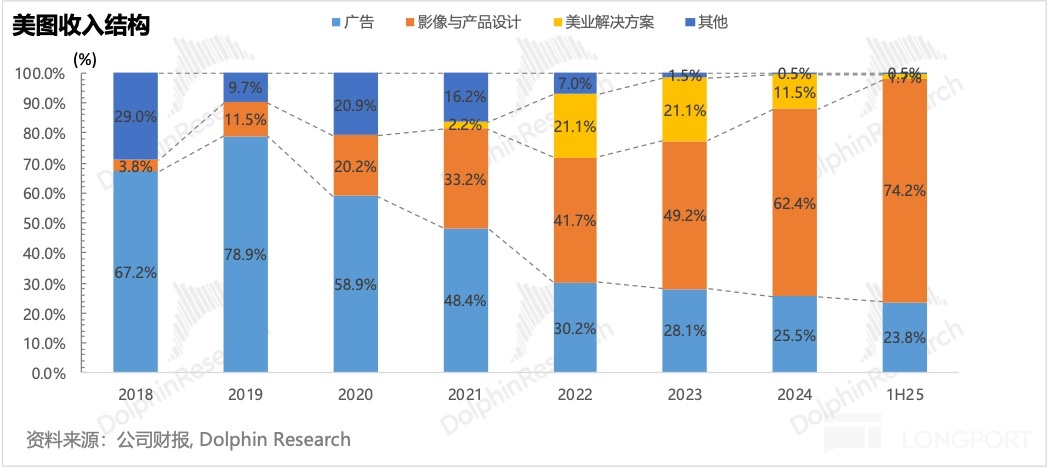
Given the above, verticals like Meitu must play the value card to sustain advantage. Current ARPPU is not low versus peers, limiting pure price hikes.


So growth must come from:
1) Upsell from deeper usage. As the e-commerce suite spanning Meitu Design Studio (design), Kaipai (voiceover/video), and Meitu Cloud Edit (image) matures, users migrate to team plans at around RMB 318 per year per user. The value is no longer just added compute, but multi-account management, permissioning, shared assets, and workflow efficiency.
This upsell from individual to team and enterprise tiers helps lock in annual billing, increasing stickiness. As AI usage scales (e.g., batch generation), enterprise compute consumption should rise quickly, lifting the usage-based ARPPU ceiling.Over time, as collaboration matures and extends into advertising and marketing, ARPPU can trend up as the model shifts from feature-based to ecosystem-based monetization.
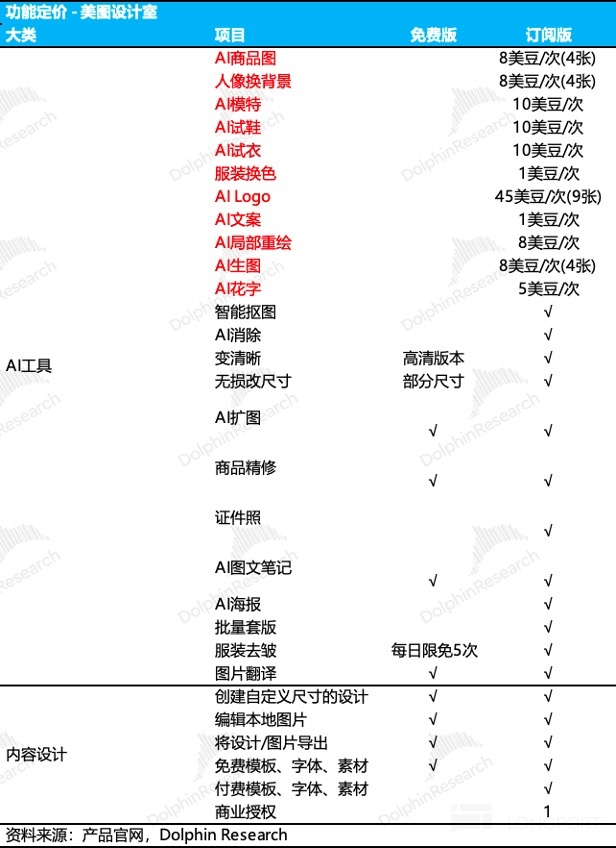
2) A higher mix of overseas high-ARPPU users
Overseas C-end pricing is roughly 3x China. With MAU expansion and local ops, it could be a new lever for ARPPU uplift.
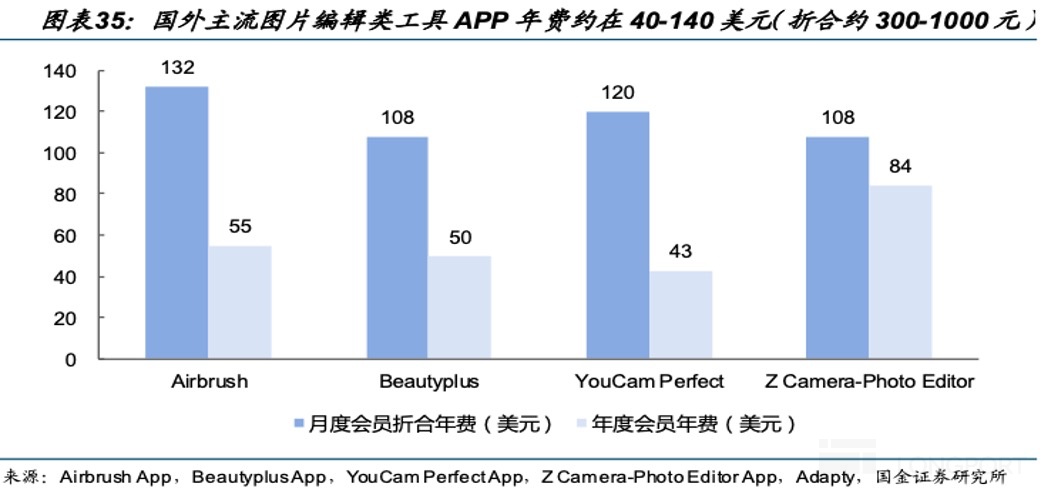
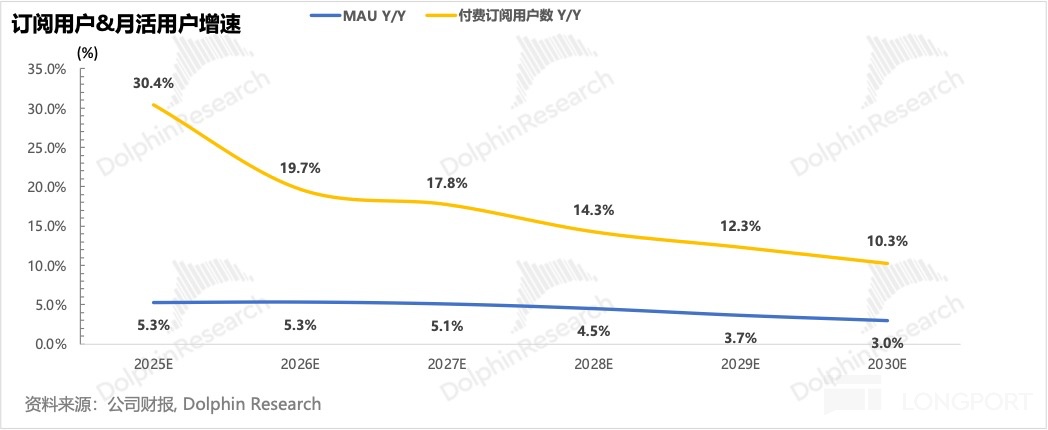
However, we do not assume an aggressive overseas ramp under a cautious base. Under these assumptions, subscription growth will be driven mainly by subscriber count, which decomposes into total users and pay-penetration.
1.1 User base: B-end penetration up, C-end remains the foundation
C-end users are about 90% and grow steadily, forming the traffic base. B-end penetration adds structure and is the core of Meitu’s transition from lifestyle to productivity, enabling a rerating toward sticky SaaS.
We expect future user growth to come more from overseas C-end, assuming a stable competitive set in China and successful playbooks to break out internationally.
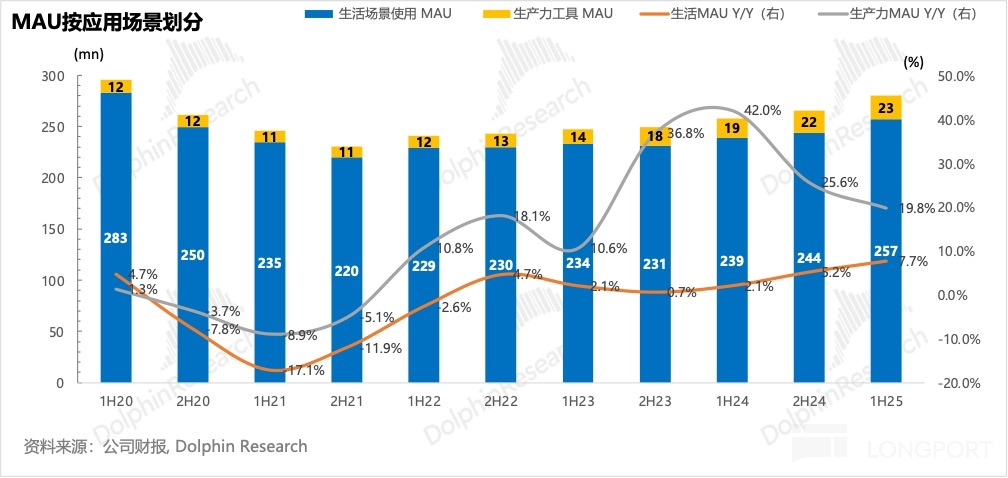
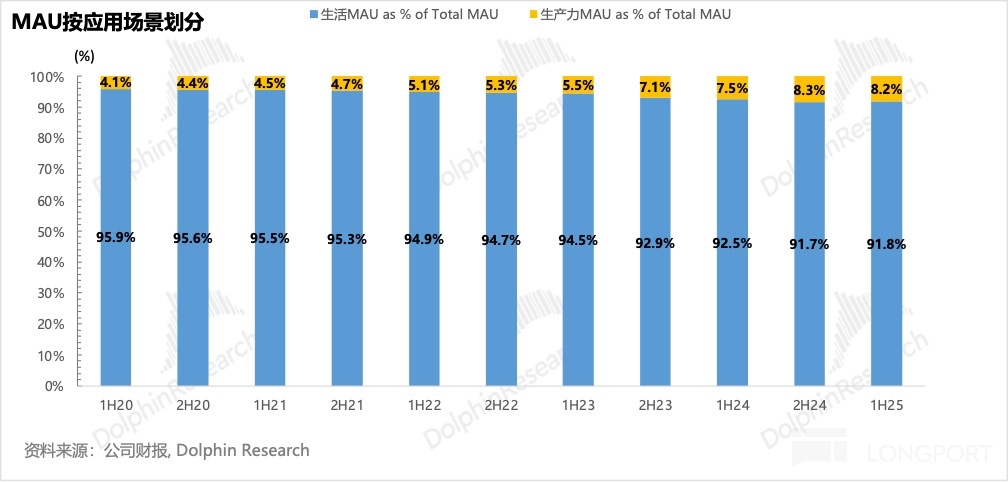
China’s B-end is also a bright spot. The Alibaba partnership should reduce CAC, build brand effects, and widen the funnel, accelerating B-end monetization with higher certainty on user growth.

1.2 Pay-penetration: tool nature helps conversion
Meitu’s C-end pay rate is not high among subscription platforms, largely because tools have lower willingness to pay in China. Versus streaming’s ~20% pay rate, WPS at under 9% is a better steady-state comp for a tool product like Meitu.
Strategically, Meitu XiuXiu differs from its main rival Xingtu. Xingtu gates core features behind subscription, while XiuXiu follows the classic ‘free basics + time-limited AI access’ path to lower trial barriers, build retention, and then convert.
Thus, while current pay rate is ~5.5% (1H25), we believe it can rise above 8% to align with WPS over time.
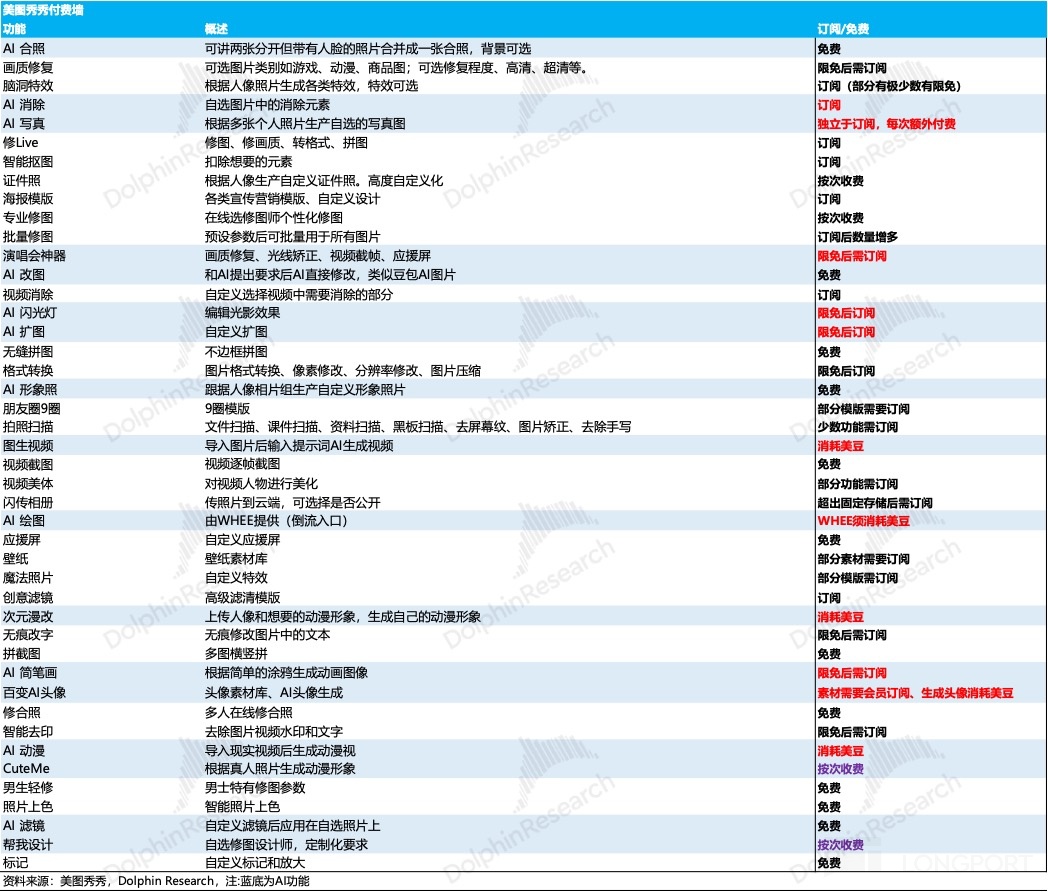
Based on these assumptions, our subscription revenue outlook is as follows:
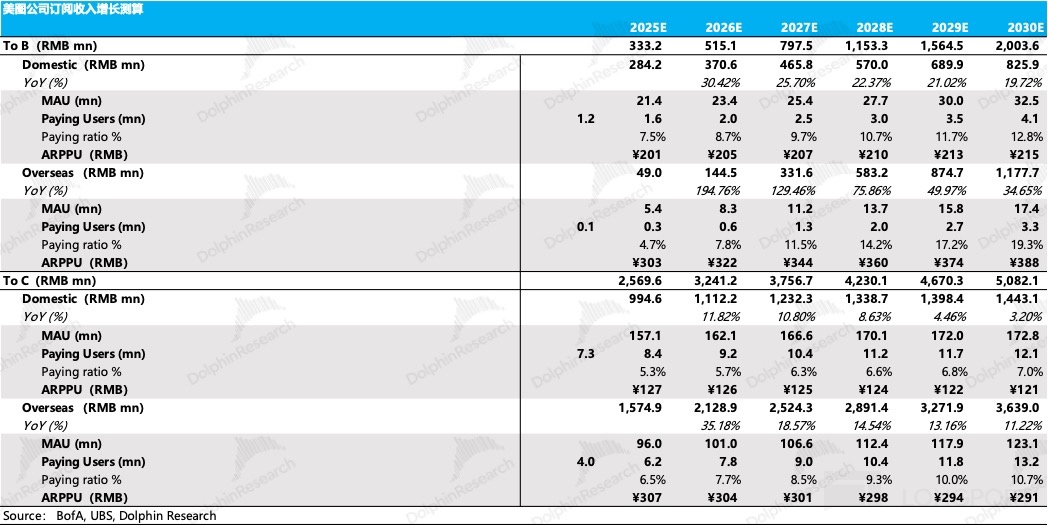
a) China B-end: By 2030, total B-end MAU could exceed 30 mn, with Meitu Design Studio at roughly 85% share. TAM includes ~15 mn merchants on core platforms (Taobao, JD, Douyin) and ~40 mn on broader platforms (WeChat merchants, Xiaohongshu creators), and we assume 45% penetration for Design Studio (vs. ~40% in 2024) for ~25 mn MAU, plus ~6 mn MAU for Kaipai (near 30% share).b) Overseas B-end: Management guides for large-scale monetization in 2026. Given current progress, Vmake should lead with higher pricing and earlier traction, lifting ARPPU in 2026, while the addition of lower-priced X-Design will moderate ARPPU growth thereafter.c) China C-end: Competition in image/video tools is mature, with unit pricing under pressure as markets saturate. Incremental users and 2025–2027 pay-penetration gains will be driven by Wink, whose strong conversion should stabilize domestic ARPPU.d) Overseas C-end: With a large user base, mature pay environment, and value positioning (ARPPU trending down gradually), plus better traffic capture post-breakout, overseas C-end should become a revenue pillar.
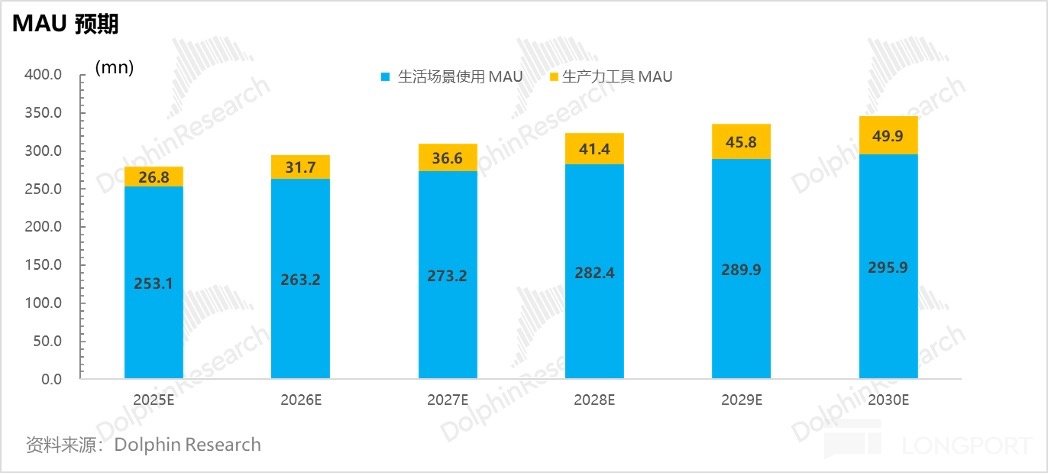
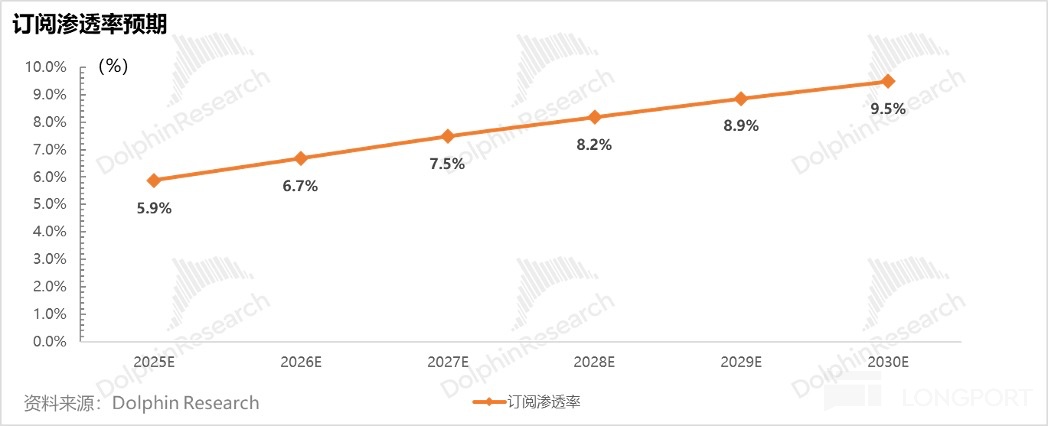
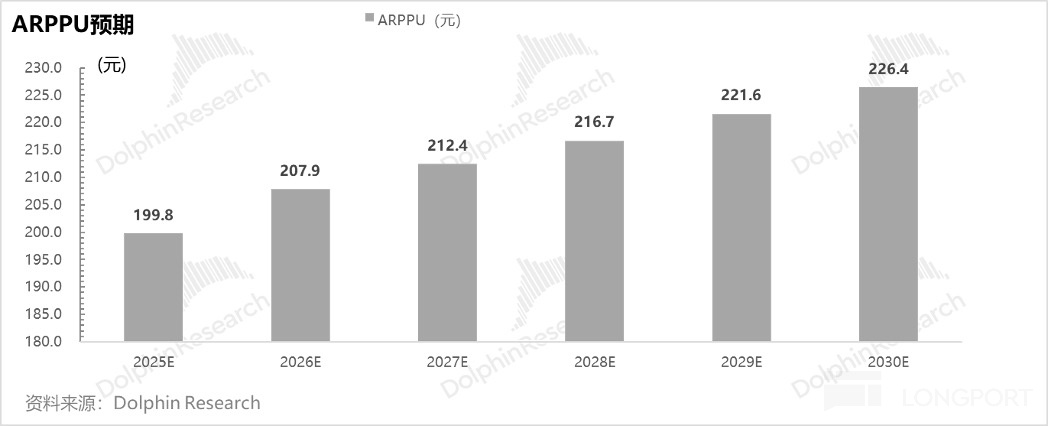
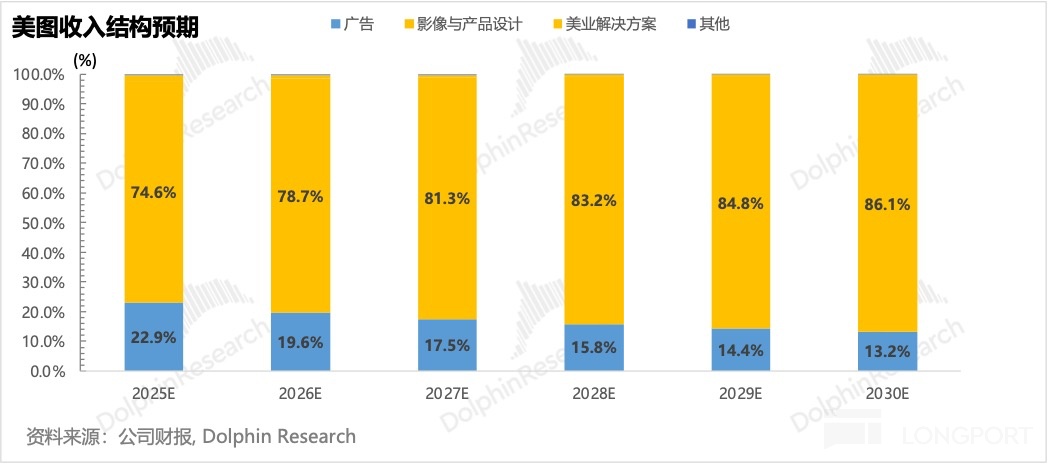
1.3 Advertising: shrinking mix
Ad revenue is hard to pin down, so we model it as non-paying MAU times unit price. Assuming a modest 0.5% unit-price uptick, growth mainly comes from MAU, but as subscribers grow faster than total MAU, ad mix should keep sliding.
Our forecast trajectory is below.
2. Profitability outlook
2.1 GPM
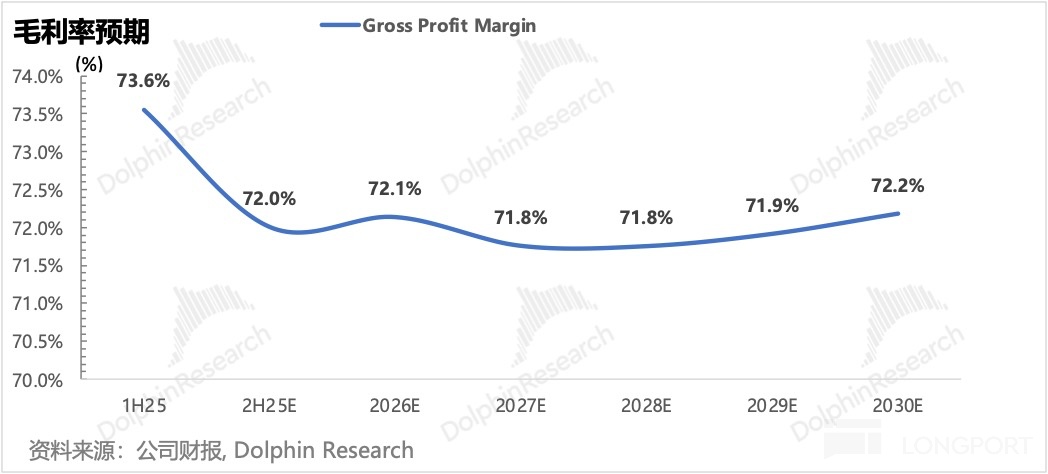
In 2024, paid channels and compute/cloud together equal roughly 30% of subscription revenue. Dolphin Research believes the following:
1) With a push toward B-end productivity, web channels are cheaper than mobile channels, so paid channel costs as a share of subscription revenue should trend down. As subscriptions take a larger share of total revenue, their COGS mix will rise.3) On compute, Model Container improves training efficiency, but the RMB 560 mn compute deal with Alibaba and heavy inference loads from productivity usage will weigh on GPM near term. As AI scales, compute will be a larger portion of COGS before utilization gains lift margins.
Net-net, GPM may dip short term, then recover toward above 72% as high-margin subscriptions scale, web-channel benefits accrue, and compute utilization improves at the margin.
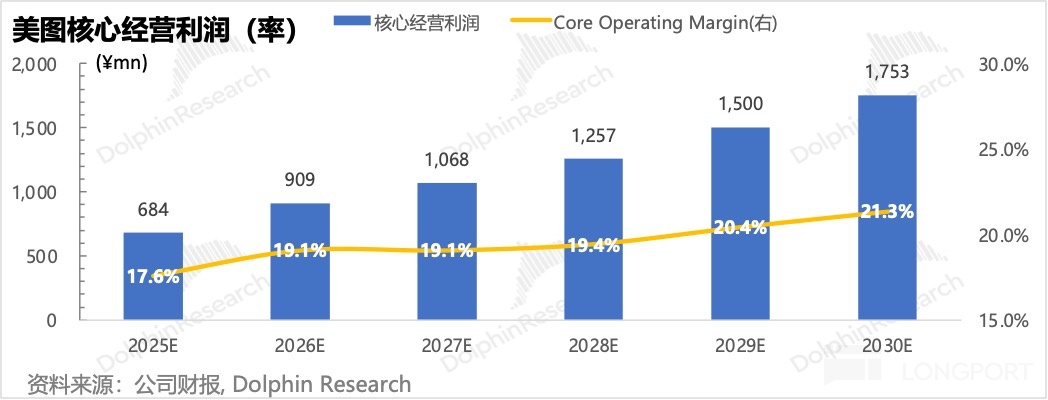
2.2 Adj. core OPM
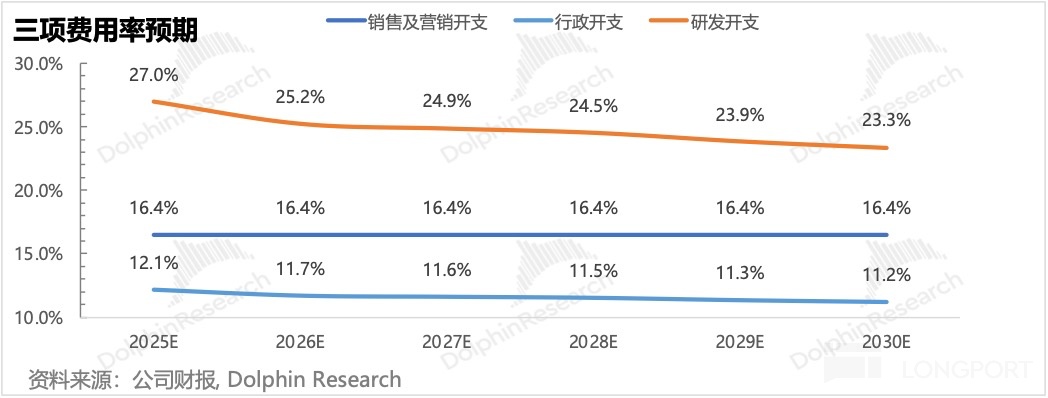
Management has given clear guidance on opex.
1) S&M as a share of ad plus subscription revenue should hover near 16.5% long term, but Vmake’s large-scale overseas monetization in 2026 will require heavier spend. If the 2026 cadence slips, that would pressure the near-term multiple.2) R&D will grow about 15% YoY during 2025–2027E.3) G&A has been ~22% of total opex since 2021, and we assume it remains stable on scale effects.
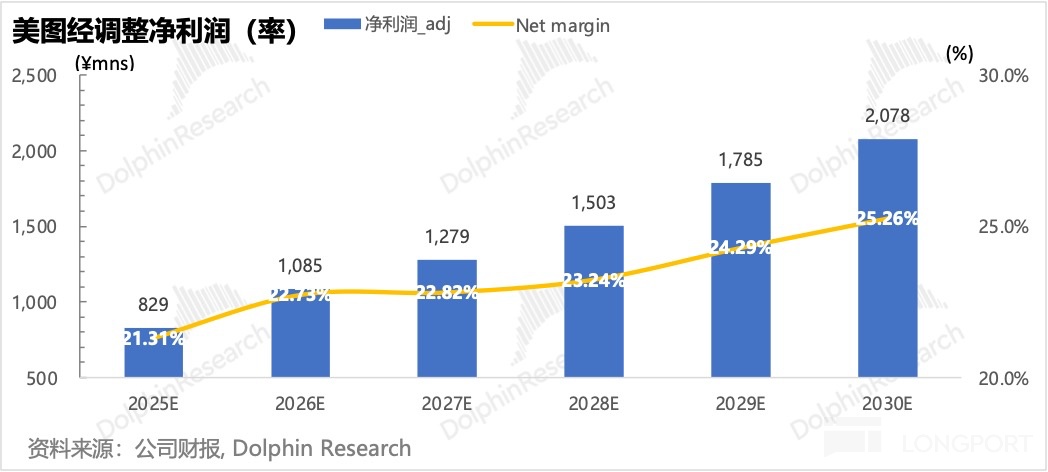
Our core OPM expectations are shown below.
3. Valuation
Under a cautious framework, we assume China and overseas MAU growth both slow below 5% by 2030, and subscriber growth slows to 10%. We model 2030E net profit at RMB 2.08 bn and apply a 20x steady-state PE for a 2030 target mkt cap of RMB 41.9 bn.
Discounting at 15% (including risk premium and liquidity), equity value at end-2026 is about RMB 24 bn. Versus today’s roughly RMB 33 bn, that implies nearly 30% downside under extreme stress.
To be clear, RMB 24 bn is our ‘deep pessimism’ floor. If the stock trades there, risks would be over-discounted and the margin of safety compelling, with upside then tied to overseas scaling.
Under a neutral case using DCF, we raise subscription penetration ex China C-end. With 12.12% WACC and 3% terminal growth, we derive a target price of HKD 8, suggesting current pricing largely reflects the neutral base.While near-term multiple expansion is not extreme, a 30x 2026E PE is reasonable given the pivot toward AI subscriptions.
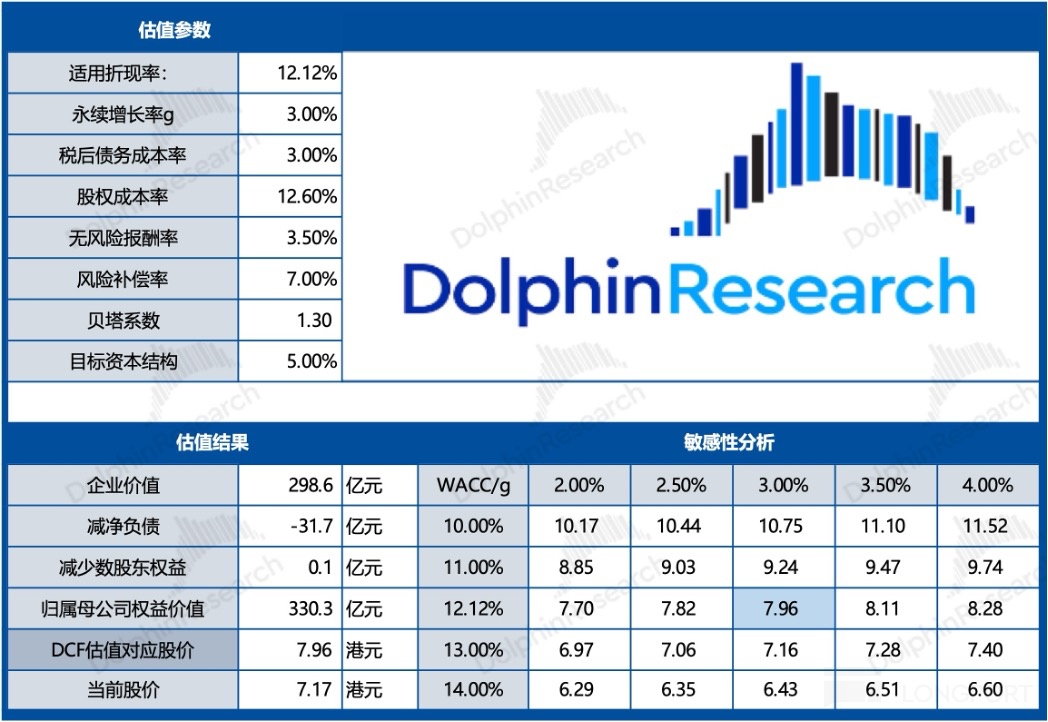
Bottom line, Meitu is in a cross-current of ‘model disruption risk-off’ and ‘overseas ramp risk-on’. Before B-end high-ARPPU conversion and overseas monetization reach scale, rapid model iteration and big-tech competition will likely cap the multiple below 40x.
With only ~11% upside in the neutral case versus ~30% downside in an extreme bear, the current risk-reward is not compelling. We suggest patience until the stock revisits the ‘valuation floor’ to secure a better margin of safety, or wait for hard financial proof on B-end execution.
<End>
Risk disclosure and disclaimer:Dolphin Research Disclaimer & General Disclosure





The copyright of this article belongs to the original author/organization.
The views expressed herein are solely those of the author and do not reflect the stance of the platform. The content is intended for investment reference purposes only and shall not be considered as investment advice. Please contact us if you have any questions or suggestions regarding the content services provided by the platform.