
D
Dec 31, 2025 at 02:48 AM
Sanhua Intelligent Controls: Low-profile biz., how does it keep catching every tailwind?
 I'm LongbridgeAI, I can summarize articles.
Sanhua Intelligent Controls: A Low-Profile Biz. That Keeps Catching the Next Big Wave
Investors tracking the humanoid robot supply chain cannot ignore $SANHUA(02050.HK). As $Tesla(TSLA.US) moves Optimus closer to mass production, Sanhua, a core Tier One supplier to Tesla, is increasingly tied to its humanoid robot program.
From a share-price perspective, Sanhua has seen multiple upward re-ratings as collaboration with Tesla and other leading OEMs deepened across NEVs and humanoids in recent years. Since the mid-2024 H-share listing, rising expectations for humanoid progress have driven sharp gains in both A- and H-shares. However, post Sep-2025, the two lines appear to have diverged.
Turning to the company itself: since the 1970s, Sanhua has grown from a near-handcrafted rural workshop into a global leader in refrigeration and auto precision components, while still pushing into new arenas. It is a classic case of manufacturing upscaling in mainland China. What capabilities powered Sanhua’s ascent, and can they sustain long-term competitiveness as it enters new markets?
To answer these, we first review Sanhua’s development path to understand its competitive edge. We also clarify what products it actually makes and sells. On this basis, the next article will analyze its humanoid robot strategy.
Main Text:
I. The company started in refrigeration. How did it grow from a mini shop to a sector leader?
Pivoting from agri-machine repair to refrigeration components on market opportunity. Sanhua’s predecessor, the Xinchang West Suburb People’s Commune Agri-Machine Repair Plant in Shaoxing’s Xinchang County, mainly did simple farm tool repairs. Operations were weak with years of losses and near bankruptcy. In 1979, founder Zhang Daocai joined as head of supply and sales, and was promoted to deputy director in 1982 and director in 1984.
He spotted surging demand for refrigeration parts as refrigerators entered Chinese households at pace, and decided to move into refrigeration components. The plant was renamed ‘Xinchang Refrigeration Parts Factory’, anchoring a refrigeration-focused strategy.
Partnering with a top university to develop a 2-position 3-way solenoid valve and break foreign monopoly. In 1987, recognizing gaps in R&D and manufacturing, Zhang secured collaboration with Shanghai Jiao Tong University. They developed China’s first 2-position 3-way solenoid valve, ending Japanese dominance.
Why pursue this product then? The decision rested on several factors:
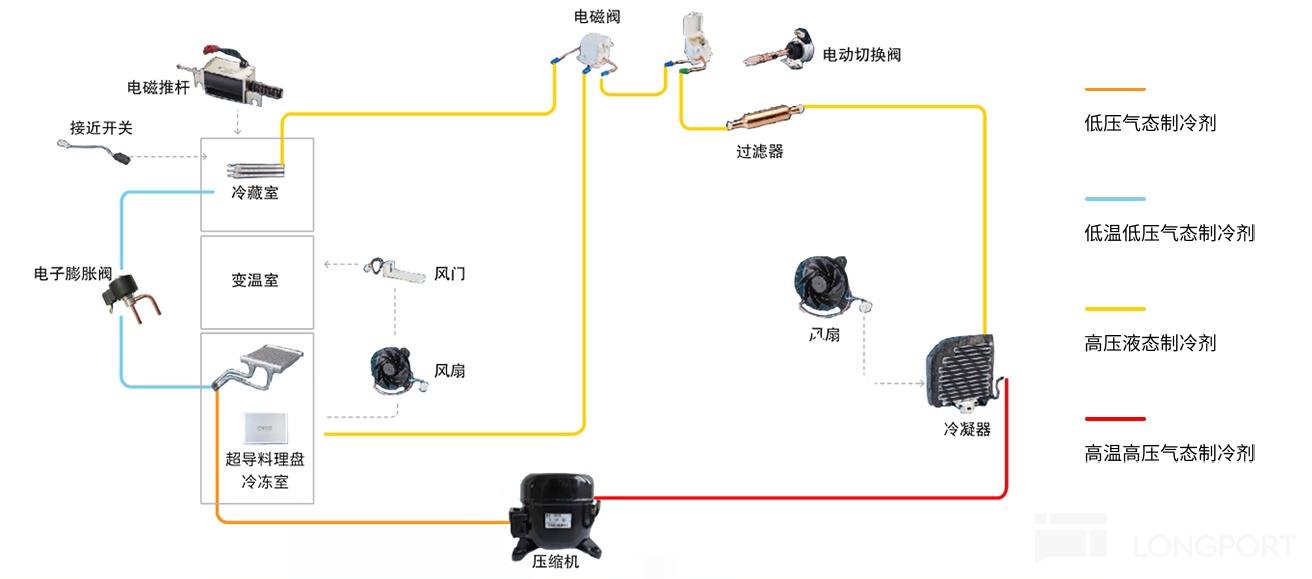
First, clear demand. The 2-position 3-way solenoid valve is a must-have fluid control component for refrigerators, switching refrigerant on/off and flow direction. No domestic producer could make it at the time, imported units were expensive, and it was a bottleneck part for China’s refrigerator industry. Meanwhile, the domestic refrigerator sector had scaled, making the valve a ‘hard demand’ item.
Second, the product had technical and manufacturing barriers, limiting commoditization and aligning with Sanhua’s positioning.
Third, vs. overseas brands, Sanhua’s cost edge supported share gains.
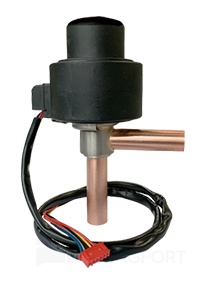
Subsequently, it developed thermal expansion valves, electronic expansion valves, and drain pumps, forming a ‘self-driven R&D, build-the-brand’ direction through new product launches. In 1992, it was renamed ‘Zhejiang Sanhua Group’.
Fig.: Solenoid valve
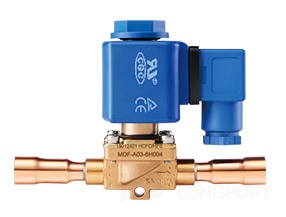
Fig.: Electronic expansion valve
Source: Sanhua Intelligent Controls website, Dolphin Research
Fig.: Refrigerator refrigeration system schematic
Source: Sanhua Intelligent Controls website, Dolphin Research
While building fridge parts, it seized the AC market opportunity. China’s AC industry scaled later than refrigerators but grew fast. Sanhua launched AC shut-off valves, again achieving import substitution.
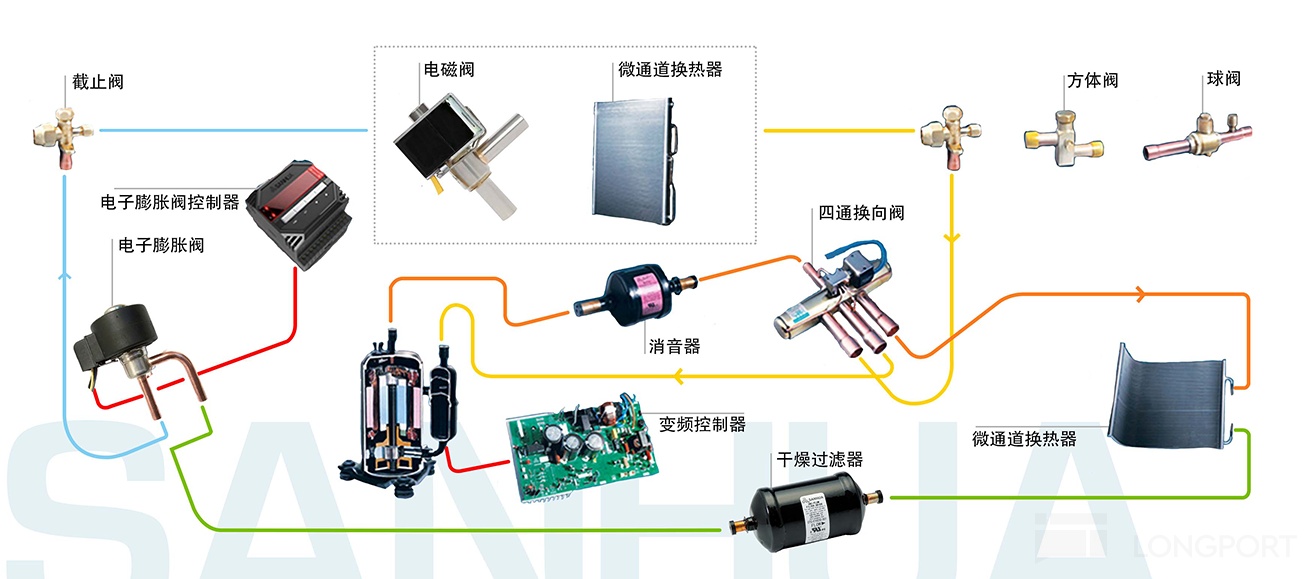
It developed the 4-way reversing valve and took share on cost strength. In 1995, it cracked this core refrigeration component, breaking U.S. dominance and supplying many domestic AC OEMs. Performance was comparable to imports but at a much lower price. Sales hit 1 mn units in 1999, global share reached 25% in 2020 and ~50% in 2006, with customers including Haier, Gree, Midea, Hisense, and overseas names such as Samsung, LG, Panasonic, Mitsubishi, and Daikin.
Fig.: Household AC system schematic
Source: Sanhua Intelligent Controls website, Dolphin Research
Acquiring a former would-be acquirer and global leader. In 2007, Sanhua acquired U.S. company Ranco, the one-time market leader and inventor of the 4-way valve. Back in 1996, as Sanhua started gaining share, Ranco took notice and tried to buy Sanhua’s 4-way valve business, a deal Sanhua declined.
II. What is a valve?
Throughout its history, Sanhua has centered on ‘valves’. In refrigeration systems, a valve is a critical fluid control component that regulates, modulates, and cuts off the flow of refrigerants by changing its opening position to precisely manage flow, pressure, and direction. Refrigeration works via heat exchange driven by refrigerant flow and phase change. For example, an AC transfers indoor heat outdoors to cool the room.
Put simply, a valve is a switch that controls whether and where refrigerant flows. But it is far more than a simple switch, with stringent demands on precision, sealing, and lifetime under complex environments and duty cycles. These are not hand-turned valves; they are actuated by solenoids or stepper motors for automated control, making them multidisciplinary products spanning mechanical engineering, fluid dynamics, materials, and electrical engineering. Valves are central to precise temperature control in refrigeration systems.
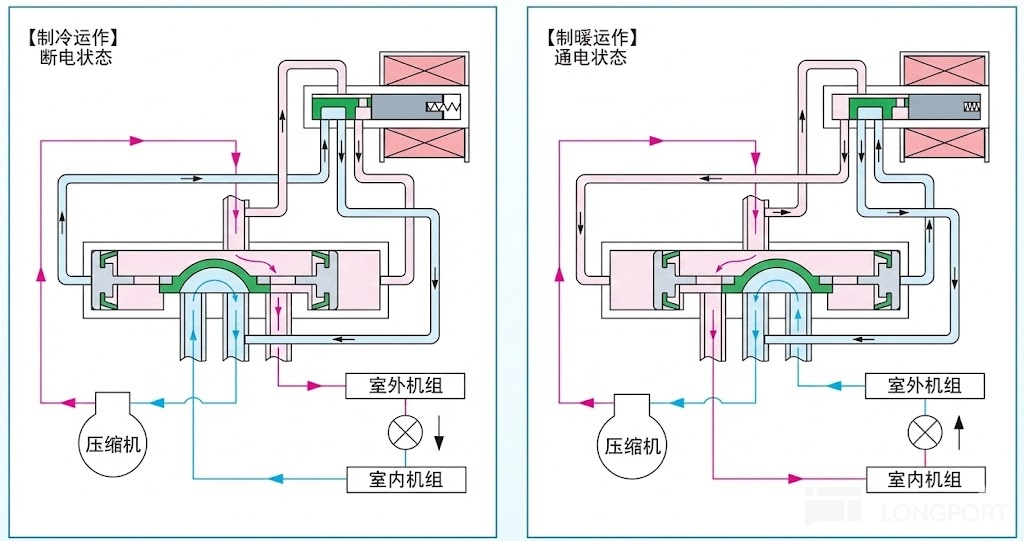
Take the 4-way valve as an example:
A 4-way valve is a special valve with four ports whose spool movement reroutes refrigerant flow, as illustrated.
Fig.: Working principle of a 4-way valve
Source: Foshan Hualu, Dolphin Research
In AC systems capable of both cooling and heating, the 4-way valve reverses between the two modes. Its internals are highly precise to ensure reliable flow-path switching, requiring exacting design, materials, and manufacturing processes.
III. Going global and breaking product boundaries
After its refrigeration breakthroughs, Sanhua shifted from a ‘cost leadership’ to a ‘technology leadership’ strategy as its capabilities evolved. It then found new growth curves in overseas markets and NEVs.
In refrigeration:
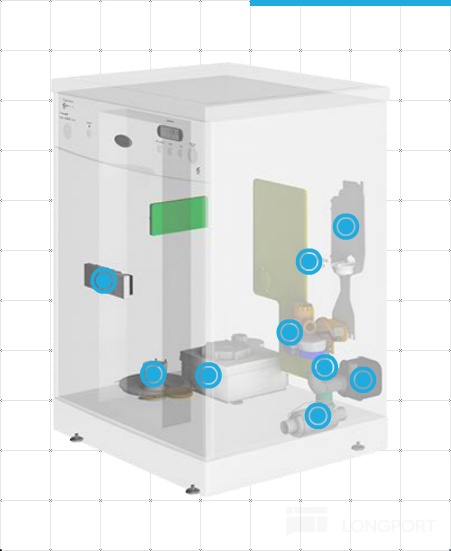
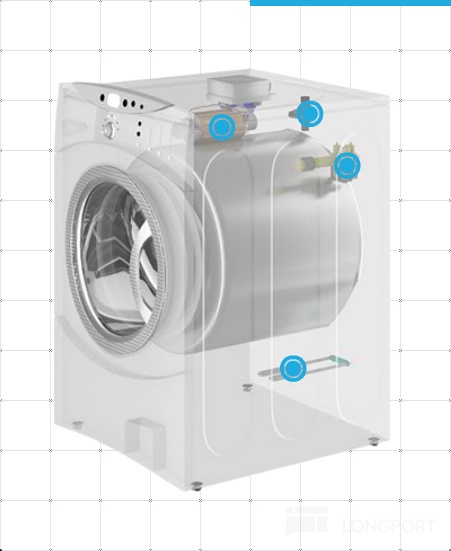
(1) It acquired overseas component makers such as Aweco, expanding into the global premium white goods supply chain. Aweco supplies leading dishwasher, washer, and coffee machine makers, serving top brands across Europe and China, including Siemens, Bosch, Whirlpool, Liebherr, Midea, Haier, and Gree.
Fig.: Aweco’s key products
Source: Aweco website, Dolphin Research
(2) It launched inverter electronic controllers and won against global giants like Danfoss and Emerson, supplying solutions to Carrier and other global leaders. Controllers are a distinct category from valves, providing control signals with core value in circuit design and algorithms. This marked a step-up from single components to system solutions.
(3) It built out microchannel products, including microchannel condensers and evaporators for residential AC, commercial AC, and heat pumps. In simple terms, microchannels are advanced heat exchangers with micron-scale channels that significantly enhance heat transfer.
Fig.: Microchannel condenser
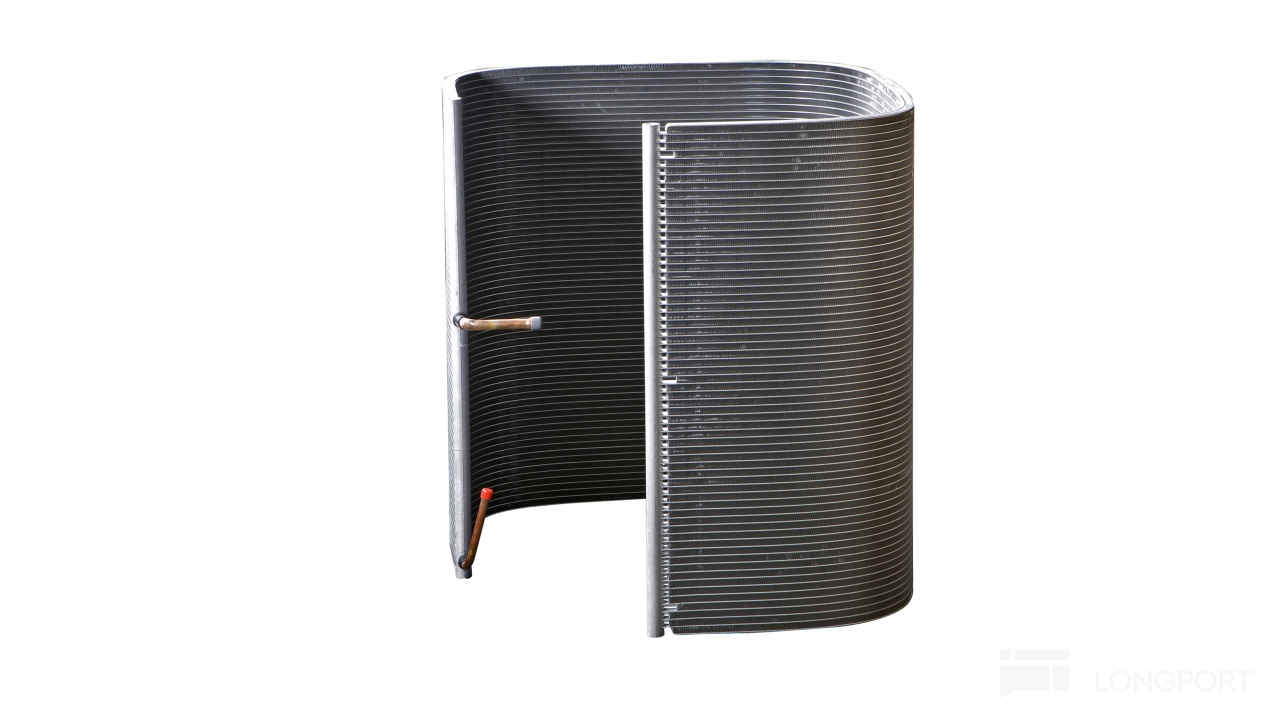
Fig.: Microchannel evaporator
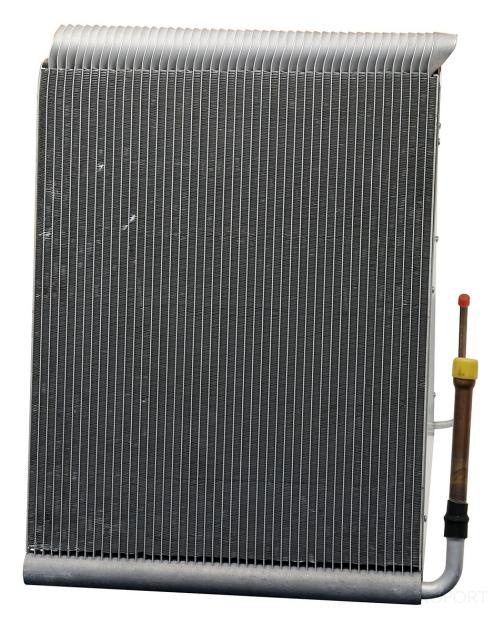
Source: Sanhua Intelligent Controls website, Dolphin Research
(4) In parallel with product-line buildout, it established plants in Mexico, Poland, and other countries.
IV. Emerging as a leader in NEV thermal management
Sanhua moved early into autos: in 2006 it set up Sanhua Automotive Components to enter thermal management. In 2014, it developed an automotive electronic expansion valve, breaking Denso’s monopoly and winning GM orders.
Fig.: Automotive electronic expansion valve
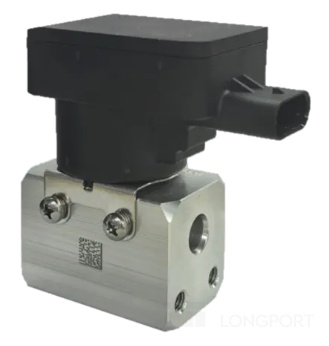
Source: Sanhua Intelligent Controls website, Dolphin Research
Before 2018, despite notable wins, the auto parts business saw limited traction. Legacy ICE supply chains were locked by overseas Tier Ones and the market lacked growth, leaving few openings for newcomers. A side note: in 2012, founder Zhang Daocai’s son, Zhang Yabo, became chairman and CEO of Sanhua Holding Group at age 38, a smooth generational transition that underpinned operational stability.
Sanhua then captured the NEV opportunity. In 2017 it created an NEV thermal management division to develop integrated systems.
In 2018, Sanhua entered Tesla’s supplier base. Proving itself with Tesla, it subsequently won programs from leading global and Chinese OEMs. Its portfolio expanded from valves to integrated modules combining valves, pumps, heat exchangers, and lines, shifting from selling parts to selling systems.
In 2019, Tesla proposed the Octovalve architecture, and in 2022 Sanhua was first to mass-produce it. The Octovalve reduces vehicle weight while boosting system reliability and efficiency. The design has since rolled out across multiple models at Tesla, BYD, and others. By 2023, auto parts contributed over 40% of listed-company revenue.
Why could Sanhua break through in NEVs but not in the ICE era?
Traditional OEMs relied on Tier Ones like Denso and Valeo for complete thermal solutions. In the NEV era, the OEM–supplier model changed meaningfully. Tesla self-architected thermal systems and worked directly with Tier Two suppliers such as Sanhua, effectively having Tesla lead R&D while Sanhua industrialized for mass production.
Leveraging its strengths, Sanhua caught the opportunity and executed, using components as the entry point and then moving up to integrated assemblies. In effect, it evolved from Tier Two to a de facto Tier One.
V. Takeaways from Sanhua’s growth: where are its core strengths?
First, sound industry calls. It anticipated demand in refrigerators, AC, premium white goods, and NEVs, and entered Tesla’s supply chain at the right time. Second, clear view of its capability boundaries. It chose product directions aligned with and reinforcing its strengths, competing on cost when needed and investing in technology when that mattered.
Finally, it has accumulated leading R&D and manufacturing capabilities domestically. These underpinned import substitution, market share gains, and top-tier customer wins.
VI. Sanhua’s NEV business centers on thermal management. What is it?
(1) Framing NEV thermal management
Automotive thermal management regulates component operating temperatures and cabin comfort. Practically, it ensures major components — in NEVs, mainly the battery, e-motor/inverter, and chips — operate safely and stably, while maintaining a comfortable cabin climate.
One might ask: isn’t this similar to the refrigeration systems in fridges and ACs above? Despite overlaps, auto thermal management differs materially. ACs manage air temperature in a fixed space, but vehicles must regulate multiple media and modules, including engines (ICE) or the ‘three electrics’ (NEVs). They also face complex, real-time varying duty cycles.
(2) Why the value pool expands in NEV thermal management
Given powertrain differences, NEV thermal systems command 2–3x the value of those in ICE cars. Looking ahead, value could rise further for several reasons:
1) More components require thermal control in NEVs, so systems are more complex.
ICE vehicles focus on engine cooling and cabin AC, with cabin heat easily sourced from engine waste heat. NEVs must manage both the ‘three electrics’ and the cabin, with the battery adding the most critical new need. Battery temperature windows are tight and safety-critical, demanding precise heating and cooling to ensure performance and prevent events like thermal runaway.
2) To address range anxiety, NEVs require higher integration (weight/efficiency) and lower energy consumption (e.g., heat pumps).
Integration comes from re-architecting the thermal system. Subsystems and loops are coupled functionally and structurally to enable information and energy exchange, better balancing thermal loads across the vehicle and improving efficiency. This addresses the low overall efficiency of legacy architectures where loops operated relatively independently.
3) Example
Tesla’s thermal system:
Tesla has iterated four generations, with Gen 5 in development, and integration has steadily risen from Gen 1 to Gen 4. Key Gen 4 upgrades include:
Fig.: Tesla Gen 4 thermal system operating modes
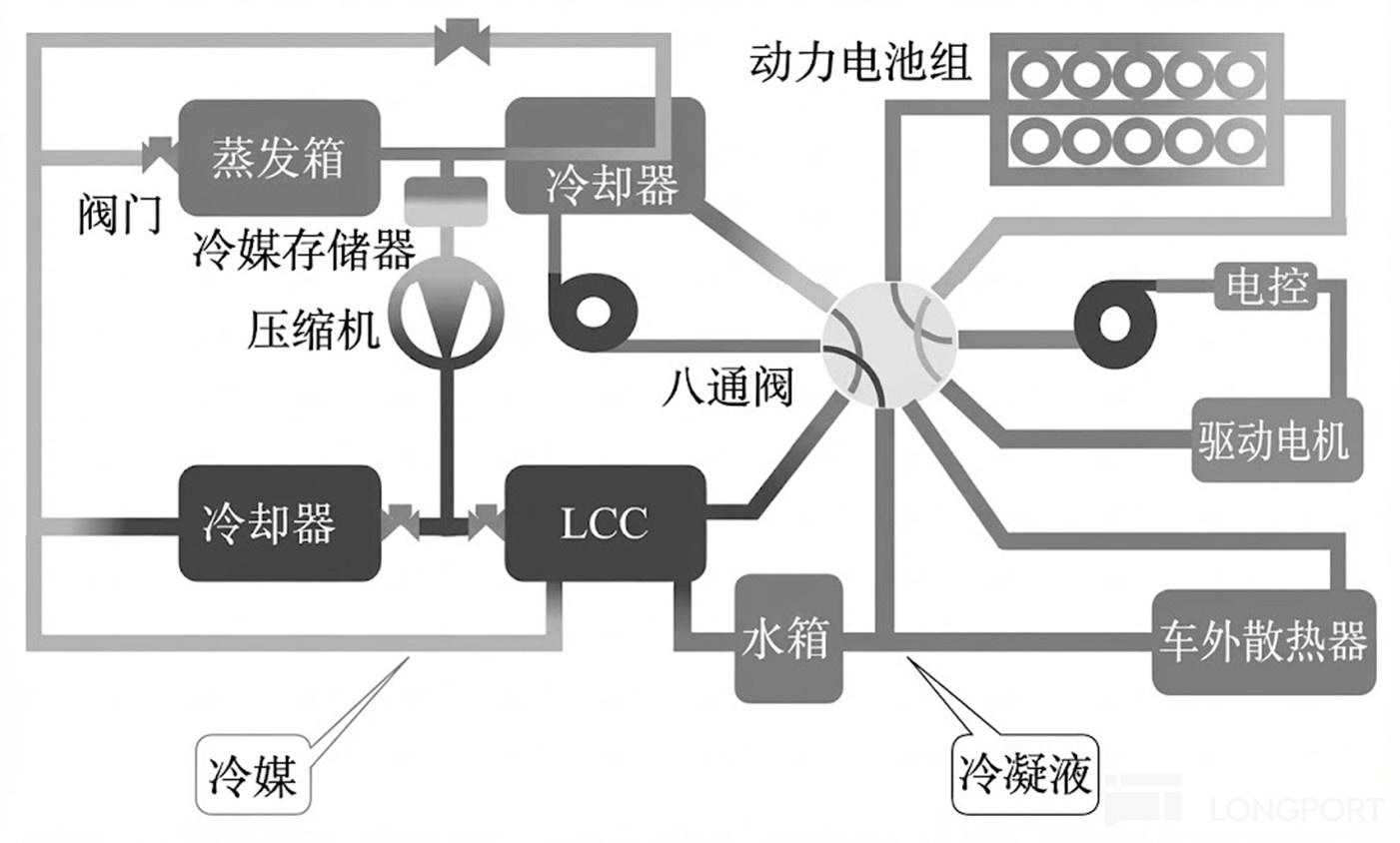
Source: ‘Review of NEV Thermal Management Research’, Dolphin Research
(1) Adopting a heat pump and eliminating PTC heaters
What is a heat pump? Its principle mirrors ACs, using a compressor to move heat, but here it spans the integrated thermal architecture rather than just conditioning the cabin. In Tesla’s setup, a heat pump handles cabin cooling and heating, while the Octovalve routes waste heat from the ‘three electrics’ to the cabin, removing the need for PTCs there.
For the battery, the system combines heat pump output with waste heat from the e-motor/inverter and other sources, transferring it to the pack via the Octovalve. This enables removal of PTCs in battery thermal control as well.
(2) High integration via the Octovalve
Tesla’s Octovalve uses a stepper-motor actuator to open/close multiple primary loops, directing coolant (note: not refrigerant) along different paths to meet temperature targets while saving energy. This enables efficient system-wide operation.
Fig.: Octovalve in different operating states
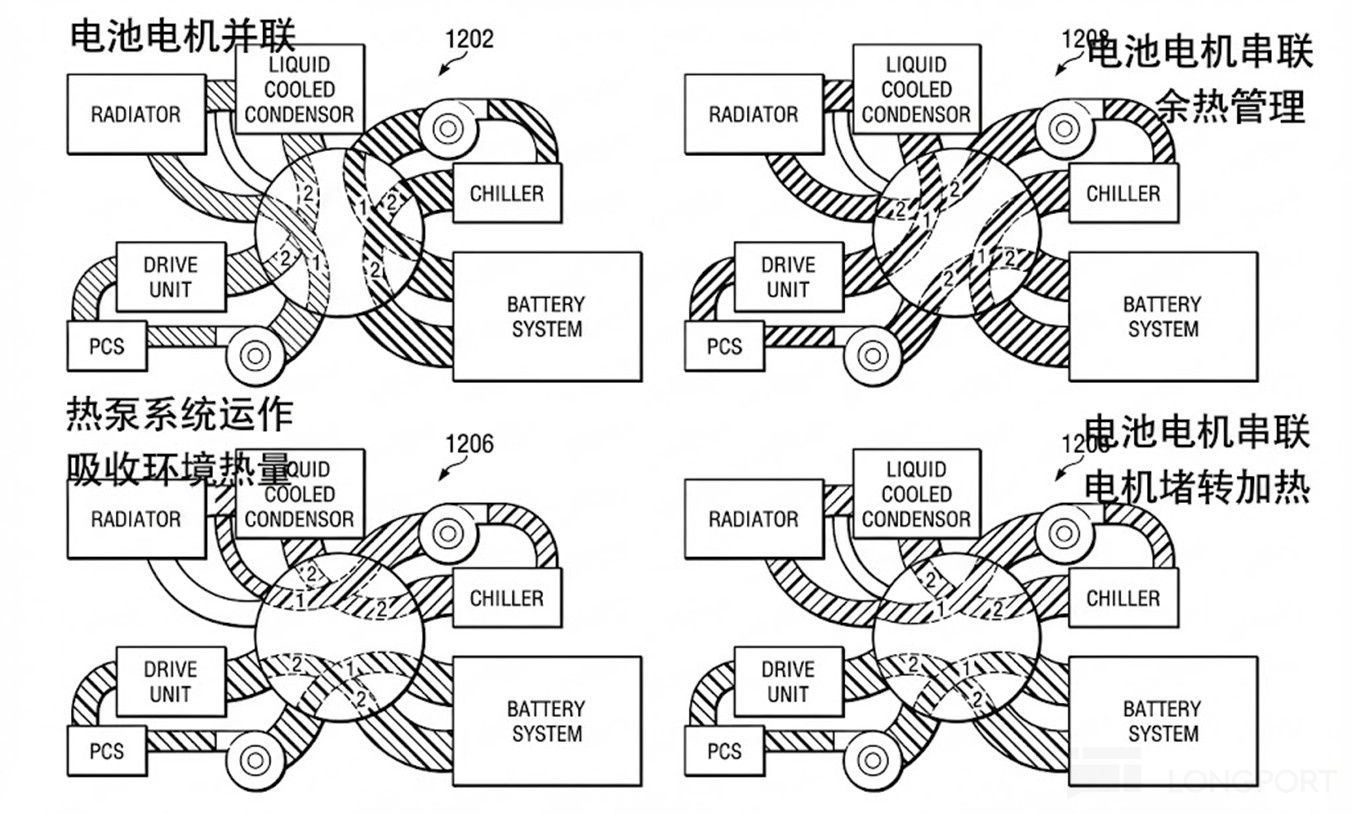
Source: Tesla patents, Dolphin Research
In simple terms, heat flows first to where it is needed and away when it is not, maximizing efficiency through flexible routing. The Octovalve is pivotal in enabling this.
(3) The value of NEV thermal systems could rise further with performance upgrades
1) With integration and energy efficiency demands, there is room for architecture and tech upgrades: cross-domain fusion, higher heat pump utilization, and advanced insulation materials (e.g., mica, aerogel).
2) Battery packs will carry more energy at higher density, concentrating heat release in smaller volumes, which requires stronger cooling, such as CATL’s double-sided liquid cooling. High-voltage fast charging also raises thermal requirements for faster, more efficient heating and cooling.
3) Rising vehicle intelligence and higher-compute chips further increase cooling needs.
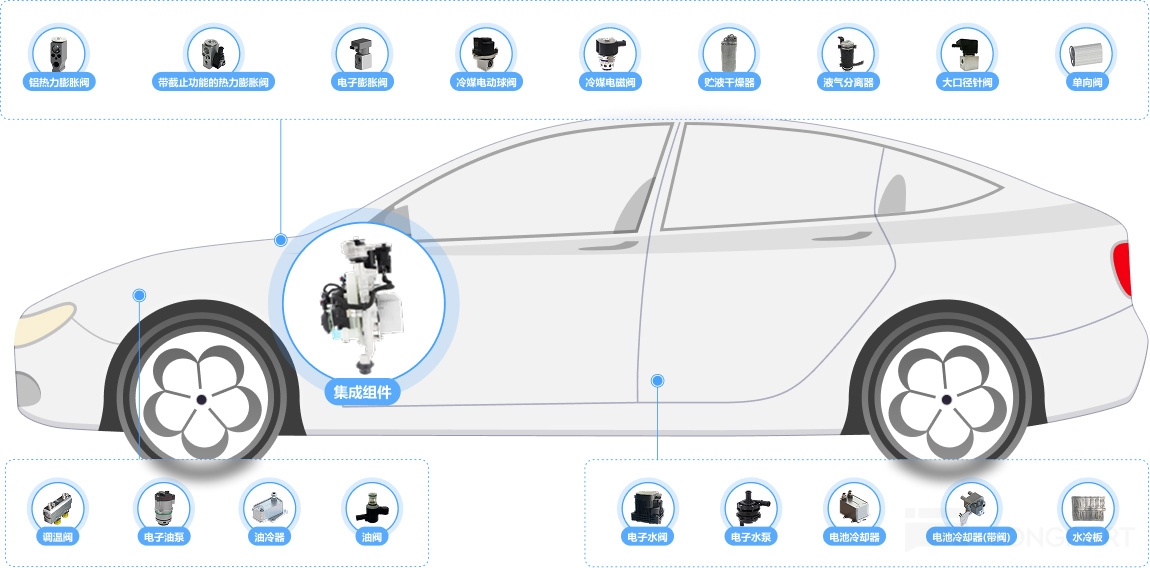
(4) What components make up the thermal system, and where does Sanhua play?
Fig.: Components of an NEV thermal management system
Source: Sanhua Intelligent Controls website, Dolphin Research
Key components include:
- Various pumps: mechanical water pumps, electric water pumps, electric oil pumps, etc.
- Valves: TXV, EXV, solenoid valves, multi-way valves, etc.
- Heat exchangers: front-end modules, HVAC boxes, condensers, evaporators, cold plates, etc.
- Compressors (mechanical/electric)
- Lines and manifolds
Apart from compressors and refrigerants, Sanhua offers mature products across most items above.
(5) A simple market sizing for NEV thermal management
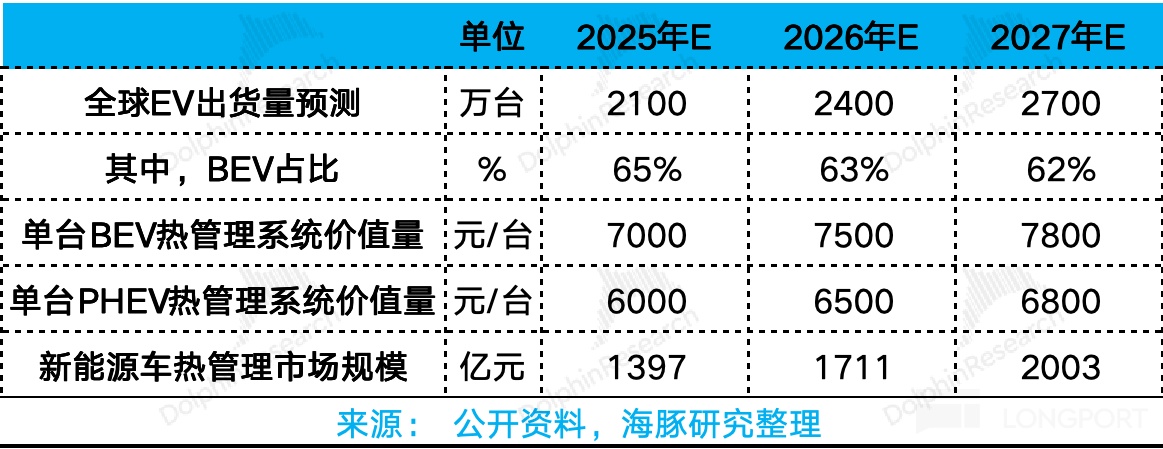
This points to significant potential in NEV thermal management. Demand extends beyond autos into data centers and energy storage as well, which also require thermal solutions with sizable markets. We will assess these in the next article.
We will also discuss Sanhua’s humanoid robot roadmap and valuation in the next piece.
<End>

Sanhua
SZ002050

SANHUA
HK02050

GREE
SZ000651

Samsung Electronics
USSSNGY

HAIER SMARTHOME
HK06690

Haier Smart Home
SH600690

HISENSE HA
HK00921

Hisense H.A.
SZ000921

Midea Group
SZ000333

MIDEA GROUP
HK00300

Tesla
USTSLA

TSLA 2X Short ETF
USTSDD

TSLA 2X Long ETF
USTSLL

AXS TSLA Bear Daily ETF
USTSLQ

XI2CSOPTSLA-U
HK09366

XL2CSOPTSLA
HK07766

XI2CSOPTSLA
HK07366

GraniteShares 2x Long TSLA Daily ETF
USTSLR
The copyright of this article belongs to the original author/organization.
The views expressed herein are solely those of the author and do not reflect the stance of the platform. The content is intended for investment reference purposes only and shall not be considered as investment advice. Please contact us if you have any questions or suggestions regarding the content services provided by the platform.