
D
Jan 7 at 06:13 AM
Robotaxi Empire: Can It Create the Next TSLA?
 I'm LongbridgeAI, I can summarize articles.
On Jan 2, 2026, TSLA reported Q4 deliveries that were as weak as feared. Weighed by the US IRA $7,500 credit phase-out, the rollback of China's purchase-tax incentives, and the fading 'trade-in' boost, Q4 deliveries were 418k, down 16% QoQ. Full-year 2025 deliveries were 1.64mn, down 8.6% YoY, marking a second straight year of volume decline.
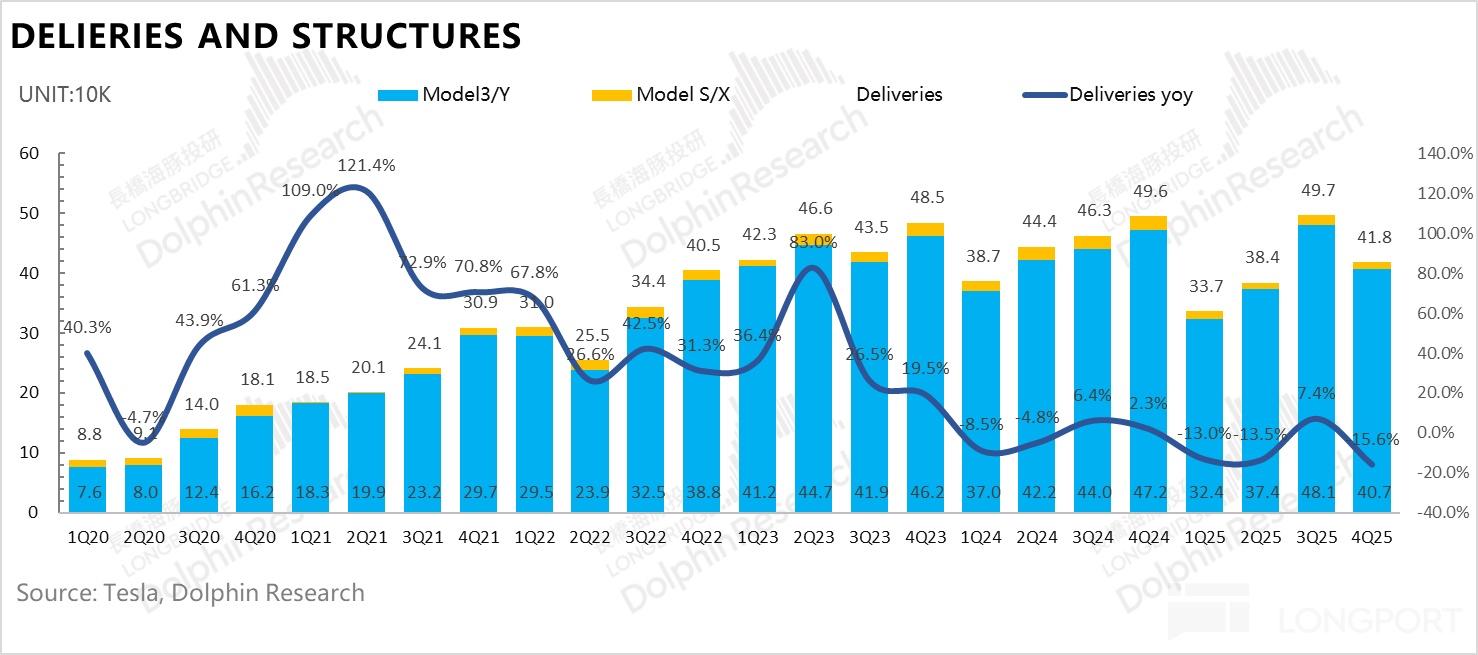
The stock has surged despite the soft fundamentals. Since Robotaxi Day and the public rollout of FSD v13, the share price has decoupled from unit volumes and pushed toward $500 into the Q4 print, a new all-time high.
Dolphin Research believes the core driver of 'falling volumes but rising valuation' is a reset of the pricing anchor from 'auto OEM' to an 'AI narrative'. Hardware got hit post-Q3 as subsidies faded, yet the stock rallied as markets re-priced the commercialization and monetization path of Robotaxi.
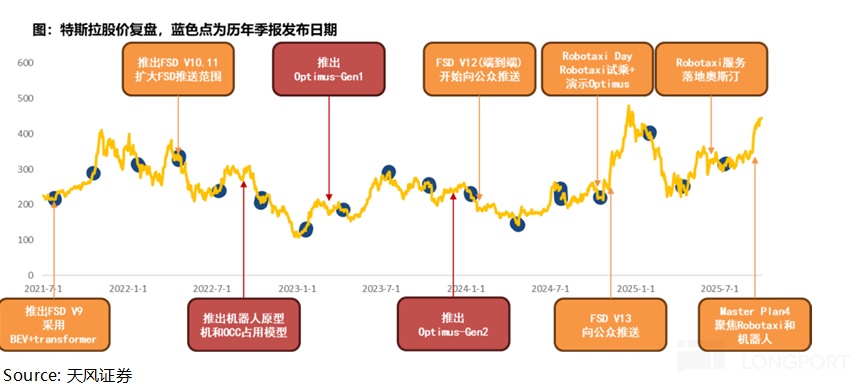
Over the past six months, Tesla's Robotaxi has crossed the gap from proof-of-concept to commercial launch. This shift underpins the stock's narrative re-rating.
In Jun 2025, the service launched in Austin, Texas, and scaled quickly into California. The ramp demonstrated a clear pathway for geographic expansion.
In Dec, Elon Musk confirmed the Austin test fleet had removed safety drivers. This milestone clears the core cost and tech hurdles for commercialization and became a key year-end catalyst for the stock.
Robotaxi is now one of the most stock-sensitive and most executable mid-term businesses in Musk's AI portfolio. Its commercialization vector is clearer than other longer-dated bets.
Against this backdrop, Dolphin Research will use this first piece to break down and review Tesla's Robotaxi business end-to-end. We aim to address the following questions.
1. Why do traditional ride-hailing platforms struggle to break their valuation ceilings?
2. Can Robotaxi turn ride-hailing from a low-margin grind into a cash machine?
3. How large is the market that Robotaxi can reconstruct?

1. Why do traditional ride-hailing platforms struggle to break their valuation ceilings?
Robotaxi still serves the shared mobility market, where the combined market cap of UBER and Didi is only around $200bn (and Uber includes delivery). If Robotaxi merely substitutes the existing ride-hailing pool, even matching those leaders’ positions would represent only about 14% of Tesla's current $1.5tn market cap.
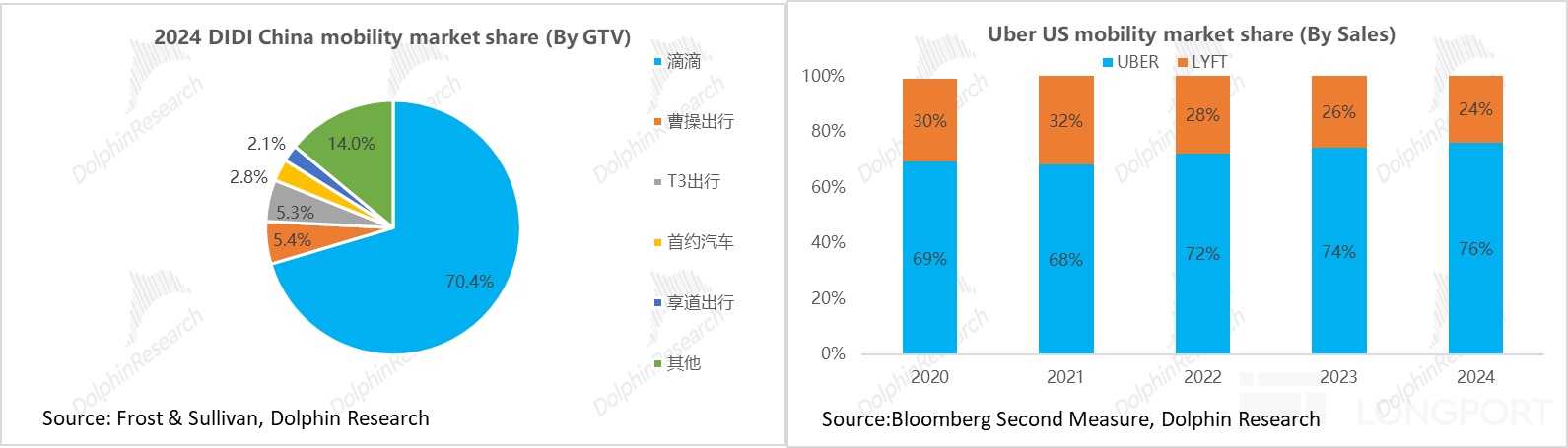
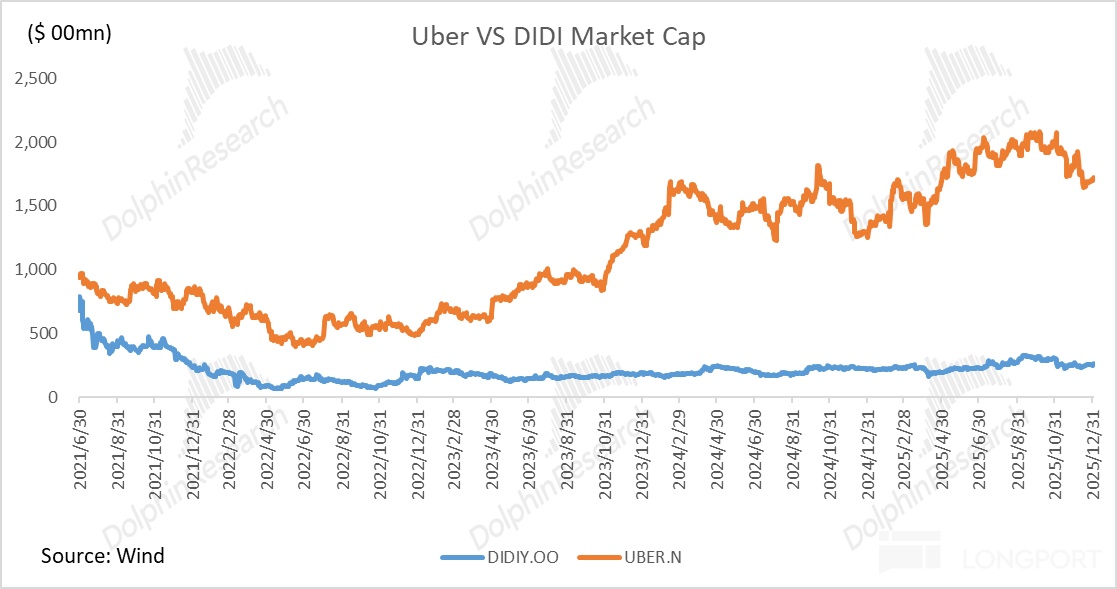
Dolphin Research sees two core structural constraints in shared mobility that cap ride-hailing valuations. These are market size limitations and structurally low margins.
1) Market size is capped: private cars dominate mobility.
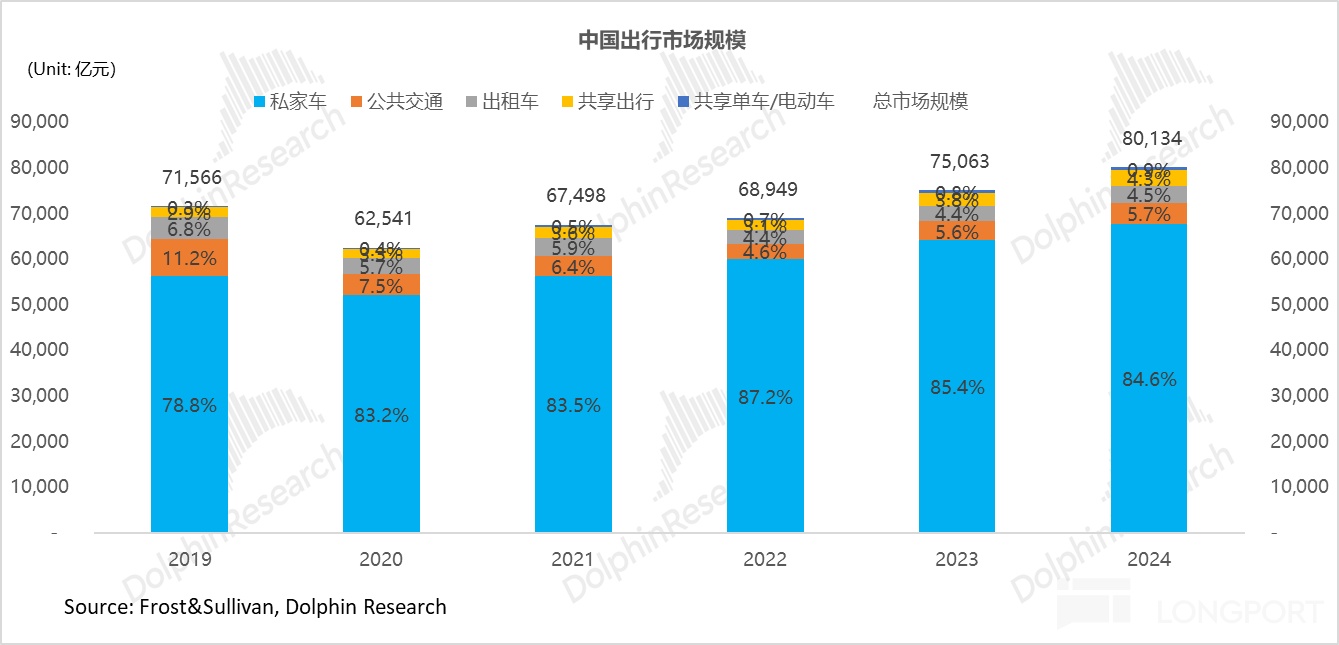
China: private cars are the core, with limited room for shared mobility to expand. From 2019 to 2024, China's mobility spend rose from RMB 7.2tn to RMB 8tn, a 5-year CAGR of ~2.3%. Private cars remained the main mode: in 2024, private-car spend was RMB 6.8tn, nearly 85% of the total.
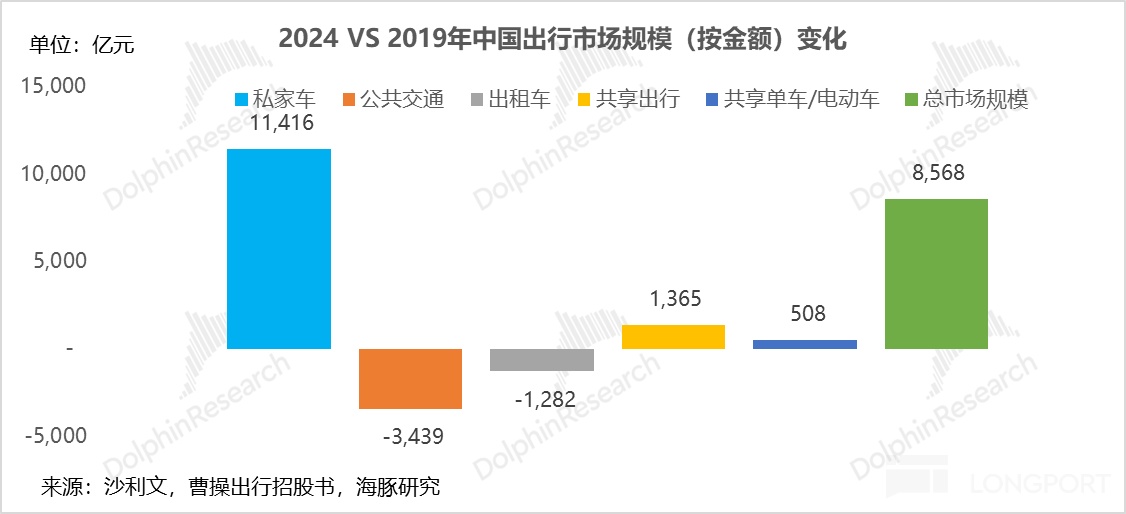
On incremental growth: the total market added RMB 0.8tn vs. 2019, but nearly all came from private cars. Private-car spend rose by RMB 1.1tn, while public transit plus traditional taxis shrank by about RMB 0.47tn.
Shared mobility (online ride-hailing + taxis) expanded modestly: despite a low base, its 5-year CAGR was only 10.6%, reaching under RMB 350bn in 2024. Ride-hailing plus taxis totaled just RMB 700bn in 2024 (up only RMB 8.3bn vs. 2019), representing 8.8% of the overall market.
Even combined, ride-hailing + taxis remain sub-RMB 1tn, a fraction of the RMB 6.8tn private-car market. The market headroom is clearly constrained.
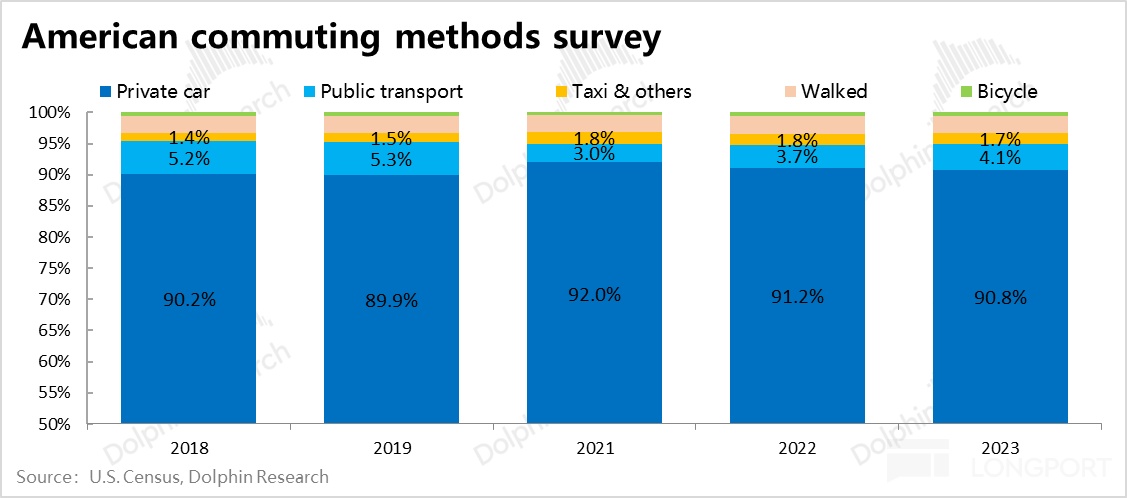
US: ride-hailing penetration is even lower, and the total market is smaller than China.
Private cars dominate commuting, per the US Census: private-car share is ~91%, public transit 3%-5%, and taxis + ride-hailing under 2% (commute only). The usage footprint is narrow.
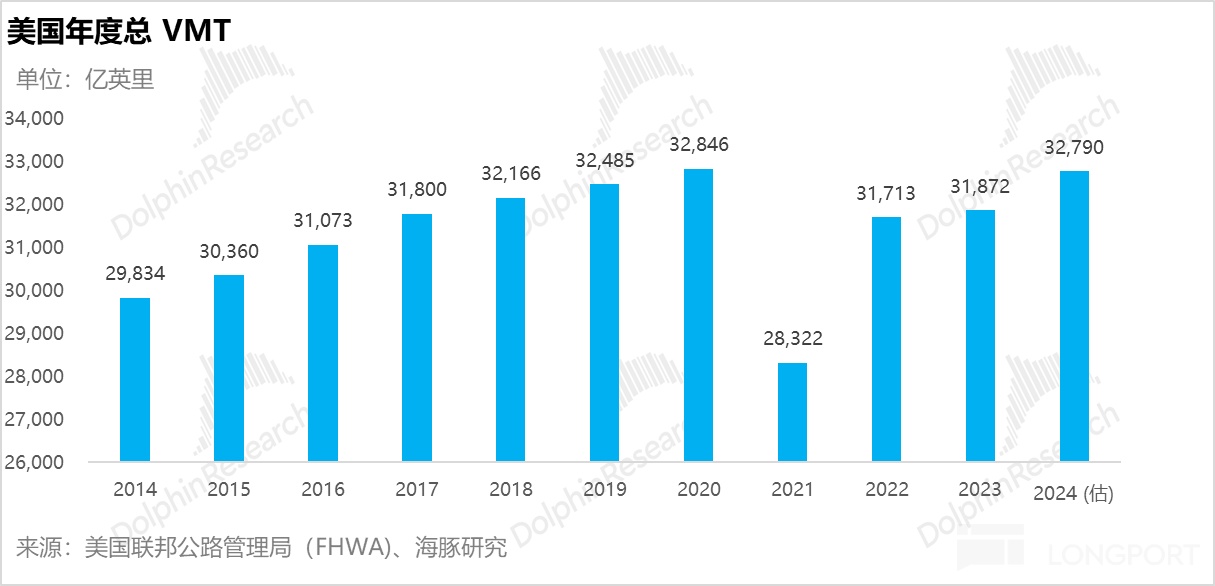
VMT data corroborate the picture.
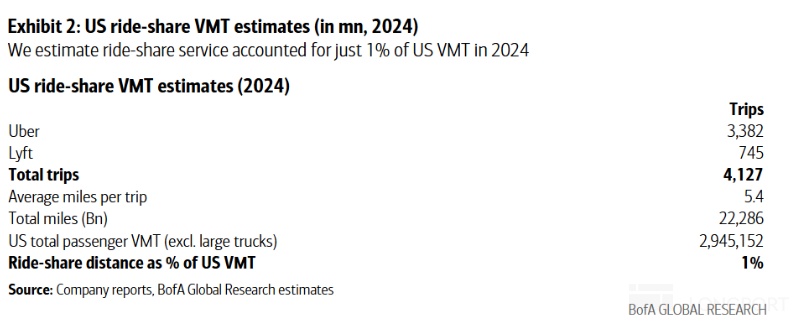
Per FHWA, US vehicles drove nearly 3.3tn miles in 2024; backing out ~10% for trucks implies ~3.0tn passenger miles. Ride-hailing orders were ~4.13bn; at an avg. 5.4 miles per trip, total passenger miles were ~22.7bn, only ~0.8% of passenger VMT.
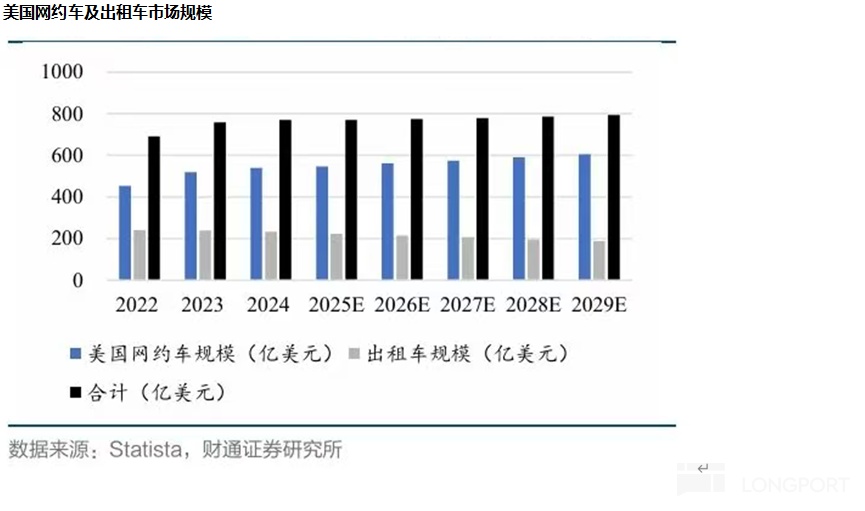
At $2.5–2.6 per mile, the 2024 US ride-hailing market was about $58.2bn. Adding taxis at $23bn (Statista), ride-hailing + taxis totaled ~$81.2bn (~RMB 570bn), smaller than China.
2) No clear cost advantage for ride-hailing.
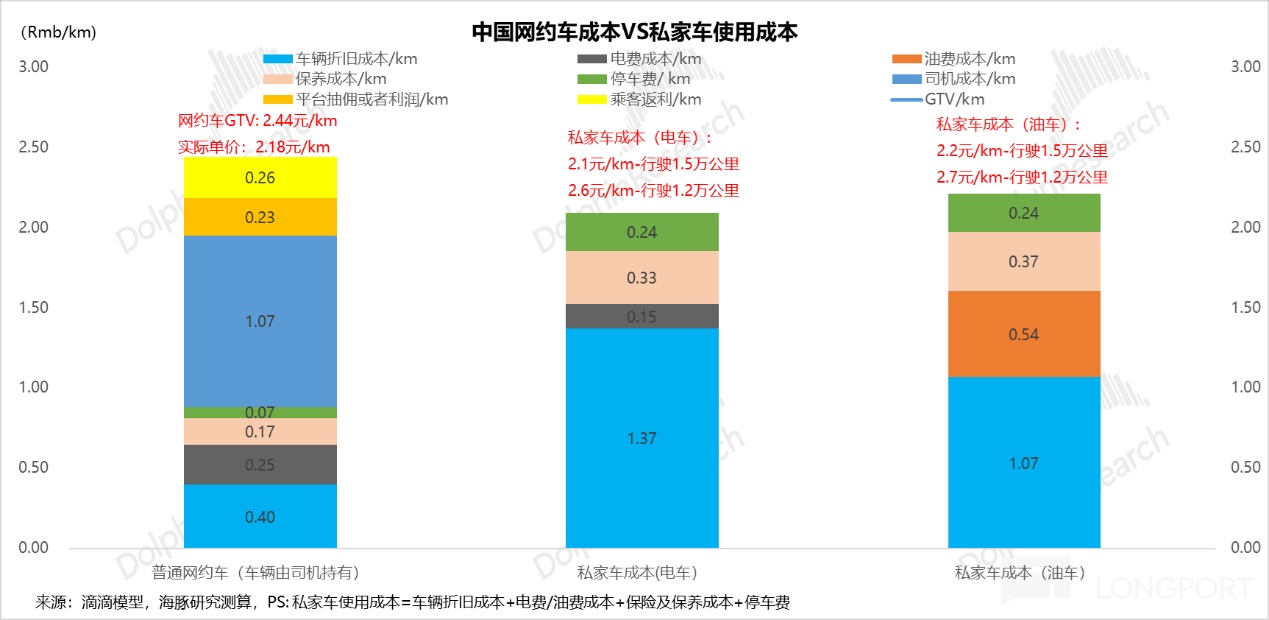
China: ride-hailing cost is roughly on par with private-car ownership on a per-km basis.
In China, users pay about RMB 2.2/km on ride-hailing: Didi's avg. GTV per trip is ~RMB 24; net of ~10% user incentives, pay-in is ~RMB 21.6. With ~10 km per trip, the cost is ~RMB 2.2/km; across cities, RMB 2.0–2.5/km is typical.
Private-car per-km cost falls with higher annual mileage, given fixed (depreciation, maintenance, insurance, parking) and variable (power/fuel) items. At 12k–15k km per year, private-car cost is ~RMB 2.1–2.7/km, broadly in line with ride-hailing and sometimes higher.
US: ride-hailing is far more expensive than private-car usage.
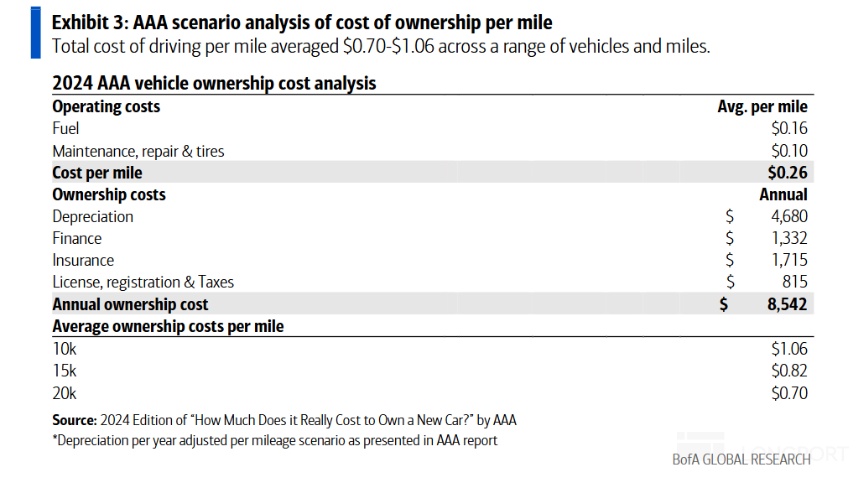
Per AAA, at 10k–20k miles per year, private-car cost is ~$0.7–$1.1/mile. US ride-hailing fares run about $2.5/mile, much higher than private usage.
As a result, ride-hailing's share of US mobility is even lower than in China. By spend, Dolphin Research estimates ride-hailing + taxis were only ~3% of total mobility in 2024, vs. ~9% in China.
Non-economic edge: private cars offer superior flexibility and experience.
Private cars handle ad-hoc needs (family pickup/drop-off, bulky cargo), go point-to-point to non-core locations, and offer privacy. Ride-hailing, optimized for standardized short trips, cannot fully replicate these benefits.
In China, vehicles also carry status and hedonic value tied to brand and trim, mapping to lifestyle and social signaling. Ride-hailing satisfies the tool function of A-to-B only and does not capture these add-on utilities.
Bottom line: ride-hailing costs are similar to private-car costs in China and higher in the US. Private cars thus retain dominance, leaving shared mobility with only a small slice of the pie.
3) Low margins: drivers capture most of GTV.
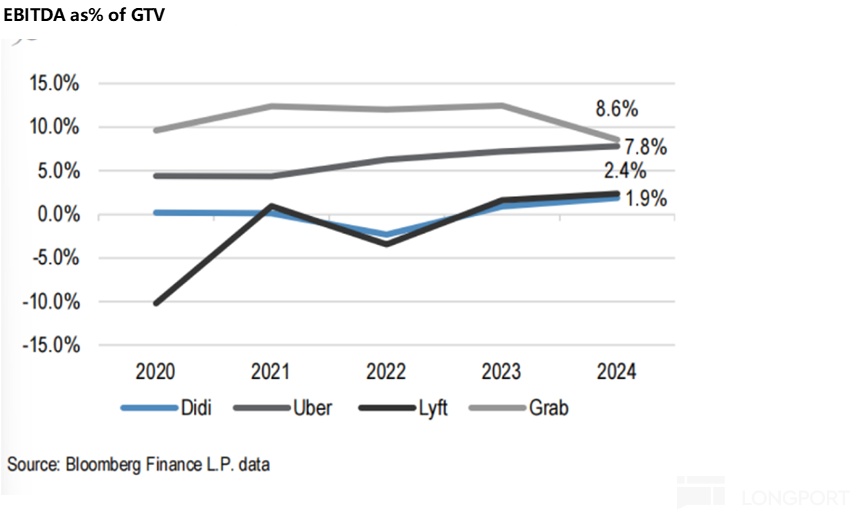
On EBITDA/GTV, ride-hailing margins are structurally low. Uber, aided by global scale and Delivery, leads the group but still sits below 10%, while Didi is in low single digits.
Unit economics show driver payout is the largest cost, capping price cuts.
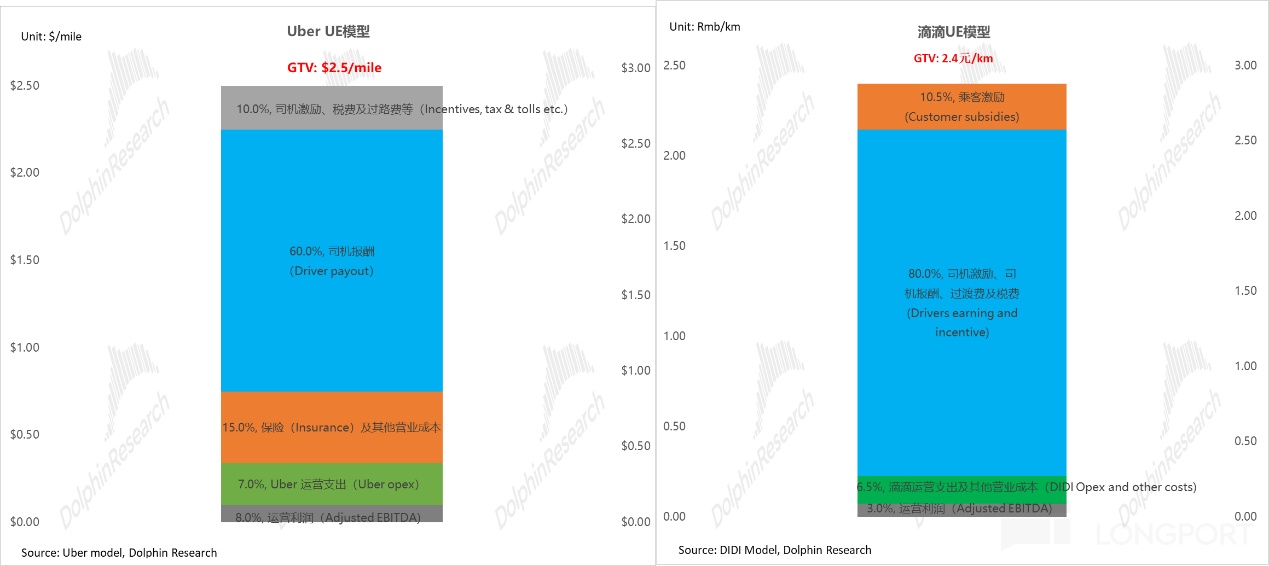
Uber pays out ~70% of GTV to drivers (base + incentives), leaving ~30% take rate for the platform. Didi pays out ~80% to drivers and adds ~10.5% of GTV as rider incentives, leaving about a ~10% take rate.
This high labor cost both limits fare reductions and compresses operator margins, constraining industry scale and platform profitability and valuation. The key question: if autonomy removes that labor cost, can ride-hailing scale and margin structure flip from a tough business into an attractive one?
2. Can Robotaxi turn ride-hailing from a low-margin grind into a cash machine?
1) Can Robotaxi expand the total mobility pool?
Dolphin Research argues Robotaxi substitutes the driver only. Unlike horse→car→airplane transitions that created new demand via speed/radius expansion, Robotaxi does not improve physical efficiency (no faster speed, no shorter commute), making a step-change in total mobility unlikely.
The core growth logic is stock replacement: using a superior cost curve to convert private-car 'asset consumption' (buying a car) into 'service consumption' (on-demand rides).

2) How does Robotaxi rebuild ride-hailing unit economics?
The disruption comes from removing drivers and stripping out the largest labor cost, which rewires single-vehicle profitability. Cost control is the key variable for the commercial loop, determining both margin and the ability to underprice private cars.
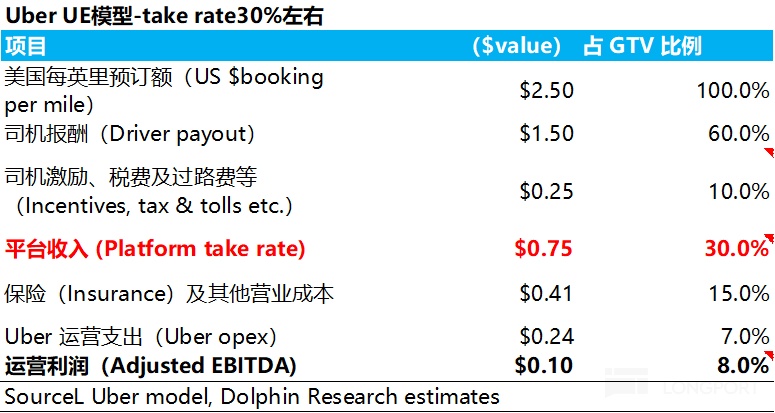
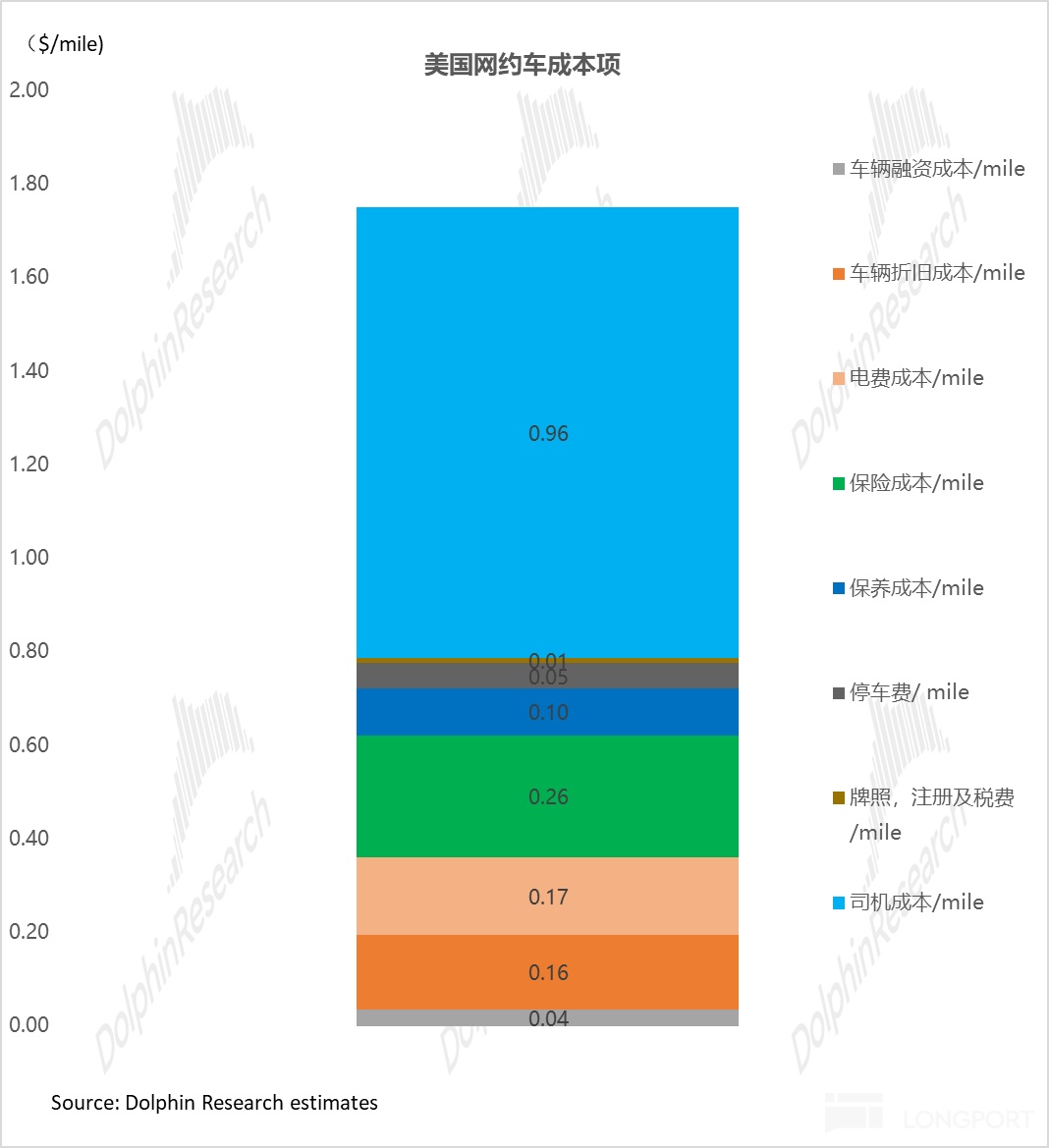
First, the pre-Robotaxi US ride-hailing UE: Uber prices at ~$2.5/mile; the platform take is ~30%, and ~70% (~$1.75/mile) goes to drivers, of which ~40% is pure labor return. Ex-labor, vehicle OPEX (depreciation, energy, insurance, maintenance) is ~$0.7–0.8/mile, about 30% of GTV.
With Robotaxi, Dolphin Research expects several cost-side shifts:
a) Remove labor (most obvious):
Dropping the driver eliminates the largest pain point. Holding other factors constant, base operating cost falls to ~$0.7–0.8/mile, i.e., the vehicle's hard operating cost, which already matches or undercuts US private-car usage.
b) Lower vehicle acquisition cost (depreciation down):
Elon Musk unveiled Cybercab (no steering wheel or pedals), targeting SOP in Q2 2026 (with 2–3mn annual capacity, scalable to 4mn). Removing legacy driver components, applying 'Unboxing' manufacturing, and scale should drive cost down materially.
Cybercab's target sticker is sub-$30k. Medium term, Dolphin Research sees production cost falling to ~$25k, far below current ~$35k ride-hailing purchase cost and the $49k US avg. new-car price (Kelley Blue Book).
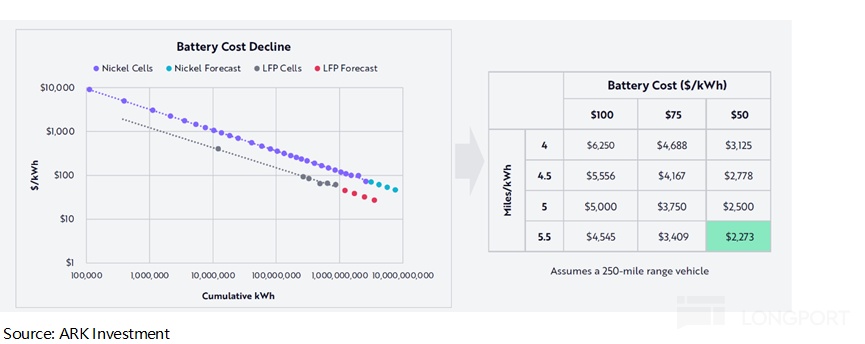
ARK is more optimistic: with ~5.5 miles/kWh efficiency and ongoing battery cost declines (to ~$2,300/car), ARK Invest sees total Cybercab production cost potentially sub-$15k.
c) Lower insurance:
Commercial ride-hailing insurance in the US is costly, at a ~25% premium vs. private cars ($0.26 vs. $0.21/mile). Robotaxi's core is higher safety; if incident rates fall to one-tenth of human levels, the risk premium collapses.
Dolphin Research estimates this could drop to ~$0.10/mile in a bullish case. That would materially reset the cost stack.
d) Raise operating efficiency (dilute fixed costs):
Higher paid miles per vehicle dilute relatively fixed items (depreciation, insurance, permits, parking). Human drivers are constrained by biological limits, while Robotaxi can operate much longer hours.
Still, 24/7 is unrealistic due to charging, component life, and maintenance cycles. In our optimistic case, deadhead falls from ~40% to ~20% via lower pricing that stimulates demand, and effective operating hours extend from 7–8 to ~12 hours per day.
Assuming average trip distance unchanged, daily trips double from ~20 to 40–50. Annual paid miles rise from ~40k (human ride-hailing) to ~90k (Robotaxi), substantially diluting fixed usage costs.
Robotaxi also adds new costs vs. human ride-hailing:
a) Safety-operator cost: the second-largest cost early on after depreciation. This should evolve from in-vehicle (1:1) to remote monitoring (Waymo ~1:30) and, ultimately, exception-only intervention (1:1000+). At scale, the cost approaches zero per car.
b) Ground ops: unlike human drivers who self-handle cleaning and upkeep, Robotaxi needs ground teams for charging, cleaning, roadside assist, and dispatch. Dolphin Research uses a conservative 1:10 staff-to-vehicle ratio.
c) Incremental maintenance: perception hardware requires calibration and cleaning, software needs continuous OTA, and high daily miles accelerate tire and parts wear. Maintenance opex will rise accordingly.
2035 Robotaxi cost cases:
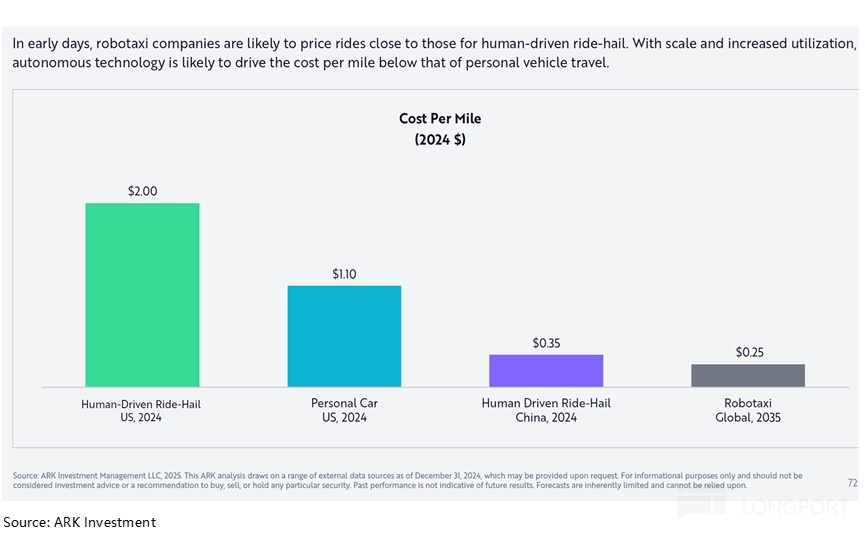
ARK Invest assumes all-in cost falls to ~$0.25/mile, well below US private-car ~$0.7–$1.0 and far below current Uber/Lyft ~$1.7–$2.0/mile (with labor as the largest component).
Elon Musk targets an even more aggressive $0.2–$0.3/mile for Cybercab. Dolphin Research estimates that range mostly covers depreciation + energy only, with insurance, cleaning/maintenance, and back-end ops not fully reflected.
Thus, Dolphin Research frames three more pragmatic 2035 cost scenarios:
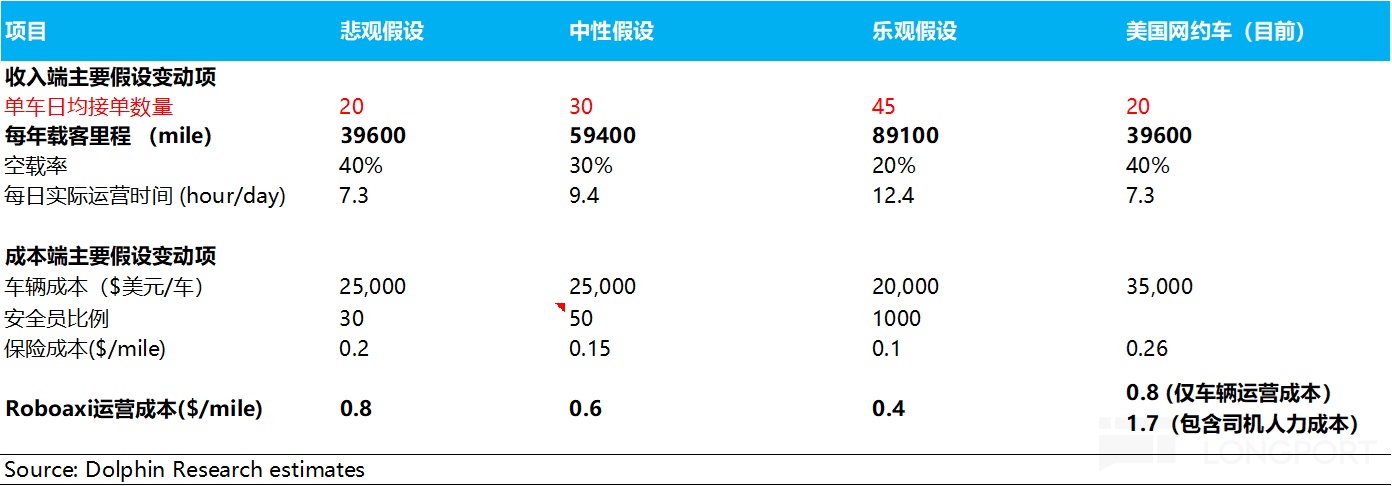
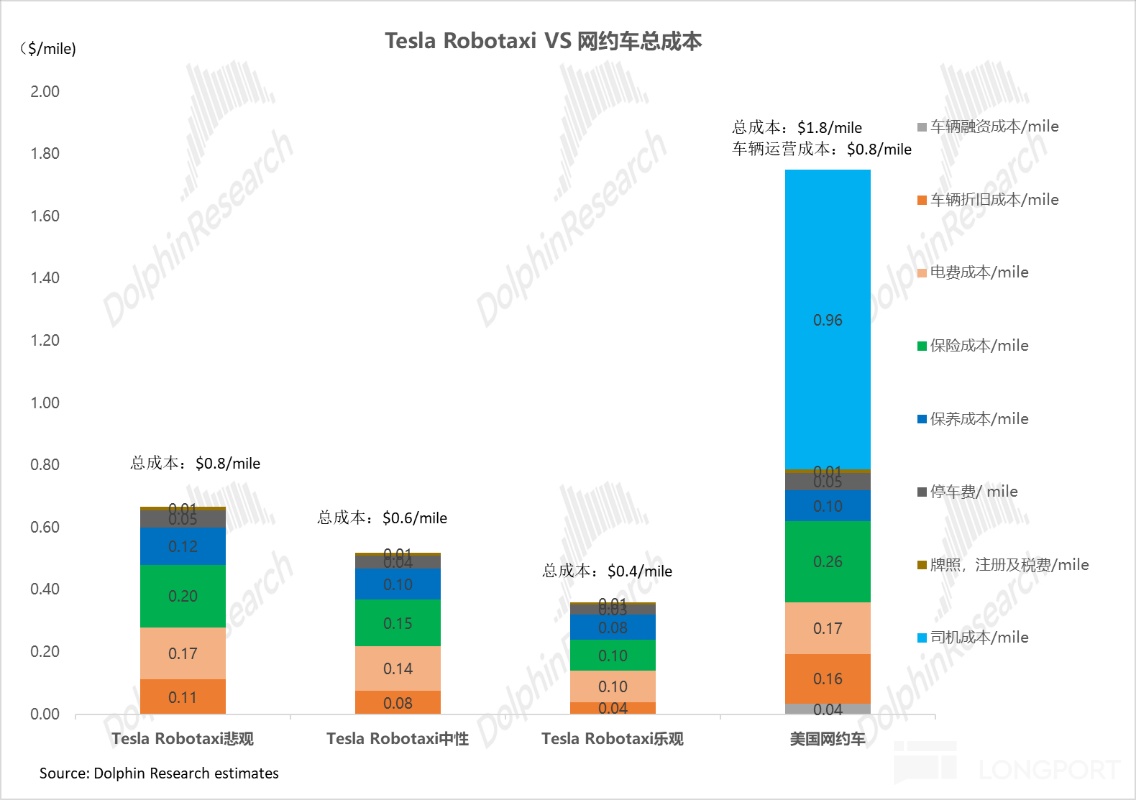
Bear ($0.8/mile): no efficiency gain vs. human ride-hailing (~40k paid miles/year). Low vehicle cost is offset by safety ops (1:30) and heavier maintenance, leaving costs roughly equal to a 'driverless' human-ride-hailing baseline.
Base ($0.6/mile): some efficiency gains (~60k miles/year, ~9.4 operating hours/day). Safety ratio improves to 1:50, insurance falls, and commercial efficiency starts to show through.
Bull ($0.4/mile): scale effects kick in (~90k miles/year, ~12.4 hours/day). Vehicle cost falls to ~$20k, with autonomy progress slashing safety and insurance costs. This may not hit Musk's $0.2–$0.3/mile target, but it is disruptive to incumbents.
Given high vertical integration (purpose-built AV platform + software/hardware), a vision-only stack, and Cybercab BOM already at ~$25k–$30k, Dolphin Research sees higher probability for $0.4–$0.6/mile for Tesla.
4) How big is the addressable market Robotaxi can reconstruct?
The ceiling hinges on whether pricing can break below private-car costs, which determines VMT penetration. In 2025, at $2.0–$2.5/mile, ride-hailing + taxis captured ~1% of VMT and ~$81.2bn of spend.
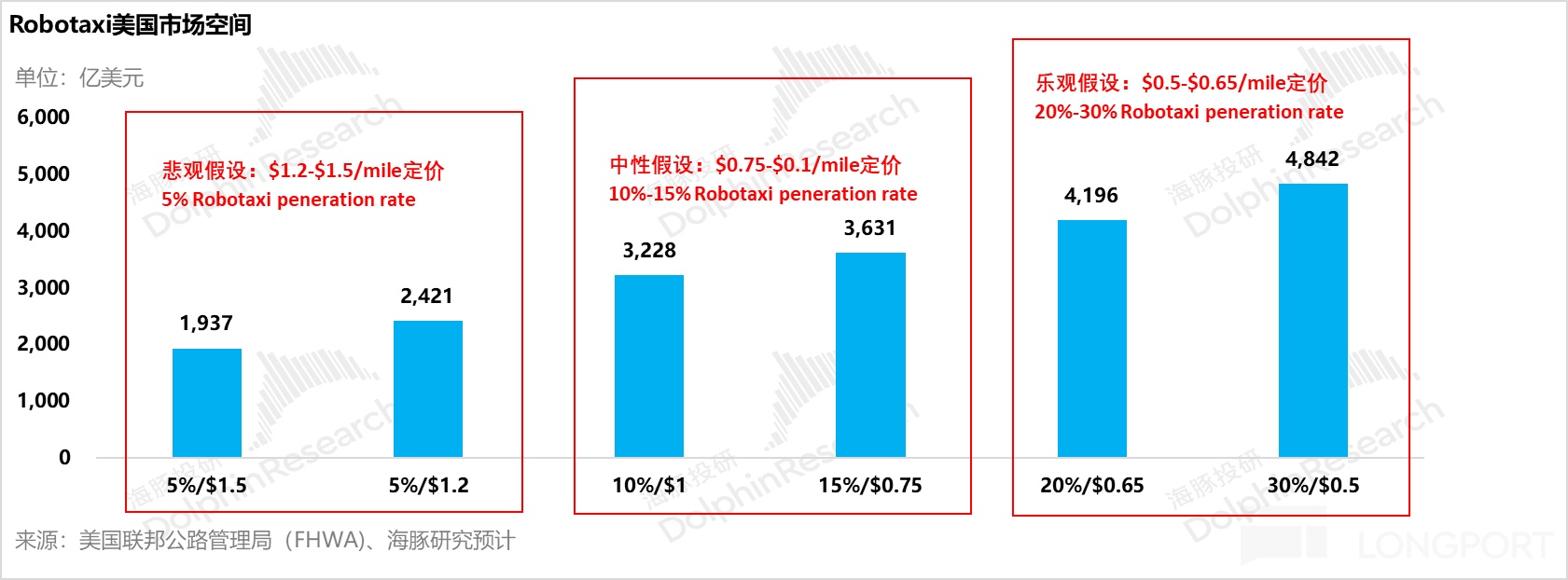
Looking to 2035, assume US VMT rises naturally to ~3.23tn miles (no major TAM uplift from Robotaxi). Different cost curves imply three outcomes by price:
i) Bear ($1.25–$1.5/mile): cheaper than Uber but still above private-car costs. Minimal substitution of private cars; penetration ~5% and market size ~$200–$240bn (2.5–3x today).
ii) Base ($0.75–$1.0/mile): at parity with private-car ownership, riders convert for convenience (no parking/insurance and no driving effort). Penetration rises to 10%–15%, market size ~$320–$360bn (4–4.5x).
iii) Bull ($0.5–$0.65/mile): clearly cheaper than private cars, making ownership uneconomic. Penetration reaches 20%–30%, and market expands to ~$420–$485bn (5–6x), reshaping mobility economics.

5) How much incremental revenue can Robotaxi add to Tesla by 2035?
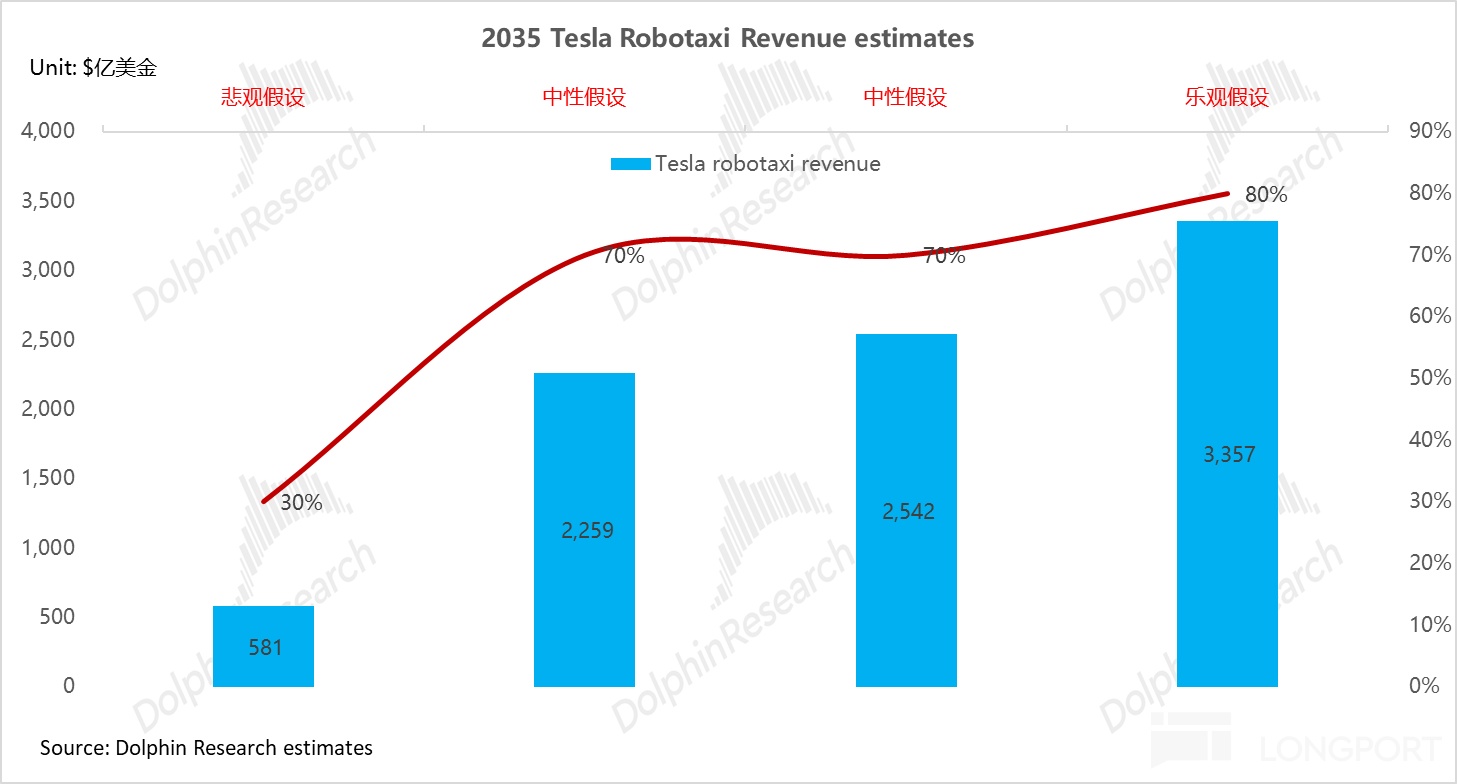
a) Bear: under-delivery on cost-down (pricing at ~$1.2/mile) puts Tesla in a red-ocean fight, with ~30% share. Robotaxi adds ~$58bn revenue in 2035, under half of 2025 total revenue.
b) Base (most likely): with $0.75–$1.0/mile pricing and a quasi-monopoly share of ~70%, Robotaxi contributes ~$220–$260bn revenue in 2035 (2–2.5x current revenue).
c) Bull: at ~$0.65/mile breaking below private-car costs, Tesla holds ~80% share, lifting revenue to ~3.5x the current base.
In the next report, Dolphin Research will assess the US Robotaxi competitive landscape and likely endgame. We will also frame the valuation uplift Robotaxi can support for Tesla: is the ~$1.5tn market cap front-loading the future, or underpricing the dawn of an AI era? Stay tuned.




The copyright of this article belongs to the original author/organization.
The views expressed herein are solely those of the author and do not reflect the stance of the platform. The content is intended for investment reference purposes only and shall not be considered as investment advice. Please contact us if you have any questions or suggestions regarding the content services provided by the platform.