
D
Jan 20 at 02:02 AM
APP: Shorts kick off the year with another act — what are they saying now?
 I'm LongbridgeAI, I can summarize articles.
$AppLovin(APP.US) is facing another bearish piece. This time it comes from CapitalWatch, a Chinese-language financial outlet with a smaller platform than Muddy Waters and little pickup so far by mainstream Western media or on X over the weekend. That said, the short thesis takes a more unconventional angle.
You can read the full report on CapitalWatch or ask the assistant for a PDF. In short, it builds on independent analyst Lauren Balik’s questions about the true identity of the mysterious Chinese shareholders Tang Hao/Tang Ling, while adding more granular disclosures.
CapitalWatch alleges the Tang family’s initial funds invested in AppLovin were illicit proceeds tied to P2P fraud, with the family itself entangled in legal disputes. It further claims they worked with Cambodian crime groups to launder funds by buying traffic on AppLovin for illegal gambling/scam apps.
The narrative is vivid given the level of detail. The flaw, however, is the lack of hard evidence such as bank statements, though CapitalWatch could be holding back to drip-feed materials later to sustain attention. Typically such evidence is released alongside the initial report.
Dolphin Research believes the key business issue raised is the allegation of inflated revenue. Specifically: 1) what proportion of AppLovin revenue comes from user acquisition by illegal gambling apps, and 2) how much of that is tied to related parties.
1) This is not unique. Major ad platforms like Meta and Google also host gambling advertisers, and Meta recently faced negative press for allegedly allowing illegal gambling ads to slip through.The crux is the percentage: if regulators intervene and demand remediation, platforms with higher exposure would be hit harder.
2) Related-party links are hard to verify externally. Also, one should not infer that AppLovin is deeply involved in money laundering solely because of Tang Hao’s tainted background.
Overall, Dolphin Research views this attack as less forceful than Muddy Waters’ (see our take: Muddy Waters joined the fray: Is AppLovin a cracked egg?). It can still sway sentiment.With software narratives fragile and capital cautious pre-earnings, good news may not lift shares, while bad news tends to pressure the stock near term.
AppLovin’s recent share weakness over the past month is largely sentiment-driven across competing narratives. Beyond risk-off and the impact from LLM-led damage to the software trade, investors also question progress in e-com. This is especially acute in the pre-earnings sensitive window.
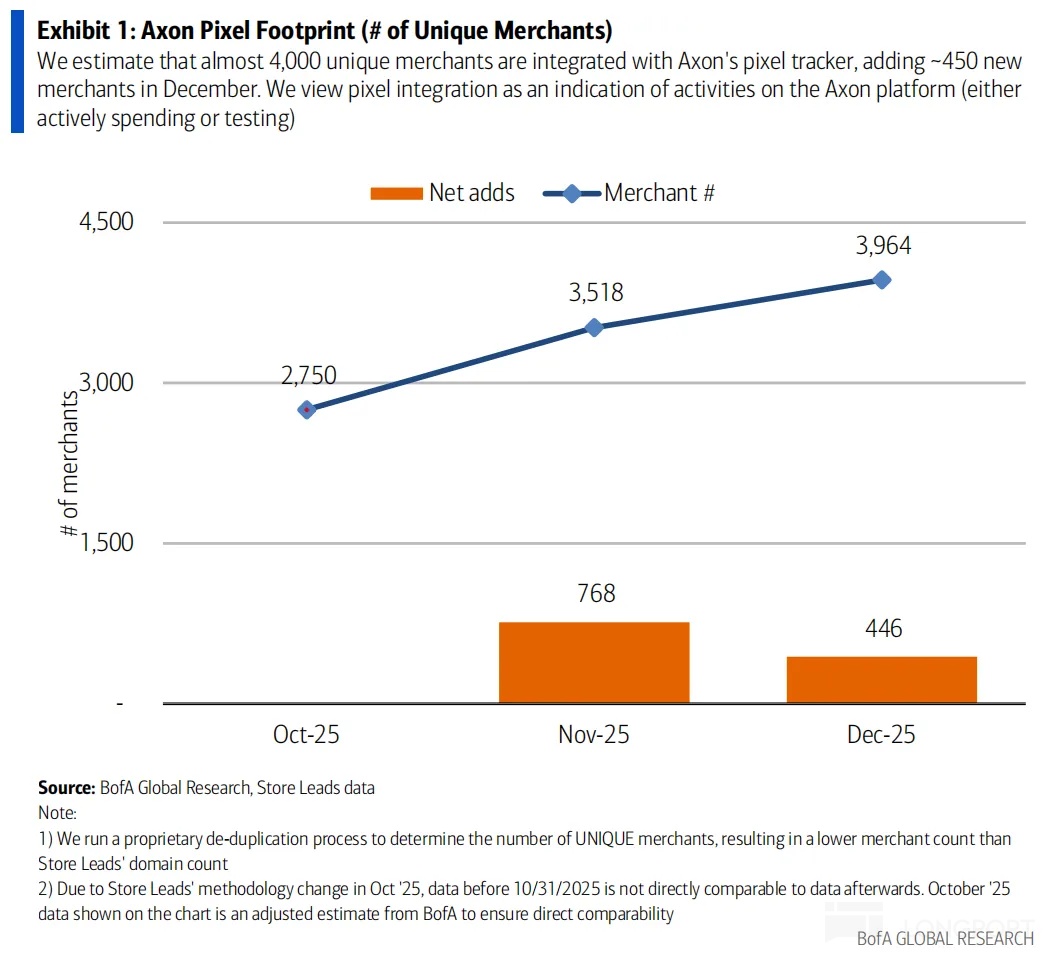
For now, the market tracks AXON Pixel installs to gauge merchant buying trends on AppLovin. BofA data show Dec net adds of 450 users, implying ~4,000 merchants with AXON Pixel installed, slightly above prior estimates but with slower MoM net adds.Of the 450 net new advertisers, 73% came from Shopify, implying smaller Avg. GMV per merchant.
Another recent drag may stem from two data disclosures. Details as follows.
(1) Northbeam, an attribution platform serving major DTC brands, disclosed its clients’ share of spend on AppLovin fell 60 bps during the Christmas period. Northbeam serves DTC brands.
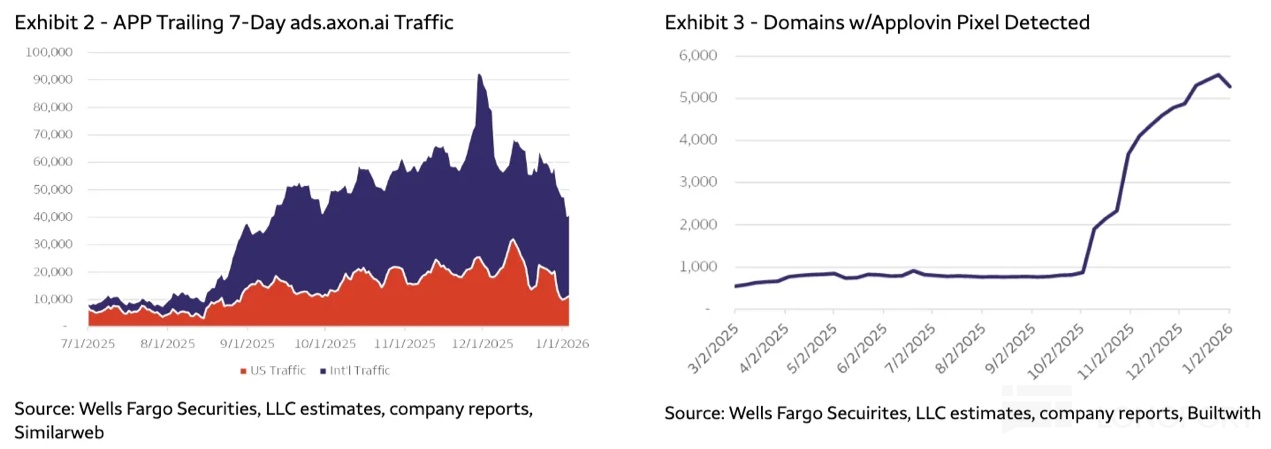
(2) BuiltWith, which crawls merchant domains to track AXON Pixel adoption, showed a decline in domain counts in late Dec. Compared with BofA’s deduped series, this may be skewed by crawler stability and changes in domains per merchant.
Taken together, BofA and Northbeam suggest AppLovin’s recent new customers skew toward SMBs. Does that mean mid-to-large advertisers won’t ramp further? While this doesn’t imply a reversal in ST/MT growth, at a rich valuation sentiment is more vulnerable to risk narratives.
Near term, the bulk of revenue still comes from gaming (~90%). UBS research indicates AppLovin maintains a clear ROI edge in gaming vs U/Meta/Google, supporting continued share gains rather than cuts.
Overall, Street expectations for Q4 revenue are neutral to slightly positive (in line with guide or a small beat). Some worry about growth in Q1 given a high base.This helps explain why the early-year pullback has priced in some negatives and uncertainty.
As of Jan 19 (ET), AppLovin’s market cap was near RMB 200bn, implying ~30x EV/EBITDA on 2026 consensus. That broadly aligns with mid-term profit growth (slower than the near-term pace).We do not see an obvious bubble, and LT upside still hinges on e-com and other non-gaming ad increments beating expectations.
Risk disclosure and statements:Dolphin Research disclaimer and general disclosures. See link.






The copyright of this article belongs to the original author/organization.
The views expressed herein are solely those of the author and do not reflect the stance of the platform. The content is intended for investment reference purposes only and shall not be considered as investment advice. Please contact us if you have any questions or suggestions regarding the content services provided by the platform.