

INTC (Trans): No foundry customers disclosed; supply remains constrained.
Below is Dolphin Research's Trans of the $英特尔 (INTC.US) Q4 2025 earnings call. For our First Take, see: Intel: AI CPU hype vs. a chilly guide — expectations doused?
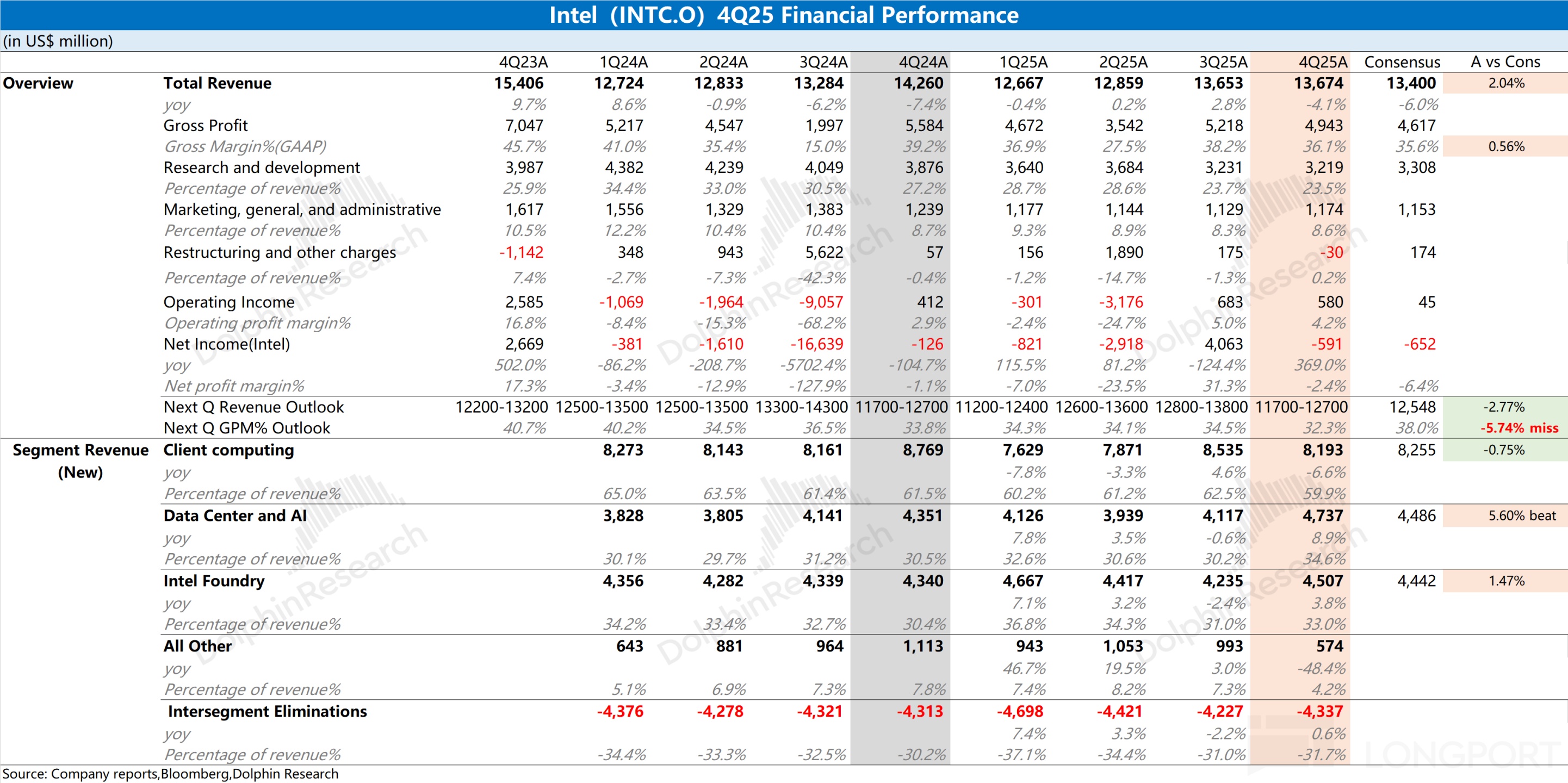
I. Key takeaways from Intel's call:
1) 18A progress: Launched Panther Lake, pulling forward delivery of 3 SKUs (vs. 1 planned). Yields are improving 7–8% per month, with focus on variance control, delivery stability, and lower defect density. There is tangible progress, though still short of industry-leading levels.
2) 14A progress: Incremental capex is paused pending customer commitments. Customers are expected to signal decisions from 2H26 to 1H27, after which spend will unlock. A realistic timeline is risk production in 2H27 and true volume production in 2028.
3) GPM: Next-quarter non-GAAP GPM guided to 34.5%, hit by lower revenue on a fixed-cost base and Panther Lake mix headwinds. A 34.5% margin is deemed unacceptable; the immediate goal is to lift it to 40%, then set a higher target once achieved.
4) Operations: Where possible, wafers are being prioritized internally for data center, while raising external wafer sourcing for Client. Strategically, capacity is tilted to data center under supply constraints, but Client cannot be abandoned.
On capex (ex-14A), 2026 is expected to be flat to slightly down, with more spend front-loaded in 1H. The aim is to better serve data center demand while keeping Client covered.
Overall: Shares rallied on CES 2026 Panther Lake news and recent Xeon price hikes. Even on 2027 numbers, the P/E is well above peers like TSMC and other U.S. semis, implying excessive expectations in the stock.
Those expectations hinge on two levers: foundry traction and a structurally higher GPM driving earnings recovery. The print offered neither a named external foundry win nor a stronger margin outlook, and instead guided GPM down, which the market finds hard to accept.
II. $Intel(INTC.US) headline numbers recap
Q4 2025:
Revenue $13.7bn, at the high end of prior guidance and the fifth straight beat. Non-GAAP GPM 37.9%, about 140bps above estimates.
Non-GAAP EPS $0.15 vs. $0.08 est., a solid beat. OCF $4.3bn; capex $4.0bn; adj. FCF positive at $2.2bn.
FY2025:
Revenue $52.9bn, slightly down YoY on capacity constraints. Non-GAAP GPM 36.7%, up 70bps YoY.
Non-GAAP EPS $0.42, up $0.55 YoY. Non-GAAP opex $16.5bn, down 15% vs. 2024.
OCF $9.7bn; total capex $17.7bn (incl. approx. $6.5bn offsets); adj. FCF -$1.6bn but turned positive $3.1bn in 2H. Cash and ST investments $37.4bn at year-end; $3.7bn of debt repaid.
III. Call details
3.1 Executive remarks
1) Strategy:
Transformation: Over the past 10 months, the foundation for a more focused, execution-driven Intel has been set. Streamlined org, less bureaucracy, added outside leadership, and a stronger balance sheet have improved efficiency and widened partnerships.
Challenges and resolve: Supply constraints capped market capture, and yields remain below target. Accelerating yields is critical for 2026, and rebuilding will take time and conviction as part of a multi-year journey.
2) Biz/products update & outlook:
Client Computing (PC CPU): Products & process: The Core Ultra line on Intel 18A (Panther Lake) reinforces position; 3 SKUs shipped ahead of plan (vs. 1). First products were launched and delivered by end-2025, with volumes above plan.
Market feedback: The 3rd-gen platform will power 200+ notebook designs, becoming the most broadly covered AI PC platform worldwide. Ecosystem depth is a key differentiator.
Roadmap & targets: Nova Lake lands by end-2026. The roadmap balances performance and cost, targeting 45% share with profitability in notebooks and desktops over the next few years.
AI role: PCs are becoming integral to AI infrastructure, with hybrid AI (cloud + client) accelerating. Intel will work with partners for seamless deployment across the stack.
Data Center & AI (server CPU, accelerators, ASIC):
Org integration: DCAI is consolidated to align CPU, GPU, and platform strategy. This is meant to tighten execution and shorten the feedback loop.
Server CPU demand & roadmap: Legacy server demand is solid as available capacity ramps. AI workloads are stressing infra capacity; Intel will keep scaling Granite Rapids and Sapphire/Emirate Rapids.
Roadmap shifted to focus on 16-channel Diamond Rapids and accelerate Coral Rapids. Multi-transaction capabilities are reintroduced into the plan.
Collab with NVIDIA: Co-developing a custom Xeon deeply integrated with NVLink. This targets higher interconnect bandwidth for AI-heavy workloads.
AI acceleration strategy: A full-stack AI and acceleration plan is in place, with deeper x86 CPU–accelerator IP fusion to come in the months ahead. Priorities include inference, genomics, and physics AI.
ASIC: Benefiting from AI networking and cloud-specific silicon demand, ASIC grew 50%+ in 2025, with Q4 annualized revenue topping $1bn. More resources and capital will be directed to scale this franchise.
Process & Foundry:
Intel 18A:
- First 18A products have begun shipping. Yield is improving steadily to meet strong customer demand.
- 18AP is on track, with PDK 1.0 delivered by end-2025. This keeps external enablement moving.
Intel 14A:
- Process development is on plan, with a broad IP portfolio and design enablement under build-out. The process kit is viewed by customers as an industry standard.
- Work with prospective external customers is active, with supplier selection decisions expected to phase in from 2H26.
Adv. packaging: Differentiated in IMP and IMT, with focus on quality and yield to meet 2H26 volume needs. This is a key early marker for foundry traction.
Foundry status:
- Q4 foundry revenue $4.5bn (+6.4% QoQ); external foundry revenue $222mn. EUV wafer revenue mix rose from sub-1% in 2023 to 10%+ in 2025.
- Foundry OP loss was $2.5bn in Q4, impacted by early 18A ramp. Yield is in line with internal plans but below ideal.
- Intel is the only manufacturer in volume with backside power delivery and gate-all-around shipping revenue. This is a notable technical milestone.
Capex outlook: 2026 capex to be flat to slightly down, more weighted to 1H. Spend underpins demand from 2027 onward.
3) Guidance:
Q1 2026:
- Revenue $11.7–12.7bn (midpoint $12.2bn). Within Product, CCG is set to decline more than DCAI as internal supply is prioritized for servers.
- Intel Foundry revenue to grow double-digit QoQ on richer EUV wafer mix and 18A pricing. Non-GAAP GPM ~34.5%, EPS roughly breakeven.
FY2026 framework:
- From Q2, internal supply improves as tool adds ramp and wafer starts grow across Intel 7/3/18A. DCAI is set for strong growth.
- Client CPU inventory is lean, and the 3rd-gen platform is highly anticipated. Watch DRAM/NAND/substrate tightness and pricing as potential constraints.
- Opex expected at $16.0bn; adj. FCF to be positive; plan to repay all maturities ($2.5bn).
3.2 Q&A
Q: Are near-term yield gains enough to offset typical seasonal revenue softness in Q1? And when could you loosen capex for structurally higher demand given rising confidence in 14A/18A, customer traction, and the internal roadmap?
A: Near term, higher yields and capacity are the best, high-ROI ways to add supply, and we are reasonably confident. We have cut building spend but are adding tools aggressively to address bottlenecks.
Wafer starts are ramping across Intel 7, Intel 3, and 18A each quarter, with conditions improving from Q2. For 14A, we will not commit capacity capex until customer commitments are in hand.
We see 7–8% monthly yield improvement focused on variance control, delivery stability, and defect density reduction across Panther Lake, 18A, and 14A. There is progress, but we are not yet at best-in-class levels.
Q: How should we think about the full-year margin path?
A: Q1 margin pressure has two drivers: revenue down on a fixed-cost base and Panther Lake still below corporate average cost structure despite sequential improvement. Its higher mix weighs on GPM near term.
As the year progresses, supply-driven revenue improves and Panther Lake cost normalizes further. A 34.5% GPM is not acceptable; first goal is 40%, then we will reset the target.
Q: With midpoint revenue guide at $12.2bn, what would an unconstrained Mar. quarter look like?
A: Hard to size precisely, but $12.2bn is at the low end of normal seasonality versus $13.7bn in Q4. With sufficient supply to meet demand, results would be well above seasonal patterns.
Q: Is the target to be the No. 2 foundry by 2030 (approx. $30bn revenue) still reasonable? How do you view the business?
A: We are building a world-class foundry. 14A development is on plan with a simplified flow and, critically, the customer IP portfolio build-out; yields and variance control are trending better.
We are engaging with key customers and expect firm capacity commitments in 2H, enabling capex deployment. Foundry is a service business built on trust and stable delivery.
Early success indicator will be advanced packaging, where revenue arrives before meaningful wafer revenue. Many opportunities are $1bn+ scale, and customers are even willing to prepay in a tight-supply environment.
Q: Server outlook, especially Coral Rapids timing and share implications while we wait?
A: We consolidated DCAI and built the team. Focus is on 16-channel Diamond Rapids with a simplified roadmap, while accelerating Coral Rapids to reintroduce multi-thread capabilities into the line.
We are confident, the team is in place, the roadmap is clear, and execution is decisive. Diamond Rapids remains the focus, with Coral pulled in.
Q: Can you shift more wafers from PC to data center for the rest of the year?
A: We are constrained and focusing Client on mid-to-high tiers, pulling back from low end. Any surplus goes to data center to meet strong demand.
This will cause some share shifts as we prioritize key customers across data center and Client OEMs. Allocation favors strategic partners under tight supply.
Q: If Q1 is below seasonal but unconstrained would be well above, should we model above-seasonal from Q2–Q4, or will Client constraints persist?
A: If supply lands as expected in Q2, we expect the rest of the year to run better than seasonal trends. That is our current planning assumption.
Q: On hyperscalers in servers, is momentum driven by them, and did shortages disproportionately impact them? What about enterprise?
A: Hyperscalers are critical to scaling. They affirm CPU-driven workloads across the board and are willing to sign LTAs, which we prioritize for deployment.
Engagement is high across silicon, software, and systems, with strong demand signals. ASIC designs with custom silicon that includes Xeon plus advanced packaging are a major collaboration opportunity.
Q: CCG down mid-teens and DCAI down high single digits — is that roughly right? Why is data center down so much if demand is strong and prioritized?
A: Both declines reflect supply constraints. We are steering as much as possible to data center but cannot vacate Client, so we are supporting both while fixing supply.
Q1 should be the trough with improvement in Q2. Finished-goods inventory that helped in 2H25 is now ~40% of its peak, so shipments are now gated by fresh wafer output.
Q: Why the inventory situation despite having your own fabs? You held $11.6bn of inventory but could not match demand timing.
A: Six months ago, the outlook assumed higher core counts but flat total units, echoed by every hyperscaler. Demand then surged in Q3–Q4.
We squeezed more from internal fabs, but our initial supply plan did not anticipate such a sharp data center unit ramp. That is the core driver of the mismatch.
Q: When will your external foundry efforts get recognized with meaningful revenue? How much external revenue defines success?
A: Engagement on 14A with prospective customers is very active. They are progressing on PDK 0.5 milestones, test chips, and observing yield, which is a process.
We expect customers to finalize specific volume products in 2H, after which we would expand capacity. In parallel, we must deliver required IP (low power, high perf, etc.) and yield to spec.
For 14A, a realistic path is risk production in 2H27 and true volume in 2028, broadly matching leading peers. More details may come at an Analyst Day in 2H.
Q: How do you size the 2026 server CPU TAM and x86 vs. ARM mix? Where does unmet demand go under tight supply, and when do constraints ease?
A: The demand surge we see is largely x86-led, tied to a refresh cycle needing to interface with AI systems where older fleets underperform. We will fight for share versus the other x86 competitor.
As supply improves through the year, we do not see constraints as the ultimate share driver. Product execution on 16-channel Diamond Rapids and pulling in Coral Rapids will matter most.
On customers, hyperscalers and top-tier OEM/ODMs remain pivotal. They state a clear preference for Intel CPUs and want as much supply as we can deliver.
Q: Given bullish AI demand and tight supply, peers are booking tools aggressively. Are you worried about longer lead times if you wait until late 2026?
A: We are actively procuring tools for Intel 7/3/18A and ramping wafer starts as much as possible. The pause is on 14A, which is tightly linked to foundry customers and must wait for commitments.
Near term, we are focused on optimizing existing tools and capacity to add supply via yield and cycle-time gains. These improvements require no capex and are a relative advantage for us.
Q: Will High-NA be used for 14A or more for 10A?
A: High-NA will be part of 14A. There will be variants within 14A, but 18A is the target for 14A positioning.
Q: Are customers designing 14A test chips already?
A: Yes, we are collaborating with some customers on PDK 0.5 and test chips. More importantly, they are scoping specific products to run in our fabs.
Capacity and pricing discussions are underway. As satisfaction rises, they will set volume and fab choices in 2H, while we parallel-path the right IP and yields.
Q: Is the team still supporting Clearwater or only Diamond Rapids? Has the next-gen Xeon 7 Diamond Rapids taped out, and any early view on HVM timing?
A: We continue to support the related products. When we say focus on 16-channel Diamond Rapids, we mean the high end to deliver a differentiated competitor in the future.
Multi-transaction matters a lot for performance and will debut in Coral Rapids. The question is how much we can accelerate it, and customers are eager.
Q: With memory tightness, any demand destruction in PCs? How do higher memory prices affect margins?
A: Memory is tight, with pricing pressure. Large OEMs and hyperscalers get more supply, while smaller customers struggle, so we are allocating to ensure CPUs ship to builds that can secure memory.
For Lunar Lake, we secured required memory early and feel relatively well positioned, though demand could rise. Since memory is integrated in-package, margins are lower on that product subset, weighing on overall GPM, in line with expectations from a quarter or two ago.
Q: Custom ASIC is at a $1bn annualized run-rate. How should we view its trajectory and customer breadth?
A: This is a ~$100bn TAM. We have hit a $1bn run-rate with strong demand as customers step up AI and networking-specific silicon, and advanced packaging is critical and attractive.
Intel can offer both custom silicon and packaging, which is our edge. We see a broadening customer base leaning into this capability.
Risk Disclosure and Disclaimer: Dolphin Research disclaimer & general disclosures
