

Minimax and Zhipu: The Ultimate Test for Large Models, Computing Power Intensity, and Funding Endurance?

Deep Dive on MiniMax and Zhipu: Will model scale, compute intensity, and funding stamina decide the endgame?
As the three-year mark since ChatGPT nears in early 2026, China’s two leading AI model startups $MINIMAX-W(00100.HK) and $Z.AI(02513.HK) listed almost simultaneously at roughly $6bn valuations. Both surged post-IPO, lifting the broader AI application space. Yet a closer read of their filings shows bottomless losses.
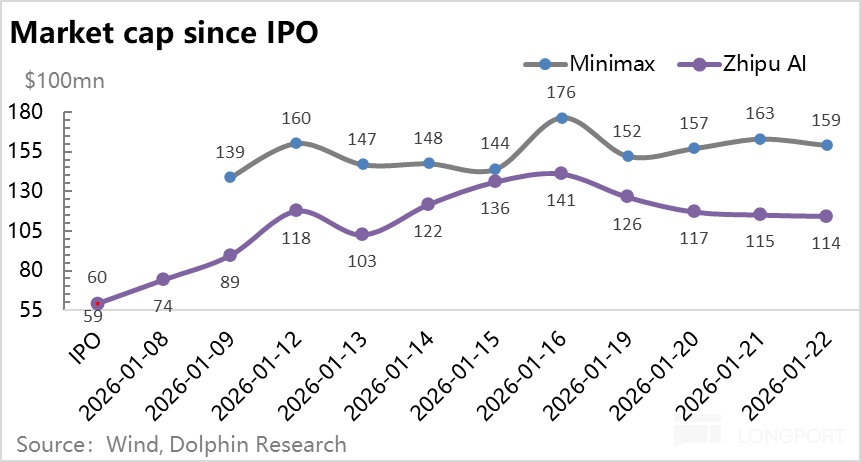
On one side, global LLMs are locked in aggressive price wars and look ever more commoditized. On the other, R&D remains a bottomless pit, even as share prices double. Against this push-pull, Dolphin Research has long asked what kind of business an LLM really is.
This time, drawing on the two newly listed names’ data, we take a hard look at the question. We focus on the following:
1) What inputs do LLMs require, and at what intensity? We examine this.
2) What role does compute actually play? We break it down.
3) How does model economics balance out? We run through the math.
4) What is the eventual business model? We outline potential endgames.
The analysis follows below. See details beneath.
I. Elevated revenue, daunting spend
MiniMax and Zhipu run lean — small teams, fast product cycles, rapid revenue growth. Headcount stayed under 1,000 by 2H25, with revenue scaling from near-zero to an annualized run-rate approaching $100mn in just 2–3 years.
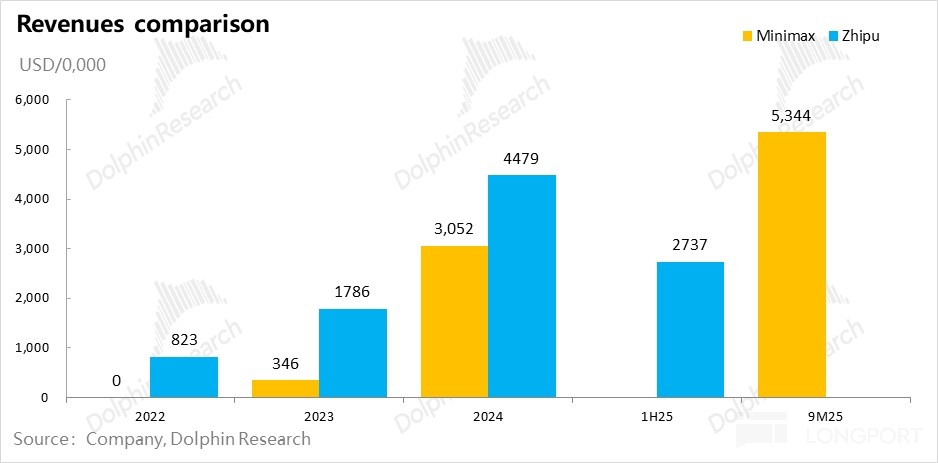
Costs dwarf even that rapid top-line growth. Zhipu, a Model-to-B player, sustained ~50% GPM through the ramp, and MiniMax, a Model-to-C player, turned GPM positive as it scaled. But both remain far from breakeven given the intensity of spend.
In 2024, total spend (COGS + Opex) for both hovered around 10x of revenue. MiniMax, despite fast growth through 9M25, still ran spend at more than 5x revenue, while Zhipu appeared even more sub-scale by 1H25.
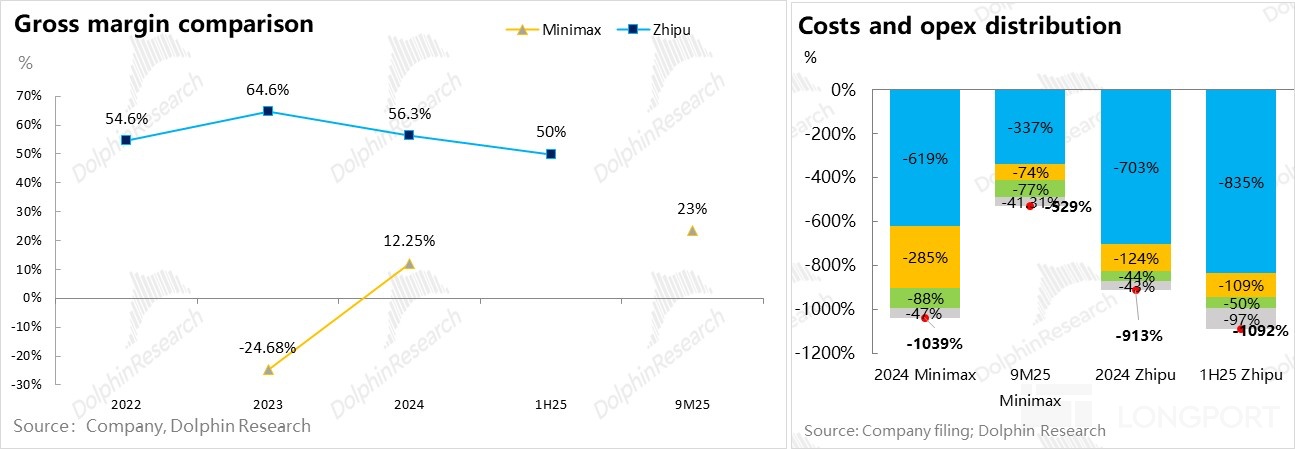
The core question: as revenue scales, do loss ratios narrow — or worsen via diseconomies? Data, compute, and algorithms are the three foundational inputs. The crux for scale economics is the input intensity LLMs actually require.
Training corpora are not publicly disclosed, but two broad points are widely accepted: a) public sources include encyclopedias, code repos, and Common Crawl;
b) most public and standard corpora have largely been exhausted for training. This narrows what can be gained from off-the-shelf datasets.
By 2026, firms rely more on synthetic data and chain-of-thought data. Looking ahead, more data will come either from ultra-fast deployment to capture more real-world scenarios, from incumbents’ proprietary troves (where internet giants have an edge), or from paid access to private datasets.
Because data usage touches compliance and privacy, filings reveal little. What does show up are compute and algorithms — with algorithmic advances driven by talent, and compute delivered via chips and cloud services. We examine these two in turn.
II. Talent is pricey — but not the core issue
Both companies kept headcount below 1,000, with MiniMax under 400; around 75% of staff are in R&D. Average monthly personnel cost runs RMB 65k–85k per person ex-SBC, with MiniMax’s R&D personnel at ~RMB 160k per month.
Because MiniMax runs leaner, payroll is at least covered by revenue as the business scales. Zhipu’s B2B focus requires more sales staff, and its heavier push on general-purpose models tempers labor-cost leverage.
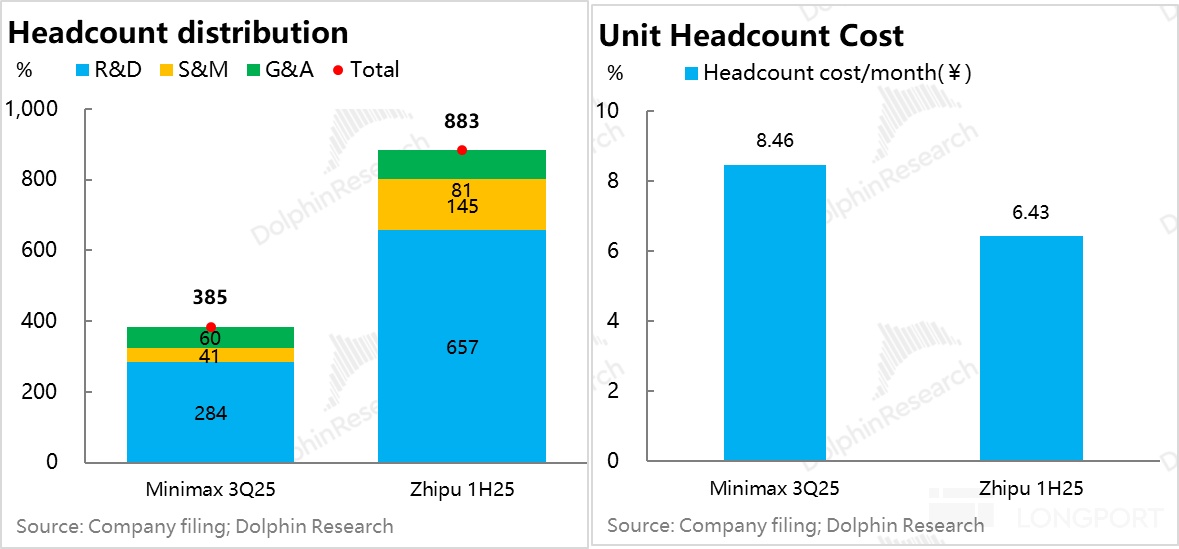
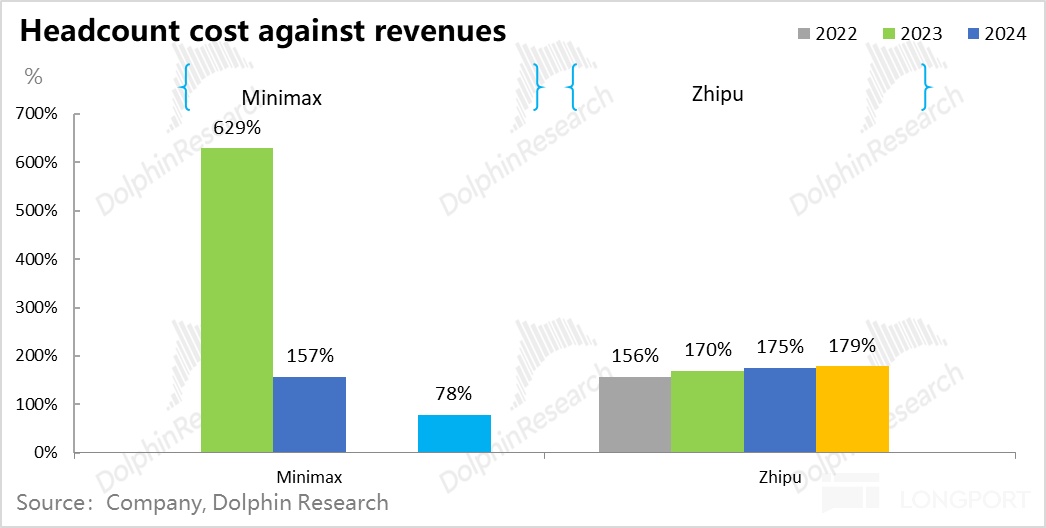
The takeaway: LLMs are about talent density, not headcount density. MiniMax’s profile likely foreshadows AI-era org structures.
A small cohort of elite model researchers is complemented by fewer roles elsewhere, as models displace many functions (MiniMax ships many AI products without massive staffing). Compensation per capita is very high, yet the total wage bill remains manageable.
MiniMax’s annual payroll is roughly $100mn (~90% of revenue). Given both firms’ base-model iteration pace, the speed of multimodal releases, and a fierce global talent war where a single hire can cost >$10mn, that payroll is not excessive. It is aggressive, but defensible.
III. Core tension: monetization vs spend — can they ever balance?
Payroll may absorb most current revenue, but compute spend dwarfs it. Wages can be diluted as revenue scales; compute, in both cases, is rising faster than the top line.
With minimal capex on the balance sheet, both rely on third-party cloud for compute. This is a lighter-asset model versus OpenAI’s more vertically controlled data-center approach.
Compute spend splits between training and inference in both firms’ financials. The split maps directly to the P&L.
In the training phase, spend is incurred before a marketable product emerges, akin to R&D that must precede commercialization. As such, training costs before deployment are pre-revenue, sunk investments and are expensed as R&D.
Once a trained model is deployed for inference and starts generating revenue, that revenue is recognized as sales, and inference compute is recorded as a direct cost in COGS. This aligns costs with revenue generation.
The logic is straightforward: companies must invest in people, compute, and data to develop models in the lab, whether or not a given model ultimately lands with customers. That development is a necessary sunk input.
Only once the model is productionized for inference — via API calls or consumer apps — do inference revenue and compute costs show up. That is when the unit economics surface.
For MiniMax and Zhipu, training compute alone accounts for 50%+ of total spend, the single biggest driver. It is a cash sink that contributes to more than half of their 5–10x negative margin.
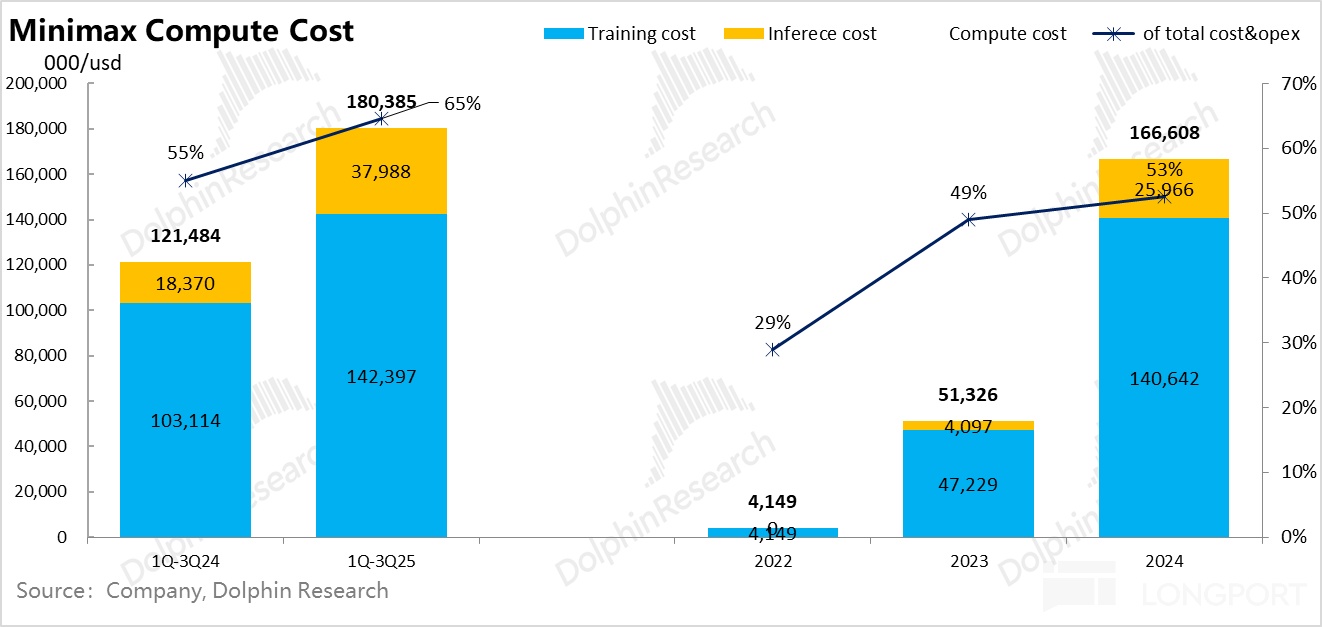
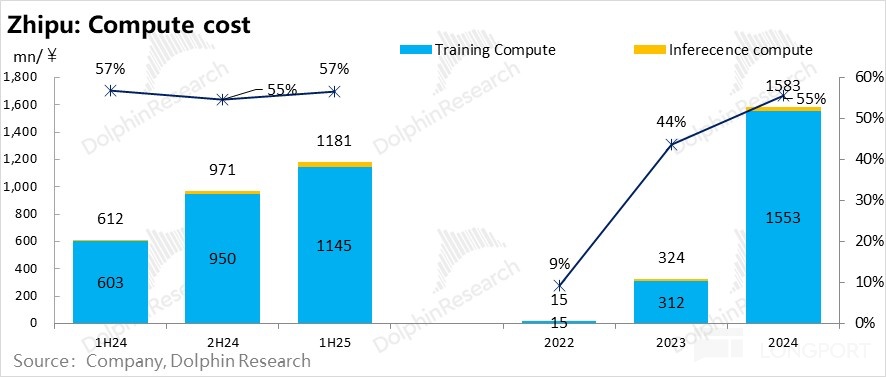
This share quantifies Dolphin Research’s prior thesis that compute drains profit pools across the stack. It is playing out in real P&Ls.
Comparing revenue creation vs. training spend makes the intensity stark. The gap is widening.
At MiniMax, 2024 revenue was only ~65% of 2023 training compute spend; despite fast scaling, 9M25 revenue covered just ~50% of 2024 training compute. Zhipu’s 1H25 coverage ratio was closer to ~30%.
MiniMax monetizes mainly overseas to-C emotional AI chat, embedding gaming and internet value-added services. The to-C internet scale effect, plus stronger overseas willingness to pay, eases pressure relative to peers.
Zhipu shows strong top-line growth but weakening recovery of training spend, as training costs rise with a steeper slope. Scale has not yet bent the curve.
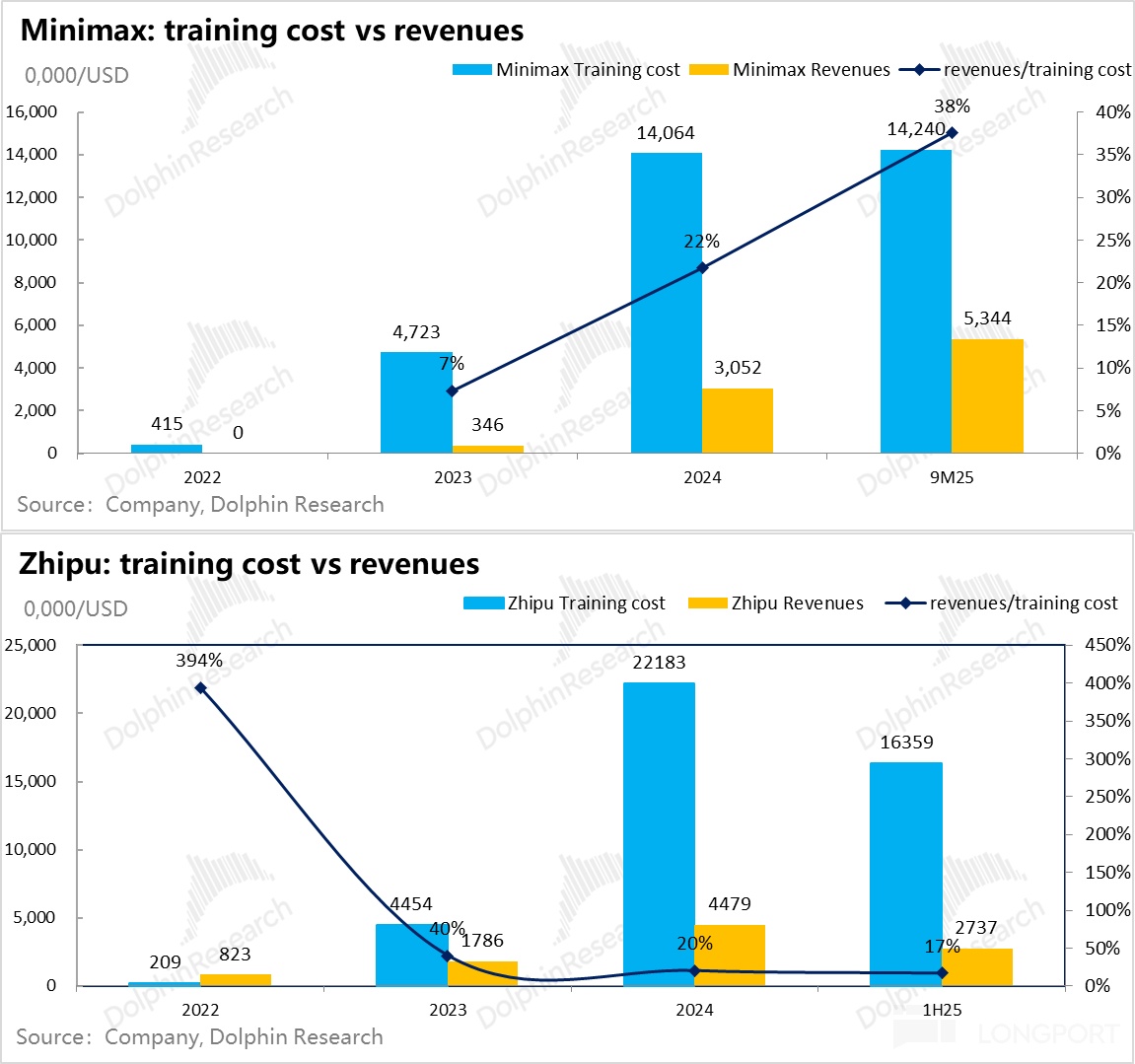
Over the past two years, both have grown rapidly as leading independent China LLMs. Yet current-year revenue has fallen short of recouping prior-year R&D spend.
Better models demand higher training costs, while revenue cannot catch up with ever-rising investment. If losses deepen with each generation, how should we think about the business value?
IV. What business model are LLMs, really?
Loss ratios approaching 1,000% underscore that LLMs are triple-intensive: talent, compute, and data. This is not a casual burn; it is structural.
Heavy investment and rapid iteration, in effect, turn a balance-sheet-heavy industry into one fully run through the income statement. Everything gets expensed in-period rather than capitalized.
LLMs gain long-term commercial value when they become true balance-sheet assets — train once, monetize for 10–20 years. Only then would capitalizing training costs have a sound business basis. Until then, it is P&L pain.
1) Compute: a rising ‘fixed asset’ outlay
For MiniMax and Zhipu, training a generation in 2023 cost roughly $40–50mn. To achieve linear step-ups in capability, the next generation requires exponential increases in data, parameters, and compute, and efficiency gains can paradoxically lift total compute demand.
Across both, each generation tends to raise training cost by 3–5x. The escalation compounds quickly.
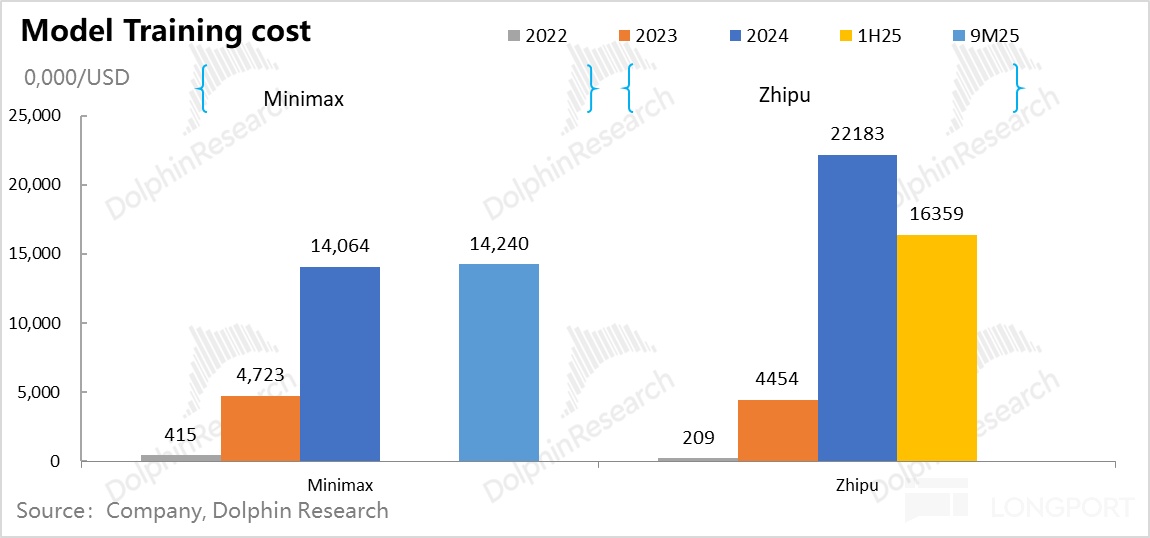
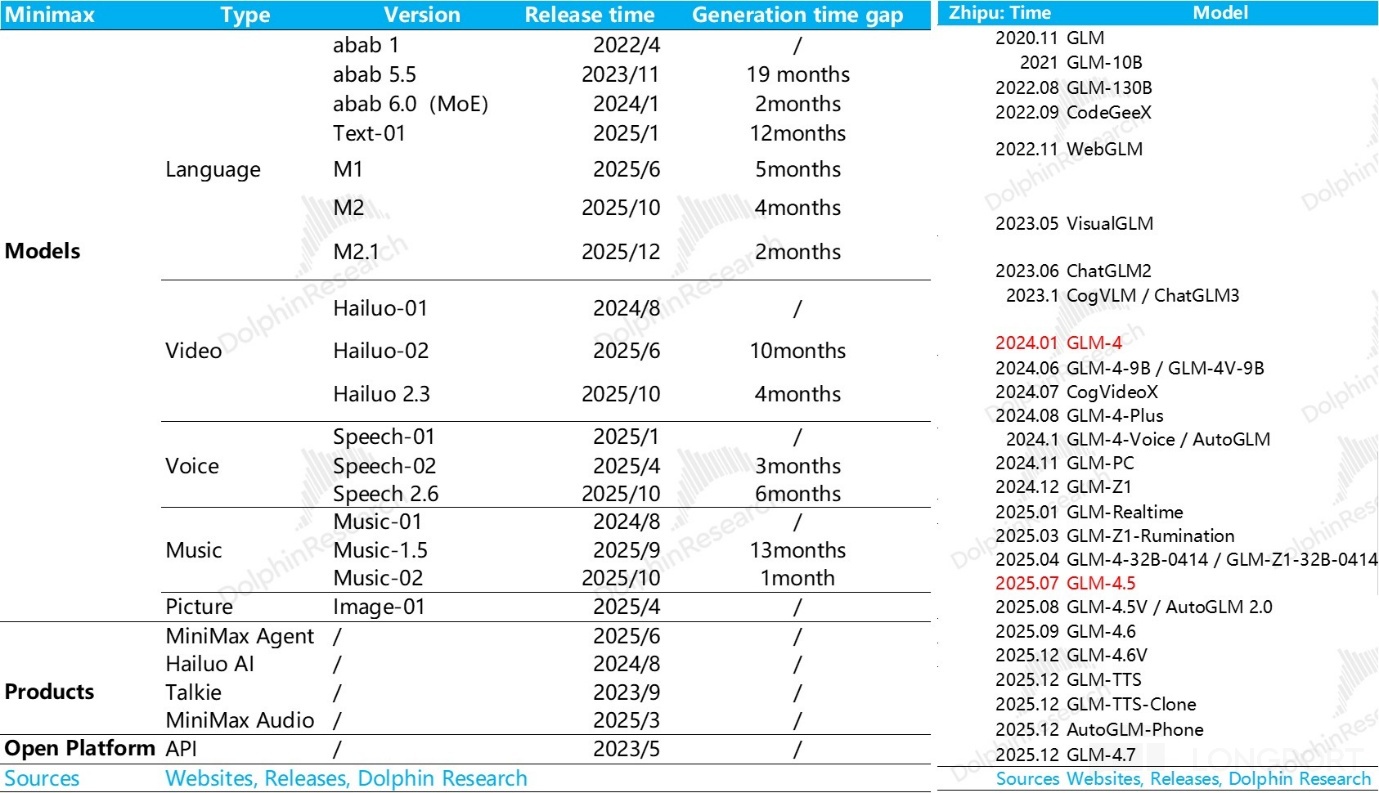
The cadence today is one new base model per year. A model trained this year effectively supports only about a year of inference monetization.
Such high compute cannot be depreciated across years and must be expensed as current-period R&D. That is how you get losses of 5–10x revenue.
2) Fast iterations: a cat-and-mouse game of revenue vs spend?
Both firms’ model revenue cannot yet cover compute, yet relentless reinvestment is unavoidable. Burning and building is the default for LLM R&D.
To make it to daybreak, companies must fund the next generation by adding payroll and raising capital equal to roughly 3–5x revenue. The financing extends runway to avoid obsolescence.
Roll this forward and revenue keeps chasing future spend. As long as they stay in the LLM race, they must keep raising, and the funding hole often widens with scale.
3) When scaling laws break: does the capital game end?
How long can this go on? The core issue is not just whether revenue growth can match training-cost growth, but when the input intensity and iteration pace can slow.
On the tech side, the turning point is when scaling laws begin to fail — when small gains in intelligence demand exploding compute. At that point, the need for constant retraining diminishes.
If high-frequency retraining ends, heavy training ‘capex’ pauses, and a single generation could monetize for 10+ years. If models keep earning without new training, the business starts to look utility-like, akin to a mature, regulated power asset.
That scenario presumes a war of attrition leaves only a few leaders, who avoid price wars and form an oligopoly, much like today’s cloud market. In that world, the LLM business model stands on firmer ground.
4) Until then, a brutal capital game
Before scaling laws break, LLM firms remain cash burners. Competition becomes a financing arms race.
For a few, financing prowess can be a differentiator, much as it has been for Nio. But capital is not a greater-fool game; it backs product quality and execution, and rising valuations reflect a two-way selection.
Media reports suggest China’s ‘hundred-model war’ has narrowed to five base-model leaders: ByteDance, Alibaba, Step, Zhipu, and DeepSeek. The field has consolidated fast.
Among the original ‘six dragons’ of model startups — Step, Zhipu, MiniMax, Baichuan, Moonshot, and 01.AI — 01.AI and Baichuan have fallen behind after DeepSeek’s breakout and fully open-source disruption of pricing. The shakeout is accelerating.
Overseas, the field is also down to five: OpenAI, Anthropic, Google Gemini, xAI, and Meta Llama. Even Meta appears to be lagging.
Some names keep raising at higher valuations, while others die on the road. In truth, financing strength reflects a combination of core talent, model strength, and product roll-out progress.
Core talent remains an ongoing, $10mn-plus global bidding war. The other two center on the model’s intelligence and, ultimately, monetization.
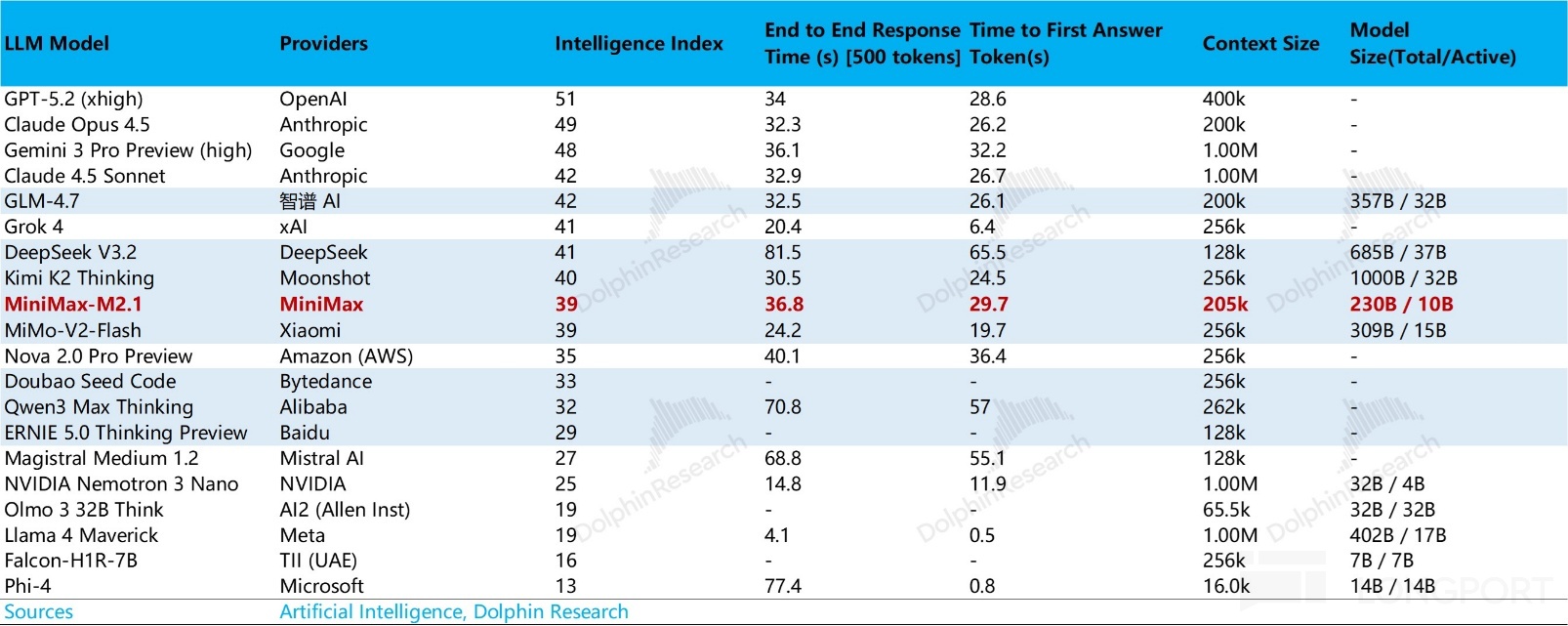
1) Model strength:
Survivors tend to appear on key leaderboards, reflecting competitiveness across dimensions such as reasoning ability, hallucination rates, parameter count, and time-to-first-token. These standings matter for customer adoption.
2) Product roll-out
Over the past year, many independents lost talent to internet giants, struggled to monetize, or were undercut by high-quality open-source models. Several failed mid-journey.
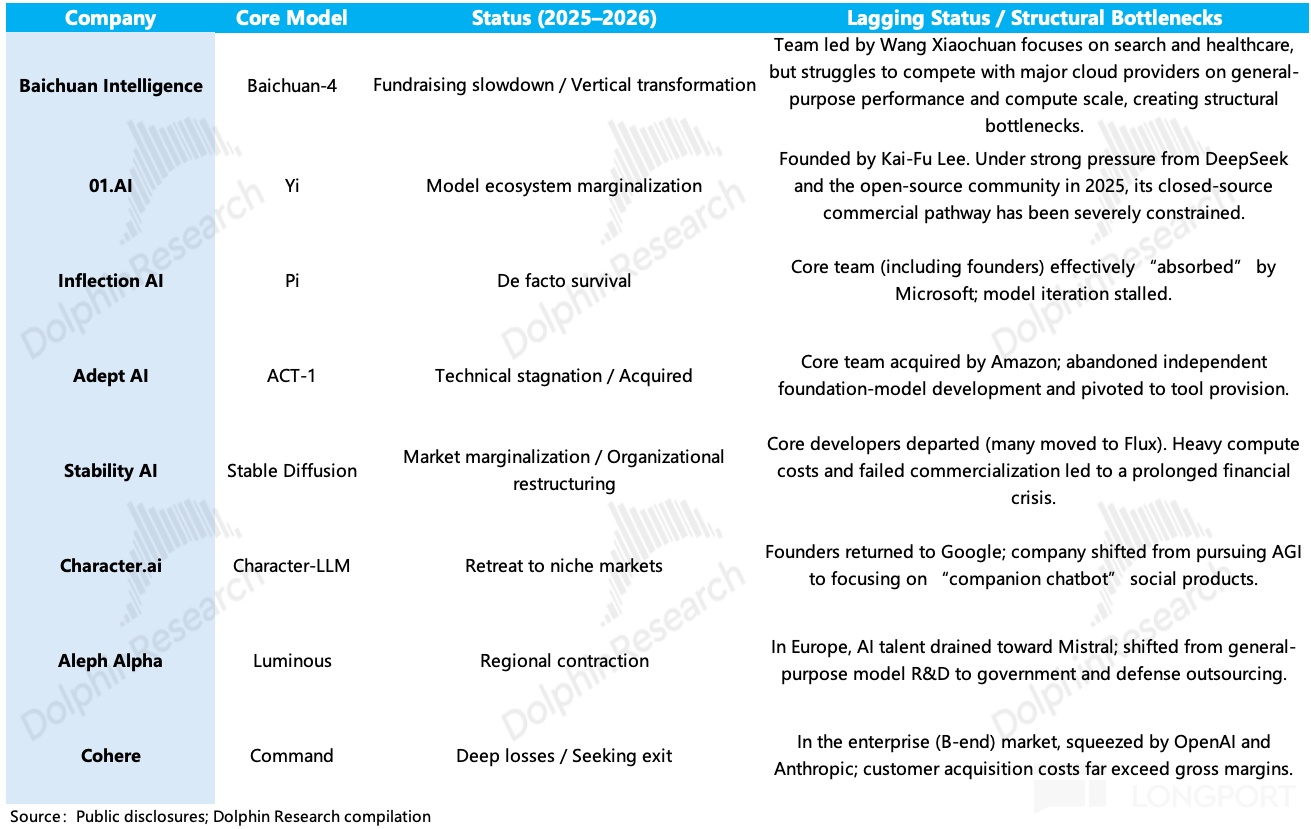
In short, until the ‘dawn’ of scaling-law saturation — and even for a while after — models will keep falling in a three-way contest of talent, model R&D, and product landing. The finalists will be decided less by headcount and capital alone.
More weight will rest on R&D progress and product roll-out quality. Those are the true differentiators.
The next piece will focus on Zhipu and MiniMax’s models and product landing to frame how to value LLMs in capital markets. We will assess both capability and monetization paths.
<End here>
Risk disclosure and statement: Dolphin Research disclaimer and general disclosure
Related articles:
‘Trillion-Dollar Question: After Splashing Out on AI, Where Does the Money Come Back?’
‘AI Bubble’s Original Sin: Is NVIDIA the Irresistible Stimulant?’
‘AI Internet Battle: A ByteDance–Alibaba–Tencent Three-Kingdoms Fight in 2026?’
The copyright of this article belongs to the original author/organization.
The views expressed herein are solely those of the author and do not reflect the stance of the platform. The content is intended for investment reference purposes only and shall not be considered as investment advice. Please contact us if you have any questions or suggestions regarding the content services provided by the platform.
