
D
Feb 4 at 09:45 PM
QCOM (Trans): Memory Shortage; Smartphone OEMs Cutting Production Plans
Below is Dolphin Research's compiled Trans of Qualcomm's FY2026 Q1 earnings call. For the earnings First Take, see 'QCOM: Memory Crunch Deepens; Mobile Stocks Not Spared?'.
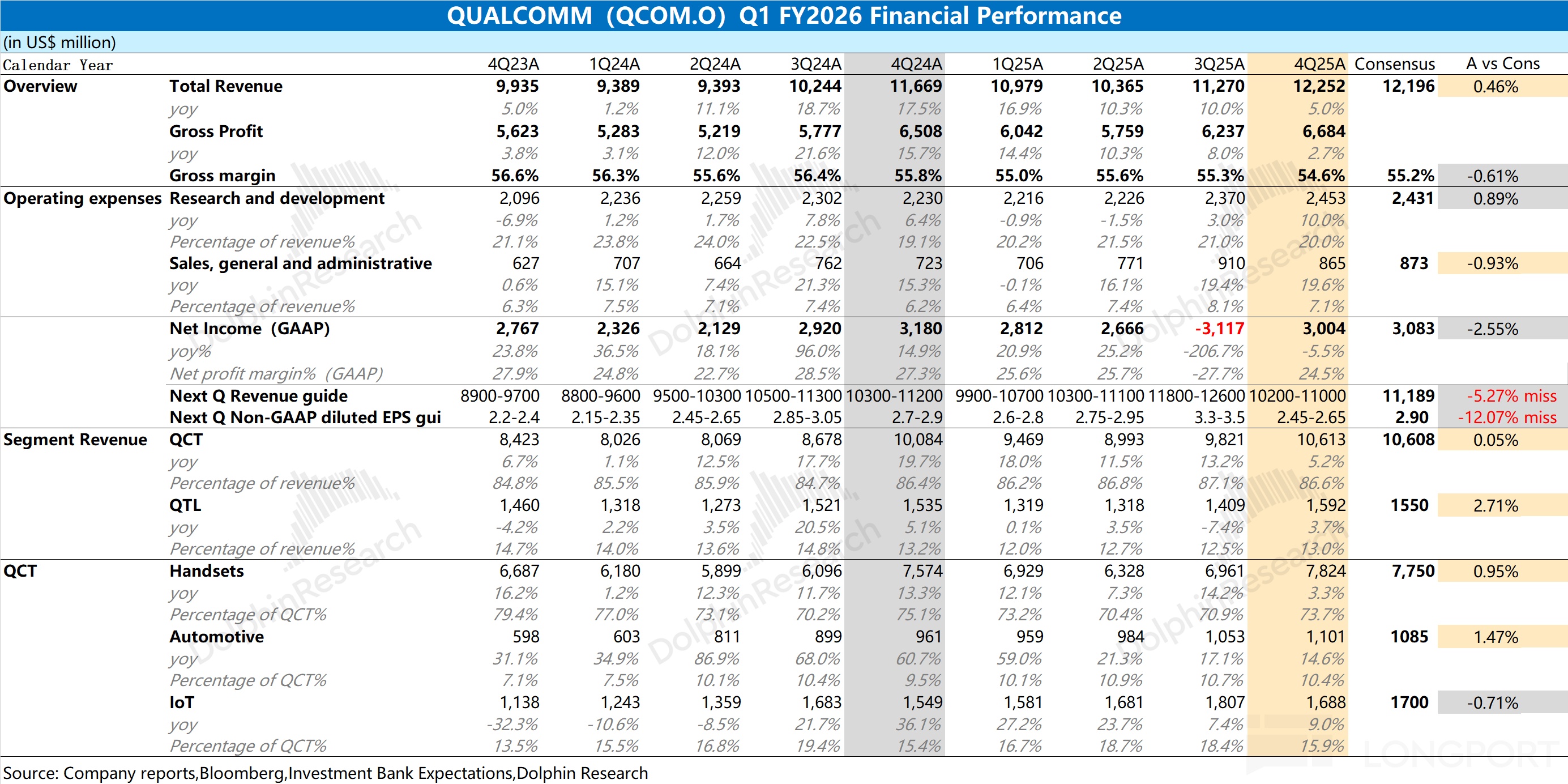
Key takeaways from the Qualcomm call:
1) Memory shortage: Over the next few quarters, smartphones will face both DRAM supply constraints and price pressure. As memory vendors pivot capacity to HBM to meet AI datacenter demand, DRAM tightness and price hikes are emerging across consumer end-markets, which could set the industry's total addressable size this fiscal year.
2) OEM behavior: Multiple handset makers, especially in China, are turning cautious, reducing chip inventory and trimming production plans.
3) Mobile downside: This is entirely memory-driven. It will not be a one-quarter issue, and the following quarter should be modeled off next quarter's seasonality baseline.
DRAM availability in consumer electronics is below demand, already visible in smartphones, with consoles and other devices starting to see the same. Impact on autos is milder as that market is less sensitive to memory price inflation.
4) Datacenter progress: No new customers disclosed. The focus is inference, targeting 5–500W workloads for small-to-mid scale deployments. Revenue contribution expected from 2027.
Overall, mobile remains the largest revenue driver and is most exposed to memory. Given next-quarter guidance of only ~$6.0bn for handsets (double-digit decline), the memory 'price up' narrative has escalated into an outright 'shortage', directly constraining build/ship plans.
Management also noted this is not a short-lived issue, implying significant full-year pressure. With the core mobile base soft and no new datacenter customers announced, the call offered little incremental confidence. If tight memory persists, consensus on earnings and valuation will likely move lower.
I. $Qualcomm(QCOM.US) headline metrics
Total revenue: record $12.3bn.
EPS: Non-GAAP EPS of $3.50, at the high end of guidance and a record high.
Segment revenue:
- QCT: $10.6bn, a record high.
- Handsets: $7.8bn, a record high.
- Auto: $1.1bn, another record, +15% YoY.
- IoT: $1.7bn, +9% YoY.
QTL: licensing revenue of $1.6bn.
Profitability: QCT EBT margin at 31%, above the 30% LT target. QTL EBIT margin at 77%.
Capital return: $3.6bn returned, including $2.6bn buybacks and $949mn dividends.
II. Qualcomm call details
2.1 Executive remarks
1) Industry dynamics and impact
Handset demand: global smartphone demand, especially premium, exceeded expectations with strong momentum through Q1 and into early 2026. Snapdragon design-win pipeline remains robust.
Memory constraints: over the next few quarters, smartphones face dual headwinds of DRAM supply and pricing. With supply shifting to HBM for AI datacenters, broad-based DRAM tightness and price increases may determine the industry's size this fiscal year.
Customer strategy: in this environment, many OEMs, particularly in China, are taking a cautious stance, cutting chip inventories and scaling back builds. This is reflected in next-quarter guidance. Management expects QCT handset revenue to revert to its prior run-rate and growth track once conditions normalize.
2) Business updates
Handsets: premium and upper-mid segments continue to expand, with strong Snapdragon adoption. For Samsung's upcoming flagship line, Snapdragon share is expected to hold at ~75%.
ByteDance launched its first Agentic AI smartphone powered by Snapdragon 8 Elite, a milestone in the shift toward AI-native phones.
Wearables and XR: wearables are evolving into personal AI companions, forming the next-gen mobile computing category. Snapdragon XR, wearables, and audio platforms are preferred by the industry, with partnerships across seven of the top nine cloud providers and 40+ personal AI devices in mass production or development.
PC: launched Snapdragon X2+ (an upgrade to the 2nd-gen platform). The Hexagon NPU leads peers in inference speed. At CES this quarter, OEMs unveiled 18 laptops powered by Snapdragon, and the company remains on track to commercialize 150 Snapdragon PCs this year.
Auto: demand for the Snapdragon Digital Chassis remains strong. A long-term supply LOI was signed with Volkswagen Group to support multiple brands, and Qualcomm will be the key tech provider for the VW–Rivian JV's software-defined vehicle architecture.
New or deeper partnerships span Toyota (RAV4), Hyundai Mobis, XPeng, Li Auto, ZEEKR, Great Wall, Nio, and Chery. The Snapdragon Elite platform has reached 10 total design programs.
IoT and edge networking: continued expansion in advanced compute, connectivity, and AI. The Orgentx acquisition enhances the vision portfolio. The new Dragon Wing processor launched alongside the Dragon Wing QX series for industrial PCs.
Advanced robotics: formal entry with a full-stack offering including Dragon Wing Q10. Partners include Advantech, Figure, and KUKA, with Qualcomm defining compute architectures for their platforms.
Datacenter: deep engagement with hyperscalers and CSPs. The next-gen inference CPU and novel AI architecture are receiving positive feedback, with shipments underway and third-party workload validation in progress.
The company closed Alphawave Semi to bolster high-speed connectivity and acquired Ventenna Microsystems to develop high-performance RISC-V CPUs.
3) Guidance (Q2)
Total revenue: $10.2–11.0bn. EPS: Non-GAAP EPS of $2.45–2.65.
By segment:
- QTL: revenue of $1.2–1.4bn, EBT margin 68–72%.
- QCT: revenue of $8.8–9.4bn, EBITDA margin 26–28%.
- Handsets: around $6.0bn revenue (primarily impacted by memory shortages).
- IoT: low single-digit YoY growth.
- Auto: YoY growth to accelerate to 35%+.
Opex: Non-GAAP opex at ~$2.6bn, up QoQ on annual comp reset and the Alphawave close.
2.2 Q&A
Q: Beyond memory pricing, what else is driving the weaker handset outlook? Samsung share is encouraging, but how should we think about full-year TAM? Will inventory correction largely end by the Mar. quarter?
A: It is entirely memory-related. Macro indicators and handset demand are solid, corroborated by licensing and sell-through data.
Unfortunately, the Q1-to-Q2 delta is all about memory. DRAM for consumer, especially handsets, is down YoY in availability as HBM gets priority in datacenters. The market will be capped by that, and we are already seeing customers align production to available memory.
Q: The step-up in QCT Auto guidance QoQ — is that ADAS ramps? What drives the higher level and is it sustainable?
A: Auto bookings continue to convert as new vehicles launch and ramp. Growth is mainly share-driven rather than industry swings, and we are confident in the trajectory toward the FY2029 revenue goal.
Design wins are increasing and our position is strengthening given the platform advantage. Flex, which integrates ADAS and digital cockpit, is progressing, with major programs entering SOP.
We announced a broad partnership with Volkswagen Group, and as OEMs see our stack deployed with BMW, ADAS traction is improving. Execution is on track.
Q: Datacenter customer progress — is memory volatility a distraction or, given BOM scrutiny, accelerating discussions?
A: Datacenter is tracking to plan, with publicly announced customers. Shipments have begun and third-party workload validation is underway.
The roadmap is on track with positive feedback and broad discussions with major hyperscalers and CSPs. Our differentiated platform performs well on specific workloads.
We are focused on execution, advancing on two fronts: adding a RISC-V CPU roadmap alongside ARM-compatible Orion, and executing AI 250 with a new memory architecture.
Revenue contribution is expected from 2027, and we feel good about that timeline. On memory volatility: we expect a milder impact in Auto given lower sensitivity to memory price inflation, while handsets are hit hardest.
Historically, premium tiers show more resilience to price hikes. The core issue now is availability, not just price, which will size the handset market, with OEMs likely prioritizing flagship models.
Consumer reaction to end-product pricing remains to be seen. The full-year handset TAM will be determined by DRAM availability, and we will monitor it closely.
Q: In premium, will OEMs downgrade chipsets/SoCs to manage costs and pass them on?
A: Despite tight memory, whenever memory is available, results are strong and consumer demand is robust. Over the years, within a flattish handset market, premium share keeps expanding.
That likely keeps OEM focus on premium. Our dual-flagship approach is resonating, and you may see more multi-tiered premium lineups like 'Ultra' variants.
Overall, we expect premium to be more resilient, assuming the available memory is what it is.
Q: Given China is particularly affected, how big is your handset exposure to China? After the Mar. drop, will normal seasonality return?
A: We do not break out revenue by region. Adjusted for market tiers within China OEM shipments, our effective exposure is lower than a simple unit-based view would suggest.
Seasonality on consumer demand should resemble history, with buyers waiting for premium launches, then purchasing in volume. As noted, the key is matching supply to demand, not demand itself.
Design-win momentum is strong, and the question is whether supply can catch up over the next few months.
Q: Opex ticks up in Mar. Will you adjust spending due to memory, or continue to invest?
A: The Mar. guide is a reasonable proxy for full-year opex. We remain disciplined under our framework: reduce investment in mature areas and fund diversification priorities.
M&A, such as Alphawave, brings incremental spend in datacenter and other priorities. Opex growth has been well below revenue and GP growth in recent years, and that framework will not change.
Q: Jun. quarter normally dips seasonally. With $6.0bn handset guidance in Mar. at ~13% YoY decline, should we expect a similar YoY decline in Jun., or is ~$6.0bn a reasonable level under current constraints? How to model Jun. off Mar.?
A: Given uncertainty, we are not guiding beyond Q2. Fundamentals on demand are strong; the issue is supply alignment.
Supply will determine the rest-of-year outlook. For intra-quarter modeling, you can use Mar. as a reasonable baseline for Jun., with seasonality similar to prior years.
Q: With demand intact but uncertain handset builds, how should we think about typical QTL run-rate by quarter for the year? Your guide seems in line to slightly below typical Mar. run-rate.
A: Dec. was strong with better-than-expected unit shipments. The next-quarter QTL guide is slightly below last year but broadly on trend, subject to supply.
Given supply challenges, our bias on full-year units is to the downside, but we need to see how the next few months unfold.
Q: So, modestly below a typical Mar.-like level is a fair assumption based on what you know?
A: Yes, that is the framework we are using.
Q: QCT margin guide is down over 100bps. Beyond lower revenue, any other factors like wafer cost or competition?
A: No other drivers. We expect GPM roughly flat vs. Dec., with margin changes driven by scale and the opex guide.
This aligns with trends peers are seeing as handsets adjust to the new production reality. Seasonality also plays a role, as many premium models launch around Lunar New Year, followed by a seasonal production dip for China OEMs.
Q: Any update on Huawei licensing? What are the sticking points, and is there risk if no deal is signed?
A: No update on Huawei; discussions are ongoing. We cannot disclose specific sticking points.
The two negotiation tracks are quite different, and for the other company we typically start discussions well ahead of renewal. No further update at this time.
Q: DRAM makers say they can meet only 50–70% of demand, with shortages possibly into 2028. How are you planning for that? Are China customers considering CXMT, and are you certified? Given Samsung's internal DRAM and your wafer commitments at TSMC, does this benefit you? How do you manage the uncertainty?
A: To clarify, for handsets we generally do not procure memory ourselves (except some stacked-memory modules); OEMs buy memory directly. At our scale, we are typically first to be certified across memory vendors.
We are certified with all suppliers, including CXMT. Our platforms are designed for flexibility across generations, with multi-gen controllers, so we can work with any available DRAM.
On the broader trend: datacenter growth continues, and memory makers have prioritized HBM capacity. Consumer DRAM availability is below demand, already visible in smartphones, and consoles and other devices are starting to be affected.
We cannot predict whether this lasts into 2027–2028, as it depends on datacenter demand. It is reasonable to assume this fiscal year's handset TAM will be set by DRAM availability.
On leading-edge wafers: supply is also constrained, but with strong supplier relationships we are confident in securing enough wafers to meet demand.
Q: If mix shifts toward more Snapdragon while total units fall, how should we think about QCT EBT margin?
A: We over-index in premium, so a mix shift up is typically favorable for margins.
Q: If Apple secures a disproportionate share of DRAM, how do you support all partners? Does this raise uncertainty into next fiscal year?
A: It is hard to predict, though note we also have another major customer with an internal memory division. Larger OEMs can generally secure more supply and will be prioritized vs. smaller OEMs.
That said, this is likely an industry-wide issue, and no OEM is fully insulated. Broadly, what we see is a supply problem, not a demand problem.
Q: On datacenter, what recent events validate your decoding advantage? What has happened since the NVIDIA collaboration? How are discussions progressing and what role do you play in the broader trend?
A: Many companies recognize Qualcomm's technical depth and execution track record. With our IP roadmap, we are among the few addressing the full 5–500W envelope.
We will enter focusing on inference, especially decoding. On decoding, we are highly competitive in power and overall TCO compute and memory density.
We are executing to plan and receiving strong feedback from large customers, from technology to product. The key now is execution and proof points.
Risk disclosure and statement: Dolphin Research Disclaimer and General Disclosure
Login to unlock14,318characters for free
This content is only available to signed-in users. Sign in to your Longbridge account to read the full post.

