D
Feb 11 at 03:05 AM
HOOD: Stock Halved? Let Earnings Speak, Other Notes ---
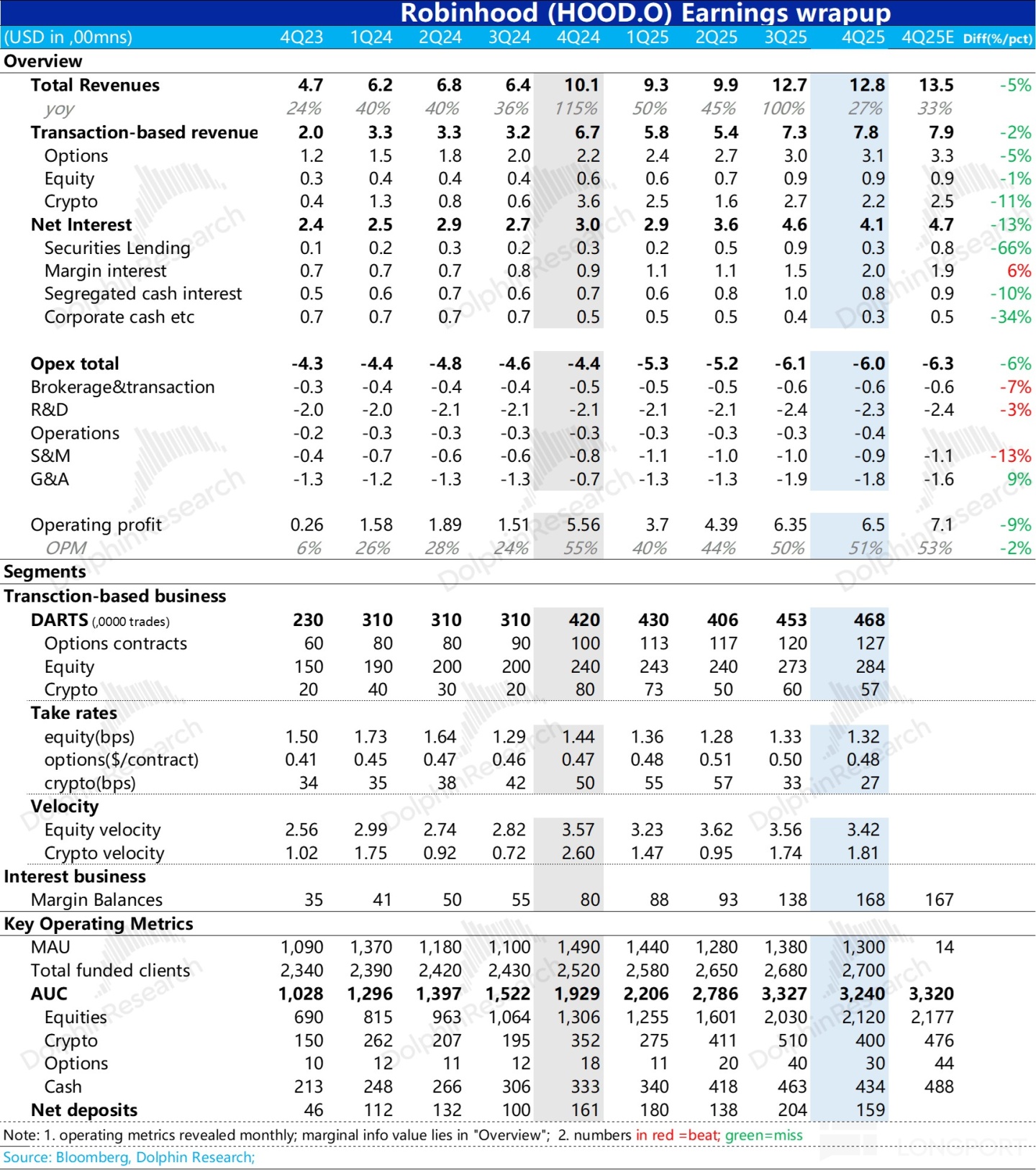
Below is Dolphin Research's transcript from HOOD's FY25 Q4 earnings call. For our earnings take, see 'Robinhood: After the spike, what is left for the US retail king?'
I. Key Financials Recap
Customers & Assets:
Total platform AUC rose nearly 70% YoY to $324 bn. This highlights broad-based asset growth.
Net deposits hit a record $68 bn for the year, up 35% YoY. Inflows remain resilient.
Delivered positive net transfers from every major broker rival for eight straight quarters. Competitive share gains continued.
Robinhood Gold subscribers reached 4.2 mn, up nearly 60% YoY. Premium adoption is scaling.
Gold (credit) card users are expected to exceed 1 mn by end-2026. The product is gaining traction.
Trading & Scale:
In its first full year of ops, the prediction market surpassed 12 bn contracts traded. Year-to-date 2026 contracts already total 4 bn.
Short selling launched in FY25. Within just a few months, equity notional traded reached $11 bn.
We now have 11 businesses each with annualized revenue over $100 mn, Legend on desktop is nearing target, and the Gold credit card is on track to meet the 2026 goal. Other lines, including TradePMR, futures, index options, and private banking, are also progressing well.
2026 Opex Outlook:
Adj. OPEx plus S&M is guided to $2.60–2.725 bn in 2026 (midpoint implies ~18% YoY growth). Investment remains disciplined.
Bridge: ~5 ppt from scaling existing businesses, ~3 ppt from amortization tied to FY25 Bitsmap and TradePMR deals, and ~10 ppt to fund new initiatives. The growth mix is balanced.
New initiatives include the Robinhood Gold Card, Robinhood banking services, strategic investments, prediction markets, the Cortex platform, Robinhood Social, Robinhood Ventures, Robinhood Chain, tokenized real-world assets, and ongoing Intl expansion. Execution will be staged.
II. Earnings Call Details
2.1 Management Highlights
1. Progress on three strategic pillars:
1.1 Go-to platform for active traders:
The prediction-market super-cycle is just beginning, with the Rothera JV with Susquehanna set to launch. The pipeline is robust.
Product expansion: Short selling went live and reached $11 bn in equity notional within months. Early demand is strong.
1.2 Win a larger share of next-gen wallets:
Gold Credit Card: Users grew 5x in 2025 to 600k, with annualized spend above $10 bn. The plan is to double to 1 mn in 2026.
Banking: Early reception is strong, with 25k+ customers and $400+ mn in balances. Over 50% of funded users set up direct deposit, indicating product-market fit.
Asset mix: Over 40% of total assets sit in ETFs, advisory, retirement, and cash. Diversification is improving.
1.3 Build a leading, long-term global financial ecosystem:
Intl expansion: Non-US customers reached 750k. Bitstamp acquisition closed, and volumes have continued to double.
Last week in the UK, ISA (tax-advantaged) accounts launched. UK product breadth is expanding.
Tokenization: About 2,000 stock tokens are available in Europe, establishing an early lead. In 2026, focus will be on permissionless, 24/7 public-equity token trading and tokenization of private-company shares.
2. 2026 roadmap and focus areas:
Active trading: Accelerate personalization, cross-asset optimization, and UX testing. The aim is higher engagement.
AI - Cortex: The Cortex assistant inside the main app targets end-to-end financial needs and could reshape trading. Rollout is expected over the coming weeks to months.
Robinhood Social: Rolling out to first cohorts soon, now with prediction integrations. Social discovery will be central.
Family investing: Build a multigenerational platform by integrating family workflows. From credit cards to banking, next comes advisory, with more to be announced at a major NY event next month.
Private markets: Via Robinhood Ventures, package private assets into registered vehicles for US retail access. Management believes this could ultimately outscale prediction markets.
Tokenization & blockchain: Launch and scale Robinhood Chain (L2), enhance Wallet, further integrate CeFi and DeFi, and enter multiple new Intl markets. The platform approach is expanding.
In Europe last year, we gifted OpenAI and SpaceX stock representations to select customers. Early signals were encouraging.
AI internal use: AI now resolves 75%+ of customer support cases. In 2025, AI delivered nine-figure cost savings and efficiency gains across functions.
2.2 Q&A
Q: Any further update on Robinhood Social?
A: Robinhood Social is in internal testing, and we recently added prediction features. It is not just an idea board, but also an engine to discover new assets.
Other firms struggled likely due to limited content diversity. With our large customer and asset base, diversity should be high.
We are increasingly confident it will be a great discovery and engagement tool. We are close to a public launch in the coming months.
Q: Why has HOOD fallen 40%+? How will management address the drawdown?
A: We stay focused on fundamentals and are pleased with the metrics. We gained share across most businesses in the past year, with $68 bn net deposits for the year and $16 bn in Q4.
Looking ahead, we have a strong product pipeline, from early-stage launches like Banking to upcoming products such as Robinhood Social and Cortex. These could be transformative.
As a public company, we have seen cycles over five years, and over time share prices follow performance. We will keep serving customers and improving products.
We also have a $1+ bn buyback in place. Volatile periods can be a good time to execute.
Q: With softer crypto and the NFL season over, how do you mitigate the impact?
A: Crypto is evolving from an asset class to the underlying tech for all asset trading, reflected in our non-US tokenization efforts and Paxos USDG collaboration. We remain constructive long term.
We are bullish on bitcoin and believe crypto and traditional finance will converge. We stay focused and are not distracted by short-term moves.
On prediction markets, while NFL ended, Jan. NBA contract volume exceeded NFL, and non-sports contracts like a government-shutdown market also saw solid activity.
Longer term, prediction markets extend far beyond sports. With more contract variety and better UX, we expect broader trader adoption.
We now have 11 lines each at $100+ mn annualized revenue, adding diversification. Crypto was nearly $1 bn of revenue last year but just 18% of total, with 80%+ from non-crypto.
Prediction markets are growing fast but still a small contributor. We will keep broadening the product set.
Q: For prediction markets, what will the JV prioritize, and what new products are coming?
A: Priorities include upgrading the trading experience, especially in sports, by adding parlays and player contracts. Depth and tools are improving.
We will connect assets across the platform to surface relevant prediction markets contextually. Discovery will be embedded across flows.
We also overhauled search, discovery, and the home page to support multi-asset, including prediction markets. This should lift engagement.
Next, we will display relevant prediction contracts across the app, such as on a stock's detail page to present a fuller picture. The goal is a unified view.
We see more new customers coming for prediction markets and will streamline onboarding. Cross-selling into retirement accounts and more is a core super-app advantage.
Additionally, the Rothera JV (a HOOD and Susquehanna-backed market and clearing venue for prediction markets, with DCM, DCO, and SEF licenses via MIAXdx) lets us vertically control the stack, from listings and pricing to economics. That control matters.
We expect front-end trading to standardize over time. Our aim is to deliver the best fills and pricing, and Rothera is key to that.
Q: How do you think about Intl expansion strategy across Europe and Asia, investment focus, and listings?
A: 2026 is a major Intl year. In the UK and EU, we will keep deepening the product suite and ship scalable features fit for non-US markets, such as the new multi-currency wallet and UK ISA.
In the EU, we treat it as a crypto-native testbed with tokenization at the core. It is a useful proving ground.
Tokenization will accelerate this year, and by year-end, benefits like 24/7 trading and self-custody should outshine traditional products. We plan to lean in.
We will also expand in parts of SE Asia and other regions. With regulators and an Intl-first design, time-to-launch per market will shorten materially.
We currently serve 750k Intl customers and expect to scale into the millions. Growth should be rapid.
Q: Competitors talk a lot about AI. Is AI a tailwind for Robinhood?
A: Yes, AI is a secular tailwind that will transform financial services. We are testing Cortex across Legend and the app.
The in-app Cortex Assistant will launch in the next few weeks, pending final polish. Customers will get it soon.
In advice, we see two shifts: powerful self-serve tools that let users decide, and redesigned advisor workflows that cut costs and expand reach. We are building for both.
For the former, Cortex can deliver recommendations, and we are engaging regulators on a safe rollout. The tech is in place.
Cortex has made strong progress, and we will launch it safely. We believe it can reshape wealth management.
Q: With ROI-focused spend, how should we think about revenue growth vs. expenses in your budget?
A: Our core principle is profitable growth. We will invest for growth and do it profitably.
We expect revenue to grow faster than expenses, which underpins our plan. For ROI, each initiative must stand on its own.
For new products, we look at long-term IRR, margin potential, and—critically—scalability, asking whether it can be a $100+ mn business in a few years. That is our bar.
For each marketing campaign, we assess payback and incremental lift. We aim for efficient spend.
We are a tech company with roughly 85%–90% fixed costs, providing flexibility. We will keep investing without oversteering.
Q: Rothera economics: why not move all prediction-market volume there, and why keep partners?
A: Our top priority is best-in-class customer execution. We expect a meaningful share to move to Rothera, but the guiding principle is best price and experience.
Across brokerage, whether crypto via Bitstamp or stock order routing, we prioritize execution quality. That does not change by asset class.
On unit economics, customers currently pay $0.02, with $0.01 to HOOD as commission and $0.01 to the exchange. The split is simple.
On Rothera, the full economics accrue to HOOD at the platform level, subject to ownership. We own 45%, Susquehanna 45%, and a third party 10%, and we control the product stack and monetization.
We will also open the venue to FCMs and counterparties for clearing and settlement. The ecosystem will be multi-sided.
Q: For Robinhood Social in 2026, is the focus Intl or the US first?
A: Network effects are key, and we must nail the experience and integration. We will launch in the US first.
As translation improves, we will expand globally. Early iterations will be US-centric.
Q: Bitstamp saw higher institutional volume in Q4 while retail dipped. How do you see the mix evolving, and what is the pricing stance across retail and Bitstamp?
A: Our retail flow is valuable to venues, drawing institutional quotes and market makers. That flywheel matters.
On pricing, retail moved to smart order routing last year, with tiered fees to serve all customer types. It is a flexible design.
In low-vol quarters like Q4, retail activity falls while more active institutions trade more at lower tiers, pulling average take rates down. In Jan., our commission rebate rate fell by 5 bps vs. Q4 average.
We target share, not price, and we continue to gain share. That remains our north star.
We are also excited about non-US perpetuals. We are enhancing tools and leverage for active traders and expect more progress this year.
Q: Interest in prediction contracts based on company fundamentals (KPIs, profitability) and linking them to stocks? Also, any tighter timing on Rothera launch?
A: We are very interested in KPI- and fundamentals-linked contracts around single names. Many come to Robinhood because it is a strong place to invest in stocks.
The richer the info and product ecosystem around a stock, the more useful it is. We already list some company-related contracts, e.g., Tesla deliveries.
For financial KPIs, some constructs may require regulatory exemptions. We are discussing paths forward.
Some contracts could be securities under SEC oversight, creating ambiguity that needs exemptions to proceed. We will work through it.
For Rothera, trading finished last week in testing, and we are aiming for a mid-year public launch. Stay tuned.
Q: How do tokenization (instant settlement, 24/7 trading) and AI intersect, and what is the timeline? What does this mean for HOOD?
A: One reason we pursue non-US tokenization and privacy-preserving stock tokens is that it simplifies agent-based software. Interoperability improves.
Integrating on-chain can be simpler and more efficient than typical broker APIs. That expands what developers can build.
It is too early to declare a chain or crypto asset as the agent payment and comms layer. If stock tokens take off, we believe we are well positioned.
Q: On Intl rollout, how do you prioritize products? Could any market get prediction markets first?
A: Prediction markets are US-only today. In the EU, we run a crypto-native platform and can also extend our traditional brokerage outside the US.
So beyond launching traditional prediction markets outside the US, an on-chain version is also possible. We are exploring both.
We expect progress, but have no specific announcements yet. We will update when ready.
Q: More color on private-market asset types and any timing, regulatory, or operational hurdles?
A: We are excited here. Our first product is in a quiet period, with the N-2 filing (a closed-end registered vehicle designed for later NYSE listing of underlying private funds) publicly filed with the SEC.
We cannot share more during the quiet period. The long-term vision is democratizing access to the next rung of private assets.
The goal is to wrap traditionally off-limits private assets into registered vehicles accessible to retail. That is the north star.
Under that framework, we can launch PE, real estate, and credit funds. We see broad demand.
Q: Thoughts on the new Trump 530A accounts and HOOD's potential role?
A: No extra details to share. We were involved in early discussions, and the initiative is disruptive and bipartisan.
If selected, we will commit fully. The Gov. has executed the rollout well, including a successful summit weeks ago.
PS: Design framework—$1,000 initial Gov. funding per child born 2025–2028, with charity and employer matches, locked until 18, and invested in low-fee S&P 500 index funds or ETFs.
Q: How will 2026 promotions evolve? Budget vs. last year, and key behaviors targeted beyond asset growth?
A: We will keep using promos with solid ROI. This year we will lean more on engineering, using AI/ML for personalization.
That should lift CX and returns on spend. It is a smarter way to deploy capital.
Budget ran ~25% last year, and we expect roughly the same range this year. We will invest steadily.
Core KPIs are unchanged: a) trader share, b) wallet share via net deposits and Gold subs, and c) acquisition of funded and institutional accounts. These drive compounding.
Beyond targeting 20%+ YoY net-deposit growth, we are focused on brand and registrations as top-of-funnel. The growth engine is healthy.
We are also seeing outsized share gains. The latest 606 suggests we may now be No.1 in options, reflecting continuous UX improvements.
Q: How will banking expand this year, and how will the flywheel work as assets move in? Any color on fundamentals and diversification?
A: Banking is off to a very strong start, with platform balances above $400 mn and over half of funded users on direct deposit. That is exceptional attachment in the early phase.
We recently raised APY to 3.5%. Customers value this, especially those concentrating assets with us.
For customers with $100k+ on-platform across products, the banking experience aims to be seamless. Interest accrues on savings and checking, without manual shuffling to optimize yield.
Clients can also keep enough cash to pay bills, reducing friction. Cash-back to brokerage has drawn positive feedback.
Banking is now the default account to start with, and by offering it in-house, we enable budgeting, goals, and large transfers to be seamless. Integration is a clear edge.
Customers get a top-tier APY without leaving the platform. We will double down, with crisp integration points.
Q: Update on the stablecoin partnership and milestones for 2026? And broadly, steps on tokenizing real-world assets, including private markets—near term vs. 5-year view, and key adoption hurdles?
A: We are confident in private-asset tokenization. It should resonate strongly overseas and also work in the US, subject to accredited status and market-structure constraints.
When we gifted OpenAI and SpaceX stock tokens in the EU, customers loved it. Even as small, non-tradable grants, the appetite for private exposure was clear.
So a 2026 priority is to deliver attractive private-market access: in the US via Robinhood Ventures' registered vehicles, and overseas via tokenization, working closely with regulators. Safety and product appeal both matter.
Early signs suggest that if we unlock this differentiated access at scale, we face limited like-for-like competition from reputable financial institutions. If we execute, it should attract substantial assets.
Q: On broader capital allocation for Intl, will you favor licenses or acquisitions to enter new markets?
A: We will pursue a dual-track strategy. In some countries, we will go organic, as in the UK and EU.
In others, we will accelerate inorganically via M&A, such as the pending Canada deal, Wonder Pi. Both paths are on the table.
The objective is to serve customers in each market, with speed-to-market and ROI as the key lenses. We will avoid large-scale, multi-platform integrations.
Our acquisitions, like Bitstamp, bring quality tech and teams with complementary capabilities. Integration has been smooth.
<End>
Risk disclosure and statement:Dolphin Research disclaimer and general disclosure
Login to unlock18,337characters for free
This content is only available to signed-in users. Sign in to your Longbridge account to read the full post.