

APP (Trans): Highly confident vs. Meta ---
Below is Dolphin Research's$AppLovin(APP.US) FY25 Q4 earnings call transcript. For the earnings take, see ‘Applovin: Haunted by ghosts, even strong results can’t hold up?’
I. Key takeaways
1. Shareholder returns: 6.4 mn shares repurchased for $2.58 bn for the year. Total buybacks underscore disciplined capital return.
2. Outlook
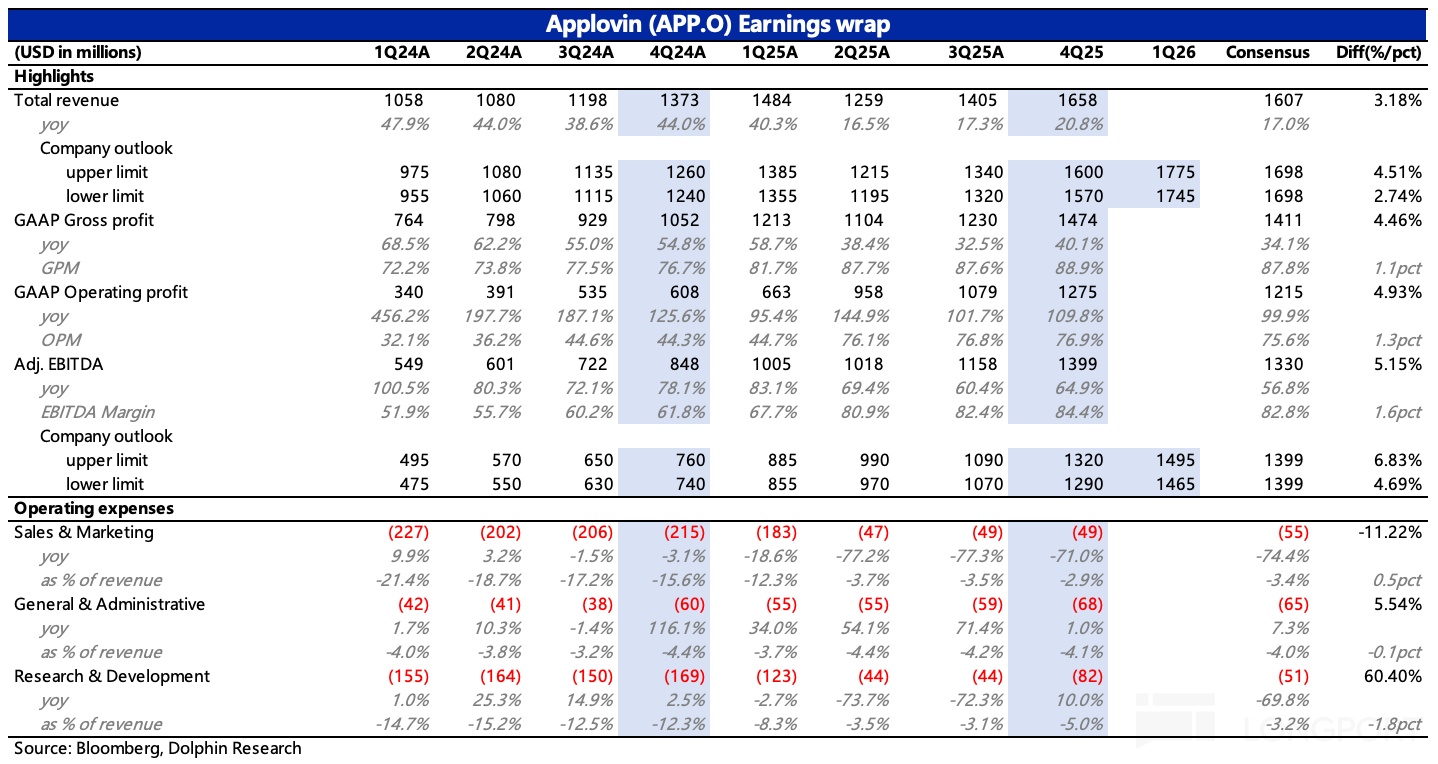
a. Revenue: $1.745 bn–$1.775 bn (+5%–7% QoQ). Guidance implies continued broad-based momentum.
b. Profit: Adj. EBITDA of $1.465 bn–$1.495 bn with an 84% GPM. Profitability remains best-in-class.
c. Focus: Breaks the typical Q1 seasonal slowdown, reflecting sustained strength in e-comm and gaming. Management signals durable demand drivers.
II. Call details
2.1 Management remarks
1. Core gaming ad ecosystem
a. Competitive logic: Addressing concerns about new entrants, MAX auctions are not zero-sum. As more bidders join, bid density rises and the pool expands even if AppLovin’s win rate dips.
- AppLovin only bids for inventory its AI model deems highest value. For lower-value impressions, even when rivals win, AppLovin still earns a 5% platform fee.
b. Network effects: Early-mover advantage in mediation with scale and data flywheels that peers find hard to replicate. Long-term accumulation underpins defensibility.
2. AI strategy
a. While AI may lower game dev barriers, management argues that as content explodes, discovery scarcity rises. Curation becomes more valuable when content supply surges.
b. As millions of AI-generated assets flood the market, precise user-content matching (AppLovin’s core AI) becomes the key value layer. This is where pricing power accrues.
c. Model evolution: Growth is driven by iterative model upgrades, not external tailwinds. Internal AI improvements are the primary catalyst.
3. New growth vectors
a. E-comm expansion: Rapid scaling and a key driver of Q4 beat and strong Q1 guide. It is becoming a material demand source.
b. Customer mix: Growth in self-service customers enhances operating leverage. The platform benefits from automation.
2.2 Q&A
Q: E-comm: progress on self-service rollout, lessons learned, and areas to improve? Also, can you quantify e-comm’s contribution to the quarter and guide (revenue or ad spend)?
A: E-comm has been live for ~18 months and is performing very well. In Q4, we launched a referral-only self-service beta, not yet GA, and we remain on track for GA in 1H this year.
Two growth vectors excite us most right now:
First, meaningfully higher spend from existing clients. Legacy cohorts grew substantially YoY in Q4 2025, driven by ongoing model upgrades, and we just shipped a large model step-up a few weeks ago that reaccelerated cohort spend.
Second, new clients via referrals are onboarding steadily. Near-term, this is not yet structurally large to the P&L, but the trendline is strong. The pipeline is building.
We won’t break out e-comm as a standalone revenue mix. We manage the platform holistically: if the game model gets 50% more efficient, spend shifts to gaming, lowering e-comm mix even as the system improves.
Adding vertical diversity like e-comm gives the model more ways to reach consumers, lifting conversions overall. In a unified auction, splitting data by vertical would be misleading for investors.
Q: You noted automated, at-scale creative production can sharply lift conversions. Where is automation today, and what do you expect over the next 12–18 months?
A: Still very early. Top gaming advertisers run tens of thousands of creatives concurrently, while top e-comm clients are only in the hundreds; more creative diversity directly boosts conversion by giving the model more chances to match user intent.
We’re tackling this gap on two fronts:
First, guiding clients to the platform’s creative logic and scaling the formats that work, with gen-AI lowering creation costs and barriers. Education plus tooling will expand supply.
We’ve piloted AI tools with 100+ clients to auto-build interactive landing experiences in the ad flow. Social and search do not need these pages, so many advertisers lack that capability, and our tooling fills the gap before broader rollout.
In addition, our video generation model is about to launch via the same pilot path. If we cut video costs from thousands of dollars to single digits and enable batch production, e-comm will meaningfully deepen its creative bench and compete more effectively with gaming in auctions.
Q: Some investors are modeling e-comm by tracking pixel counts. Any guidance for those attempting this math?
A: Building a precise e-comm model is hard at this nascent stage. Meta has pixels on 10+ mn sites, while we’re in the thousands, and although pixel count correlates with advertiser count, it’s too early to map volume-price outcomes. Before GA and scaled go-to-market, advertiser growth will be bursty and hard to predict until the business matures.
That said, a few metrics are compelling. First is very high acquisition efficiency: in small-scale tests on social and search, 30-day LTV covers CAC, which is rare and validates the unit economics.
Second is funnel optimization headroom: in referral mode, ~57% of qualified leads convert to active advertisers, leaving 43% drop-off. We aim to push that toward near 100% before GA.
In short, we are entering a hyper-growth phase. Once the advertiser base stabilizes at predictable scale, we can share more datapoints for modeling, but for now 30-day LTV payback best signals the explosive potential.
Q: Over the next 3–5 years, if consumers shift to agent-based interfaces, what is the impact? And how should casual game devs think about chatbots competing for time?
A: On the supply side, LLMs lower dev barriers, letting anyone generate games from ideas without engineering. Pros studios speed output, and personalized content proliferates.
This content explosion benefits us, as when content commoditizes and overloads, discovery becomes more valuable. New devs must monetize via MAX and acquire users through our ad stack, reinforcing our model under abundant content.
On time competition, we don’t think chatbots displace all entertainment. Casual games like solitaire and crosswords are quick, relaxing, and skew older-female; it’s hard to see that cohort abandoning word games to chat with bots a decade from now.
Instead, LLMs may be complementary:
- If AI lifts productivity, people may gain more leisure time for gaming. This expands the attention pool.
- If AI raises game quality and diversity, better content directly drives growth for our model that matches users to content.
Q: With self-service vs. prior managed service, how have merchant/customer types changed?
A: With self-service, we removed the minimum GMV threshold. Smaller businesses with $100k–$mn annual GMV can now buy traffic directly, broadening access.
We value helping SMEs scale. One Israel-based cookware brand entered at $4 mn revenue, then put 65% of its acquisition budget to AppLovin, grew to $16 mn and turned profitable, and now aims for $80 mn this year with us as the primary channel.
This $4 mn to $80 mn arc proves our playbook works for smaller brands. Our strategy is ‘serve devs/indie brands first, then scale across industries,’ mirroring our path in gaming.
Q: We see non-e-comm apps deploying your pixel. One-offs or a new direction?
A: We’re not restricting verticals; auto insurance-type categories can go live now. We prioritize transaction-based businesses, including fintech and performance-led non-e-comm, which are working well on our model.
Over the next few months we’ll focus on lead-gen use cases that hand off to call centers. This expands our performance canvas.
Our goal is to serve every performance-driven, transaction-heavy vertical, improving UX via diverse ad content and driving platform growth. Vertical breadth sharpens the match engine.
Q: Meta is bidding more aggressively in in-game environments. Competitive implications?
A: Meta has long been a key demand partner on MAX. They bid on all ID-on (IDFA) traffic, roughly two-thirds of interstitials, but not yet on no-ID inventory, which could change in coming quarters.
Over recent years, more bidders entered MAX auctions, including Unity’s Vector, Liftoff’s Cortex, Moloco, and Google transitioning to auctions. It’s a misconception that more competition erodes the leader in an auction system.
Two reasons explain the opposite: we have scale and strong tech, and not all impressions are equal. AXON 2 prices impression value exceptionally well.
Some impressions are extremely valuable to us and highly profitable, while others would be loss-making if we overbid. As Meta strengthens, they absorb lower-value or low-margin slots we avoid, and as platform operator we collect a ‘tax’ on those trades, improving MAX economics.
Thus, more bidders actually raise MAX’s market value without hurting AppLovin’s bidding environment. With AXON 2’s leadership, added competition fills monetization gaps so every impression finds the highest payer.
Q: You’ve long encouraged devs to switch mediation. What defines MAX’s moat today?
A: MAX’s moat isn’t just mediation tech. Since the 2018 entry via acquisition and subsequent MoPub feature integration, we built a leading, high-concurrency auction, and in AB tests MAX typically beats peers by several percentage points on density and yield.
But a few points of uplift alone could be subsidized by deep-pocketed rivals. The irreplaceability comes from tightly bundling monetization with the market’s strongest UA solution, and for many devs, AppLovin is over 50% of UA spend.
Leaving MAX means losing top-tier monetization and the core growth engine, making switching costs prohibitive. The ecosystem is compounding at strong double digits as tech iterates.
When growth compounds with non-replicable tech, you get a closed, resilient loop. MAX is not a tool; it is infrastructure for these businesses.
Q: 2026 AXON marketing: does the ‘$1 mn/day’ target still apply? Is GA the main gating factor?
A: We’re still testing, and absolute marketing dollars are small, evident in margins holding at 84% EBITDA. With strong growth and ideal LTV/CAC, even ramping spend shouldn’t compress EBITDA materially. If margins dip due to marketing, that’s a positive signal of scaled, high-ROI acquisition.
That said, we’re pacing spend deliberately while we finish the tooling stack, such as gen-AI video and automated interactive pages. Opening the floodgates without creation tools would hurt advertiser success rates.
We want new clients to outperform, not just show up. Despite ~30-day payback, we’ll stay disciplined until tooling matches demand, then scale marketing to a new level.
Q: Concern that Meta could use its graph to enable deterministic attribution in no-IDFA contexts post-ATT, hurting vertical ad networks. Technically feasible, and if so, can growth offset share loss?
A: In theory, parts may be technically possible, but they’d violate Apple’s terms, and Meta depends on platform ecosystems. It’s unlikely they risk sanctions for a vertical too small to move their needle.
Even if they found a way to bid on no-ID traffic, they still face AXON 2 head-on. The fear is anchored to a five-year-old mental model where Meta had outsized share.
Post-IDFA, Meta remains active on ID-on traffic, but the field has structurally changed. Unity, Liftoff, and Moloco are stronger, and AXON 2 is the biggest technical step-change, giving us clear leadership.
We don’t see any rival capable of dislodging that edge today. AXON 2 is a self-learning closed loop, compounding with data, and our depth in mobile gaming and verticals is unmatched.
If uneasy, ask advertisers running on both AppLovin and Meta about wallet share on ID-on inventory. That speaks most clearly to current competitiveness.
Q: For AXON marketing that pays back in ~30 days, which channels are most effective? Among Google Search, Facebook, Instagram, etc., which converts best?
A: Too early to call winners, and we don’t want to mislead. We do see interesting returns via deep partnerships with measurement firms and specialists.
For example, sponsoring Triple Whale and TPN podcasts has driven growth, blending performance with brand-building to get AXON heard. Brand lift is feeding search activity as prospects discover us and then Google us.
Our blog and SEO are just starting, so we’re buying keywords to capture intent while organic improves. The playbook is to combine brand with performance, triggering search and conversion.
Q: With $11+ bn annual auction scale cited on your blog, is massive data a prerequisite for probabilistic bidding efficiency? What constraints would copycats face?
A: Modeling approach and data substrate differ fundamentally. Meta’s model is elite but built on social signals, while ours is bespoke to our ecosystem, and our clients are tuned to it.
As the largest UA buyer in mobile gaming, budgets don’t shift simply because a rival appears; our pricing on that traffic is precise, with AXON bidding CPMs in the thousands for the right users.
In a market already tilted to us with frontier tech, it’s hard to imagine late entrants displacing us. Only if we stopped innovating would clients seek alternatives, and that won’t happen overnight.
We’re a 14-year, engineering- and product-led company, and iteration speed is a core edge. Our team is top-tier and relentlessly innovating, compounding the model with data loops and engineering leverage that capital alone can’t copy.
Q: On the new ‘Prospecting Campaign,’ feedback suggests it strongly shifts spend to net-new users. Without splitting out numbers, how might this influence 2026 advertiser behavior?
A: Advertisers struggle to measure true incremental value from retargeting, but the value of a net-new customer is intuitive. A one-size-fits-all mixed cohort wasn’t enough.
So we launched Prospecting Campaigns in Q4. Advertisers upload historical purchase data, and our model excludes existing buyers to focus fully on new users, aligning spend with incremental growth.
Adoption has been unusually fast because results are visible in real time once toggled on. Into 2026, first-party new-user targeting will be a core lever to win more non-gaming, especially e-comm, budgets.
Q: Some believe demand partners bid differently across auctions. Your view?
A: MAX is a fair, transparent system that is regularly audited, and it holds the majority share of the market. It would be irrational for a partner to use one bidding strategy on a small platform and a different one on dominant MAX.
To stay competitive, bidders must treat MAX as the primary battlefield and bid their true, most competitive prices. We ensure a fair arena, and partner behavior follows scale and efficiency.
Q: On the 43% drop-off among qualified e-comm leads: what’s blocking activation and how will you fix it?
A: The core hurdle is a lack of suitable ad creatives, especially video in our required formats. Many qualified prospects want to onboard but stall in technical integration without compliant assets.
We’re scaling gen-AI tools to auto-produce platform-ready video creatives, lowering content barriers. As adoption spreads, activation rates should materially improve.
Q: You guided to double-digit growth in 2H25. Into 2026, can that persist as a durable step-up?
A: MAX growth is rapid and powered by the ecosystem’s strength. A key loop is that ad platform growth drives developers to reinvest proceeds into UA, creating a buy-monetize-rebuy flywheel.
As long as we and other gaming marketing platforms perform, MAX’s growth has a strong foundation. This is now corroborated by multiple datapoints.
Unity’s Vector is scaling fast, and Moloco, a private company, is showing strong growth on the road. When peers are also expanding quickly, it signals our underlying market is outrunning expectations without signs of slowing. The surge is tech-driven and systemic, not anecdotal.
Q: Comparing RL frameworks: e-comm has been live 18 months—how does its model progress vs. gaming, and is it evolving faster or slower?
A: The gaming model self-improves via outcomes and memory over time. E-comm follows the same logic, but it’s still very early and far from gaming’s data depth, where we have near-marketwide visibility and three years of compounding iteration.
E-comm started later with low penetration, so gains now are less from steady-state self-learning and more from team-driven optimization and new client data inflows. The curve is steeper at low base.
Every site that deploys a pixel returns behavior and transaction data, and as scale ramps, penetration will jump from ‘very low’ to ‘very high.’ That density is the catalyst for breakout model performance.
Q: Ads are often seen as zero-sum, and demand is perceived constrained. With rivals also improving, how do you view future supply and conversion headroom?
A: We’re far from exhausting supply. Mobile ads aren’t zero-sum like ride-hailing; smaller gaming ad networks couldn’t be growing if it were.
Over 1 bn people play casual games daily, skewing adult female, a high-purchase-power cohort. Their time and spend in-game are under-monetized today versus potential.
Historically, conversions were ~1% per 1,000 impressions; while higher now, we believe 5% is achievable when the model is confident about user action likelihood. The cap is not physics—it’s density and diversity of demand.
The bottleneck is insufficient advertiser diversity to always match the user’s momentary interest, especially when only game ads are available. E-comm introduces a second option, and deeper vertical penetration will let us match more needs more often, driving sustained conversion lift.
Q: Target advertiser scale and types: will you pursue larger, upper-funnel brand budgets now or is that a longer-term plan?
A: We chase non-brand budgets, meaning performance dollars optimized to transactions or measurable outcomes like lead capture. That’s our core strength; we won’t build a big salesforce to chase brand dollars via lengthy 4A agency paths.
We prefer tech-driven ‘step-change’ growth stories to indiscriminate brand spenders. The Israel cookware case shows how our tools enable daily budgets to ramp from thousands to tens of thousands with revenue compounding to $80 mn.
In gaming we serve devs; in non-gaming we’ll focus on D2C operators, especially Shopify merchants, rather than Madison Ave agencies. Scaling these businesses strengthens our platform as digital infrastructure.
Q: For Q1 2026 guidance of +5%–7% QoQ—above typical Q1—what assumptions offset post-holiday seasonality in e-comm? What are you seeing in e-comm and gaming?
A: We only guide to what we have high conviction in. A strong Q4 gave us an excellent exit rate into the year, driven by three forces: steady gaming, early referral-mode traction in e-comm, and the new net-new user model.
We also factored in headwinds: Q1 seasonality vs. Q4 holidays, and two fewer calendar days in Q1. Despite that, momentum and AXON 2.0 penetration in gaming and e-comm give us confidence in 5%–7% QoQ.
This out-of-season growth underscores the AI platform’s conversion lift. It highlights structural rather than transient tailwinds.
Q: Model iteration and self-serve GA impact: is e-comm uplift comparable to gaming? And how will GA contribute to the P&L cadence this year?
A: GA won’t flip the P&L in the first months, given our already large base. Its impact will accrue steadily over time and represents net-new budgets, but relative contribution depends on overall growth scale.
On models, we no longer highlight single unlocks in gaming because improvements are continuous. E-comm starts from a lower base, so each optimization can yield bigger relative uplifts than in the more mature gaming model.
Still, recall the base math. If e-comm was ~10% of revenue last Q1 and we improve it by 40%, that’s ~4% uplift overall. The compounding engine matters: once we prove performance leadership, budgets flow from social and search.
As a new entrant, we must be best-in-market, and sustained model iteration is how we win durable share. That is the long game.
Q: Among growth drivers, where does new supply rank?
A: Supply is growing naturally as MAX scales, with annual ad GMV well over $10 bn. At this size, signing a large publisher moves the needle less than improving demand efficiency.
We field many inbound requests from publishers seeking our monetization tech, and we have room to expand supply. But our priority is the demand side.
By optimizing demand generation and the core model, conversion can rise substantially without new supply. Model iteration and demand depth are our top focus.
Q: In e-comm, do formats supported by AXON—end cards, full interaction flow, and elements—form a key differentiator?
A: Yes. Our format enforces attention, unlike most ad environments. The closest analog is TV, but viewers often look away; on mobile we lock full-screen for 30+ seconds while users are actively engaged with their phones.
Advertisers get 30–60 seconds, or more, of deep engagement. That experience is hard to find elsewhere in digital marketing today.
From quality and engagement standpoints, we offer a superior touchpoint. It is a starting-line advantage for our clients.
Q: Given e-comm vs. gaming differences in parameters, LTV math, and components—and data scarcity now—why the confidence that e-comm models can match or exceed gaming?
A: We’re not starting from behind. Even at low penetration, at least half of e-comm advertisers say we’re on par with the largest social platforms, so we’re building from strength.
Unlike gaming where we’re at near ‘max level’ with marketwide signals, e-comm has pixels on thousands of sites vs. a potential in the tens of millions. That gap is the opportunity.
Confidence rests on two pillars: a high starting point—the algorithm and engineering foundation is already delivering—and data as a catalyst. We don’t need gaming-like penetration to inflect.
Each new advertiser adds transactions and engagement signals that accelerate self-improvement. As dots connect into surfaces, the data compounding becomes the strongest growth catalyst.
Q: Beyond e-comm, which industries are you serving, and how mature are they?
A: Non-e-comm is very early, and we broadly call it ‘web ads.’ Any site-based, transaction-led business should fit our performance stack in principle.
But vs. the 18-month e-comm build, other verticals are less evolved. We’ll first go deep in e-comm, then port to other transaction-heavy web verticals over time.
Q: Q4 R&D ticked up. With 84% margins, where could costs rise, and how do you prioritize cash use vs. debt given current balances?
A: We’re confident in sustaining ~84% Adj. EBITDA margins. The only near- to mid-term swing factor is performance marketing.
If we see exceptional ROI and scale, we’ll lean in, which could compress margins temporarily. But we run spend with tight discipline and rapid payback, like the ~30-day cycle Adam cited.
On cash, priority one is organic growth: retain core talent, pay competitively, hire for e-comm and engineering. The business is highly cash-generative, so reserves keep building.
After funding growth, priority two is buybacks. We’ve been active and will remain so, with ~$3.3 bn authorization remaining, optimizing capital structure and returning cash.
In short: invest in people and product first, then sustain shareholder returns. That sequence is unchanged.
<End>
Risk disclosure and statement:Dolphin Research disclaimer and general disclosure
