

AMAT (Trans): Semi equipment >20% YoY; momentum through 2027
Below is Dolphin Research's transcript of AMAT's FY2026 Q1 earnings call. For our earnings take, see 'Applied Materials AMAT: Capex Super-Cycle Is Here, Equipment Stocks in Spring'.
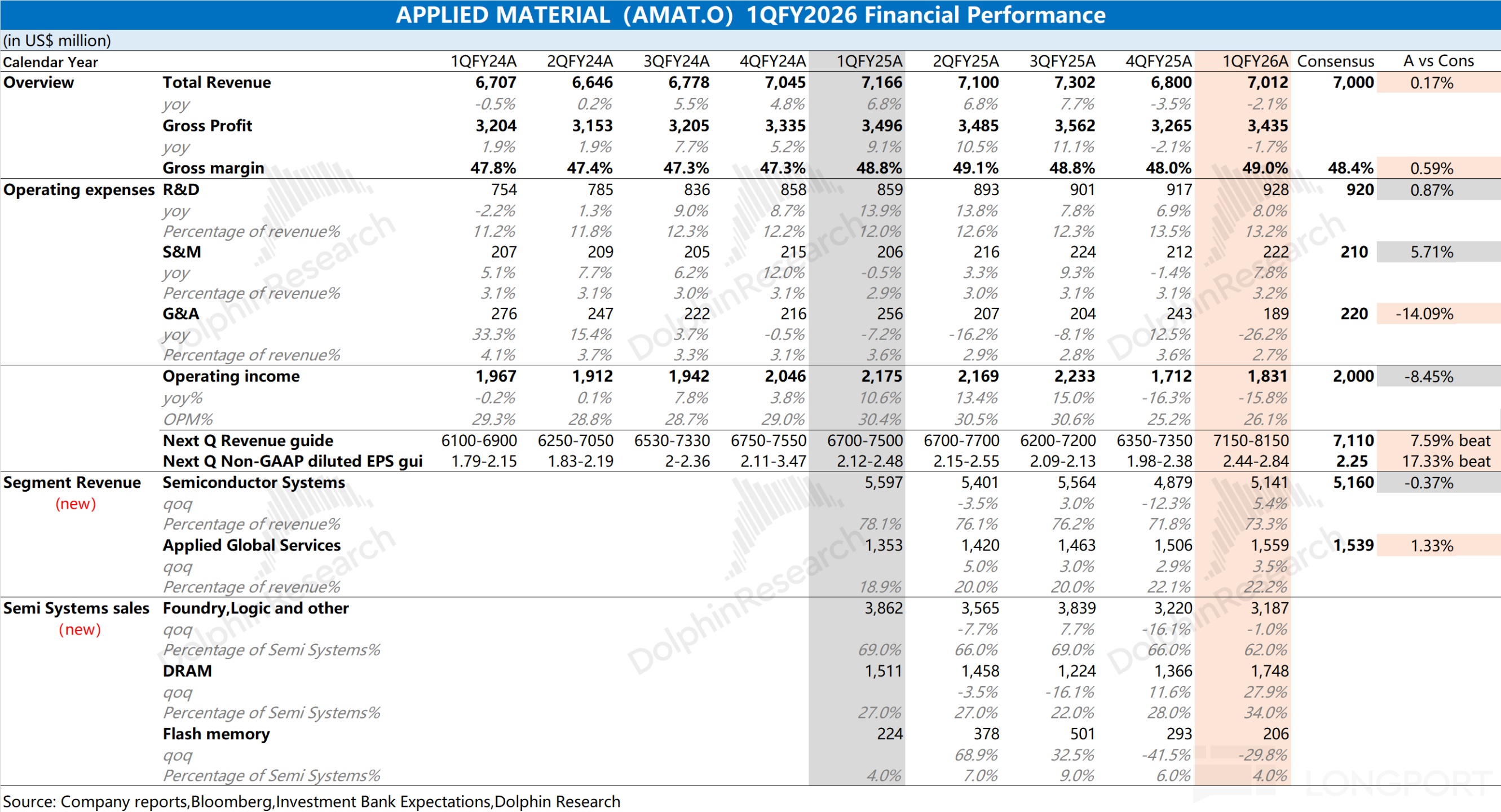
AMAT call highlights:
1) 2026 outlook: semi equipment revenue is expected to grow over 20% this calendar year, with demand skewed to 2H. NAND and ICAPS (flat) grow slower, while services target low-teens growth (11–15%). Cleanroom availability is the key pacing factor for investments, and strong momentum is expected to extend into 2027 given customers' long-range visibility.
2) NAND market: 2026 equipment demand should grow modestly. NAND is expected to remain below 10% of total wafer fab equipment (WFE) spend.
3) Memory capacity adds: in DRAM, most spend is going to greenfield capacity. In NAND, current spending is focused more on line upgrades.
Overall, AMAT not only delivered a better-than-expected next-quarter guide but also issued a full-year 2026 outlook. Semi equipment revenue is set to grow 20%+, which is well ahead of market expectations.
Based on the next-quarter guide, Q2 (Feb–Apr) semi systems revenue is $5.8bn. That implies average quarterly revenue of $7.0bn+ in 2H FY2026. With a two-year Capex up-cycle ahead, management raises the company revenue CAGR outlook from ~10% to ~15% over the next two years.
Roughly 30% of revenue comes from mainland China, which has weighed on the stock's PE vs. peers given U.S.-China semi tensions. Post estimate revisions, the stock trades at ~23x FY2027 EPS, well below ASML and Lam Research at 30x+.
While China exposure still carries risk, memory equipment demand is running well ahead of expectations. Valuation remains relatively undemanding, and both earnings and multiple have room to re-rate in this Capex super-cycle.
I. $应用材料.US 财报核心数据回顾
Q2 FY2026 guidance:
- Total revenue: $7.65bn (±$0.5bn), up ~9% QoQ.
- Non-GAAP EPS: $2.64 (±$0.20).
- Semiconductor Systems revenue: approx. $5.8bn.
- AGS revenue: approx. $1.6bn.
- Other revenue: approx. $0.25bn.
- Non-GAAP GPM: approx. 49.3%.
- Non-GAAP opex: approx. $1.415bn.
- Non-GAAP tax rate: approx. 11%.
2026 growth outlook: semi equipment to grow 20%+ this calendar year with demand tilted to 2H; cleanroom availability is the key pacing item. With improved multi-year visibility from customers, growth strength is expected to continue into 2027.
II. AMAT earnings call details
2.1 Key remarks from management
Segment updates and outlook
Advanced logic
- Customers are adding FinFET capacity while ramping gate-all-around (GAA) nodes in parallel.
- AMAT is the clear No.1 process equipment supplier in advanced logic, leading in materials deposition, modification and treatment, conductor etch, and e-beam.
- GAA meaningfully expands the served addressable market and catalyzes multiple share-gain opportunities.
DRAM and HBM
- Customers are adding 6F² capacity while developing next-gen DRAM architectures.
- AI compute is driving outsized HBM demand: larger die sizes and 3–4x more wafer starts per dollar per bit than standard DRAM.
- HBM stacks are moving from 12-high to 16-high and will reach 20-high or more, further lifting wafer starts and advanced packaging demand.
- The company is the No.1 process equipment supplier in memory, with leadership in DRAM interconnect/patterning materials deposition, conductor etch, and e-beam.
Advanced packaging
- HBM and 3D chiplet stacking are the fastest-growing sub-segments in 2026.
- AMAT leads in deposition and removal, extending its overall lead in advanced packaging.
NAND
- 2026 equipment demand grows modestly, and NAND is expected to stay below 10% of WFE.
ICAPS (IoT, comms, auto, power, sensors)
- WFE spend is expected to be roughly flat YoY globally and in China.
Tech innovation and product roadmap
Cold field emission e-beam (CFE): revenue is expected to double to $1bn+ this calendar year, making it one of the fastest-growing businesses in 2026. CFE accelerates learning for next-gen chip architectures and adoption of AMAT's process portfolio.
2026 new product plan: 10+ launches targeted this year, including three announced this week.
Radical treatment system: delivers die-level precision engineering of nanosheet surfaces, enabling faster next-gen GAA transistors.
New etch platform variant: angstrom-level precision for critical edge steps in GAA and advanced DRAM, extending leadership in conductor etch.
Spectral ALD: selective deposition of single-crystal new materials, reducing contact resistance in advanced logic by up to 15%.
Materials transitions: leading the shift in logic contacts from ALD tungsten to ALD molybdenum. With more transistors and metal layers, copper PVD steps will continue to scale materially and remain an order of magnitude larger than ALD Mo.
EPIC platform and co-innovation
EPIC joint development agreement: first EPIC JDA announced this week with Samsung Electronics. EPIC is a global platform to enable high-velocity co-innovation with customers and R&D partners.
Timing: EPIC is slated to go live later this year.
Services (AGS) and AI enablement
Advanced services demand: as customers scale complex new tools in HVM, demand for advanced services is accelerating, supporting low-teens growth (11–15%) for AGS. This ties to higher throughput and yield on increasingly complex nodes.
AIx software: 30,000+ chambers are connected to AIx servers for AI-driven monitoring, diagnostics, and analytics. Connected-tool response times are down 30%, boosting wafer output for customers and productivity for AMAT field engineers.
Logistics automation: all major DCs now use state-of-the-art AI-driven robotics, meaningfully improving part delivery speed and accuracy while optimizing inventory.
Capacity, supply chain, and operations
Customer visibility: cloud service providers are increasing Capex plans, fab utilization is rising across device types, and advanced foundry/logic and DRAM are largely full with pricing up. Customers are providing much longer visibility and adding new fabs and expansions slated over the next several years.
Manufacturing capability: systems capacity has nearly doubled in recent years, and supply chain operations have been strengthened. AMAT is giving longer demand visibility to direct suppliers to propagate signals through the chain, ensuring materials and labor support.
Inventory readiness: proactively added nearly $0.5bn of inventory to support build plans, positioning well for customer growth.
2.2 Q&A
Q: How do you view 2026 WFE? Peers see low-teens to ~22%, while you guide semi equipment 20%+. What drives the growth and where does share come from?
A: We expect semi equipment to grow 20%+ this calendar year, weighted to 2H. Cleanroom constraints are pacing growth, and 2027 should also be strong.
AI is the core driver. Energy-efficient compute is enabled by advanced logic, DRAM (incl. HBM), and advanced packaging, which we expect to be the fastest-growing WFE segments in 2026, 2027, and beyond. We are No.1 across these high-growth areas and positioned to extend leadership and gain share.
Advanced logic: we are No.1 and see the opportunity to serve over 50% of the market in GAA and interconnect (incl. backside power). We lead in deposition, conductor etch, and packaging. DRAM: No.1 in standard DRAM, HBM DRAM, and HBM packaging; rising wafer demand for HBM requires 3–4x wafers per same bits, and we lead in interconnect/patterning materials, with fast growth in conductor etch and e-beam; 2026 is strong, and we expect share gains at 6F² and 4F².
Advanced packaging: overall No.1 and No.1 in HBM; packaging is a high-growth business in 2026 and for years ahead. HBM and 3D chiplet stacking grow fastest in 2026, where our deposition and removal leadership supports high share.
NAND and ICAPS: less directly driven by AI/HPC. NAND grows this year but remains below 10% of total WFE, and ICAPS is flat globally and in China after heavy spend in recent years. Net, we see 20%+ growth in semi equipment this year, lead positions in the fastest lanes, and a strong setup for 2027 and beyond.
Q: How should we think about gross margin in an up-cycle, considering volume leverage, value pricing, and improved downstream profitability?
A: Since I became CEO, GMs are up 700bps and at a 25-year high. Our strategy is to focus innovation at inflections and target the fastest-growing value pools in logic, DRAM (incl. HBM), and packaging powered by data-center AI. These are the fastest-growing WFE segments where we lead, supporting strong revenue and margin expansion.
We are pushing a higher-value product pipeline and taking co-innovation to a new level with EPIC. EPIC provides multi-node visibility to guide R&D, improve productivity and value capture, and get our products and advanced services designed in. This spans process tools, e-beam, and AIx to accelerate learning and time-to-market.
Q: On WFE, you now see ICAPS flat globally and in China. What changed vs. three months ago when consensus expected China down?
A: Last quarter we said 2026 would be strong, led by AI-driven markets (advanced logic and DRAM incl. HBM), and that view is unchanged. We previously expected ICAPS WFE to be down modestly this calendar year due to digestion, but now see it roughly flat globally and in China. Longer term, ICAPS should grow mid-to-high single digits, but still well below AI data-center driven markets.
Q: On advanced packaging, HBM and 3D chiplet stacking are strong. Can you size 2026 vs. 2025 and situate packaging within the 20% equipment growth?
A: Advanced packaging WFE is up this year, driven by HBM and 3D chiplet stacking. We have very high share and remain No.1, making packaging one of our fastest growers this year and reinforcing overall leadership.
Looking ahead, AI efficiency demands larger substrates to maximize density and connect more GPUs, memory, and high-speed I/O for higher performance at lower power. New substrates and architectures will scale over the next several years, and our innovation pipeline aligns with these inflections. We expect packaging to lead and compound at a high rate for many years.
Q: To get 20%+ equipment growth, with Q2 at $5.8bn, the Q2–Q4 avg. needs to be ~$6.5bn and likely higher for the year. Is that the right way to think about the trajectory and exit rate?
A: That framework is reasonable. The signal is 20%+ for the year with a higher 2H; we provided Q2, but the exact intra-year pacing is still being finalized. There is sufficient demand to support the 20%+ signal, though we are not providing a precise quarterly path.
Q: Is growth capped primarily by cleanroom space? If there were more space, would growth be higher, and how does 2027 look?
A: Yes, cleanroom availability is the bottleneck this year for advanced logic and DRAM. Customers have largely exhausted available space, with multiple new fabs coming online in 2027 and capacity stepping up each quarter, so constraints persist into next year.
Conversations with top customer CEOs and R&D leaders point to a long AI data-center wave. They see very high CAGRs, with data-center wafer starts surpassing PCs and eventually smartphones. It is early to size 2027 precisely, but based on customer dialogs, 2027 should also be very strong.
Q: Semi revenue hit $1tn much earlier than expected. With WFE intensity at ~15% of semi revenue, is 15% still the right lens as AI data-center revenue accelerates?
A: WFE intensity has risen to about 15%, but our focus is winning each sub-market, especially the largest and fastest-growing. AI data centers have pulled forward industry expansion.
The fastest-growing equipment markets are advanced logic, DRAM (incl. HBM), and advanced packaging because they enable AI efficiency. We have invested for years to lead here, and these end-markets are growing fastest now and for years to come.
Given the divergence across end-markets, the old 1/3 logic, 1/3 ICAPS, 1/3 memory model is less useful. We expect advanced logic and DRAM to take a meaningfully larger share of total spend than ICAPS and non-HBM memory. Our positioning is strongest in the fastest lanes.
Q: Does this imply you can capture more value and drive higher GMs as these markets expand?
A: Since 2019, anticipating the AI wave, we built the Integrated Materials Solutions group to prepare for a changing WFE mix, with a core focus on high-value customer solutions. AI is a race to bring new architectures to market.
In AI-enabling segments, we are well placed to deliver high-value solutions and share in the value created. We have expanded GMs over multiple years and are highly confident in continued GM expansion.
Q: AGS opex looks contained, but with 200mm tools moved from AGS to SSG, is AGS growing pro forma? Any sizing?
A: We provided restated figures post realignment, with 200mm tools reclassified from services to systems. Q1 AGS grew 15% YoY, and Q2 guidance implies ~12–13% YoY. We expect AGS to sustain low-teens or better growth.
The base is 55k tools installed, growing 5%+ annually. New AGS offerings like AIx are ramping, revenue is fully recurring with 2/3 under contract, avg. term 2.9 years, and 90% renewal. AGS cash profitability can cover dividends.
Q: You doubled systems manufacturing capacity. If 2023 semi systems was about $5.0bn per quarter, can you reach $10.0bn per quarter?
A: Directionally reasonable, but we are not giving a number. We have significant headroom, with pre-placed capacity partly built out for current growth and more available to scale further.
The key is coordinating with ~2,000 suppliers, signaling strongly, and securing two-year visibility and BOM specifics with customers so suppliers can prepare early. Output capacity is not the limiting factor; the broader challenge is cleanrooms, supply chain, and training service engineers. We now have unprecedented visibility and configuration detail from customers.
Q: What drives the 2H acceleration in 2026? Conventional wisdom says memory cleanrooms are tight until late 2027, so is it foundry/logic? Or still cleanroom?
A: It is cleanroom. We already expected a stronger 2H based on available space in DRAM and advanced logic. Customers have raised plans, and space remains the pacing item; more new fab announcements are coming, and multiple DRAM and advanced logic fabs plan to come online next year.
Q: What share of WFE is now data-center/AI-driven, and how does that compare with last year?
A: Over 20% of recent leading-edge wafer starts are for data centers, and the share is rising rapidly. This year, data centers have surpassed PCs in leading-edge wafer consumption, and we expect them to surpass smartphones by 2029. Traditional data-center silicon is growing 10–20%, while AI components are growing 30–40%, supporting WFE growth 20%+.
Q: AGS 6-yr CAGR is ~11%, the low-teens target. With systems up, higher utilization, more value-added services, and a large installed base, can AGS outgrow its historical 10–12% this year? Is 13–15% YoY sustainable?
A: Q1 was 15% YoY and reflects multiple tailwinds. Installed base growth and new, higher-value offerings typically let AGS outgrow the core semi business. History was held back by trade restrictions and lost accounts, so it was below this season's pace.
We are confident in low-teens growth, with upside in high-utilization quarters. Our service innovation pipeline is strong: 30k chambers connected to AIx to raise service value and engineer productivity, while customers are ramping GAA, backside power, and complex memory. We see a favorable multi-year AGS growth setup.
Q: For Process Diagnostics & Control across DRAM, advanced logic, and advanced packaging, where is demand strongest? Are you nearing or above a $2bn annualized run rate?
A: No specific number, but it is one of our fastest-growing businesses this year. We lead in e-beam imaging with the highest resolution and 10x faster imaging. This is critical to our process tools and to customers for faster learning and time-to-market, and we will roll out new materials characterization technologies and products.
This business is among our top growers this year. We are highly confident high growth continues through 2027 and beyond.
Q: Can you rank relative growth in logic vs. DRAM for 2026–2027? Will one outpace the other over the next few quarters?
A: Hard to rank as demand is paced by fab readiness, not end-demand. Overall semi grows 20%+; NAND and ICAPS (flat) are slower, while advanced logic, DRAM, and advanced packaging are the faster group with similar AI pull. All three are in the fast lane, but ramp timing differs by fab, so we do not manage to a relative ranking.
Q: You expected GMs to lift with revenue absorption in 2H 2026. Still the case, and what would it take to reach or exceed prior mid-50s without China?
A: We expect modest GM improvement with both tailwinds and headwinds. Tailwind: semi systems up 20%+ with higher GMs than AGS; headwind: China flattish and a mix shift to smaller customers. Opportunities for continued improvement remain, but the progression is likely very gradual through the year.
Q: For memory capacity adds over the next few quarters, is the focus node conversions to squeeze more bits from existing lines? How do opportunities differ between node upgrades and new capacity, and is this mostly an AGS story?
A: In DRAM, most current investments are in new greenfield capacity, which we can clearly see. In NAND, current spending is more focused on line upgrades, where our participation is smaller.
HBM wafer starts are roughly 3x those of standard DRAM per equivalent bits. As the industry moves from HBM3 to HBM4, that multiple rises to ~4x, and stack heights are moving from 12-high to 16-high and will go to 20-high.
Q: You added $0.5bn of inventory to support ramps. How should we think about days of inventory and working capital?
A: Days of inventory are about 153 and should not rise materially. We built the additional $0.5bn over the past year to support higher output and to cover our revenue outlook, and as revenue steps up, days should stay in this range.
Q: Opex model: you are on a larger growth path and plan to invest more. Is that fully reflected this quarter, and how about for the year?
A: Q1 opex was well controlled with no major YoY increase. Q2 opex is up ~6% QoQ to fund growth programs in the portfolio, including early EPIC lab projects. Most of the increase is productive investment, and while EPIC will lift spend into year-end, opex growth should trail revenue growth.
Q: Systems GMs are about 54% (actual 54.5%). With systems growing faster, should GM improvement show up at the system level or overall?
A: We expect continued modest improvement in overall GMs. There is a mix headwind from customer composition this year, but the product mix is migrating to higher-value inflections. Each completed R&D program tilts the portfolio toward the highest-value nodes, supporting long-term GM expansion.
Q: On DRAM, customers are developing 4F². How confident are you in maintaining share, and when will decisions be clearer?
A: We have grown share meaningfully in DRAM over the past decade, and it remains one of our strongest businesses. We expect to gain further at 6F² and are very well positioned at 4F², with high confidence in continued share gains.
Q: Will NAND add wafer capacity this year?
A: NAND wafer starts have not grown for several years, and most of what we are shipping is for upgrade projects on existing NAND lines. Each node delivers significant bit-density gains, so current wafer starts are sufficient to meet demand.
Risk disclosure and disclaimer: Dolphin Research disclaimer and general disclosure
