D
Mar 10 at 11:12 AM
NIO (4Q25 Trans): Confident in FY26 volume growth of 40-50%
The following is Dolphin Research's transcript of Nio FY25 Q4 earnings call. For the earnings read-through, 'Farewell to the 'Grim Reaper': Is NIO back in the driver's seat?'
I. Headline Numbers Recap
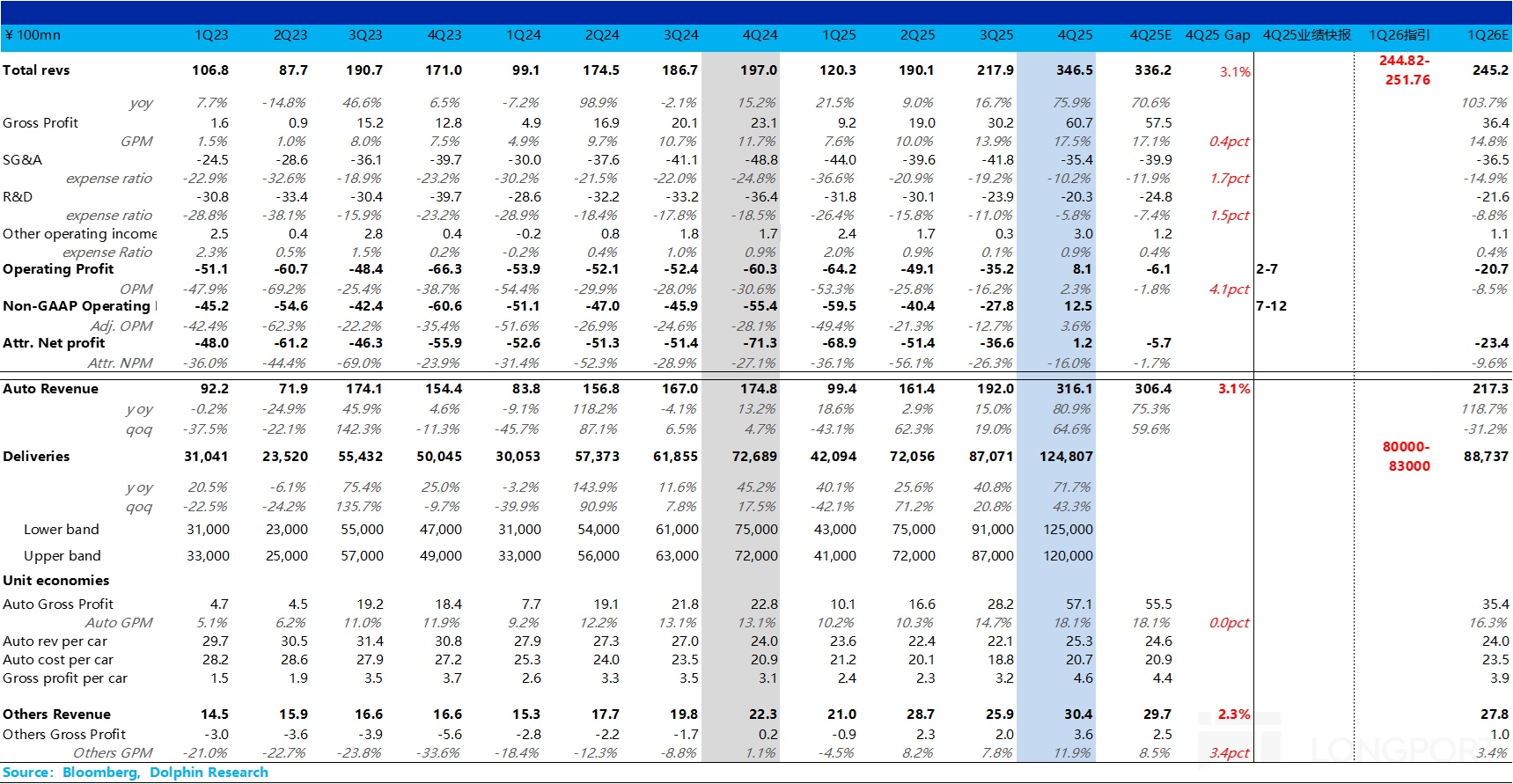
II. Details from the Earnings Call
2.1 Key Management Remarks
① Overall strategy and development stage
New phase: The company has entered its third development stage. A fresh high-growth cycle is underway.
Core strategy: It will continue to invest decisively and consistently across 12 full-stack domains of intelligent EV tech to secure product and technology leadership. This commitment remains intact.
Organization and efficiency: By implementing the Customer Business Unit (CBU) mechanism and driving organizational optimization, operating efficiency keeps improving. The focus is a user-value-centric CBU model that strengthens the biz. system, enhances ROI, and tightens cost control, and the company will keep deepening the changes.
② Product progress and plans by brand
Nio brand:
Status: The all-new ES8 has seen strong momentum since deliveries began in late Sep 2025. It reached the 70,000 delivery milestone in just 160 days, setting a monthly record for models priced above RMB 400k.
26 Q2 outlook: Nio will launch the all-new ES9, an executive flagship SUV positioned as the culmination of 11 years of tech innovation and user experience. ET5, ET5T, EC6, and ES6 will also roll out 2026 model-year updates.
ONVO brand:
The L90 has seen an excellent response since launch, becoming a 2025 bestseller among large electric SUVs. Its momentum continues to build.
Q2 outlook: ONVO will introduce the L80, a large 5-seat SUV with dual cabins front and rear. Meanwhile, both the L90 and L60 will receive upgrades and facelifts.
Firefly:
Status: Launched in 2025, Firefly quickly established itself, ranking No.1 for seven consecutive months in the premium small EV segment in top-tier malls. User interest is expanding into more regions.
③ Core technology progress
Key tech in mass production: Multiple core technologies have reached mass production, including an automotive-grade 5nm chip, intelligent driving, a full-scope vehicle OS, and the Skylight intelligent chassis. These innovations improve performance and user experience while delivering notable cost advantages.
Intelligent driving (NWM):
- In late Jan, Nio released a new NWM (new world model) trained under a closed-loop reinforcement learning paradigm. It is among the first in China.
- In Feb (the first full month after the new push), AD accounted for over 80% more driving time vs. Jan. Adoption is rising fast.
- In cities, 2,000+ swap stations support Power Swap Pilot, seamlessly integrated with city NOP to offer the industry's only fully automated energy-replenishment experience.
- ONVO's intelligent driving achieved end-to-end upgrades in urban NOA, parking assist, and intelligent safety. In 2026, ONVO will upgrade both the hardware and software stacks for intelligent driving.
④ Sales and service network
Store footprint: The company operates 171 NIO Houses and 395 NIO Spaces. The ONVO brand has 420 stores. It also runs 406 service centers and 75 delivery centers.
Channel expansion: In 2026, it will expand into lower-tier markets via 'Sky stores', shared sales and service outlets for all three brands. This should broaden coverage.
Energy-replenishment network:
- Nio operates 3,815 swap stations and over 28,000 chargers, including ultra-fast and destination chargers. The footprint keeps expanding.
- On Feb 6, 2026, cumulative swaps reached 100 mn, a milestone evidencing broad user and market validation. During the Lunar New Year break, single-day swaps hit a record above 177k.
- Nio emphasized swapping as a systemic innovation addressing the vehicle-battery lifecycle mismatch and as a key form of storage. It sees swap as a core component of the new power system.
⑤ Globalization and subsidiary updates
Overseas expansion: The Firefly brand (including RHD models) is now available in 10 countries. In 2026, Nio will continue to expand overseas under a country distributor model, with Firefly as the lead brand.
Chip subsidiary Shenji: The intelligent driving chip subsidiary Shenji completed its first equity financing round, raising RMB 2.257 bn at a post-money valuation above RMB 8 bn. Proceeds will support the development of high-performance chips and reinforce Nio's long-term positioning in autonomous driving and embodied AI.
2.2 Q&A
Q: On product and volume goals. ES9 and L80 will launch in Q2; what is the model roadmap for 2H? In a challenging industry backdrop, do you still target 40%–50% full-year volume growth?
A: The market was challenging in Q1, and China's total passenger car volume is likely to be slightly down YoY. That said, NEV penetration should rise further, with BEVs especially strong.
BEVs drove last year's NEV growth, lifting their share in new-car sales from 26% to 33%. In the premium market, BEV awareness has started to cement, with penetration doubling last year.
For models priced above RMB 300k, BEV sales rose 58% YoY while PHEVs fell 4%. BEV penetration in the premium segment climbed from 14% in Q4 2024 to 27% in Q4 2025.
The large 3-row and large 2-row SUV segments are entering a golden era for pure EVs. Since Sep 2025, large 3-row BEVs have led for five straight months, with 2H volumes up over 350% YoY, while range-extended models fell 6% YoY.
Our product cadence matches this trend, underpinning confidence in full-year growth. We expect to benefit as these segments expand.
This year brings three new large models: ES9 (executive flagship SUV) in Q2 with a product-tech event on Apr 9; a large 2-row SUV on the ES8 platform in Q3; and ONVO L80 in Q2. Together with ONVO L90 and the new ES8, we will have a full lineup in premium large SUVs.
Among existing models, ET5, ES6, and EC6 lead their segments with steady demand. L60 ranks top-three in its segment and will get a refresh this year. Firefly holds a high share in premium small EVs, and demand rebounded rapidly post-holiday.
We are very confident in full-year deliveries. Jan–Feb is a seasonal trough, yet we still grew YoY. We guide Q1 deliveries to grow 90%+ YoY and remain very confident in the 40%–50% full-year target.
Q: On autonomous driving. After the new model push, Feb AD time rose 80% MoM. What are users' key feedback points? With peers rolling out major upgrades this year, what are Nio's L3/L4 highlights and differentiation?
A: The best ultimate metric is AD usage as a share of total driving time, and the reduction in incidents. In Feb, usage rose over 80% vs. Jan. The current version has not yet consumed heavy compute on training data. We will invest more compute into data training this year, with two major releases slated for Q2 and Q4.
The world-model-plus-closed-loop-RL path has shown very high ceilings, and more data should keep improving the experience. We are highly confident in subsequent performance.
Q: On Q1 GPM guide. Based on volumes, with raw-material inflation and ~RMB 10k promotions, can you guide Q1 GPM? Second, related-party receivables have risen each quarter, mainly from battery partners—any outlook for changes?
A: On Q1 vehicle GPM, we expect to hold roughly at Q4 levels. While Q1 volumes face seasonal and policy effects, ES8 backlog and post-holiday order recovery are solid, so ES8's contribution share in Q1 should be secured.
As ES8 carries higher margins, mix supports overall GPM. On the other hand, lithium carbonate and other commodities saw upstream price increases starting in Q1; since this is just beginning, we believe the negative impact can be reasonably contained.
Related-party receivables mainly reflect amounts due from Weineng's battery assets under BaaS. As BaaS penetration and our sales rise, receivables to Weineng increase accordingly. That said, Weineng has made progress in equity financing, debt financing, and bank consumer installments, with diversified and stable channels. Repayment and overall conditions remain under control.
Q: On raw-material inflation. You noted pressure started in Q1 and could be more evident in Q2. Given Nio's premium positioning and solid demand/new orders, can you pass through the cost pressure downstream?
A: We do face cost pressure. Driven by AI compute demand and some geopolitics, chips and commodities such as copper and lithium carbonate are trending up, creating substantial pressure on costs and GPM this year, though full-year visibility remains limited.
We will work with the supply chain to keep improving efficiency to mitigate the margin headwinds. This will be an ongoing effort. This year we will launch three large new models, bringing five large SUVs on sale for the year.
Large vehicles will account for a higher share of total volume, and their margins are higher than lower-priced models, offering better resilience. Strategically, we are confident we can absorb or control raw-material risk and keep full-year margins within a reasonable range.
Q: On opex. Cost control is paying off, with R&D down from RMB 3 bn in Q2 to RMB 2 bn in Q4. Will Q1 and Q2 see further optimization, or is RMB 2 bn the new quarterly run-rate?
A: In 2026, R&D investment will be RMB 2.0–2.5 bn per quarter, roughly flat vs. 2025 for the full year. We will continue to raise R&D efficiency under the CBU operating mechanism, avoid ineffective spend, and improve output. We will also dynamically adjust pace and spend based on 2026 operations and ROI discipline to ensure adequate investment in key products and core technologies, reinforcing long-term competitiveness.
Q: With a strong volume outlook, higher-priced/high-margin new models from Q2, and cost inflation emerging from Q2, how should we think about achieving non-GAAP breakeven or profitability in 2H? What does that imply for FCF for the year?
A: On volume, we maintain the 40%–50% full-year growth goal and have strong confidence given the three large models. On margin, costs are a headwind, but large-model margins are healthy—ES8 topped 20% and neared 25% in Q4—so large vehicles offer better downside protection.
For 2026, we still target full-year 'non-GAAP OP profitability'. We remain focused on reaching that milestone.
Q: On the in-house chip unit Shenji. After the successful financing, what is the mid-term strategy? Beyond internal supply, will Shenji pursue external customers such as other OEMs or suppliers?
A: Shenji has closed its first equity round, and investors recognize its R&D strength and commercialization prospects. External validation has been encouraging.
Next steps: R&D: We have started developing the next-gen chip and will also launch products for the mid-end market to serve more customers. Market expansion: We will pursue opportunities in Robotaxi and embodied intelligence. We already see interest from many external customers, including auto companies, and are making progress in early-stage engagements.
Product progress: Our second advanced-node chip for broad customers has taped out and is in mass production, with very competitive performance.
Q: On the upcoming ES9. Compared with last year's ET9, what new capabilities does it bring? How will it be positioned and priced?
A: ET9 is an executive flagship sedan and among our highest-end products, with the Horizon special edition well received by users. Many advanced technologies from ET9 will carry over to ES9, and ES9 also brings its own innovations. Their positioning differs markedly: ET9 is an executive flagship sedan, while ES9 is a tech-forward executive flagship SUV.
Q: On battery swapping. With fast charging advancing, can you explain swapping's advantages and necessity, and your medium- to long-term plan for charge/swap networks?
A: We welcome more OEMs building charge/swap infrastructure, which helps raise BEV penetration and accelerates the shift from ICE/PHEV to pure EVs. This is positive for the whole market.
Charging and swapping are complementary, not mutually exclusive. We have built over 28,000 ultra-fast and destination chargers, making us one of the most active charge-network builders in China. Together, swapping plus charging addresses different use cases and forms a system that is chargeable, swappable, and upgradable.
Some peers have recently improved charging speeds, which is a healthy tech trajectory. However, for the foreseeable future, even the fastest charging still lags swapping on speed and experience—an industry consensus.
Swapping also does things charging cannot do: it offers a systemic fix for the vehicle-battery lifespan mismatch. Today, battery warranties commonly cover 8 years/160k km with 70% SOH, while private cars often last 15 years or more. Decoupling car and battery avoids the problem emerging in year 8–9.
Under Nio's swap system, long-life design, charge/discharge strategy, and battery health monitoring/operations significantly improve safety and maximize battery life. This is a comprehensive solution. As distributed storage assets, swap stations also participate in grid storage and interaction, creating considerable commercial value.
Compared with typical storage, swap stations avoid one round of construction and deliver ~6% efficiency gains, improving unit economics. China now has nearly 3,800 swap stations; at a 10,000-station plan, full batteries per site would add up to a vast storage network. Existing stations already equate to 60–70 GWh of storage capacity.
Overall, continued buildout of the swap network elevates user experience and forms a core long-term business for the company. It should provide a durable competitive edge for long-term commercial success.
Q: On the chip biz. You mentioned the second chip is stronger and more competitive than the first. Can you share more details? Will you focus only on AD and robotics, or also develop cockpit chips? Also, how broad is model coverage and how much cost saving comes from in-house chips?
A: The second chip still uses a 5nm process and offers excellent price-performance. Its compute is roughly equivalent to about three Orin X chips, at a materially lower cost than our first chip.
It has wide applicability in AD and embodied robotics. By design, it is a strong on-device inference chip with broad use cases. We are not yet disclosing which models will use it, but many industry customers are interested and early tests and engagements are underway.
Q: On services. Service GPM reached 11.9% in Q4—was that mainly driven by higher swap-station utilization? Looking to 2026, will service margins keep improving?
A: 'Other biz.' reflects services and community-related revenue. In 2025, with a larger user base and better efficiency, revenue exceeded RMB 10 bn, a sizable share of total. In 2026, as the fleet continues to grow, we expect revenue to keep rising and to continue contributing positive GP.
On charge/swap operations, we will keep expanding the network, adding swap stations at roughly 1,000 per year. This front-loaded buildout will cause some operating losses, but profits from other services can cover them, keeping the overall trajectory manageable and improving.
One more point: services and community turned profitable in 2025. We expect profitability to keep improving in 2026, and even with 1,000 new swap stations added, we should still achieve that goal.
Q: On SG&A optimization. We discussed R&D; can you share more on SG&A? Q4 SG&A was RMB 3.5 bn—should we annualize that as the 2026 baseline/range?
A: In Q4 2025, as volumes and sales increased, SG&A moved into a more reasonable zone. Beyond higher revenue, this reflects the CBU mechanism and ROI-based organizational efficiency gains implemented from 2025. On the flip side, there were no major launches in Q4, so marketing activity was relatively light.
In 2026, we will keep improving SG&A efficiency under the CBU mechanism. While absolute SG&A will rise with higher volumes, our control target is to keep SG&A below 10% of sales.
Q: On volumes and GPM by brand. We discussed volume targets and reasonable margins. How should we view dynamics among the three brands, or the five large SUVs vs. other models? How will mix support sustainable GPM expansion?
A: On volume and margin details, 2026 is highly dynamic, so it is hard to pin down mix by model. Broadly, five large SUVs will make up a high share of total volume, and Firefly's sales rebounded quickly post-holiday, already back to last year's normal run-rate. On margins, cost pressure is significant this year, and we will keep working to improve margins at each brand, though it is hard to give precise figures now.
Longer term, internal targets remain: Nio brand 20%–25%, ONVO 15%+, Firefly 10%+. These remain important internal goals.
One more point: from 2025, our internal focus shifted from pure volume to quality growth—balancing total profit or operating results with volume. Each model now has a dedicated squad under the CBU mechanism. They are responsible for optimizing each model's trade-off among volume, margin, and operating results, a key change on the go-to-market side, already reflected in improved outcomes in Q4 and Q1.
Risk disclosure and disclaimer:Dolphin Research Disclaimer and General Disclosure
Login to unlock17,149characters for free
This content is only available to signed-in users. Sign in to your Longbridge account to read the full post.