

Sungrow: Bolt From the Blue. ESS Is Hot — Has Sungrow Cooled?

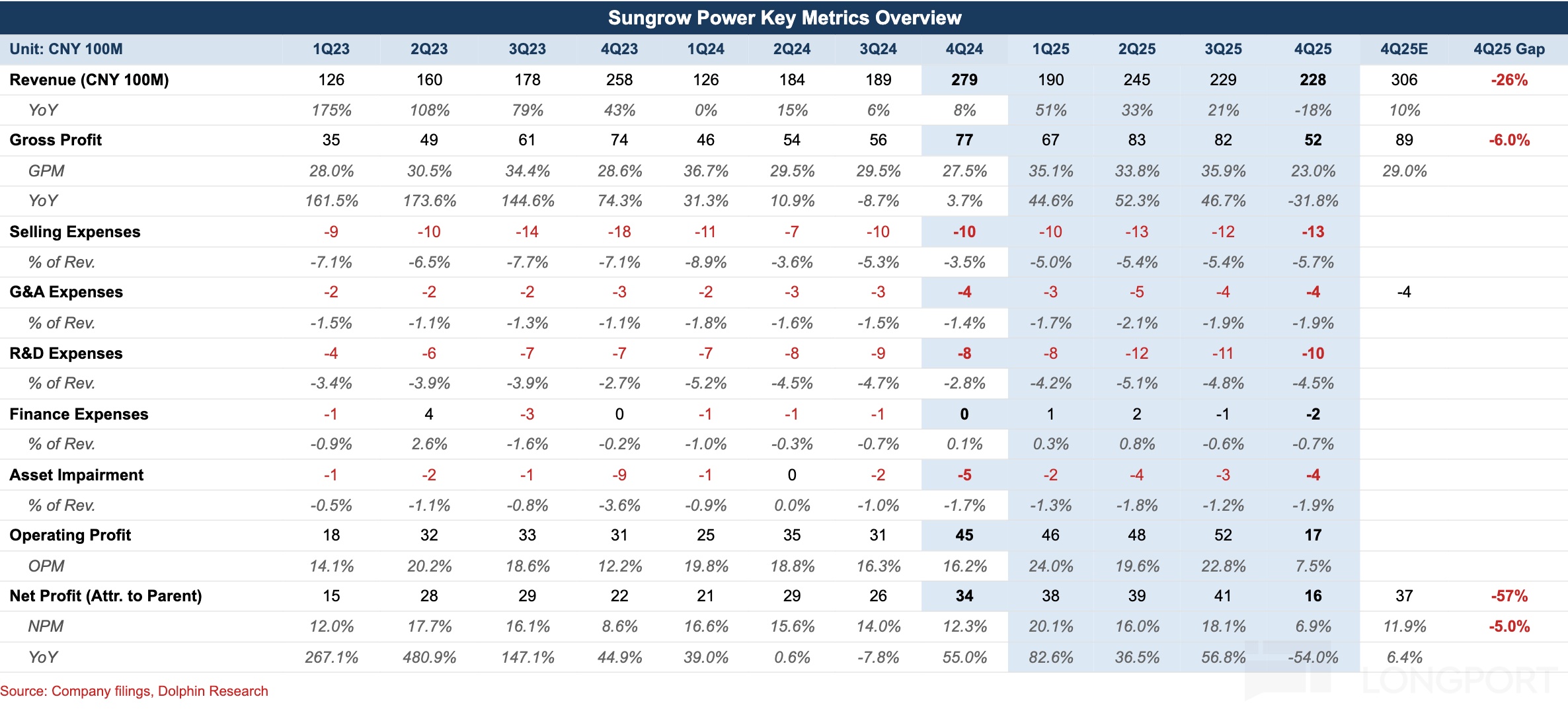
On the evening of Mar 31, 2026,$Sungrow Power Supply(300274.SZ) released its Q4 2025 report. Results missed badly, revenue growth stalled, and margins collapsed. The energy storage systems (ESS) business was the core drag behind the bomb:
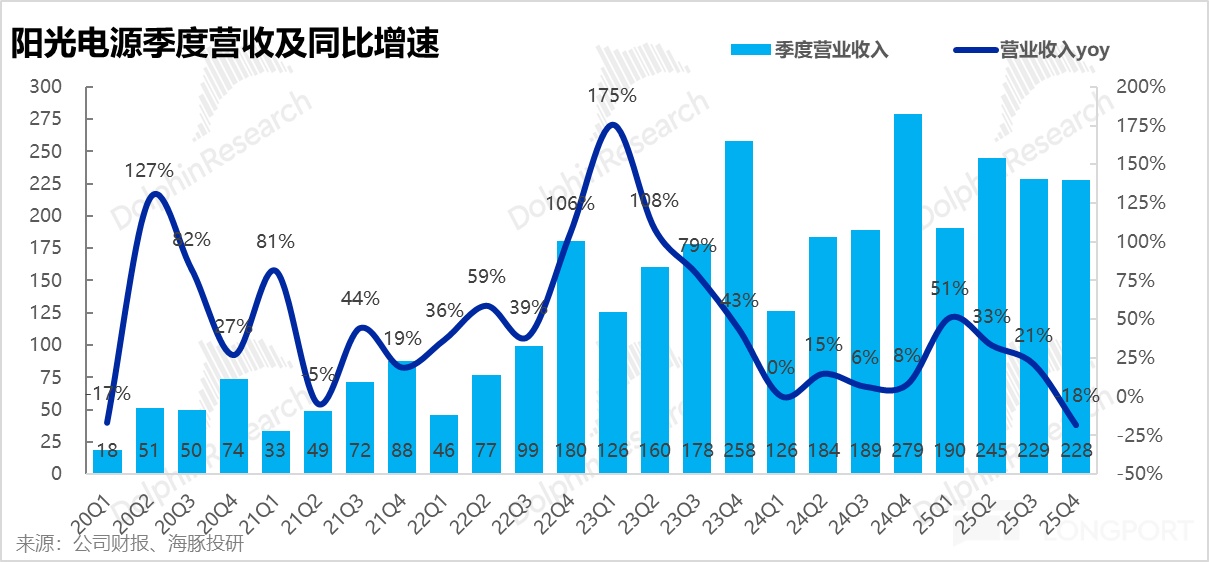
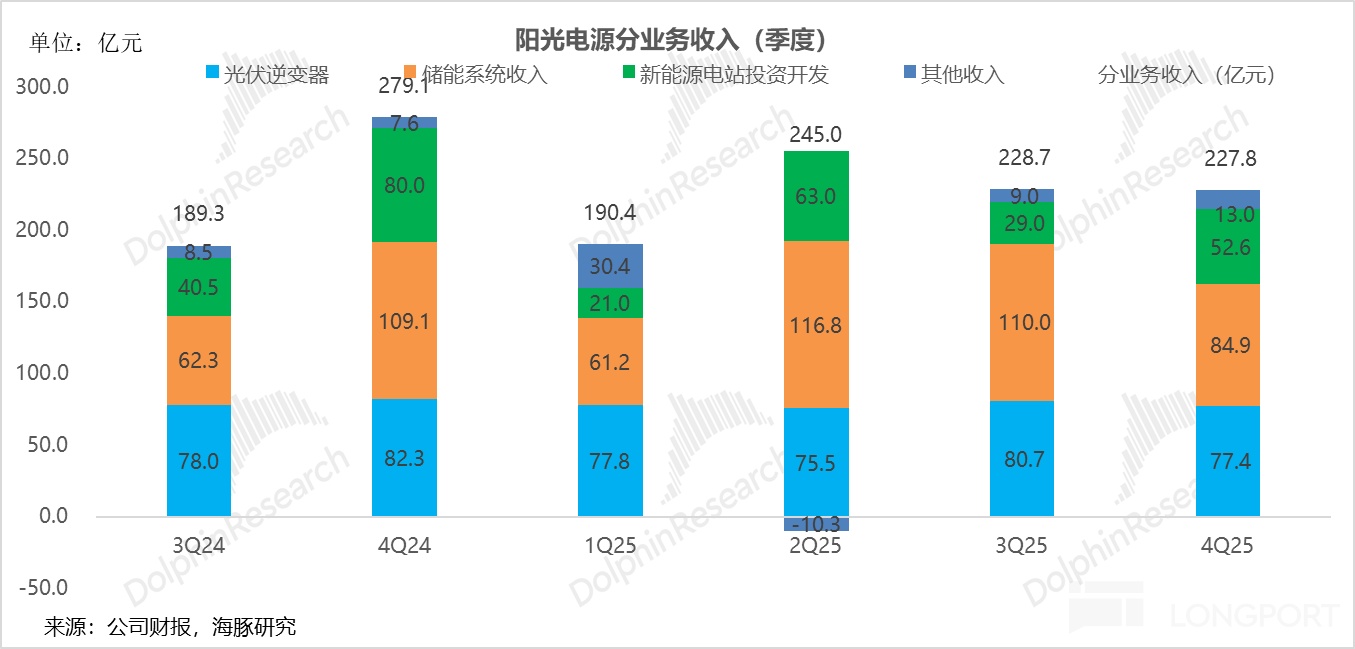
1) Q4 revenue sharply missed, posting the first YoY decline since 2022: Q4 revenue was RMB 22.8bn, down 18% YoY and far below the RMB 30.6bn consensus. The miss was primarily driven by ESS.
By segment:
a. ESS revenue plunged, with severe divergence between volume growth and price decline: Q4 ESS revenue was RMB 8.49bn, down 22% YoY and 23% QoQ.
On volume, ESS shipments reached 14GWh in Q4 (up ~40% QoQ), and 43GWh for the full year (+52% YoY). The company has strategically exited low-margin domestic orders, keeping overseas as the clear priority (overseas accounted for 86% of Q4 shipments).
On pricing, the implied Q4 ASP fell to ~RMB 0.6/Wh, about 45% lower vs. Q3. Beyond shipment-to-revenue timing gaps, Dolphin Research believes intensified overseas competition drove price-for-volume trades, while tariff cost sharing depressed reported revenue.
b. PV inverter business under pressure, with strategy fully pivoted to overseas: Q4 PV inverter revenue was RMB 7.74bn, down 4% QoQ. Domestic demand softened on policy changes and the company’s exit from loss-making projects, leading the traditional year-end rush to fade; Q4 shipments were just 33GW, with full-year shipments at 143GW (-3% YoY).
That said, a higher mix of overseas high-value shipments (full-year mix up to 56%) lifted the full-year ASP by 10% YoY to RMB 0.22/W, stabilizing the base.
c. Power plant investment and development saw a Q4 pulse but remained pressured for the year: Q4 revenue reached RMB 5.26bn, up 81% QoQ due to concentrated recognition at year-end grid-connection deliveries. However, full-year revenue was RMB 13.2bn, down 21% YoY, as policy (Document No.136) heightened IRR uncertainty for PV plants, dampening downstream investment starts.
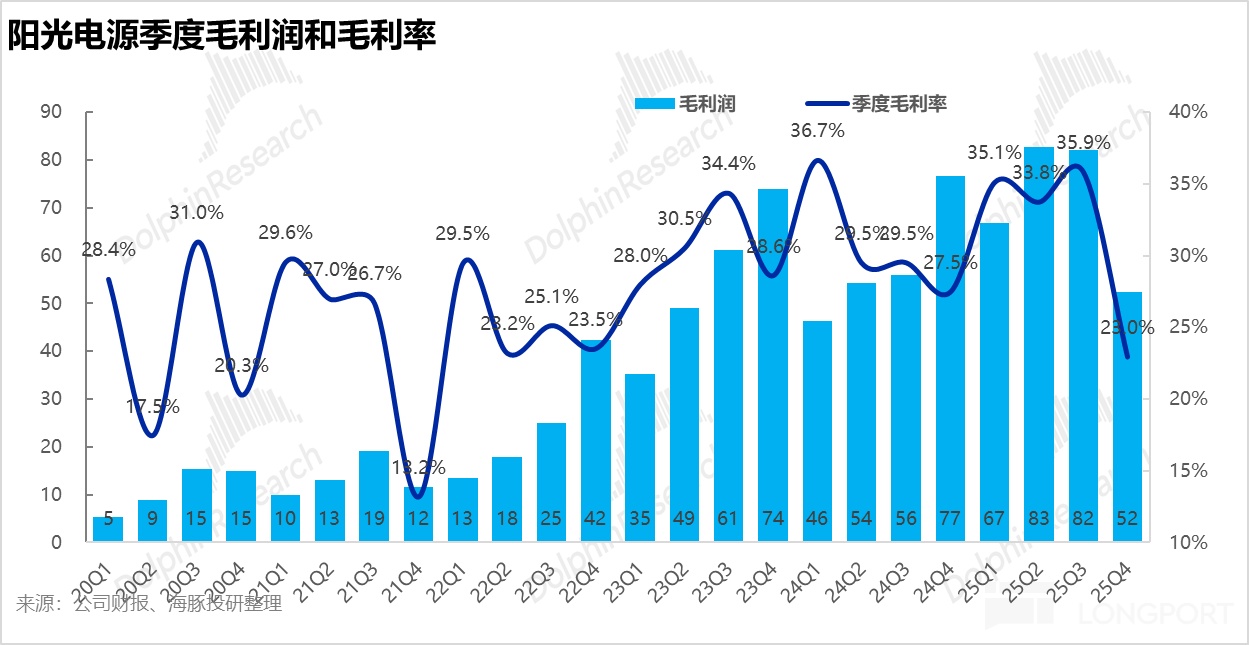
2) GPM fell off a cliff on mix deterioration and cost headwinds: Q4 gross profit was RMB 4.2bn, down 32% YoY, with blended GPM collapsing from ~36% in Q3 to ~23%.
a. Mix drag: low-margin EPC/plant development saw concentrated year-end recognition, lifting its revenue mix by 10ppt QoQ to 23% in Q4 and pulling down headline GPM.
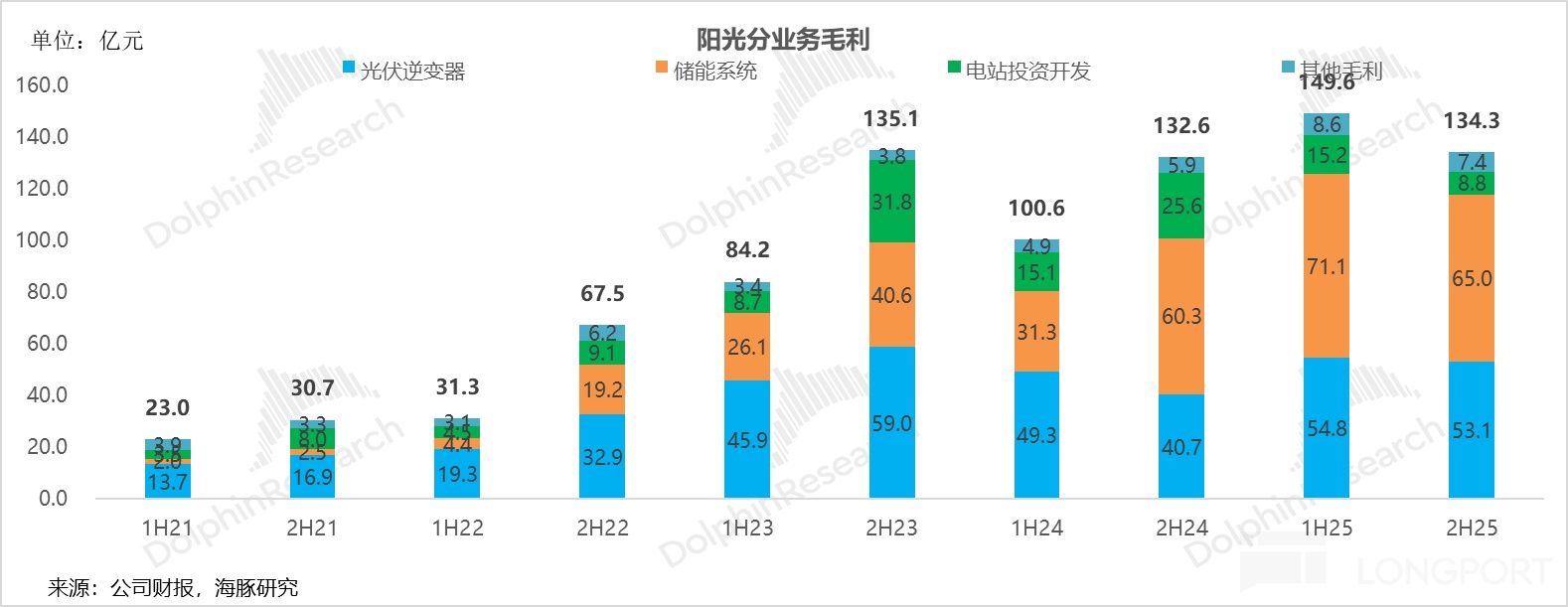
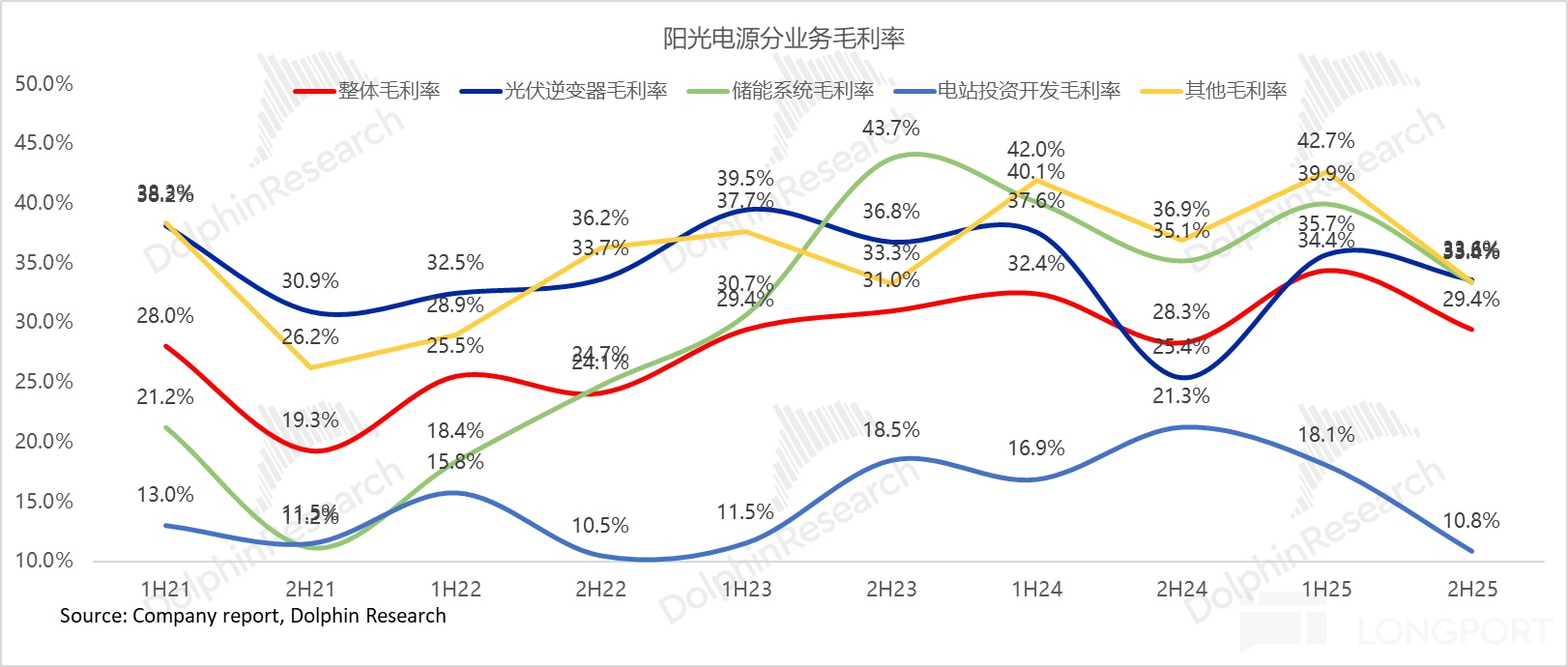
b. ESS GPM slumped: price concessions amid intensifying overseas competition, tariff cost sharing, and rising lithium carbonate combined with fixed-price ‘closed’ contracts that could not pass through costs pushed H2 ESS GPM down to 33.4%.
c. PV inverter GPM narrowed slightly: higher input costs for copper, IGBT, and aluminum squeezed margins, trimming H2 inverter GPM by 2.1ppt QoQ. With overseas revenue mix up to 63% in H2, the continued GPM slide confirms that overseas premium competition has turned structurally tougher.
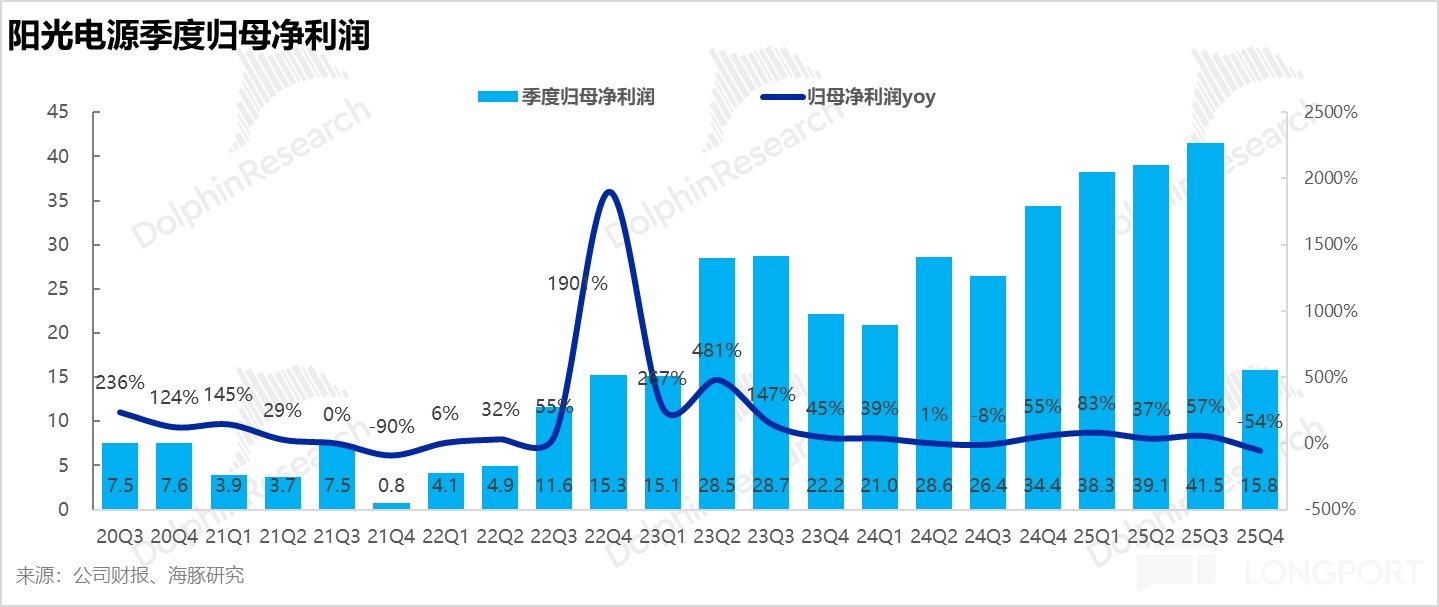
3) Q4 OP and net profit both collapsed, with rigid opex and impairments weighing: Q4 attributable net profit fell 54% YoY to RMB 1.6bn, with NPM plunging 11.2ppt QoQ to just 6.9%. Key drivers were:
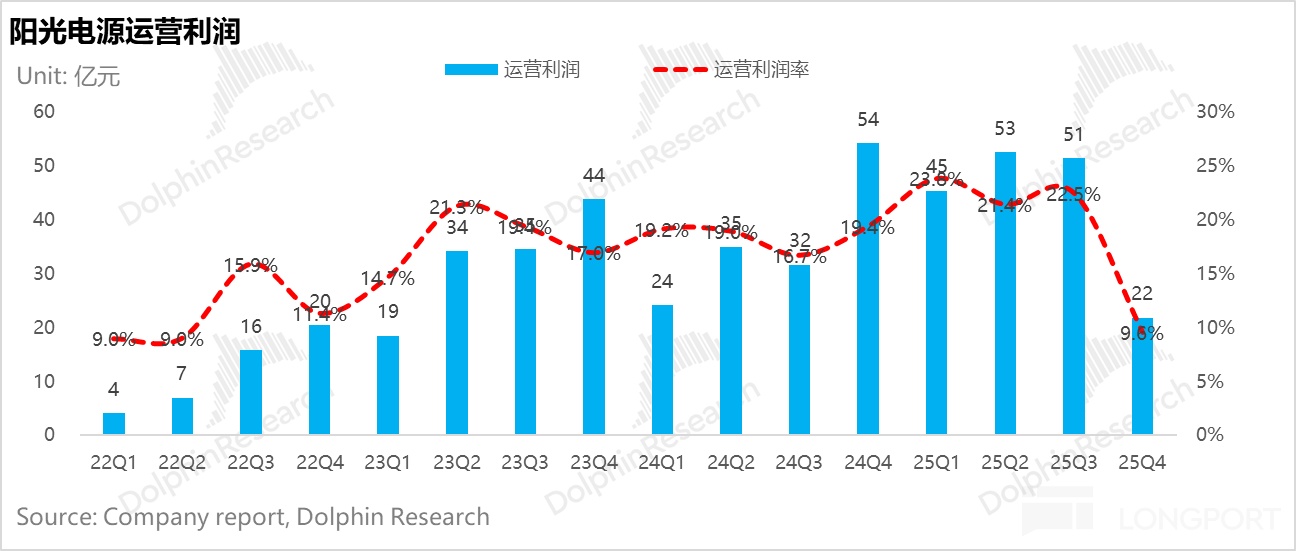
Revenue stalled while overseas expansion and new biz spending remained rigid, amplifying negative operating leverage. To build a ‘third growth curve’ in AIDC power and next-gen ESS, R&D rose 31.3% YoY to RMB 1.03bn in Q4; selling expense reached ~RMB 1.3bn, up 32% YoY, to build the global network. With GPM collapsing and opex elevated, Q4 OP fell nearly 60% YoY.
In addition, Q4 asset and credit impairment losses hit RMB 900mn (up ~RMB 600mn QoQ), mainly from Vietnam and domestic plant impairments, and ~RMB 200mn of inventory write-downs amid fiercer competition, further depressing reported earnings.
Dolphin Research comment:
Overall, Sungrow’s Q4 2025 performance was brutal. Despite a global ESS market still growing over 70%, the company slipped into revenue stagnation with both GPM and NPM falling off a cliff.
More critically, ESS — the core of its valuation and now its largest revenue pillar, surpassing PV inverters — suffered a ‘Waterloo’ in Q4. A near-halving of headline ASP and a sharp GPM slide dragged overall results into the mud and shook confidence in its prized ‘overseas premium moat.’
Management sought to attribute price and margin erosion to optical or one-off factors (e.g., a high base from a large UK project in Q3, higher mix of low-price domestic and Middle East/Americas in Q4, and year-end after-sales and rebates). However, with overseas revenue mix not falling, the sharp ASP and GPM deterioration likely reflects domestic ESS hyper-competition spilling over abroad and rapidly intensifying overseas pressure.
Under pressure, Sungrow likely made defensive price concessions in high-value overseas markets to secure orders. The abrupt ASP compression, weaker margins, and inventory write-downs tied to fiercer competition all corroborate this bearish trend.
If this ‘involution spillover’ is confirmed by subsequent results, Sungrow’s valuation premium could be repriced. Its dual moat of ‘tech leadership + brand premium’ in price-insensitive overseas markets risks being breached; in a bearish case, failure to widen the tech gap could trigger share loss and ASP declines — a classic volume-price double whammy that explains the market panic after this print.
Looking into 2026, the ESS value chain may face a double test of demand hesitation and cost headwinds:
Industry slowdown: on rising upstream materials and a wait-and-see stance (some projects likely slip into 2027), the company cut its 2026 global ESS growth outlook to 30%-50% from 40%-50%.
Shipment guide: even so, Sungrow guides an aggressive 40%-50% ESS shipment increase in 2026 to 60-65GWh from 43GWh in 2025. By region, growth is weak in Middle East & Africa, with some rebound in China, 22%-35% in the Americas, and similar growth in APAC and Europe. Management reiterated a bottom line of focusing on profitable projects.
Despite the strong shipment guide, Dolphin Research sees two key fundamental risks for 2026:
① Volume vs. price: ESS revenue may see more volume without more sales
Even if 2026 ESS shipments rise 40%-50%, continued overseas price erosion could fully offset volume gains. In a bear case, assuming the 2026 ESS ASP holds only at the Q4 level of RMB 0.61/Wh (down ~30% YoY), revenue growth would slow from +49.4% in 2025 to just +3.2% in 2026 even with shipments on plan, implying a stall in headline ESS revenue.
② Lithium carbonate surge could bite, with cost pass-through constrained
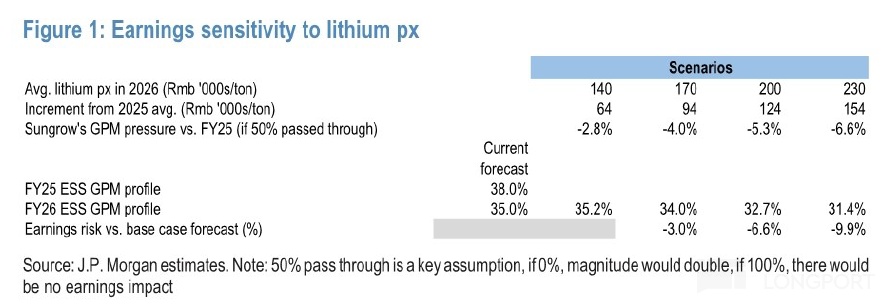
On margins, the company faces a pincer from both ends. Many legacy contracts are fixed-price without lithium-linked pass-through, compressing margins as lithium rises — a key reason for the H2 ESS GPM decline.
For new orders, management noted that passing costs downstream will be difficult in a more competitive overseas buyer’s market. If lithium averages RMB 140k–230k/t and only 50% is passed through, Sungrow’s ESS GPM could be hit by 3–7ppt; at 0% pass-through, the impact doubles to 6%–14%. Only 100% pass-through would preserve current profitability.
Thus, although Sungrow’s market cap has fallen from over RMB 400bn post-Q3 to ~RMB 279.2bn now (-36%), much of this move has been pricing in the Q4 bomb risk.
Looking ahead, if ‘tougher overseas competition + domestic involution spillover’ becomes a steady state, and lithium’s rise keeps pressuring GPM, the current derating may not fully reflect a 2026 volume-price double hit. EPS could even decline YoY in 2026.
Therefore, it is premature to declare that Sungrow’s risks have cleared. Before the core ESS profit engine stabilizes, investors should wait for at least another quarter to assess its overseas pricing power and margin floor.
Full analysis below:
I. Q4 total revenue stalled QoQ and fell 18% YoY
Q4 revenue was RMB 22.8bn, the first YoY decline (-18%) since 2022 and well below the RMB 30.6bn consensus. The miss mainly stemmed from ESS:
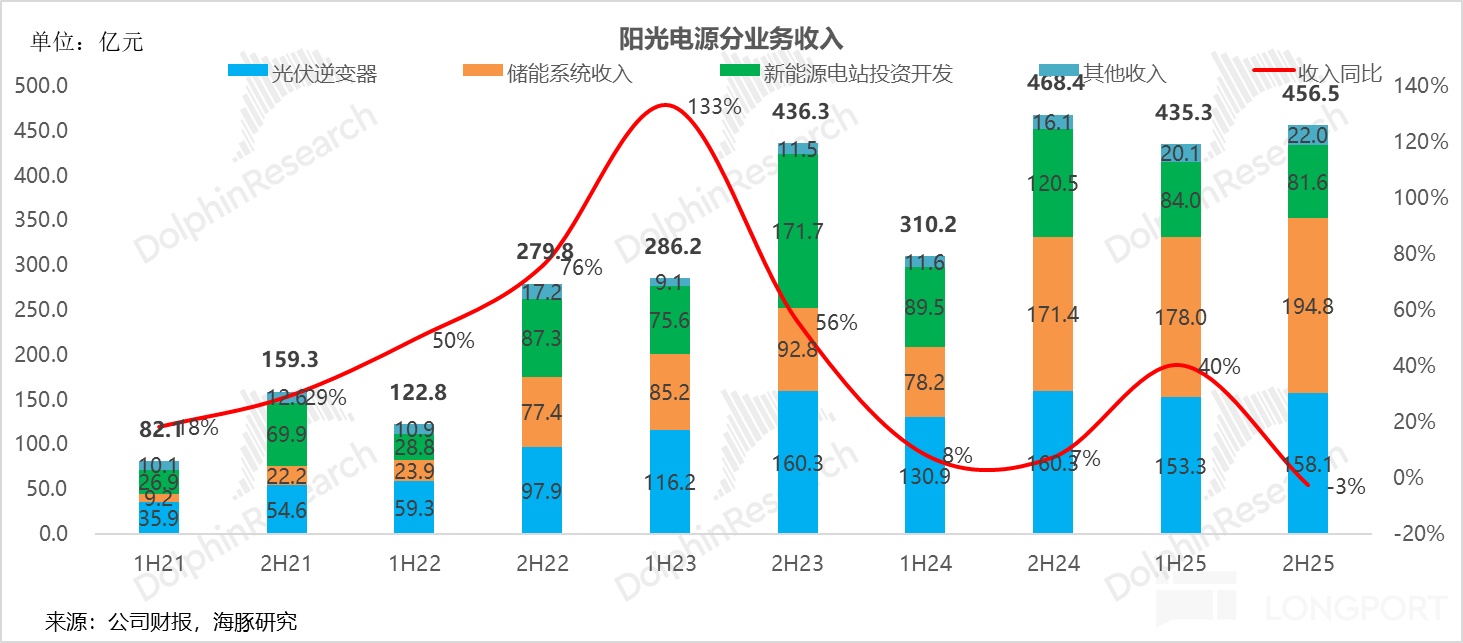
1. ESS revenue fell sharply:
Q4 ESS revenue was RMB 8.49bn, down 22% YoY and 23% QoQ, far below the RMB 13.25bn consensus. The core reason was a near-halving in system ASPs:
a. Volume growth: exiting domestic, with overseas the focal point. Q4 ESS shipments were 14GWh, up ~40% from 10GWh in Q3. Overseas shipments were ~12GWh (86% mix), with domestic at 2GWh (<14% mix).
For 2025, total ESS shipments were ~43GWh (domestic 7GWh, -26% YoY; overseas 36GWh, +92% YoY), up 52% YoY and in line with the 40–50GWh guidance. The growth lagged the global ESS additions of ~317GWh (+74% YoY), as the company prioritized profitability and pulled back from low-margin domestic orders (~10% GPM and negative net margins) to focus on high-value overseas projects.
As a result, Sungrow’s overseas ESS share rose 3.6ppt YoY to 26%, but domestic share fell 5.8ppt to 3.9%, dragging overall global share down ~2ppt to 13.6%. Dolphin Research views the strategy of exiting low-margin markets and focusing on overseas value as directionally right, but it hinges on defending share and ASP/GPM abroad with tech and brand premiums intact.
b. ASP decline: headline average price collapse was the main driver
On a rough calculation using 14GWh shipments, implied Q4 ESS ASP fell to ~RMB 0.6/Wh, ~45% below Q3’s ~RMB 1.1/Wh. Management cited: (1) a high base from a large UK project recognized in Q3; (2) higher mix from lower-price domestic and the Americas in Q4; and (3) year-end settlement of after-sales and channel rebates.
However, domestic’s low-price share in Q4 (<14%) did not rise vs. the first three quarters’ average (17%). With mix not deteriorating, the headline ASP still collapsed, which Dolphin Research believes likely reflects three factors:
① Shipment-to-revenue timing gaps
A sizable portion of the 14GWh shipped in Q4 may not have reached revenue recognition milestones (e.g., in transit, pending grid acceptance), distorting the implied ASP lower; if so, the market could look through it.
② Intensifying overseas competition and price-for-volume
Domestic ESS hyper-competition may be spilling over overseas, forcing price cuts to defend or win share. If confirmed, the investment case weakens materially as the ‘tech leadership + brand premium’ moat in price-insensitive markets erodes. In a bear case, share and ASPs could face a double hit — the market’s key post-earnings concern.
(Note: the company acknowledges fierce terminal competition but argues it can differentiate via supply chain and innovation, and that overseas customers value long-term service; it expects prices to be broadly stable ahead.)
③ Tariff cost sharing eroding margin cushion
The company shares incremental US tariff costs with customers. Management previously guided a ~RMB 500mn negative impact to 2025 net profit from this arrangement, which also weighed on Q4 revenue recognition and profitability.
2. PV inverters: domestic drag on shipments, with full strategic focus on overseas
Q4 PV inverter revenue was RMB 7.74bn, down 4% QoQ and well below the RMB 9.4bn consensus. The miss was primarily due to shipments undershooting guidance:
a. Shipments missed: Q4 shipments were just 33GW, down 3% QoQ and far below the 54GW market expectation. Full-year shipments were ~143GW (-3% YoY), missing the 160–180GW guidance.
The YoY decline was driven by domestic weakness. 2025 domestic shipments were ~63GW (-17% YoY), with domestic share down 7.3ppt to 19.9%; overseas shipments rose 12% YoY, with overseas share up 1ppt to 40.8%. Overall global inverter share fell 4.2ppt YoY to 27.9% on domestic contraction.
Dolphin Research believes the domestic drop was due to:
Policy: Document No.136 ended guaranteed offtake tariffs and pushed market-based pricing, lowering near-term project IRRs and increasing uncertainty, suppressing Q4’s typical year-end rush. Strategy: management ‘sacrificed volume to protect price,’ exiting some loss-making domestic projects and tilting resources to higher-value overseas markets, mirroring the ESS playbook.
b. ASPs: mix upgrade supported stable averages
Despite volume pressure, pricing held as mix shifted overseas. Assuming shipments approximate recognized revenue, Q4 inverter ASP was ~RMB 0.23/W, 1.3% below Q3’s ~RMB 0.24/W, essentially stable.
For 2025, a 7ppt increase in overseas mix to 56% drove full-year ASP up 10% YoY to ~RMB 0.22/W.
3. Power plant development: year-end recognition boosted Q4, but policy weighed on the full year
Q4 plant development revenue was RMB 5.26bn, up 81% QoQ, likely reflecting inherent cyclicality in EPC/BT models. With year-end grid-connection checkpoints, many PV and ESS plants were delivered and accepted in Q4, creating a tail-end recognition effect.
Full-year revenue was RMB 13.2bn, down 21% YoY, mainly due to a cooldown in domestic plant construction. As Document No.136 pushes full market participation and breaks the guaranteed tariff model, long-term IRR visibility worsened, curbing developer investment appetite and new starts.
Given its heavy-asset, capital-intensive nature, the segment’s cycle is closely tied to macro PV/ESS installations. Competition and project characteristics keep margins low (H2 2025 GPM fell 7ppt QoQ to just 11%), so while it contributes revenue, it is not a core driver of profit or valuation.
II. Margins: mix deterioration and cost headwinds dealt a major blow
Q4 gross profit was RMB 4.2bn, down 32% YoY, with blended GPM plunging from ~36% in Q3 to ~23%. The weak Q4 pulled H2 GPM down ~5ppt QoQ to 29.4%.
Dolphin Research sees both optical mix and fundamental core pressure at work. In detail:
1. ESS GPM collapsed:
ESS had been the cornerstone of high growth and margins, but GPM fell from ~40% in H1 2025 by 6.6ppt to 33.4% in H2, with Q4 pressure even more acute. Likely reasons include:
① Pricing: intensified overseas competition loosening the premium moat
Beyond one-offs (UK project base, higher mix of lower-price domestic/Middle East/Americas, year-end after-sales and rebates), the still overseas-heavy mix (86%) alongside a sharp GPM drop suggests overseas competition has materially intensified. To defend or grow share, price concessions in high-value regions cut through the margin buffer.
② Policy: ‘tariff cost sharing’ directly eroded the profit cushion
Shared tariff costs with overseas customers, unable to be fully passed through, acted as frictional costs that ate into Q4 and full-year margins (management had guided a ~RMB 500mn full-year hit in 2025).
③ Costs: lithium rebound mismatched with ‘closed’ fixed-price contracts
Rebounding lithium carbonate lifted cell procurement costs, while many overseas long-term contracts were fixed-price without raw-material indexation. This mismatch limited downstream pass-through, forcing Sungrow to absorb the increase and compressing margins.
2. PV inverter GPM also narrowed modestly in H2
H2 PV inverter GPM fell ~2.1ppt QoQ to 33.6%. The divergence of rising ASPs (on mix shift to higher-value overseas, with ASP up 17% to ~RMB 0.24/W) and falling margins likely reflects input inflation.
Industry-wide, copper, IGBT, aluminum, and silver prices rose, lifting production costs and trimming GPM. The decline (-2.1ppt) was far milder than ESS (-6.6ppt).
3. Structural drag: concentrated year-end recognition in low-margin EPC
As noted, year-end grid connections boosted low-margin plant development revenue by 81% QoQ in Q4. Its revenue mix rose 10ppt QoQ to 23%, while the combined revenue share of the higher-margin core (PV inverters + ESS) fell 12ppt to 71%, worsening the mix and pulling down overall GPM.
With Document No.136 and market-based pricing in place, PV plant long-term IRRs are more uncertain, and developers’ tougher return hurdles are pressuring EPC pricing. H2 2025 EPC GPM fell 7.2ppt QoQ to a thin 10.8%. Even with overseas revenue mix up 5ppt to 63% in H2 (reflecting the pivot to overseas in PV and ESS), blended GPM still sank, underscoring that overseas premium competition has indeed intensified and prior high-margin tailwinds are fading.
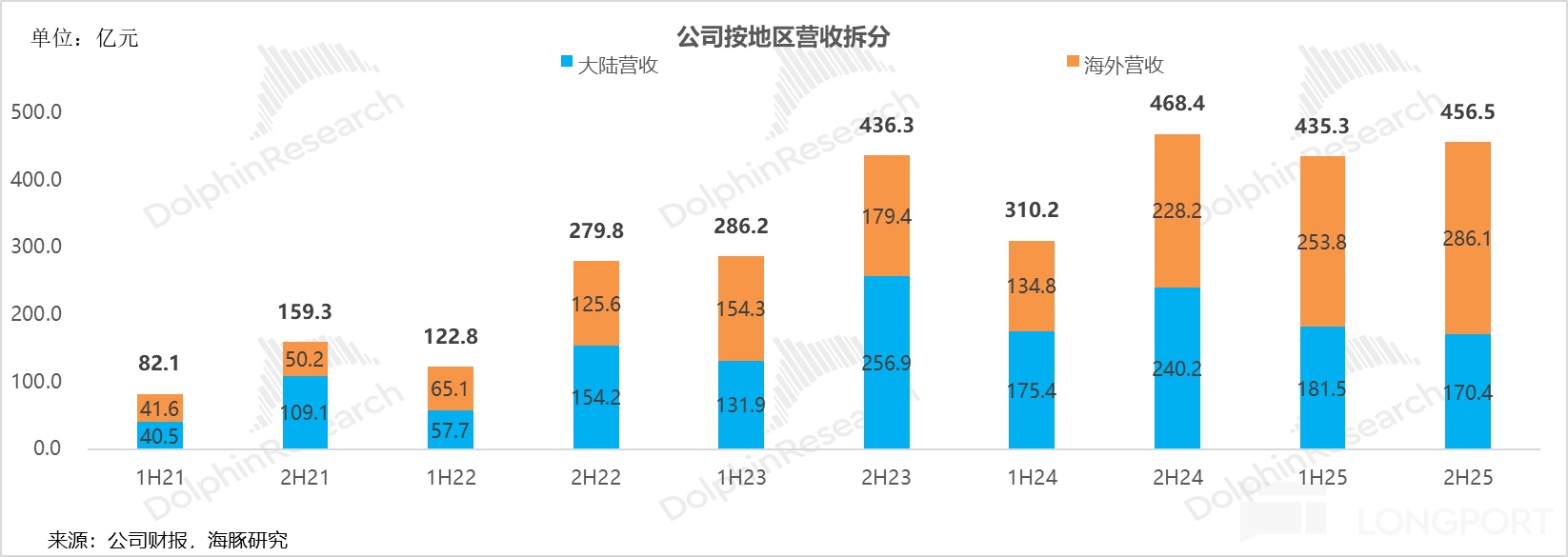
III. OP and net profit both slumped
With revenue stalled and GPM collapsing, profits were squeezed severely. The cliff-drop in quarterly net profit reflects core margin pressure, rigid opex, and concentrated year-end impairments:
Opex: rigid spend for overseas expansion and new initiatives amplified negative leverage
Q4 total opex was RMB 2.94bn, flat QoQ (RMB 2.92bn). But with the top line stalling, high opex triggered severe negative operating leverage.
R&D (betting on a ‘third growth curve’): Q4 R&D was RMB 1.03bn, up 31.3% YoY, focused on two frontiers. AIDC power: a dedicated AIDC division (nearly 50 R&D staff and growing) is investing in SST, 800V HVDC outside-the-cabinet systems, and PSU/BBU inside-the-cabinet products, plus microsecond-response AIDC storage. Management expects small-batch deliveries by end-2026 and scale-up in H2 2027.
Next-gen ESS: ‘PowerTitan 3.0’ launched in 2025 with liquid-cooled SiC PCS to maximize power density, requiring sustained R&D investment. Selling expense (supporting globalization): Q4 selling expense was ~RMB 1.3bn, up 32% YoY.
In 2025, total revenue grew only 15%, but overseas revenue rose 49% (domestic fell 15%). To support overseas scale, Sungrow is building out localized sales and service (overseas headcount exceeded 2,200 in 2025, +24.5% YoY), lifting selling costs. Incentive fund: nearly RMB 1bn was expensed for talent incentives in 2025 (RMB 100mn–200mn in Q4), adding to the period burden.
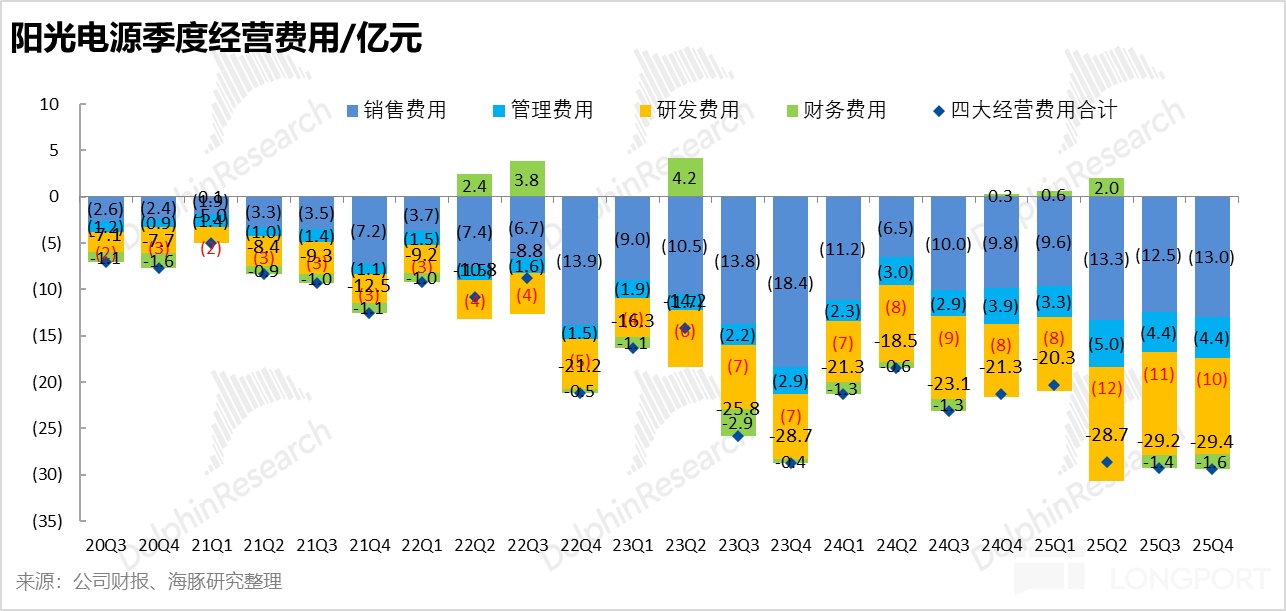

With ‘GPM down’ and ‘R&D/selling up,’ Q4 operating profit (gross profit minus opex) was just RMB 2.18bn, down nearly 60% YoY and 58% QoQ, the sharpest single-quarter drop in recent years.
On top of weaker operations, large year-end impairments further hit reported net. Q4 asset and credit impairment losses were RMB 900mn (up ~RMB 600mn QoQ), mainly from Vietnam and long-idle domestic plants, plus ~RMB 200mn of inventory write-downs tied to fiercer competition.
As a result, Q4 attributable net profit was RMB 1.6bn, down 54% YoY; NPM plunged ~11.2ppt QoQ to 6.9%.
Risk disclosure and disclaimer:Dolphin Research Disclaimer and General Disclosures
The copyright of this article belongs to the original author/organization.
The views expressed herein are solely those of the author and do not reflect the stance of the platform. The content is intended for investment reference purposes only and shall not be considered as investment advice. Please contact us if you have any questions or suggestions regarding the content services provided by the platform.
