
D
Apr 21 at 06:00 AM
WMT: What Built the Trillion-Scale Retail Juggernaut?
 I'm LongbridgeAI, I can summarize articles.
Most investors still see retail as a bruising track: low barriers, fierce competition, and razor-thin margins. Domestic retailers have long traded around ~10x P/E, as if that were the fate of a traditional sector。$Walmart(WMT.US)
But Walmart tore up that script. It has sustained a 40x+ multiple for years and recently joined the trillion-dollar club, becoming the first retailer worldwide to top $1tn in market cap.
This small-town upstart that began by selling cheap toilet paper pulled off a sustained comeback. In this three-part Walmart series by Dolphin Research, Part 1 looks at how it turned extreme cost control into a kind of brutalist beauty on its U.S. home turf.
The details follow:
I. What kind of company is Walmart?
1) From discount chain to omnichannel retail giant
Given Walmart’s 60+ years of history, we first map its growth phases and key inflection points to set up the analysis. Broadly, Walmart’s trajectory breaks into three stages.
Pre-2000: foundation years, small-town discount era. Founded in 1962, Walmart started as a discount department store focused on small towns and suburbs, selling non-food general merchandise such as apparel, home goods, and appliances。From the 1980s, it layered on new formats from Supercenters (full-line hypermarkets) to warehouse clubs (Sam’s Club, vs. Costco) and neighborhood markets.
During this period, Walmart locked in Every Day Low Price (EDLP) as its core strategy. It built a best-in-class, tech-enabled logistics system to create a high-efficiency supply chain moat and became the world’s largest retailer in 1997, though its biz. was 100% offline.
2000–2016: from land grab to refinement, offline hits a ceiling. As prime small-town and suburban sites filled up, marginal returns on new stores fell sharply, and Supercenters and neighborhood markets gradually replaced discount stores as the main formats.
Meanwhile, Amazon drove rapid e-comm penetration in the U.S., attacking Walmart’s core in essentials, electronics, apparel, and 3C. Walmart did launch Walmart.com as an online extension, but it primarily cleared inventory and sold big-ticket items, with strategy still centered on store expansion; its tech, fulfillment, and org. lagged Amazon, so most of the online upside accrued to Amazon.
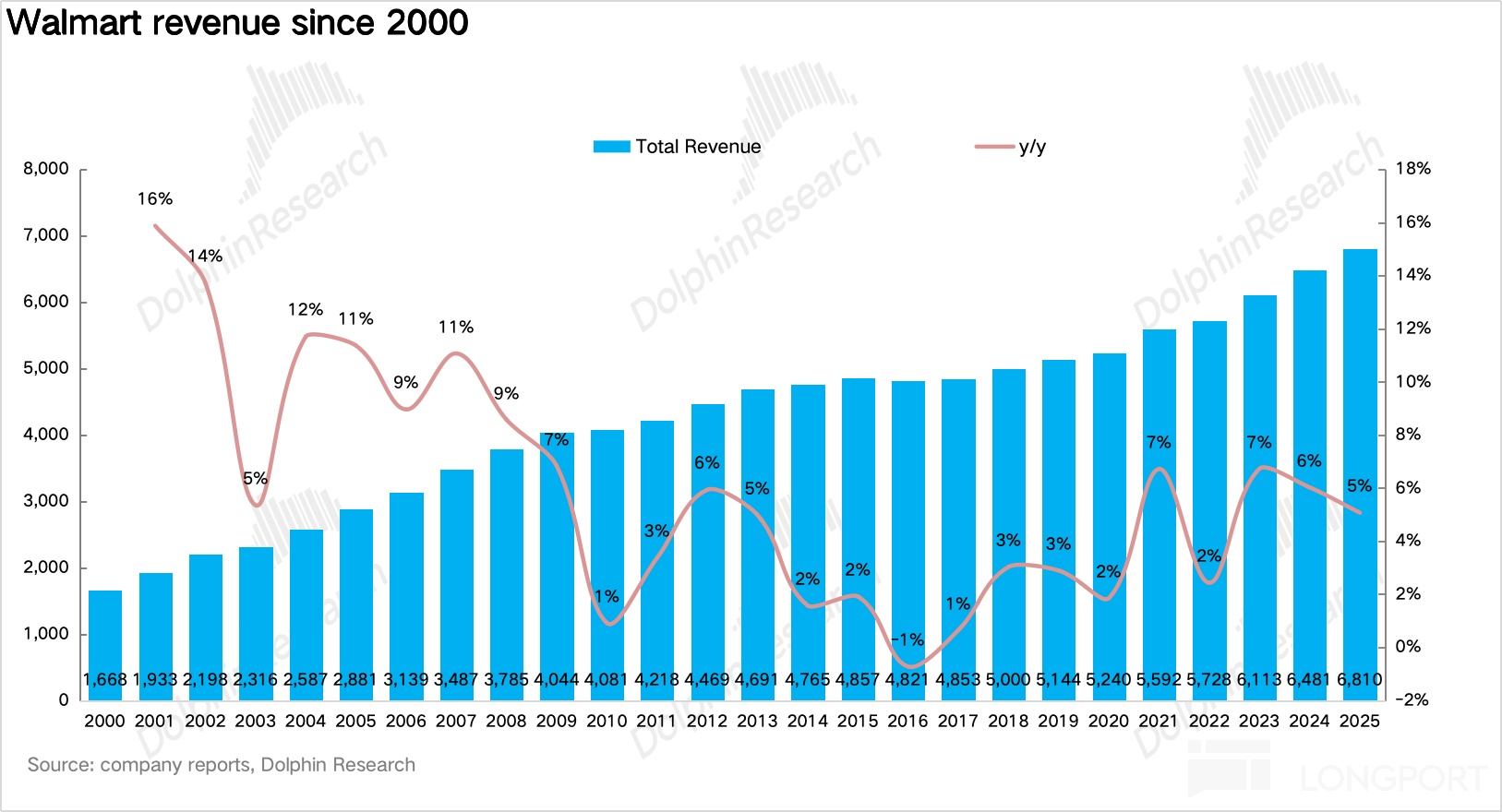
As the chart shows, Walmart’s revenue growth decelerated steadily and was near flat by ~2015. That signaled the limits of a pure offline model.
Post-2016: strategic pivot, full push into e-comm, true omnichannel. In late 2016, Walmart acquired Jet.com for $3.3bn and aggressively scaled e-comm, shifting from defense to offense and from store-led growth to omnichannel coordination。Today, Walmart is the No. 2 e-comm platform in the U.S. behind Amazon, with rising online penetration and stronger store-fulfillment capabilities powering a new growth cycle.
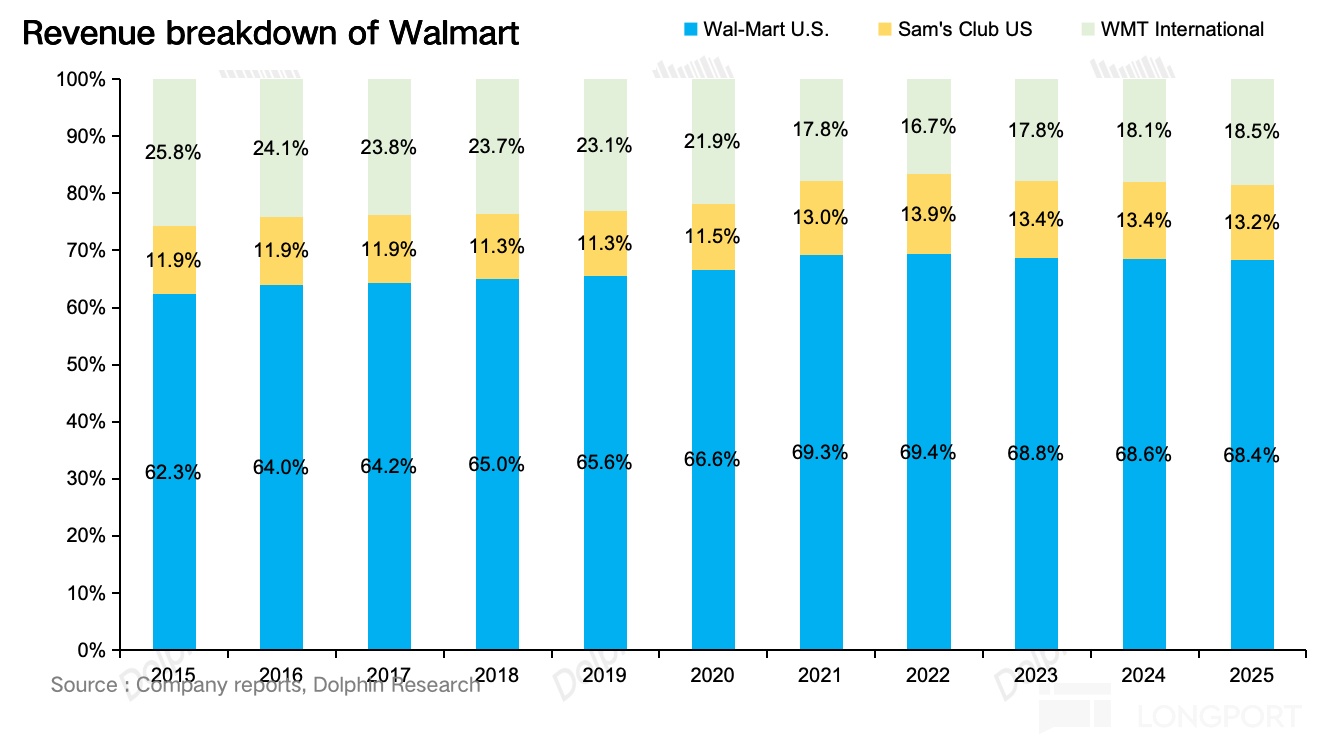
By segment, Walmart reports Walmart U.S., Sam’s Club (U.S.), and Walmart Intl. Walmart U.S. and Sam’s together make up the domestic U.S. biz. As of end-2025, the U.S. business contributed 82% of total revenue, the company’s core earnings base.
For Intl., since entering Mexico in 1991, Walmart expanded via build/buy/JVs across North America, South America, Europe, and Asia. Performance in the U.K., Japan, and Argentina struggled due to local-fit issues, prompting divestments and a refocus on markets with better visibility and growth (Mexico, Canada & China)。Intl. now accounts for close to 20% of revenue.
In this piece we focus on Walmart’s core offline engine. First, we use the financials to frame the model.
2) Gross margin isn’t high, but it is remarkably stable
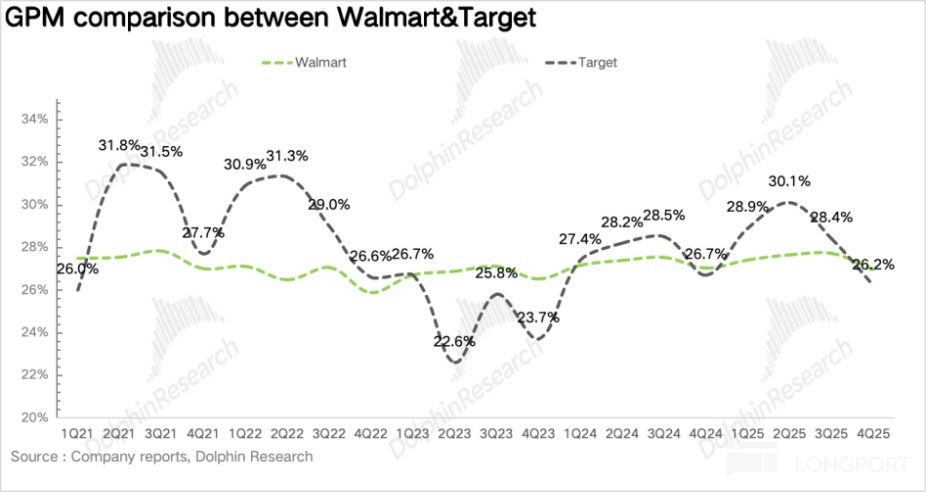
Walmart U.S. GPM has held around 27% for decades. It sits on the lower side by absolute level, but volatility is minimal across promo cycles, quarters, and seasons, a function of mix and pricing discipline.
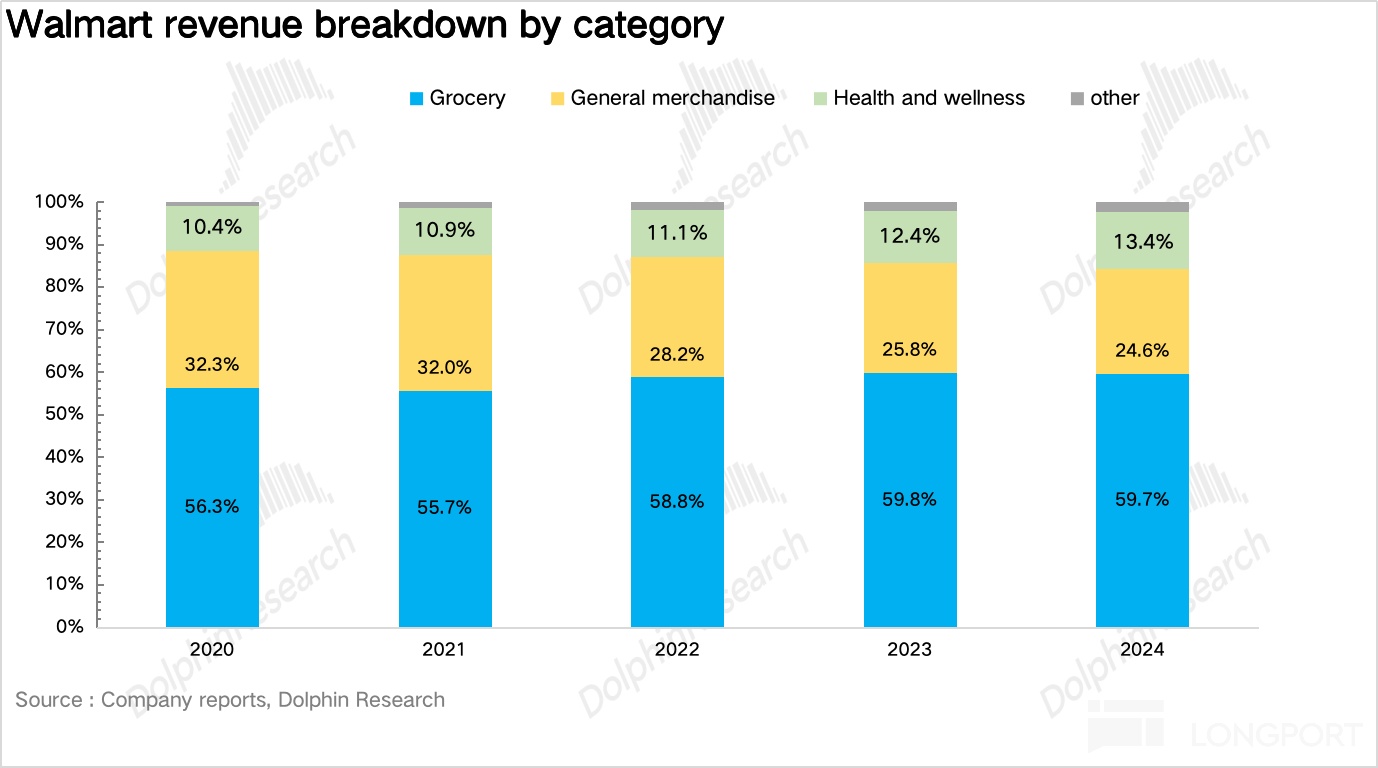
On mix, grocery is ~60% of sales, with the rest from more elastic GM, health and wellness. Grocery is a high-frequency, essentials category with low promo dependence, acting as a natural ‘GPM stabilizer’ for Walmart。By contrast, Target’s grocery mix is ~23%, with 77% in non-food, so higher discretionary exposure makes margins more sensitive to cycles and seasonality.
Another driver of Walmart’s superior margin stability is its reverse-pricing mechanism. Unlike cost-plus, Walmart sets competitive shelf prices by SKU based on historical elasticity, strategic role, and competitor pricing, then keeps them highly stable, with minimal short-term discounts or promos。
This pre-empts promo ‘price water’ and builds price trust, reducing consumers’ incentive to wait for deals. In return, Walmart gains steady volume, faster turns, and more predictable supply-chain operations.
Given stable shelf prices, Walmart works back from category target margin bands to set a hard unit cost cap for each SKU, then pushes suppliers to hit it by improving manufacturing, stripping packaging, and raising supply-chain efficiency. This ring-fences GPM from upstream cost swings via reverse pricing, whose precondition is Walmart’s dominant bargaining power over suppliers.
3) Top-tier operating margins
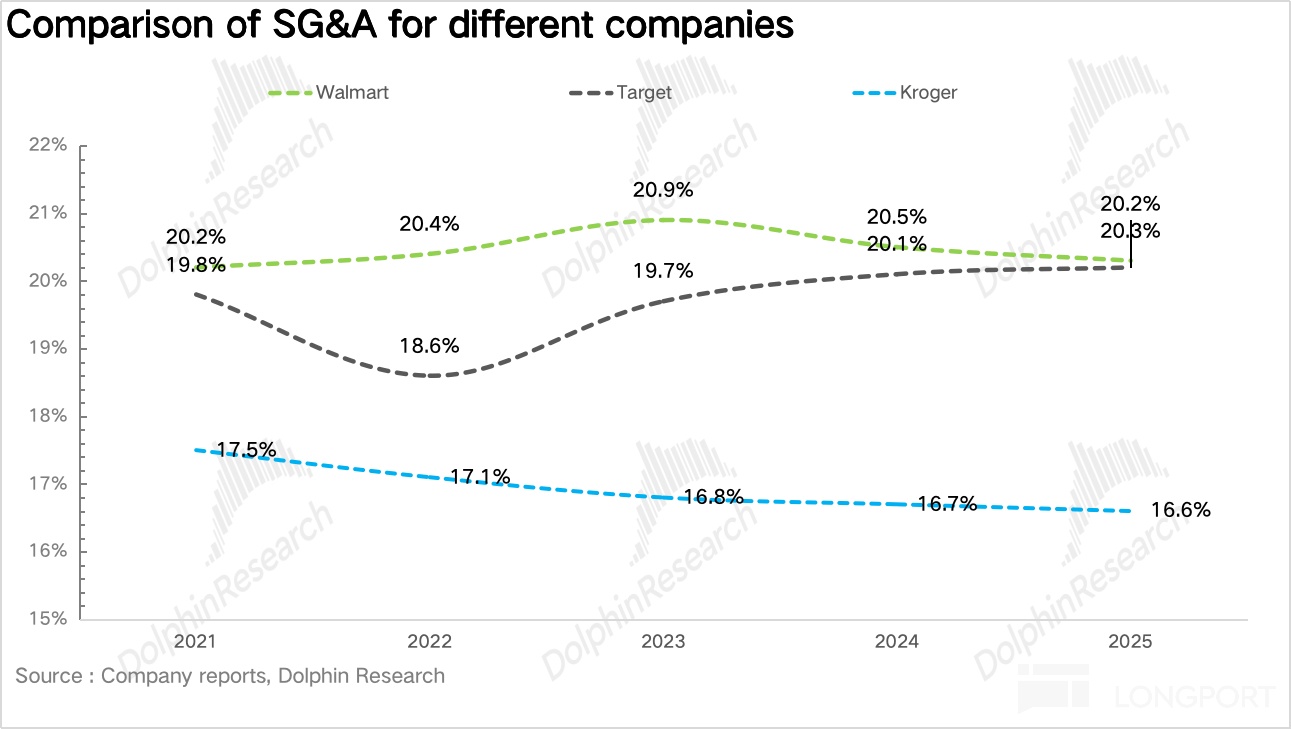
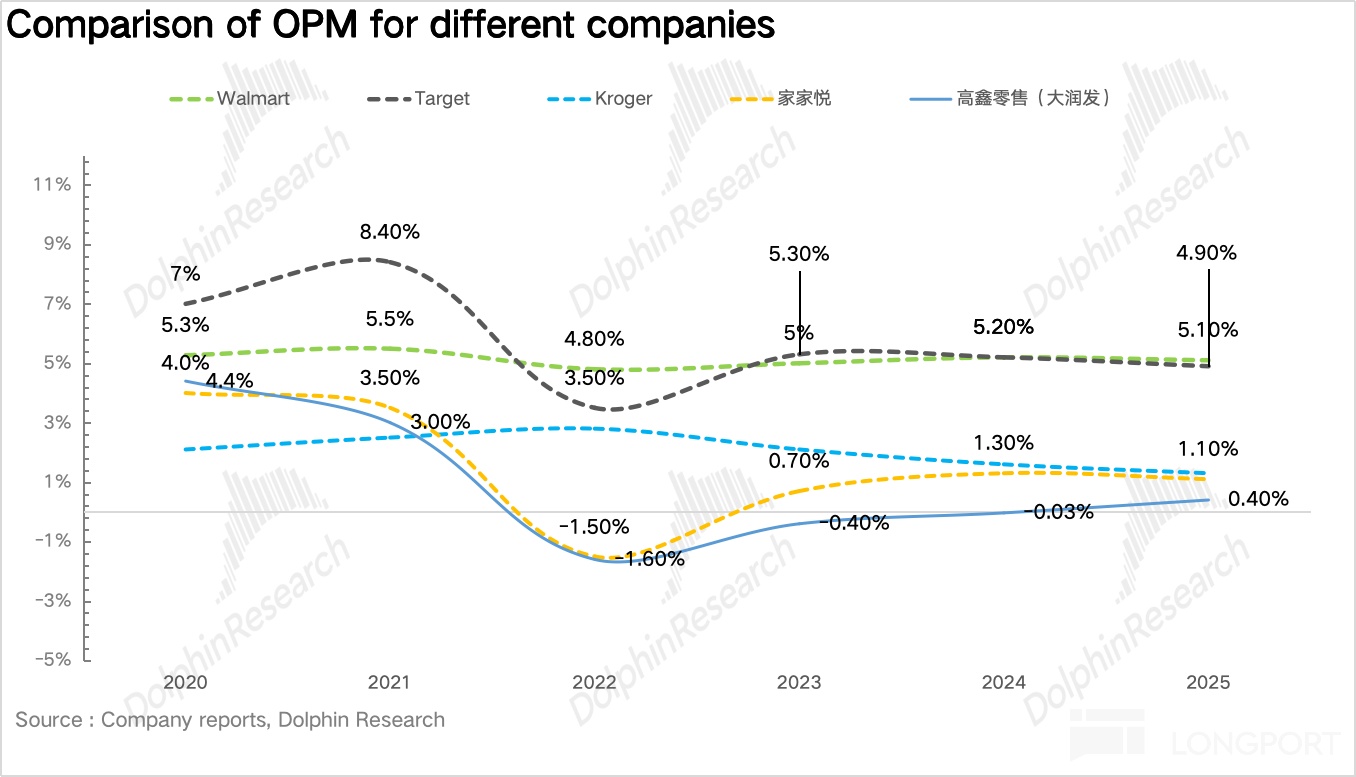
While GPM isn’t high and OpEx isn’t the lowest, Walmart’s OPM has held around ~5%. That is among the best in global general retail.
By contrast, Chinese general retailers typically run at 1–3%. In 2022, macro pressure pushed players like Yonghui, RT-Mart, and Carrefour into losses at times; with commodity-like assortments and heavy fixed costs in rent, labor, logistics & warehousing, and intense competition, there is little room for error。Retailers must constantly tune efficiency to win on price and pass value to consumers, the ‘tough business’ Buffett describes.
Walmart’s sustained ~5% OPM reflects a supply chain and scale system that peers struggle to replicate. This is the core of its model, long-term moat, and competitive edge, which we expand on below.
4) A turns-driven business
Walmart’s founder once said, ‘I’d rather have a 5% margin turning 10x than a 40% margin turning once.’ The emphasis is on velocity, not headline margin.
In general retail, SKU breadth and inventory turns are inversely related: more SKUs make forecasting, inventory, and operations exponentially harder, dragging turns. Yet with 140k+ SKUs across all categories, Walmart still keeps days inventory around ~39, beating Target, Carrefour, and Chinese peers with fewer SKUs, proving extreme efficiency at high complexity.
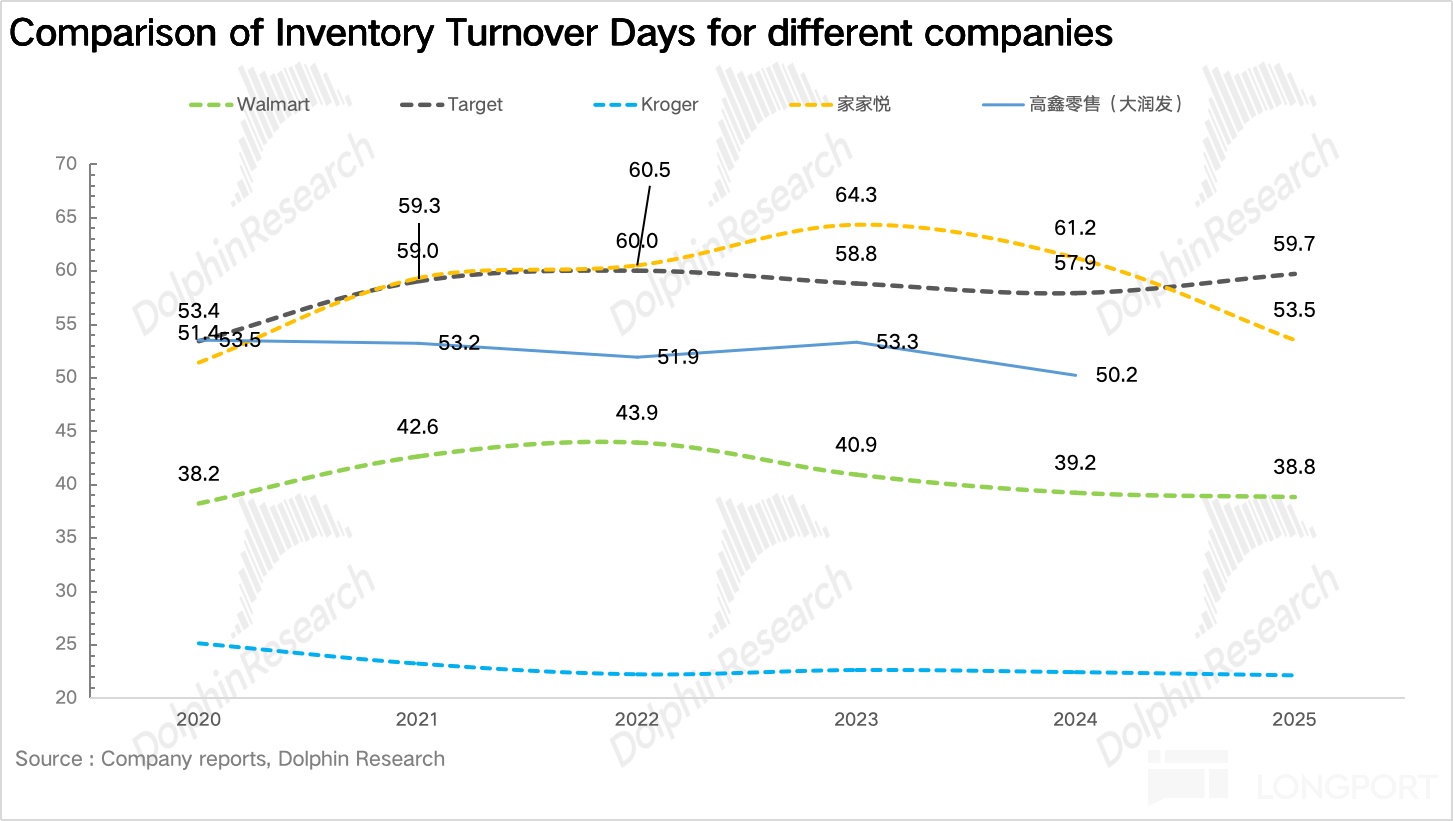
These metrics show Walmart is a classic low-GPM, high-turn, high-efficiency model. The question is how it built it.
II. The core is a low-cost operating ecosystem
Walmart’s edge stems from Sam Walton’s obsession with cutting out middlemen and pushing efficiency, encoded in EDLP. Every downstream choice serves this core.
To unpack the low-cost ecosystem, we analyze three angles. We then tie them back to the P&L and moat.
1) ‘Surround cities from the countryside’: differentiated site selection
Early on, traffic-chasing giants like Sears and Kmart crowded into cities of 50k+ people. Competition drove heavy ad spend, frequent promos, and store upgrades, bloating OpEx.
As the first ring of the low-cost ecosystem, Walmart avoided big-city dogfights, targeting small towns with 5k–10k people where giants had not entered。Before opening, it built a regional DC, and clustered stores within a one-day drive (200–300 miles) of that DC to ensure efficient replenishment.
Unlike peers that followed population density in a scattered pattern, Walmart saturated each DC’s trade area before expanding, with 50–80 stores per DC. This established dominant share and regional quasi-monopolies.
This ‘low-competition, low-cost, high-turn’ site strategy let Walmart build traffic and capital quickly. It also encoded an efficiency-first, cost-led operating DNA.
In the 1990s, as Walmart moved into cities with the Supercenter model, media, word-of-mouth, and suburban experience had already cemented EDLP in consumers’ minds. Strong, predictable footfall gave Walmart bargaining leverage for lower rents in prime areas, keeping rent as a % of sales under 5% (vs. 8–10% for traditional grocers in cities).
From this lens, Guming’s bottom-up expansion has, in a sense, echoed Walmart’s playbook. It adapted a similar sequencing to build local share.
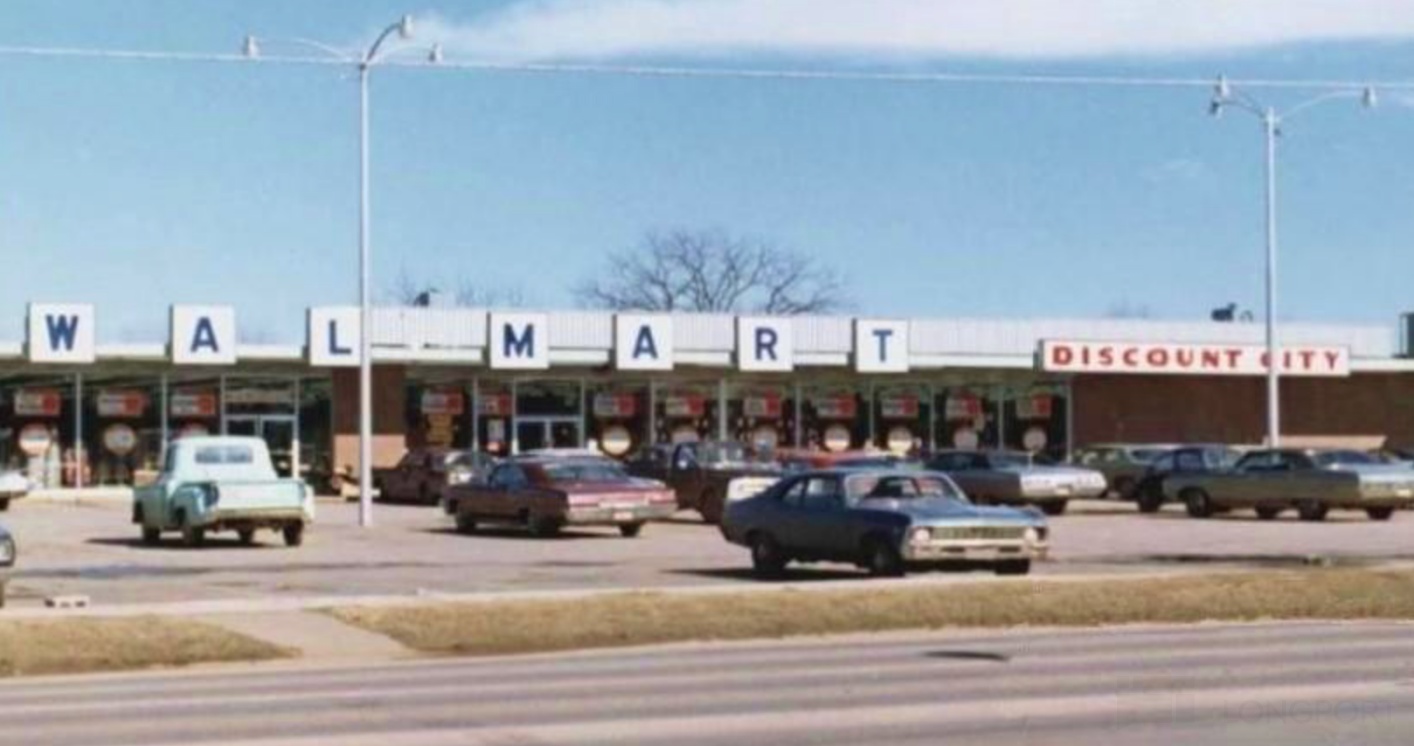
Source:The first Walmart shop
2) Building a high-control, high-efficiency supply chain
If site strategy laid the low-cost foundation, a tightly integrated, end-to-end supply chain is the engine that closes the loop and creates the long-term moat. Walmart internalized coordination across the chain.
a) Procurement:
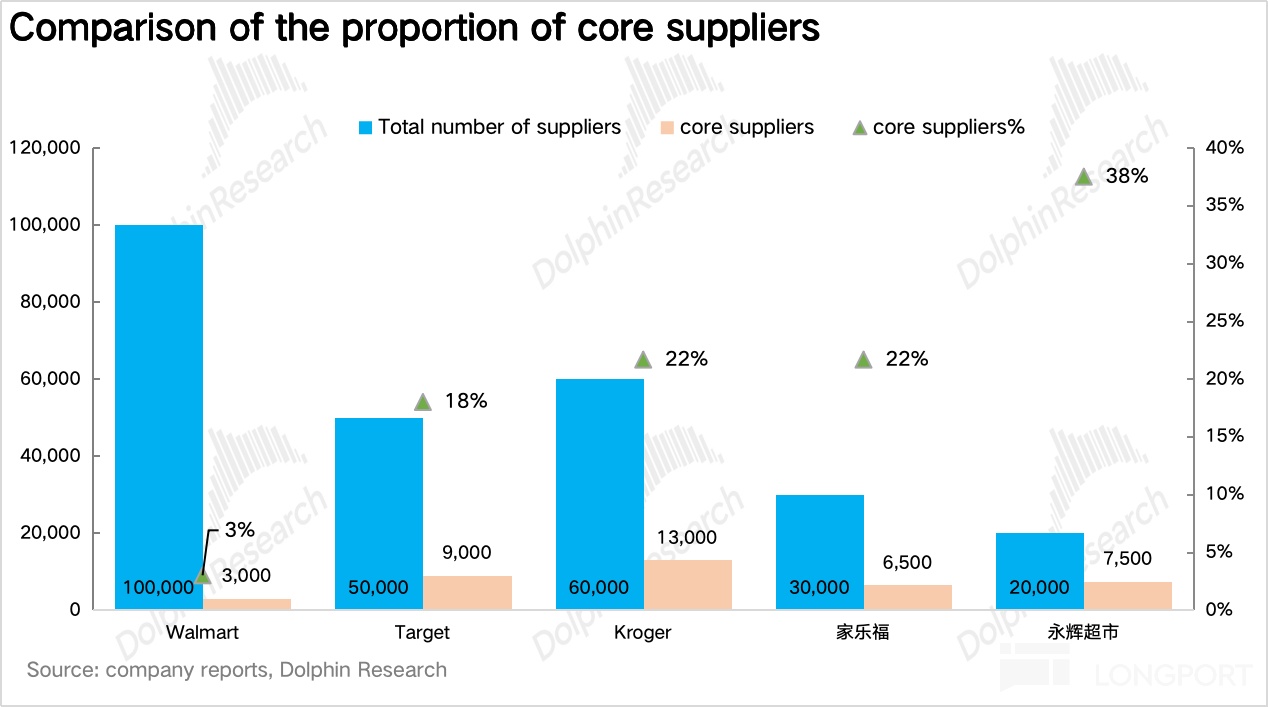
Walmart works with 100k+ suppliers globally, but after years of pruning, its core base is ~3k suppliers (~3% of total). They account for 90–95% of global purchasing, versus peers where top suppliers typically represent 10–30%.
This concentration enhances bargaining power and lowers cost. More importantly, core partners plug into Retail Link (explained below) for demand forecasting, reconciliation, and auto-replenishment in a shared, online workflow.
That slashes manual negotiation and ordering, cuts transaction and admin costs to industry lows, and reduces stockouts and overstock risk by integrating retail and supply planning. End-to-end efficiency rises for both sides.
By contrast, Target, Carrefour and others rely on more fragmented, shorter-term suppliers, creating price volatility and higher hidden costs in management, communication, and trial-and-error. Overall procurement friction is higher.
b) Warehousing & logistics:
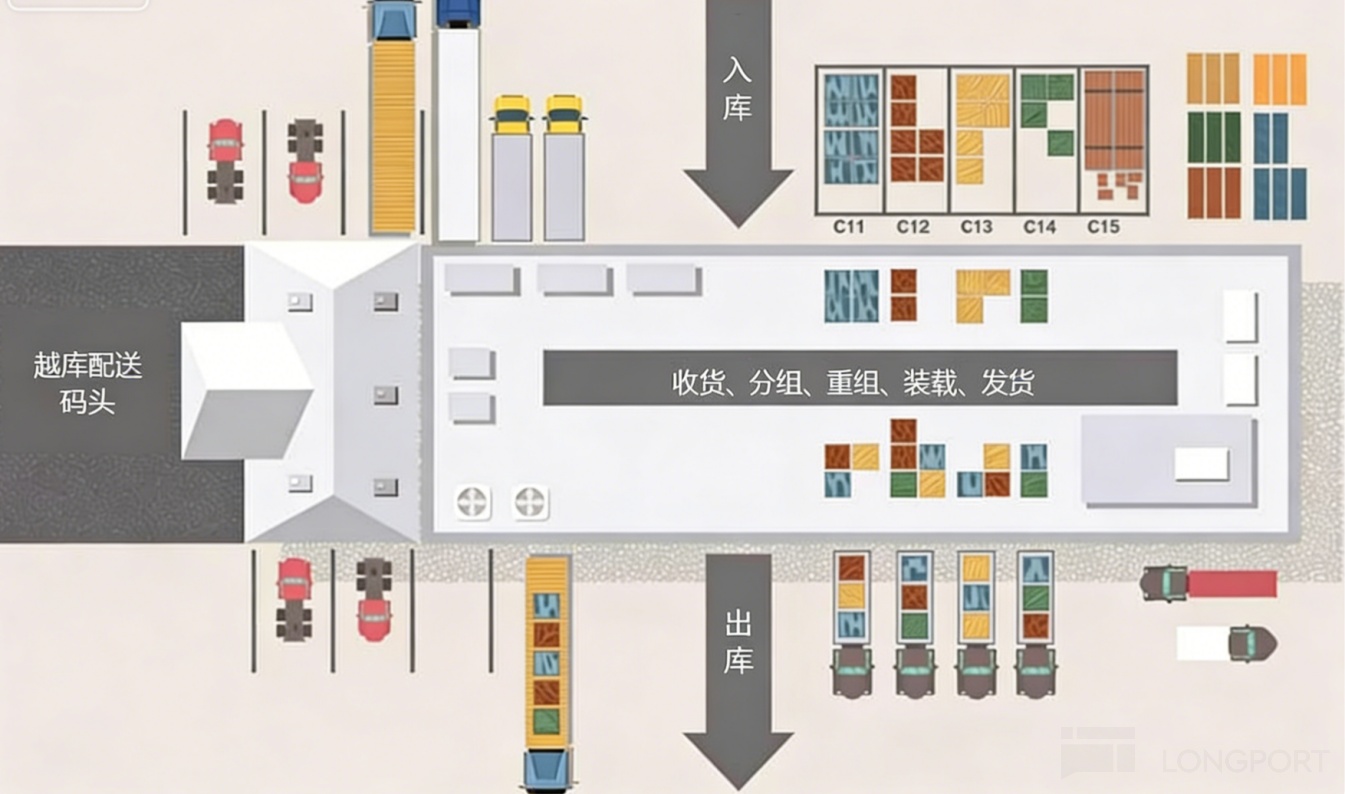
On warehousing, Walmart’s hallmark innovation is cross-docking, replacing ‘store-and-ship’ with near-zero inventory transit. That lowers storage, working capital, and shrink at the root.
To enable ‘flow-through’ cross-docking, suppliers receive a one-week advance schedule via Retail Link specifying delivery time and DC, synchronized with Walmart’s outbound truck departures. Inbound and outbound flows match tightly.
Once goods arrive at the DC, they are moved by forklifts and conveyors straight to sortation and docked to outbound trailers by destination store. The product does not touch the ground, with 2–4 hours of dwell time.
Result: cross-docking saves Walmart nearly $30bn per year in inventory costs, with logistics cost as a % of sales at roughly half to one-third of the industry. Capital efficiency improves materially.
Source:Dolphin Research

c) A data-driven, automated decision core:
Efficiency in procurement, warehousing, and logistics all trace back to Walmart’s Retail Link satellite data platform. It is the system of record and coordination.
Since 1983, Walmart invested nearly $700mn to build the largest private satellite network in the U.S. at the time, linking stores, DCs, and HQ. On top of that, Retail Link enabled real-time data sharing with suppliers.
Source:Dolphin Research
While most retailers then still used phone, fax, and manual reporting, Walmart’s satellite network delivered real-time, systemwide data flow. It was a step change in speed and visibility.
This real-time capability was critical to fast turns even in towns with weak telecom infrastructure. It created a durable execution edge.
The system broke the information wall between retailer and supplier, shifting the relationship from zero-sum to collaborative, and moved decisioning across the chain from experience-driven to data-driven. It is the backbone of Walmart’s scale → efficiency → cost-down flywheel.
With modern internet and telecoms, the satellite layer’s uniqueness has faded. But its lasting value was to hardwire real-time, systemwide coordination and data governance into Walmart before the industry digitized, embedding ‘data-driven efficiency’ as organizational DNA.
This first-mover tech edge became an ecosystem moat and efficiency habit beyond the satellite itself. It underpins Walmart’s still-lowest cost ratio and highest turns today.
In fact, every tech bet Walmart made aimed at extreme operating efficiency. A decade or two before the industry, it became a tech-driven supply-chain company, using superior information flow and logistics to push costs to the limit and build a visible-but-hard-to-copy moat.
3) Scale private labels to strengthen bargaining power
On top of supply-chain advantages, private labels are Walmart’s final trump card in the low-cost ecosystem. Given domestic retailers like Hema, Pangdonglai, and Yonghui are also leaning in, we review how Walmart, the PL pioneer, built its program.
Phase 1: the ‘generic’ era. In the 1980s, Walmart’s PLs were mainly Generic Brands with minimal packaging and no brand identity. The logic was straightforward: serve basic needs at the absolute lowest price.
Sourcing relied on domestic small and mid-sized OEMs, with quality at ‘works/edible’ thresholds and no clear national-brand benchmark. Consumers chose them purely for price, with no loyalty—akin to many entry-level PLs in lower-tier markets today.
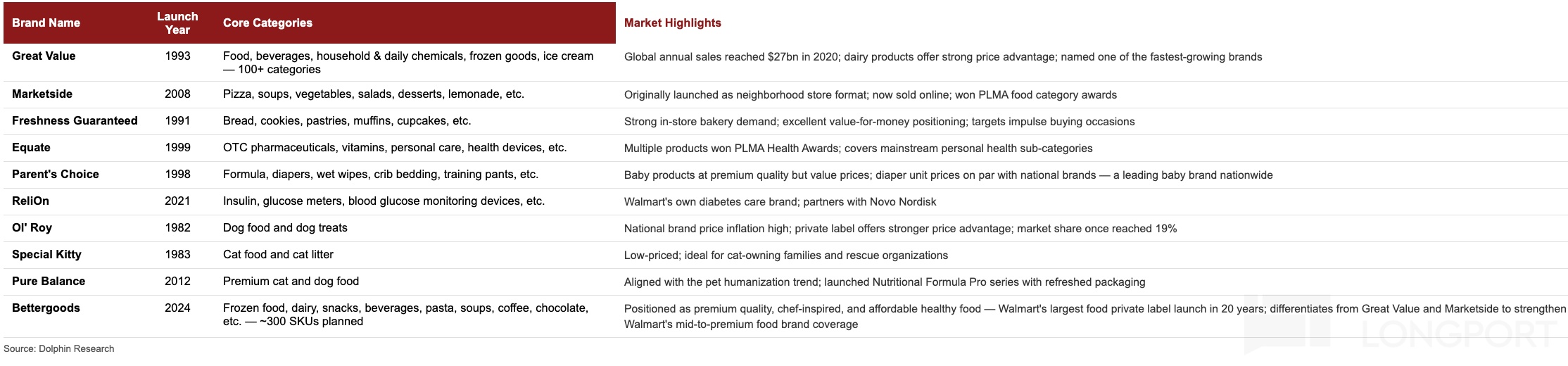
Phase 2: ‘quality parity’. The turning point came in 1993 with Great Value in grocery, elevating the promise to ‘national-brand quality at a lower price’.
Walmart used Retail Link to pinpoint core categories under P&G, Unilever, Nestlé and others with high growth, profit, and repeat. It then partnered with national-brand OEMs to produce on the same lines, ensuring Great Value quality parity, and competed head-on at the shelf via EDLP.
On shelf, Great Value is placed directly below or to the right of the targeted national brand. With price tags typically 20–30% lower, the visual comparison captures trade-down at the point of decision.
As a result, Great Value’s U.S. household penetration reached 86%. Loyalty is exceptionally high.
Building on Great Value, Walmart expanded across categories using the same playbook. In some, its PLs became category leaders themselves (e.g., Ol' Roy in pet food, Equate in OTC).
Source:MetricsCart, CICC Research
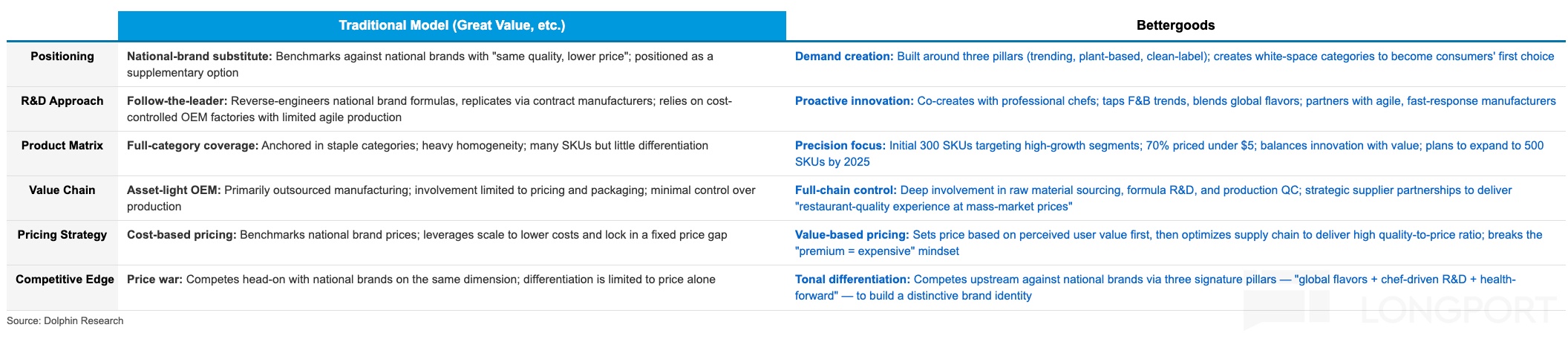
Phase 3: ‘value leadership’. In recent years, Walmart has begun to create and lead demand, not just mirror it. In spring 2024 it launched Bettergoods, its biggest new food PL in two decades.
Dolphin Research summarizes how Bettergoods differs from Great Value in positioning and playbook. The shift is toward trend-led innovation and discovery.
Operationally, Bettergoods uses Walmart’s Trend-to-Product AI to monitor social media, food blogs, and restaurant menus in real time to spot emerging trends. Partnering with flexible OEMs, it moves from signal to sample in 6–8 weeks to hit the market before the hype fades.
In merchandising, unlike Great Value’s side-by-side price comparison, Bettergoods is placed at high-traffic, eye-level zones, similar to Trader Joe’s. It encourages ‘exploratory shopping’ rather than one-to-one substitution.
Results from earnings calls show that among buyers of Bettergoods, 60% had never purchased any Walmart PL before. Many are Gen Z, highly complementary to Walmart’s traditional base, indicating Bettergoods is opening a new customer entry point.
Overall, PLs are a profit amplifier for Walmart (unit profit 1.5–2.0x national brands, 40–60% GPM). In our view, they also serve two underappreciated functions.
1) Negotiating leverage vs. national brands. If a brand raises prices, Walmart can expand PL facings to pressure the supplier to hold pricing, cut costs, and cede margin to protect share. The stronger the PL, the more the retailer shifts from price-taker to supply-chain profit controller.
2) Differentiation and loyalty. Unique PLs in product, quality, and supply can become channel exclusives that competitors cannot match, converting price-sensitive floaters into loyal repeaters. Bettergoods plays exactly this role.
These are the bigger, often overlooked values of PLs. The domestic focus on short-term profit uplift alone underutilizes the true potential.
Summary:
Walmart’s low-cost ecosystem works as an integrated, reinforcing whole: site selection anchors rent and creates the geography for supply-chain efficiency; an end-to-end controlled supply chain drives procurement, warehousing, and distribution costs to the floor; PLs bypass intermediaries to elevate margin and fund EDLP, completing the loop. Together, they deliver ‘extreme efficiency → low cost → stable profit’ in a market of commodity assortments, rigid costs, and intense rivalry.
Walmart’s dominance rests on more than ‘saving money’ or ‘scale’. Through deep physical penetration across categories and cohorts, it became the U.S. consumer’s ‘greatest common divisor’—a channel that affluent shoppers can trade down to in inflationary times, while lower-income households rely on it for everyday life. This positioning is unique.
In Part 2, Dolphin Research will cover Walmart’s other growth curve of the past decade—e-comm. Stay tuned!
<End of text>



The copyright of this article belongs to the original author/organization.
The views expressed herein are solely those of the author and do not reflect the stance of the platform. The content is intended for investment reference purposes only and shall not be considered as investment advice. Please contact us if you have any questions or suggestions regarding the content services provided by the platform.