

 Posts
Posts Likes Received
Gintel Holdings: "Narrative Recession" and Medra Impact under Geopolitical Risks

I. Key Events
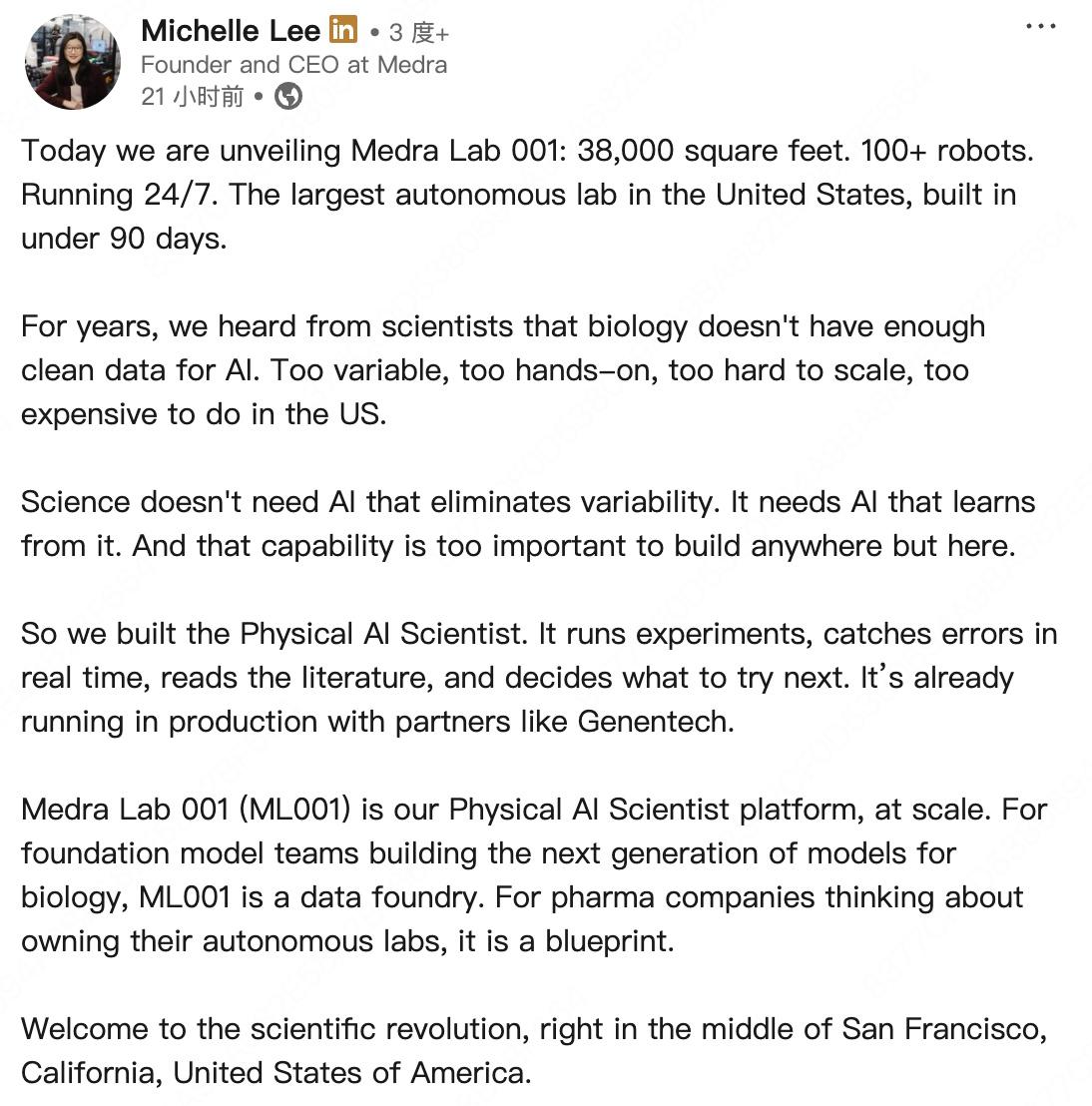
• On April 24, 2026, Medra announced that the ML001 laboratory has been completed and will be put into production within 90 days. This marks a significant milestone of "delivery and operation," following the plan mentioned when it secured $52M in funding in December 2025.
II. Core Highlights of Medra ML001 and Its Laboratory
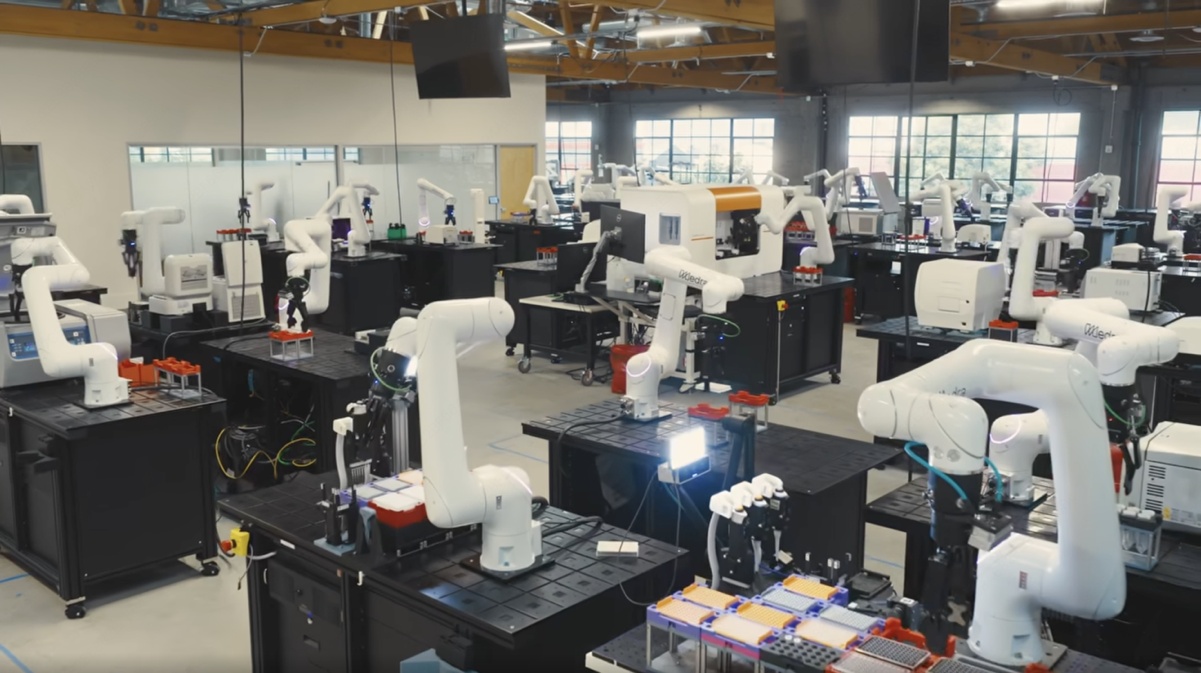
• It is the largest of its kind in the US, with plans to deploy about 100 perception-capable robots in the lab, reportedly automating 70% of common laboratory instruments, far exceeding traditional automation systems (typically only 5-10%);
• It builds a "closed-loop laboratory" combining physical AI and scientific AI. Using computer vision and adaptive control, robots can detect and correct errors in experiments in real-time. Meanwhile, based on the multimodal reasoning of large language models (LLMs), it can automatically adjust hypotheses based on unstructured data (videos, images, results) generated from the previous round of experiments and generate the next round of experimental plans in natural language;
• Instead of pursuing pure software licensing, it directly collaborates with pharmaceutical companies for early-stage drug R&D. It has already established deep partnerships with Genentech (under Roche), Cultivarium, and Addition Therapeutics, and completed a $52 million Series A funding round at the end of 2025, led by Human Capital with participation from well-known institutions like Lux Capital and Neo.
II. Impact Points for XtalPi
• Medra's launch of ML001 (38,000 sq ft, approx. 3,500 sq m) directly targets XtalPi in terms of scale and autonomy level;
• Among Medra's officially announced partners, Genentech, as a technology bellwether in the pharmaceutical industry, is now a contested major client;
• XtalPi's strengths lie in its underlying physical algorithms (quantum physics + force fields) and mature standardized robotic workstations, while Medra emphasizes "multimodal AI Agents," claiming they can operate 70% of off-the-shelf instruments like a human;
• Global capital is fluid within the AI drug discovery track. As a new darling in Silicon Valley, Medra has attracted top-tier VCs like Lux Capital. This may prompt international institutions holding XtalPi stock in Hong Kong to consider rebalancing their portfolios or at least adopt a wait-and-see attitude sentimentally.
III. Impact vs Defense
• Brand Position: XtalPi has deeper political-economic moats in the Middle East (e.g., cooperation with UAE royalty) and Asia;
• Technological Leadership: XtalPi possesses tens of millions of real experimental data points accumulated over time, which new entrant Medra cannot simulate with algorithms in the short term;
• Commercial Maturity: XtalPi already has stable revenue in the hundreds of millions of RMB, while Medra is still in the early stages of project delivery.
Note: If Medra proves that general-purpose robots are more flexible and cost-effective than XtalPi's specialized workstations, XtalPi's heavy asset investment could face depreciation and technological iteration pressure. But more concerning is that Medra's rise is not just about competition on technical metrics; it resembles a geopolitical game concerning "R&D sovereignty" and "supply chain trust."
$XTALPI(02228.HK)
The copyright of this article belongs to the original author/organization.
The views expressed herein are solely those of the author and do not reflect the stance of the platform. The content is intended for investment reference purposes only and shall not be considered as investment advice. Please contact us if you have any questions or suggestions regarding the content services provided by the platform.
