D
Apr 28 at 12:23 PM
KO (Trans): Will deliver balanced volume and pricing growth this year
Below is Dolphin Research’s Trans of KO’s FY26 Q1 earnings call. For the earnings breakdown, see 'Zero-sugar surges, AI trims costs: the 'soda' wins big'.$Coca Cola(KO.US)
I. Key takeaways from the print
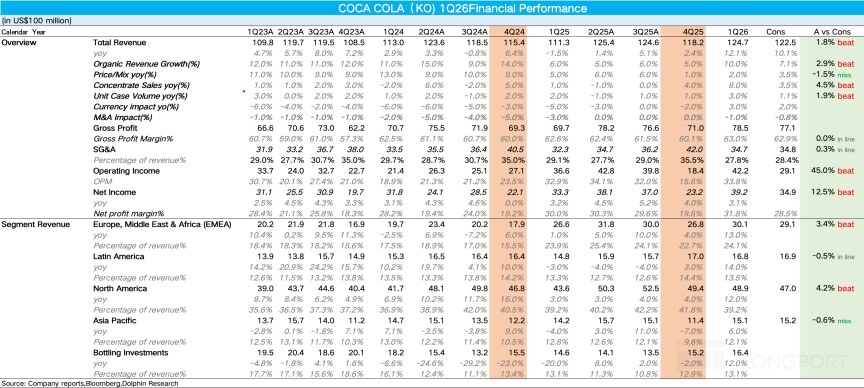
1. Guidance raised: Reaffirmed 2026 organic revenue growth of 4%-5%. FX-neutral comparable EPS ex-M&A now +6%-7%, and comparable EPS +8%-9% (up from +7%-8%) on a lower effective tax rate of 19.9% (-100bps vs. prior). FX expected to add ~1-2pts tailwind to comparable net revenue (vs. ~1pt prior) and ~3pts to comparable EPS.
2. Cash flow and balance sheet: FCF about $1.8bn, up YoY. Net leverage at 1.6x EBITDA, below the 2.0x-2.5x target range, with a cautious posture while awaiting the IRS tax dispute court ruling.
3. CCBA separation: Coca-Cola Beverages Africa sale expected to close in 2H26, subject to approvals. Anticipated headwinds of ~4pts to comparable net revenue and ~1pt to comparable EPS. Post-separation, margins should expand as lower-margin bottling mix is removed.
4. Quarterly cadence: Q1 benefited ~50bps on volume from six extra calendar days and an earlier Easter. Q2 concentrate shipments are expected to lag unit case growth by ~2pts. Q4 will have six fewer days vs. Q4 2025.
II. Call details
2.1 Management highlights
1. Global performance
a. Unit cases rose 3%, with all segments up. The system has delivered value share gains for 20 straight quarters. Over the last year, more than 600k new customer outlets were added globally, expanding coverage.
b. Off-shelf reach grew double digits, and over 340k new coolers were deployed. The system has led industry customer value creation for eight consecutive years.
2. North America
a. Volume, revenue, and profit all grew, with both volume and value share gains. Volume was up 4%. Broad-based execution supported the performance.
b. Price/mix was soft, driven by Easter timing, adverse mix in packaged water, and capacity constraints at Topo Chico. These factors weighed on the quarter’s price realization.
c. Category-wide growth: Coca-Cola trademark, Fanta, Presca, Arbor, Powerade, Sunny, Smartwater, and Minute Maid all posted volume growth. Coca-Cola trademark led industry retail sales growth. Momentum was broad across brands and packs.
d. Innovation contributed: Coca-Cola Cherry Float, Diet Coke Cherry, Mr Pibb, and Power Water supported c-store expansion. Mini cans also extended reach in convenience. Innovation remained a key lever in the channel.
3. Latin America
a. Value share gains with volume, revenue, and profit up. Brazil and Central America growth offset declines in Mexico and Argentina. Execution remained resilient across markets.
b. Mexico saw sugar tax effects early in the year, but the system has a playbook from 2014. RGM and granular consumer ops delivered better-than-expected outcomes. Mitigation efforts are ongoing.
c. FIFA World Cup activations began in Q1. Connected packaging is driving consumer engagement and data insights. Programs are scaled across markets.
4. EMEA
a. Europe, Middle East, and Africa delivered value share gains, with all operating units growing volume. Revenue and profit both increased. Execution was consistent across the region.
b. Europe: Consumers remain cautious, but tighter brand-linking to key occasions and passion points (FIFA World Cup, Premier League) and more surgical value pricing drove share gains. Disciplined RGM underpinned results.
c. Middle East: Q1 volume grew overall, but March turned negative due to conflict. Employee safety and business continuity are top priorities. The environment remains fluid.
d. Africa: Emphasis on localizing the system and strengthening RGM. Ramadan activations in Egypt and Algeria are examples of tailored execution. Local insights remain critical.
5. Asia Pacific
a. All operating units delivered volume growth despite a tough base. Revenue grew, while profit declined on tea and coffee commodity headwinds and inventory cost allocation. The region still gained share.
b. Price/mix was -6pts, reflecting long-term investment in developing markets. Strategic affordability weighed on mix in the near term. This aligns with a future-facing strategy.
c. China: Focus on quality growth and categories where the brand has the right to win, with Sparkling leading. Broad portfolio activations during Chinese New Year. The aim is not full-category coverage.
d. India: Driving affordability, tying Thumbs Up to the T20 Cricket World Cup. Sprite is expanding deeper into rural areas with localized language content. Penetration remains a priority.
e. Japan: Value share gains, with Georgia Coffee optimizing pack options for different occasions. Portfolio tailoring continues. Execution remains disciplined.
f. Of the near 10pt decline in APAC Q1 margins, roughly two-thirds reflect a one-off allocation from China juice inventory costs. This is a Q1-specific item. Underlying trends are more stable.
6. Consumer-centric strategy (the four I’s)
a. Insights, Innovation, Intimacy, and Integrated Execution. These pillars guide portfolio and market actions. Discipline has improved outcomes.
b. Coca-Cola 00 (zero sugar, zero caffeine, zero calories) relaunched in Europe, based on the insight that ~60% of adult drinkers manage caffeine intake at night. Packaging, price, and comms were aligned to the use case.
c. Sprite’s global 'It’s Dat Fresh' platform; in China, launches include Sprite with probiotics and Sprite+Tea. Localized extensions support relevance. Innovation tracks consumer needs.
d. Fuze Tea now spans 80+ markets, with global tea posting double-digit volume growth. Scale is reinforcing share gains. Expansion continues.
e. Fairlife capacity: Webster plant to come online starting Q2, ramping through the year. Capacity build supports the next growth phase. Investment remains on track.
2.2 Q&A
Q: Q1 unit cases were strong, but price/mix was soft for a second straight quarter. How should we think about full-year balance between volume and price/mix? Will the NA and Asia divergence persist?
A: We are very pleased with the quarter, which supports our message that this year is about balanced top-line growth. Not just in Q1, but for the full year. All operating units grew volume and gained share, and EPS growth was strong, which gives us confidence.
Over the next two quarters, the algorithm will oscillate around that balance. By year-end, you should see volume and price/mix in equilibrium. We are managing all levers, including pricing, with affordability embedded in our global RGM architecture. The pressure is most acute on low-income consumers, and we are keeping them in the franchise with affordable options not only in single-serve but also entry multi-serve packs. Overall, we are confident in delivering the updated full-year outlook.
Q: On costs, you noted company-level exposure is manageable, but bottlers face more direct aluminum and PET pressure. How are you collaborating across the system?
A: The environment is evolving and hard to forecast precisely. At the company level, exposure is limited and currently manageable, while bottlers have greater aluminum and PET exposure tied to oil and supply chain volatility. System-wide, we have a playbook that has worked well for years. RGM capabilities, cross-enterprise procurement teams coordinating with most system partners on resilience and productivity, and a range of cost-management actions are in place. Each market is different, so the mix of levers varies locally. We are confident that local decision-making will help us navigate this cycle, staying agile amid uncertainty as we have over the past 3-5 years.
Q: On Coca-Cola trademark strategy, after relaunching 00 in Europe, how do you allocate resources across Diet Coke, Coke Zero, and 00?
A: We are very happy with the trademark’s performance, where growth is coming from cores and innovations across multiple pack sizes. Effective execution of a broader lineup goes back to the multi-year build of global RGM with our bottlers. At our scale, small daily improvements compound into meaningful impact.
00 worked in Europe because it started with the four I’s: a key insight that consumers want to cut caffeine at certain times while keeping the taste and brand they love. With fit-for-purpose packaging, pricing, and comms, and stronger execution muscles, this became a successful innovation that broadened our reach. We have also improved innovation discipline and success rates over time. In North America, we are similarly expanding on the Cherry platform with Diet Coke Cherry, Coca-Cola Zero Cherry Float, and Mr Pibb Cherry, again through a consumer-first approach plus stronger execution.
Q: Q1 GPM showed a rare negative underlying contribution. Was it timing? How do tea and coffee inflation trends develop, and what is the CCBA impact on 2H margins?
A: Q1 margin dynamics were unusual, mainly due to a specific APAC item: the allocation of China juice inventory costs, which is a one-off in Q1. Tea and coffee do face commodity pressure that will persist through the year. Stepping back, we do not expect a material full-year deviation from underlying drivers.
RGM provides a strong foundation for margin preservation, while we drive efficiency across the P&L. On costs, we have multiple actions to offset commodity pressure, which we view as manageable ex the inventory item. On CCBA, it is mechanical: removing a lower-margin bottling asset lifts corporate margins. For 2026 specifically, FX should be a modest tailwind to margins.
Q: What are the underlying APAC growth drivers? With China and India strong for two years, how sustainable is it, and what changed vs. the past?
A: All APAC operating units grew volume and the region gained share. We are pleased but see more to do, as many countries are still developing and this region is our future growth engine. In China, we chose years ago to focus on quality volume and categories where we have the right to win, rather than full-category coverage. That is paying off, with Sparkling leading, share gains, and stronger core execution with partners before expanding outward.
In India, it is also a long-term build. We benefit from local brands acquired long ago that give us a complete lineup and a unique way to connect with consumers. But in RGM and bottler capability build, there is still a way to go vs. mature markets. The -6pt APAC price/mix is consistent with investing for the future; while there were some one-offs this quarter, the priority is investing for growth and healthy system economics to bring more consumers in ahead of the curve.
Q: APAC OP margin fell nearly 10pts. Can you unpack drivers and the path forward?
A: The Q1 margin impact was driven by the inventory item and is Q1-specific. We have plans through this year and into next to address it. Priority one is the consumer base: get volume growth within our market boundaries and invest appropriately. APAC is rich with opportunity, and we like the start on volume this year. Our global portfolio allows near-term targeted investment while driving margins back to where they should be over time.
Q: Outlook for EMEA, especially conflict in the Middle East and regional inflation? And an update on Fairlife capacity?
A: EMEA performed well with volume and profit growth and continued share gains. In the Middle East, Q1 volume grew overall, but March was most affected by conflict. We are working with partners, prioritizing employee safety and business continuity. The teams draw on experience from past episodes, focusing on controllables and staying close to consumers.
We are confident in managing the region’s complexity and will stay focused on balanced growth. In a very dynamic world, we will lean more on the power of the system. We believe we are well prepared to keep thriving there. On Fairlife, it is a terrific brand, and the Webster plant will start coming online in Q2 and ramp through the year, underpinning the next phase of growth.
Q: North America posted solid Q1 volume, and the FIFA World Cup is approaching. What are the acceleration opportunities? How is Mexico performing post sugar tax?
A: We are pleased with 4% volume growth in NA, reflecting strategy and system execution in the right place. Broad-based, multi-category, multi-brand growth ensures the right in-market impact. On the World Cup, we began activations in Q1, which was the right move by NA and Mexico operators with bottlers. Q2 is when it lands, with deep digital integration: in the US, consumers can now engage via packaging to access content, rewards, and even convert interactions to retailer transactions. This is the path we intend to scale.
In Mexico, the sugar tax had an impact early in the year. The system is resilient with a proven playbook from 2014; with RGM and precision ops plus personalized consumer and customer connections, we outperformed expectations. Mexico still created a geographic mix effect on overall price/mix, but we will lean into local and global brand marketing throughout the year to offset tax effects. Brazil and Central America fully offset volume declines in Mexico and Argentina.
Q: How are you leaning into away-from-home channels?
A: Globally, away-from-home outperformed at-home slightly, though in the US Q1 was the opposite. Strategy is unchanged: connect with consumers across occasions and need states. In NA foodservice, we are working closely with customers to understand their consumer profiles with more precision, offering not only core products but also more innovation within categories. We see further room to expand beverage occasions. As the preferred supplier for many partners, we have ample runway to grow the category and drive frequency. Our RGM and consumer insight capabilities will support sustained growth in this channel.
Q: As the new CEO, any new observations or shifts in marketing, especially converting younger consumers at the point of sale?
A: The transition has been smooth. We will stay the course on the many initiatives of recent years because we have conviction in them. Three beliefs are core: first, we are in the best industry, and bottling partners share that belief and keep investing. Second, we have an unrivaled portfolio with 32 billion-dollar brands, and we aim to scale them to multi-billion, with consumer-centricity and the four I’s helping us do better. Third, our unmatched system reach with bottlers’ distribution networks, layered with digital capabilities on what we already do best, will unlock more growth at scale. Expect us to keep moving along these vectors.
Q: New US foodservice formats like Dutch Bros and Seven Brew are emerging, and McDonald’s is pushing craft beverages. How will KO participate, and how do you view McDonald’s and Red Bull?
A: We have an excellent, long-standing partnership with McDonald’s, and that remains unchanged. We are fully engaged in discussions on craft beverage explorations at McDonald’s and across other QSRs. At McDonald’s, Sprite is performing very well in the craft space with Sprite Berry Blast and Lunar Splash, expanding in-restaurant beverage occasions. Beverages remain dynamic with constant new opportunities. As the top value creator for customers, we believe we have a long-term advantage. We respect customers’ decisions to partner with others, but our focus is bringing consumer-led innovation to each customer and broadening collaboration.
Q: How does the 'four I’s' framework reinforce the trust flywheel with bottlers?
A: After 30 years in the industry, we believe trust and partnership with bottlers are at an all-time high, and we nurture it daily. Tying the four I’s to value creation comes back to three beliefs: if we stay consumer-centric in portfolio management and engagement, and collaborate with customers to make every occasion work, the pie grows for everyone. Trust enables agility and greater ecosystem value, but it takes years to build and a second to lose. It is the same with consumers: we must respect their choices and get better every day, advancing with humility at our scale.
<End of text>
Risk Disclosure and Disclaimers:Dolphin Research Disclaimer and General Disclosures
Login to unlock16,073characters for free
This content is only available to signed-in users. Sign in to your Longbridge account to read the full post.