

QCOM (Trans): Q3 marked the bottom for China Android; signed a new major client for its custom ASICs.
Below is Dolphin Research's transcript of QCOM's FY26 Q2 earnings call. For our earnings take, see 'Qualcomm: Will This AI Shot in the Arm Offset the Handset Weak Spot?'.
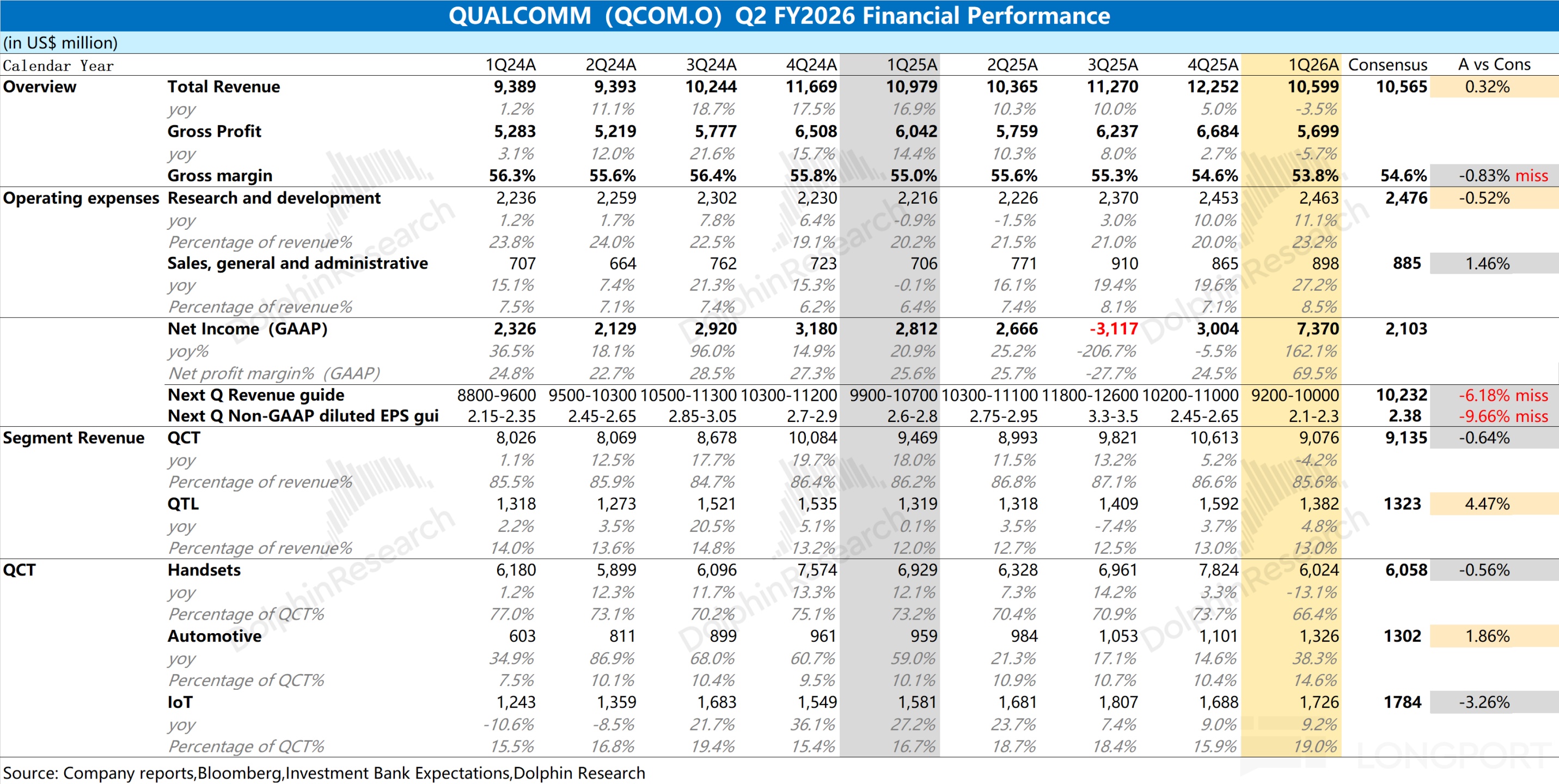
I. QCOM earnings recap
1. Shareholder returns: Returned $3.7bn to shareholders this quarter. This included $2.8bn in buybacks and $945mn in dividends, with capital returns running at an accelerated pace.
2. Guidance for next quarter (FY26 Q3):
- Revenue of $9.2–10.0bn, Non-GAAP EPS of $2.10–2.30. - QTL revenue of $1.15–1.35bn, EBT margin of 67%–71%. The QoQ margin step-down is mainly driven by softer low-end unit assumptions. - QCT revenue of $7.9–8.5bn, EBT margin of 25%–27%.
- QCT Handsets revenue around $4.9bn, impacted by tight memory supply across the industry.
- QCT IoT to grow high single digits YoY, and QCT Auto to accelerate to ~50% YoY.
- Non-GAAP opex of approx. $2.6bn.
3. Key financials: Revenue was $10.6bn (top end of guide) and Non-GAAP EPS was $2.65 (top end). QTL revenue was $1.4bn with 72% EBT margin (top end, helped by mix, while global handset units were roughly flat YoY). QCT revenue was $9.1bn with 27% EBT margin. Within QCT: Handsets $6.0bn, IoT $1.7bn (+9% YoY), Auto $1.3bn (+38% YoY, another record), with Auto+IoT up ~20% YoY combined.
4. Notable accounting/policy change: Released the previously recorded valuation allowance on deferred tax assets, recognizing a $5.7bn non-cash GAAP tax benefit (excluded from Non-GAAP). This follows the U.S. Treasury and IRS rule in Feb allowing deduction of previously capitalized U.S. R&D expenses under the corporate AMT.
5. Longer-term trend: Management reiterated that QCT China Android revenue will bottom in FY26 Q3 and return to sequential growth in Q4.
II. Earnings call details
2.1 Key management commentary
1. Company strategy: Agentic AI to drive the next upgrade cycle
- a. Management believes the company is in a 'profound transition'. Agentic AI workloads will fundamentally change UX across connected edge devices, reshaping roadmaps across platforms. - b. Agents need to run persistently in the background, fuse sensor data, orchestrate multi-step tasks reliably, and ensure high security. Installed bases were not designed for this, creating a major upgrade cycle and TAM expansion. - c. Agent orchestration is predominantly CPU-intensive. QCOM sees itself as having world-class CPUs across smartphones, PCs, autos, and its upcoming data center entries, combined with unmatched connectivity and efficient NPUs, forming core assets for agentic AI. - d. The portfolio spans from milliwatt wearables to kilowatt data centers. No other semi vendor matches this breadth and scale; strategic customer engagement is stepping up, accelerating AI diversification.
2. Auto
- a. Q2 Auto annualized revenue run-rate surpassed $5bn for the first time, and is expected to exceed $6bn by end-FY26, driven by the 4th-gen Snapdragon Digital Chassis across connectivity, telematics, infotainment, ADAS and autonomous. - b. Over 1mn vehicles now use Snapdragon Ride processors to power ADAS/autonomy. - c. 5th-gen Snapdragon Digital Chassis begins commercial shipments by end-FY26, the largest gen-over-gen leap in company history: 3x CPU, 3x GPU, and 12x NPU performance, enabling in-car agents and L3/L4 autonomy. - d. In FY27, share gains and content per vehicle should continue to rise, especially in ADAS. The BMW AD stack is performing well, and collaborations with Bosch and Wave, plus broader OEM engagements, underpin the growth pipeline.
3. IoT / Physical & Industrial AI / Personal AI
- a. Agentic workloads and edge AI are driving redesign cycles across key IoT products. The overall funnel is healthy with clear momentum. - b. Personal AI: Expect a notable ramp in next-gen smart glasses in 2H, together with agentic AI progress, which could catalyze an inflection in category demand. - c. PC: The 2026 Snapdragon X2 PC platform is in production, pairing Orion CPUs for always-on agentic experiences. The NPU delivers up to 85 TOPS, the fastest in notebooks, with leading on-device token generation rates. Snapdragon X2 delivers ~30% better end-to-end agent experiences vs. same-gen Intel; ASUS ZenBook A16 earned high marks from PC MAG, noting QCOM is not just catching up but, in some ways, setting the pace. - d. Physical & Industrial AI: The Dragonwing IQ10 platform, unveiled at CES, drew strong interest, offering a major step-up vs. IQ9 — up to 700 TOPS on-device AI via NPU, an 18-core Orion CPU, support for 20+ camera sensors, and integrated security. - e. Building on the Figure AI design win, QCOM signed a multi-year deal with Nora, strengthening its broader robotics opportunity. It also launched a second Arduino platform based on QCOM silicon at Embedded World as a prototyping platform for robotics and industrial AI developers. - f. Multiple industrial AI products are moving from design wins to deployments across retail, utilities, oil & gas, and agriculture verticals.
4. Data center
- a. Alphawave integration is off to a good start. QCOM is pursuing multiple opportunities with hyperscalers, CSPs, sovereign AI projects, and global partners. - b. Entered custom silicon, with a leading hyperscaler engagement now ramping, and first shipments expected in the Dec qtr (CY26 Q4). - c. Flagship data center CPUs and high-performance AI inference accelerators are progressing well. More details and wins will be disclosed at the Jun 24 Investor Day.
5. Handsets
- a. Quarterly performance tracked expectations, and channel sell-through held up. However, chipset shipments ran well below true consumer demand; management believes FY26 Q3 is the bottom for China Android revenue. - b. Agentic smartphones are starting to influence the premium tier and should strengthen into FY27. ZTE Nubia launched an agentic AI phone on QCOM, and Xiaomi released an agent framework. Multiple Android OEMs are building agentic systems, making the AI upgrade path clear and a key tailwind for high-end demand.
6. 6G
- a. 6G is the next-gen wireless for the AI era, enabling agentic use cases like 'see what I see' and new mobile/personal devices such as uplink-rich smart glasses. - b. 6G will be an AI-native network, with inference, learning, and autonomy as core functions. As a distributed intelligent fabric, it will fuse communications with wide-area real-time sensing, turning networks into critical infrastructure and enabling new telco biz and economic models. - c. QCOM is building end-to-end solutions: from modems and compute for phones/PCs/wearables/autos, to next-gen high-efficiency radio units for RAN, wide-area sensing platforms, and high-performance compute and AI accelerators for the RAN edge, core, and data centers. - d. At MWC, QCOM launched a 60-company 6G alliance spanning operators, cloud infra, AI-native players, and auto OEMs, with very positive feedback from partners, customers, and governments.
2.2 Q&A
Q: Ahead of the Jun Investor Day, can you say if the custom chip with the hyperscaler is a CPU, accelerator, or networking part, and how big it is?
A: (Cristiano) Many details will wait for Jun 24. What we can share: as we said, we invested heavily in building assets and CPUs; we also have accelerators and different memory solutions for them. Through the Alphawave deal, we added significant capabilities in custom ASICs and connectivity, and we have been pursuing customer ASICs with good progress for a few quarters. Given our capabilities and market shifts, this is accelerating. We are excited. It is a major hyperscaler, and we are thinking multi-generational collaboration. That is all we can say now.
Q: Why the confidence that FY26 Q3 is the bottom for China Android QCT revenue, given Sep is usually seasonally down and visibility is low?
A: (Akash) Chinese OEMs are impacted by tight memory in two ways. First, total handset market size — we see a small decline in the low/mid tiers; the bigger impact is OEMs cutting build plans to digest channel inventory. Both factors are reflected in actuals for the Mar qtr and in the Jun qtr guide. In these two quarters, our shipments ran materially below true consumer sell-through due to inventory drawdowns. Looking ahead, we are confident Q3 is the bottom, after which revenue should align more closely with real handset demand rather than being suppressed by inventory digestion.
(Cristiano) One add: our licensing business gives us real visibility into activations. We see how end demand behaves after price moves, so we can clearly compare true consumer demand vs. our shipments. The dynamics Akash described make us confident Q3 is the bottom.
Q: With Arm pursuing vertical integration, and NVIDIA focusing on inference, how is the DC competitive landscape shifting, and what is QCOM's differentiation?
A: (Cristiano) Our positioning in AI is clearer than ever. The evolution started with training, GPU-centric; as inference scaled, training GPUs were used for inference; as inference scaled further, specialized solutions emerged and DCs decoupled into compute-bound and memory-bound. Now comes the next phase: moving from 'producing tokens' to 'creating demand for tokens' via agentic experiences and orchestrators, running across many devices. Our differentiation: First, CPUs — critical in the agent era — where we have one of the strongest assets, with leadership proven in PCs, phones, and autos, and DC-grade agent CPUs coming. Second, combining IP depth with custom silicon delivery and extensive connectivity IP — further reinforced by Alphawave's IP model. Third, accelerators with unique dense-compute, low-TCO solutions focused on specific decoupled functions. Fourth, edge presence — products like Open Claw for desktop and co-work rely on high-performance CPU devices, catalyzing an upgrade cycle. We are very optimistic; we will show the full roadmap on Jun 24.
Q: Can you revisit the multi-year framework with Samsung, given market chatter about lower share and more in-house SoCs next year?
A: (Cristiano) It is a very stable relationship. Recall we reframed it: historically we were about 50:50 vs. Samsung in-house; now QCOM is over 70%. That is the framework this year and next, and we plan the biz on '>70%' share, sometimes higher. It is one of our most stable accounts, and we are confident in Snapdragon's position. With agentic impact, share could even bias positively.
Q: Is the Dec qtr shipment to the hyperscaler an accelerator or a CPU?
A: (Cristiano) It is a custom product we co-developed with a hyperscaler, starting shipments in Dec.
Q: How do you see QTL in 2H — flat with seasonality, or any bigger swing?
A: (Akash) Global handset units were roughly flat YoY in Q2, which underpins both actuals and guidance. In Q3 guidance, we see weakness in low/mid tiers, while premium/flagship remains resilient, and the guide reflects that mix. That is a reasonable framework looking ahead.
Q: If China handsets bottom in Q3 and grow in Q4, but Sep is usually up for Apple and that uplift is missing this year on lower share, how should we think about Sep qtr seq. for Handsets?
A: (Akash) You are right — we expect QCT Handsets revenue from China OEMs to bottom in the Jun qtr (Q3) and then grow sequentially. Apple is usually up in Sep, but that uplift is absent this year given share assumptions. Those are the inputs for modeling the Sep qtr.
Q: So will Handsets grow QoQ in Sep when you net those factors?
A: (Akash) We are not guiding that specifically at this time. The two factors mentioned are the key modeling inputs for Sep.
Q: With agentic devices/phones driving change, will the memory constraint persist into 2027? How much memory do agentic phones need, and is this a headwind through 2027?
A: (Cristiano) It is too early to call 2027. One key observation: AI is ramping fast, shifting from inference to 'creating token demand' with many agents. We see two things: first, device requirements and participants are changing, with compelling collaborations between handset OEMs and AI companies, pushing designs toward stronger CPUs that can run these workloads. Second, there is a lot of noise in memory, with some DC-exposed players moving to the edge while new memory entrants are adding capacity. We will keep watching how 2027 evolves.
Q: How much QCOM IP is in the custom chip shipping in Dec? The window looks tight — is it mostly Alphawave chiplet/DSP-type content, or a product with substantial QCOM IP?
A: (Cristiano) Two points. Our DC customer engagements actually started before Alphawave; that deal expanded execution capability and our IP stack. You should expect multi-gen, long-term collaborations with those customers that ultimately pull in substantial QCOM capabilities. Details will come on Jun 24, including customers, roadmap, and IP.
Q: Is your Apple share assumption still 20% for this fall's models?
A: (Akash) No change — we assume 20% share in the models launching this fall, with no product relationship thereafter. That has been consistent for years. For FY27, sell-side models imply just over $2bn from Apple products, which we view as a reasonable assumption for QCT.
Q: Weakness is in mid-tier while high-end is solid — are OEMs prioritizing scarce memory for premium models, and what is the mix impact?
A: (Akash) OEM behavior is rational. If you must allocate limited memory, you prioritize premium and flagship where profits reside — which is exactly what is happening in the market.
Q: What does 2029 mean for 6G — spec release or shipments?
A: (Cristiano) I highlighted 6G because it will be very different for QCOM vs. prior Gs and opens sovereign AI and DC opportunities. Timing remains: prototypes in 2028, first silicon possibly in 2028, early commercial in 2029, and scale in 2030.
Q: Can you size China within Handsets, and is true end demand in China and globally weakening or stable with shipments merely below demand?
A: (Akash) From a total handset market view (more a QTL lens), low/mid tiers are slightly down, but overall market size in the Mar qtr did not change much, which we will keep monitoring. QCT shipments to China OEMs reflect two things: market size and OEM inventory actions. My earlier point about inventory digestion ending and Q3 being the bottom refers to that; thereafter our shipments should realign with true market size.
Q: As ADAS mix rises and Auto shifts from cockpit to ADAS, how will revenue and margin trajectories evolve?
A: (Cristiano) Revenue will accelerate significantly as silicon content surges. That is true on both ends — cockpit from 3rd to 4th gen climbed, and from 4th to 5th will leap again. Autos are becoming a compute surface; as we add processors and move from more L2++ to L3, compute per vehicle climbs sharply, making this a major internal revenue accelerator for Auto. (Akash) On margins, two levers: shifting from chips to modules raises revenue opportunities, and software on top of silicon further lifts the margin structure. We still model around the corporate avg., but Auto has multiple growth vectors.
Q: With about $2bn Apple product revenue in FY27, how will Apple royalties evolve?
A: (Akash) Royalties will not change until we renegotiate, and should remain at current levels, as that business is independent from chips.
Q: Will QCOM approach data centers via ASICs or merchant silicon, and will it compete head-on with existing ASIC vendors? What does this mean for margins?
A: (Cristiano) The answer is 'all of the above'. As a new entrant we are flexible but realistic — DC silicon revenue is concentrated among a few giants who, as DCs decouple, adopt different strategies for compute vs. connectivity. Expect QCOM to participate across merchant, custom, and modular IP configurations — it will be a bespoke business. (Akash) For the specific custom engagement we noted, we expect it to be accretive at the OP margin level.
<End of text>
Risk disclosure and statements:Dolphin Research Disclaimer and General Disclosures
