
D
Apr 30 at 12:53 AM
GOOGL (Trans): ROIC-Disciplined AI Investment to Stay Ahead
Below is Dolphin Research's$Alphabet(GOOGL.US) $Alphabet - C(GOOG.US) FY26 Q1 earnings call Trans. For the earnings take, cf. 'AI Google: No Ghost Stories, Only a Bumper Harvest'.
I. Key takeaways
1. Capital returns: the BOD approved a 5% increase in the quarterly dividend. This raises quarterly cash returns to shareholders.
2. Outlook: at spot FX, Q2 consolidated revenue faces ~1ppt FX tailwind (vs. 3ppts in Q1). Full-year CapEx raised to $180–190 bn (prior $175–185 bn), incl. Intersect-related investments. CapEx in 2027 is expected to be materially higher vs. 2026. The Wiz acquisition will be a low-single-digit percentage headwind to Cloud OPM for the rest of 2026.
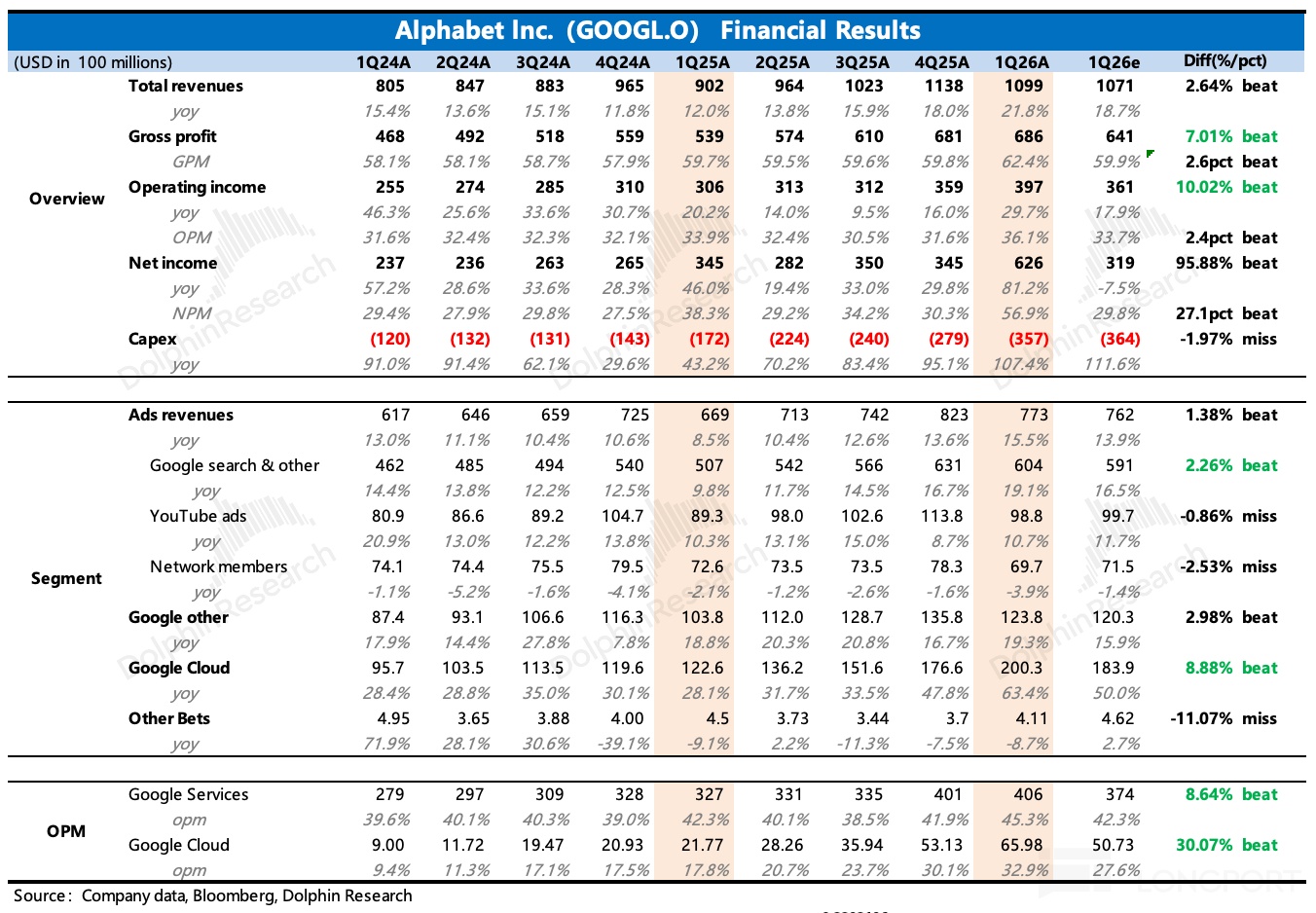
3. Key financials: consolidated revenue of $109.9 bn (+22% YoY; +19% at constant FX), marking the 11th straight quarter of double-digit growth. OP was $39.7 bn (+30% YoY), with OPM at 36.1%. Net income was $62.6 bn (+81% YoY, driven mainly by unrealized gains on non-marketable equity securities), EPS $5.11 (+82% YoY).
4. Cash flow and CapEx: CFFO $45.8 bn (TTM $174.4 bn), CapEx $35.7 bn (~60% servers, ~40% data centers and networking), FCF $10.1 bn (TTM $64.4 bn). Cash and marketable securities ended at $126.8 bn, with LT debt of $77.5 bn.
5. Cloud: revenue topped $20 bn for the first time (+63% YoY). OP reached $6.6 bn, tripling YoY, with OPM expanding from 17.8% to 32.9%. Backlog nearly doubled QoQ to $462 bn, with slightly over 50% expected to convert to revenue over the next 24 months.
II. Earnings call details
2.1 Management remarks
1. AI infra and models
a. A portfolio spanning in-house TPUs, Axion CPUs, and NVIDIA GPUs offers the industry’s broadest compute choices, with first access to NVIDIA Vera Rubin NVL72. This mix targets diverse training and inference workloads.
b. Launched the 8th-gen TPU: TPU 8t (training) offers 3x the processing throughput of Ironwood and 2x performance. TPU 8i (inference) improves perf-per-dollar by 80% vs. the prior gen.
c. Gemini 3.1 Pro continues to push the frontier in inference, multimodal understanding, and cost. Flash Live audio models now power voice interactions in Search and the Gemini app, with speech-to-text across 70 languages.
d. Generative media models are performing strongly: Lyria 3 has produced 150 mn+ songs in the Gemini app. Nano Banana 2 reached 1 bn images in roughly half the time, while Veo 3.1 Lite is the most cost-efficient video model.
e. The Gemma 4 open-source model exceeded 50 mn downloads within weeks. Aggregate downloads across all open-source models surpassed 500 mn.
f. First-party models now process 16 bn+ tokens per minute via direct APIs, up from 10 bn last quarter. This reflects rapid scale-up in production usage.
g. Internally, Project Antigravity is moving engineers toward truly agentic workflows. Autonomous digital task groups are already accelerating development velocity.
2. Search
a. Search and Other revenue reached $60 bn (+19% YoY), led by retail and financials. These verticals showed broad-based strength.
b. Query volume hit an all-time high, with AI Overviews and AI Mode driving overall search expansion. Engagement continues to rise across use cases.
c. Personal Intelligence has expanded to U.S. users. People are asking more personalized questions.
d. Search latency is down 35%+ over five years. After upgrading to Gemini 3, core AI response costs fell over 30%.
e. AI Max is out of beta. Over 30% of customers' search spend uses AI-powered ads (AI Max or Performance Max), delivering more conversions at the same spend.
f. Direct Offers within AI Mode is getting positive feedback from users and advertisers. Gap, L'Oreal, and Chewy have signed up for tests.
g. Testing new ad formats in AI Mode that showcase retailers' sales recommendations. Early signals are encouraging.
3. Google Cloud
a. Enterprise AI solutions became Cloud’s No.1 growth driver for the first time, with GenAI product revenue up nearly 8x YoY. AI-led demand is broadening.
b. New customer adds doubled YoY. The number of $100 mn–$1 bn deals doubled YoY, and several $1 bn+ contracts were signed.
c. Existing customers are exceeding initial commitments by 45%, accelerating vs. last quarter.
d. Gemini Enterprise paid MAUs rose 40% QoQ, while partner-channel seats sold and internal adoption each increased 9x YoY. Adoption momentum remains strong.
e. Over the past 12 months, 330 customers each processed 1 tn+ tokens, with 35 reaching 10 tn. Token throughput is scaling materially.
f. Launched the new Gemini Enterprise Agent platform and Agentic Data Cloud. These expand the agent stack for enterprises.
g. Gemini-driven workflows in BigQuery grew over 30x YoY. Data workloads are increasingly AI-infused.
h. The Wiz acquisition closed in Mar. and is outperforming. Combining Google threat intel, SecOps, and AI, it introduced Gemini-powered threat detection, red-teaming, and auto-remediation agents.
i. Will begin delivering TPU hardware to select customers' own data centers. This expands the addressable market.
4. YouTube
a. Ad revenue was $9.9 bn (+11% YoY), driven by both direct response and brand. Demand was broad-based.
b. U.S. living-room viewing exceeds 200 mn hours daily. Over 10 mn channels post Shorts every day.
c. Net new non-trial subs for YouTube Music and Premium hit the highest quarterly add since Premium launched in 2018. Subscription momentum is robust.
d. YouTube Premium Lite is now fully available in 23 countries. It will expand to 10+ additional countries in Q2.
e. Gemini powers the YouTube Creator Partnerships platform, integrated into YouTube Studio and Google Ads. Creator tooling is becoming more AI-native.
f. Subscription revenue continues to grow faster than ad revenue. Mix shift favors subs.
5. Subscriptions and other
a. Subscriptions, Platforms and Devices revenue was $12.4 bn (+19% YoY). Growth was broad-based.
b. Paid subs reached 350 mn, led by YouTube and Google One. Scale-up continues.
c. Consumer AI paid plans were the strongest this quarter, driven mainly by the Gemini app. Monetization is ramping.
6. Other Bets
a. Waymo now operates in 11 major U.S. cities, adding six in 2026. It completes 500k+ fully driverless rides weekly, doubling in under a year.
b. Wing continues to expand and announced entry into the SF Bay Area. Network density is improving.
c. Verily secured external financing and is being deconsolidated from Alphabet. GFiber announced a merger with Astound Broadband and is expected to be deconsolidated in Q4.
7. Ads and commerce ecosystem
a. The Universal Commerce Protocol (UCP) is seeing broad industry adoption. Amazon, Meta, Microsoft, Salesforce, and Stripe joined the technical committee.
b. Ulta Beauty launched Agentic Commerce across AI Mode, Search, and the Gemini app. It enables an end-to-end flow from discovery to checkout.
c. Maps uses Gemini to boost promoted pin relevance, lifting ad relevance by nearly 10%. Early results are positive.
d. Smart Bidding uses Gemini to match user intent with advertiser products. It unlocks granularity that was previously hard to scale.
2.2 Q&A
Q: With compute constrained, where will next-gen compute be directed in Search over the next 12 months to drive ROIC?
A: We are fully leveraging investments in building Gemini models, then applying them across Search and the Gemini app to advance AI Overviews and AI Mode. These in turn are lifting product usage.
Looking ahead, both platforms still have significant runway to serve users more deeply. Bringing agentic workflows into Search in consumer-friendly ways, including within the search experience, is a major opportunity. We are still early, but our full-stack AI investments position us well to deliver these experiences in Search, and I am excited about it.
Q: How do you price TPUs sold to third parties, given their high ROIC when powering multi-year Google Cloud workloads?
A: We frame this through the lens of serving Google Cloud customers. Within that, some scenarios make clear sense — for example, capital markets clients running high-performance AI workloads who want TPUs in their own data centers.
We see this trend across several industries, and in some cases frontier AI labs as well. We are opportunistic, yet still view it largely as a Google Cloud opportunity, primarily delivering infra via Cloud and, at times, selling TPU hardware directly to select customers.
We do apply an ROIC framework in evaluating these choices. Some hardware sales also help us achieve greater economies of scale across the overall compute environment, supporting reinvestment into next-gen frontier tech.
Q: Is the current CapEx trajectory sufficient for the sizable backlog, and how to think about CapEx growth into 2027?
A: We have increased CapEx each year and done so prudently to meet demand from external customers and internal teams. The ROIC proof is in the growth we see — in Search, in Cloud, and in backlog-driven opportunities within Cloud.
Given strong demand, we are evaluating how best to support continued growth and future opportunities, hence raising CapEx to match needs. We will share more specifics on future calls, but the opportunity ahead is substantial and we aim to capture it responsibly.
Q: What is driving all-time-high Search query volume, and is there room to lift ad coverage from the ~20% historical level?
A: We are pleased with Ads performance. Google Services also benefited from a strong FX tailwind.
Search strength is not from a single driver, but from many parts of the business. By vertical, retail, financials, and healthcare contributed the most, though all major verticals helped. We make hundreds of quarterly improvements for users and advertisers, which is what drives results, and have delivered strong ads while materially evolving the results page.
Query volume continues to grow and is at record highs. AI Overviews and AI Mode are encouraging more usage and overall query growth, including commercial queries.
On the 20% coverage, better intent understanding with AI and other gains suggest there is room for coverage to rise. Overall, Gemini’s intent understanding expands our ability to serve ads on longer, more complex queries that were hard to monetize, and we are deploying Gemini models across all ad infra to drive the three major improvements I highlighted.
Q: How do you see differentiation in AI infra and your ability to scale compute while maintaining margins?
A: I do think we are genuinely differentiated. We are unique in offering a vertically optimized AI stack and a co-developed approach spanning infra, models, platforms, tools, apps, and agents.
We have frontier models and in-house chips, which help us stay ahead, and we’ve deeply invested in security layers to keep everything safe. I believe we are the only provider offering all of this in a vertical stack at scale.
Overall, I view this as Google Cloud’s integrated capability. We can serve customers in multiple ways and match needs better than others, and our ability to invest and stay at the frontier puts us in a strong position.
We invest against tangible demand signals, not only for revenue but through an ROIC lens, which helps us capture the moment responsibly.
Q: What does UCP mean for Google Services as agentic commerce scales over the coming years?
A: We are early in the agentic era. Agentic is more than completing a transaction; we see agentic experiences as incremental and transformative in how people shop from discovery through decision-making, while helping brands differentiate.
We are intent on building agentic experiences that work for users, partners, and the broader ecosystem. The goal is to remove the drudgery in shopping so consumers can focus on what they enjoy.
For decades, you had to choose between speed and being savvy; with agentic commerce, you no longer trade off speed for certainty. The vision is a more assistive, personalized, and seamless commerce experience.
We are deliberately creating space in agentic workflows for shoppers to see valuable elements beyond price, like customer service and brand loyalty, while removing friction across the journey. That is where UCP comes in — an open standard for agentic commerce that spans the full journey from discovery to purchase to post-sale support.
It was built with industry leaders such as Shopify, Etsy, and Walmart. We have significant feedback and integration interest from hundreds of top tech firms, payments partners, and retailers.
It will power new checkout experiences in AI Mode, Search, and the Gemini app, enabling shoppers researching on Google to check out directly with select merchants.
Q: As agentic shopping rolls into Search, how do you view price and volume trends for core AdWords?
A: Our primary focus is user experience. As noted, we are creating space within agentic workflows so users see valuable elements during the shopping journey.
Once that space exists, compelling ad formats naturally follow. Also, beyond traditional agents, there are many AI ways to improve shopping — such as our apparel virtual try-on in the U.S. and Google Lens.
There is much more to do, but the key remains: focus on UX, and the rest will follow.
Q: With compute constrained, how do you decide allocation across orgs and projects, and what are the filters?
A: The starting point is what R&D needs to build frontier models — the compute to train those models, effectively GDM’s requirements as the foundation of our work. That is a core operating principle.
Then, with long-range planning, we plan for core areas like Search and YouTube, and for Google Cloud. In Cloud, enterprise AI solutions grew 800% YoY this quarter, and we see strong demand for Gemini Enterprise, AI solutions, and infra, and in some cases TPUs in customers’ data centers.
We model and allocate across these areas. In the near term, compute is indeed a constraint — for example, Cloud revenue would be higher if we could meet all demand. We are managing through this phase, investing continuously with a durable long-term planning framework, and allocating against an exceptional opportunity set.
Q: Will you consider ads in the Gemini app, and how do you think about that decision?
A: For monetization of the Gemini app, the current focus is AI Mode. We are confident that ad formats that work well in AI Mode can translate successfully into the Gemini app.
For now, within the Gemini app we focus on the free tier and subscriptions, with AI paid plans a major contributor to Google One revenue growth. To be clear, ads have always been essential to scale products to billions of users, and when done well, ads can be valuable, useful commercial information. We will share plans at the right time, but we will not rush.
Q: Beyond higher query volume, are AI tools shortening purchase journeys and lifting conversion? How much Search growth is behavior change vs. new ad tools?
A: Think of this through the expansive moment for Search. AI is fundamentally changing how the world searches and accesses information, with query volume at all-time highs.
Traditional search began with ten blue links; now AI Overviews and AI Mode make search smarter and support more complex questions. We also have Lens, Circle to Search, and Search Live — now available in all AI-Mode-supported countries and languages — underscoring the expansion.
Layer on AI-powered search ads that let SMBs reach customers at scale in ways that were impossible a few years ago, plus Google Translate and more. Put together, we are in a strong position and excited about the road ahead.
Q: What is driving Cloud margin expansion? Are AI revenue margins lower?
A: On margin expansion, strong top-line growth in both Cloud and Google Services provides operating leverage through the P&L. That is the first-order driver.
We continue to run a highly efficient, productive organization. Even within technical infra — where we are investing heavily in data centers and servers — we are pushing process innovation, with costs allocated by consumption across Cloud and Google Services.
Google Cloud margins expanded significantly YoY, largely on strong revenue growth and extremely efficient operations. Thomas and team have done an excellent job operating efficiently while supporting customers, delivering needed products, and driving revenue, all while managing mid-P&L items tightly — from efficient infra to using AI to optimize our business, including internal coding and Gemini-assisted real-estate layout optimization. We will keep pushing efficiency, while recognizing higher CapEx-driven depreciation will be a headwind.
Q: How does vertical integration help with a complex supply chain (inflation and constraints)? Do 2026/2027 CapEx plans factor supply-chain price inflation, and how do you split compute between internal and external Cloud?
A: On overall compute allocation, I covered the cross-business framework earlier. Long-term planning and the ROIC lens give us a good way to plan ahead.
We are indeed navigating a complex supply-chain environment, and that is embedded in all our guideposts. Our operating scale and ability to partner across layers — with suppliers seeing the strength and diversity of our businesses and the demand we drive, plus our frontier tech and full-stack investments — help us form deeper relationships across the chain.
Coupled with economies of scale, all of this is working in our favor. We will continue to manage costs and availability carefully.
Q: In Search, could some use cases be better monetized via subscriptions rather than ads?
A: We are proud to build at the frontier and think deeply about capability and cost boundaries. That lets us serve users at scale while invoking the most powerful models for the most challenging queries.
Over time, as we serve more valuable use cases, some users will want access to the most capable models, and there may be different ways to provide that. We will put users first and support them how they want to use the product.
We already offer tiered subscription plans that grant access to more powerful models across the Google experience, including in Search. This quarter saw very strong AI sub growth driven by interest in better Gemini models, which positions us well to serve a wide range of needs, including in Search.
Q: How big is the TPU sales opportunity, and how much of backlog growth is TPUs vs. Cloud?
A: Broadly, we see substantial demand for AI solutions and infra, including significant demand for both GPUs and TPUs. We are proud to offer a broad, diversified portfolio that matches customers' real needs.
On backlog, the TPU hardware agreements Sundar mentioned are included in the $462 bn Cloud backlog, though the majority remains GCP contracts. Slightly over half should convert to revenue over the next 24 months.
For TPU hardware sales, we expect small revenue recognition to start later this year, with the bulk realized in 2027. Timing aligns with delivery and acceptance milestones.
Q: What are margins on large AI deals with GenAI companies, and can they be comparable to overall Cloud?
A: We won’t comment on specific contracts. But in a compute-constrained environment, when we allocate resources across opportunities, we operate against a disciplined ROIC framework.
<End of text>
Risk disclosure and statements:Dolphin Research Disclaimer and General Disclosure
Login to unlock19,215characters for free
This content is only available to signed-in users. Sign in to your Longbridge account to read the full post.

Citigroup
USC

CureVac BV
USCVAC

NVIDIA
USNVDA

Alphabet - C
USGOOG

Alphabet
USGOOGL

Chewy
USCHWY

GAP
USGAP

NVDA 2X Long ETF
USNVDL

XL2CSOPNVDA
HK07788

XI2CSOPNVDA
HK07388

YieldMax NVDA Option Income Strategy ETF
USNVDY

Direxion Daily NVDA Bear 1X ETF
USNVDD

T-Rex 2X Long NVIDIA Daily Target ETF
USNVDX

T-Rex 2X Inverse NVIDIA Daily Target ETF
USNVDQ

GOOGL 1X Short ETF
USGGLS

GOOGL 2X Long ETF
USGGLL

CITIGROUP INC 6.250 NON CUM SER II PFD WI
USC-R