
D
Apr 30 at 06:04 AM
Single-track strategy limits Meta AI's imagination
 I'm LongbridgeAI, I can summarize articles.
Hi everyone. This is Dolphin Research.
$Meta Platforms(META.US) did not stumble on Q1 prints, but on guidance that failed to ease margin compression concerns. This contrasts with pre-earnings chatter about spending discipline that had nudged the buy side to expect tighter costs. At heart, the stock is paying for a missing second growth curve to monetize AI, and investors are running out of patience.
Here are the details:
1. No spending pullback; more to come: Meta raised 2026 Capex guidance by $10bn to $125-145bn, citing higher component costs such as memory. Meanwhile, Opex guidance stayed put, not delivering the downward reset the market hoped for.
Over the past two months, rumors swirled about VR cutbacks and rolling layoffs, seeding expectations of tighter spend. Instead, outlays are rising, which clearly misses the mark vs. those expectations.
2. Revenue growth not accelerating in tandem: Whether the market will endorse higher investment hinges on whether it forces enough growth. Last quarter, Capex guidance was also raised, but management paired it with a strong Q1 revenue acceleration outlook, which helped a pre-print expectations reset even as positioning was cautious.
This time, higher Capex is paired with a slowing Q2 revenue guide (midpoint +25% YoY vs. +33% in Q1). At the same time, forward user engagement signals softened, with Q1 active users showing the first seasonal pullback, implying more margin pressure through the year. The direction of this marginal change deviates from buy-side expectations.
3. Ads alone cannot carry the full AI narrative: To be clear, Meta’s ad biz remains very strong and is enjoying a tailwind. Q1 revenue grew 33%, beat guidance, and met buy-side marks.
But AI is not the only driver. North America macro held up, winter sports events added heat, and the shift of CPG marketing online continues. Short-form video is a structural tailwind lifting Reels, pushing CPMs higher, and Threads monetization adds incremental dollars. These are ad-industry growth engines that would benefit Meta even without AI.
What Meta lacks is a near-pure AI growth curve outside ads like Google Cloud, which is already in a monetization phase. That would let investors underwrite AI ROI more transparently. Instead, Meta keeps stepping up spend while the ‘pure AI payback’ remains hard to pin down and likely below prior imagination.
With the Q2 guide implying a moderating growth slope, incremental spend invites more scrutiny. Not outright rejection, but reduced visibility alone can move the near-term valuation anchor lower.
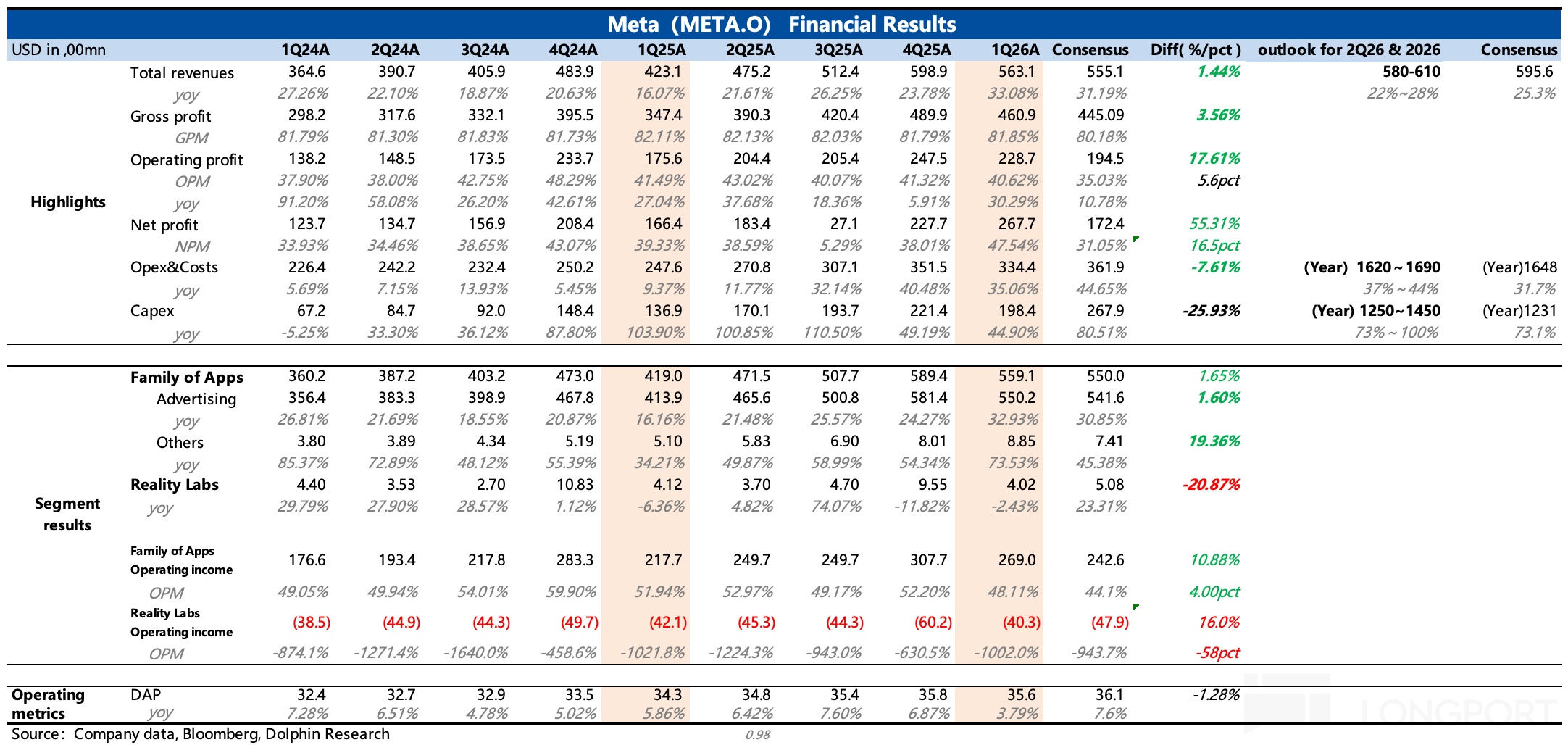
4. Holding the line on OP growth: Q1 operating profit was solid at $22.9bn, with OPM stable QoQ at ~41% (net profit lifted by a Feb tax-rule change and an $8bn reversal; excluding that, OP was $18.8bn, +13% YoY). Lower RL losses helped, and depreciation has not yet caught up with high Capex, with D&A up only ~10% QoQ, while Q1 Capex was under $20bn, just 14-16% of full-year guidance.
Pre-print, the Street expected Meta’s 2026 OP growth at 4-5%. Even without an Opex cut, the continued spending stance could still stoke concerns about full-year profit downside. Management did commit to positive full-year OP growth, setting a floor that likely prevented a more panicky reaction.
5. Stock hit, buybacks remain paused: Repurchases were already halted last quarter, and the company chose to keep investing aggressively this quarter, even if it means borrowing. Despite the selloff, buybacks did not resume, and like Google, shareholder return was limited to a routine $1.35bn dividend, which looks light.
Cash plus short-term investments stood at $81.2bn at Q1-end, flat QoQ. Free cash flow was $12.4bn in the quarter.
6. KPI snapshot
Dolphin Research view
Versus Google, both raised Capex into strong revenue, yet investor reactions diverged. The crux is Meta has yet to prove ‘spend in, value out.’
Ad growth is partly AI-aided (better recommendations, AI content/features lifting time spent), but industry and product cycle tailwinds are also big. Ads remain the core, and with Meta’s high share, upside imagination is limited. By contrast, Google’s cloud benefits from both share gains and a cyclical upturn, opening much larger optionality.
In short, for Meta, AI is still more of a defensive cost line today. Accelerating pure AI monetization would help justify heavy spend, but the most mature models are still ToB productivity use cases. Pure ToC monetization, whether subs or ads, lacks penetration and remains loss-making.
Near term, with the second curve tough to land, investors prefer to see tighter cost control (though necessary tech spend caps how much can be cut) over open-ended investment with fuzzy payback. In absolute terms, $140bn of annual Capex is heavy even for Meta’s cash machine, at well over half of annual revenue.
This dilemma likely keeps Meta’s 2026 valuation anchor around a sub-historical ~20x PE vs. a ~25x historical center. That is why our full-year stance since Jan has been ‘opportunity lies in bottoming and repair, not breakout on euphoric swings.’
Assuming +25% revenue growth for the year, Opex at $165bn, and a 15% effective tax rate, we estimate 2026 OP at $85bn (+3% YoY) and post-tax OP at $72.3bn. After an 8% pre-market drop, market cap is ~$1.55tn, implying ~21x this year’s profit. This sits near the near-term pressured valuation center and is not yet at our preferred ‘bottom-repair’ zone.
For higher risk tolerance, one could trade time for upside and lean a bit more positive: Many longs are bypassing this year’s profit squeeze and anchoring value to 2027, assuming a recovery next year.
On that basis, OP could be ~$105bn in 2027 (+24% YoY), putting the current cap at ~18x post-tax PE. That implies multiple repair from ~18x to 22-25x over two years, which, discounted back at 10%, centers near ~$2tn. That leaves roughly 15-30% sentiment-driven upside, pending catalysts such as new Muse LLM progress or a revival in rate-cut expectations.
Detailed takeaways below
I. Guidance slowdown and the pain of no second curve
Q1 revenue printed $56.3bn, accelerating to +33% YoY, with FX tailwinds contributing ~400bps, broadly matching more optimistic buy-side views.
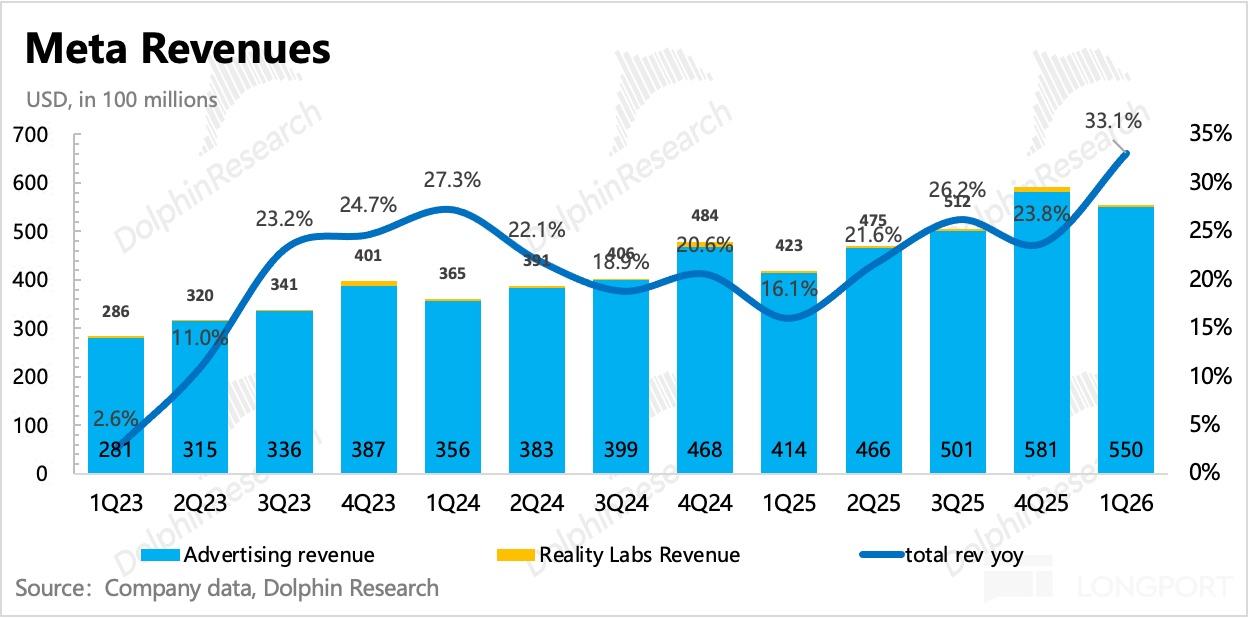
Q2 revenue guide: Management guided 2Q26 revenue to $58-61bn, implying +22-28% YoY with ~200bps FX tailwind. While inline with sell-side, it neither beat the usual cadence nor sustained the sequential acceleration, so the tone feels underwhelming.
By segment:
1) Ads: Reels and AI-led
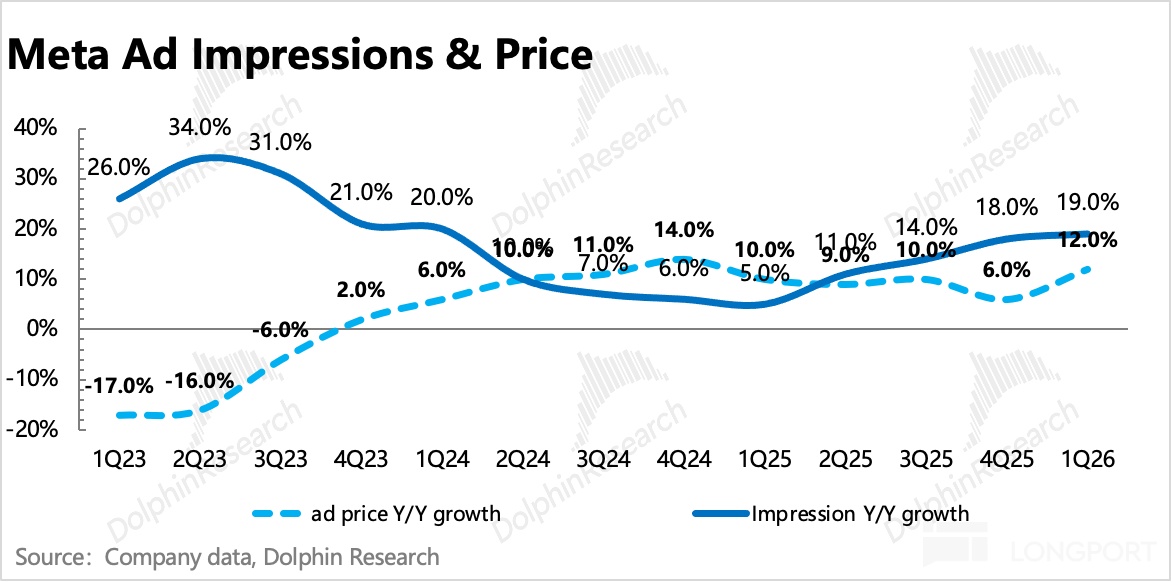
For ads, we prefer to split volume and price to read macro, competition, and product signals. This helps parse the drivers more cleanly.
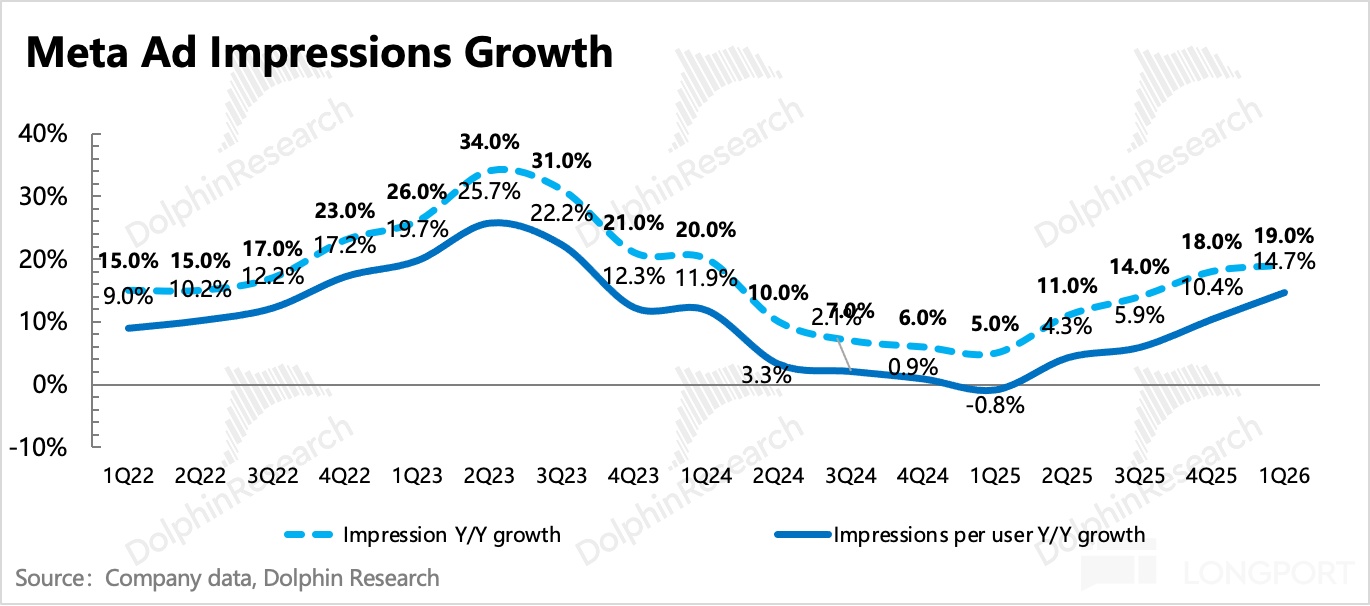
1) Impressions
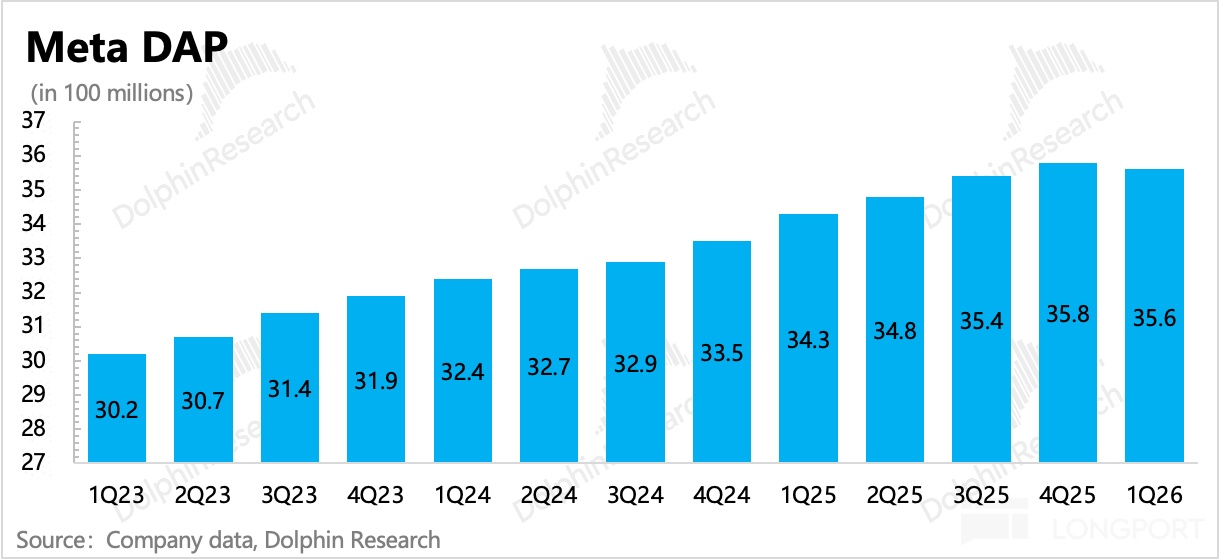
Ad impressions accelerated to +19% in Q1. One driver is a growing user base, with DAP (DAU across the app family) up 4% YoY, though growth slowed and showed its first seasonal pullback, flagging future pressure.
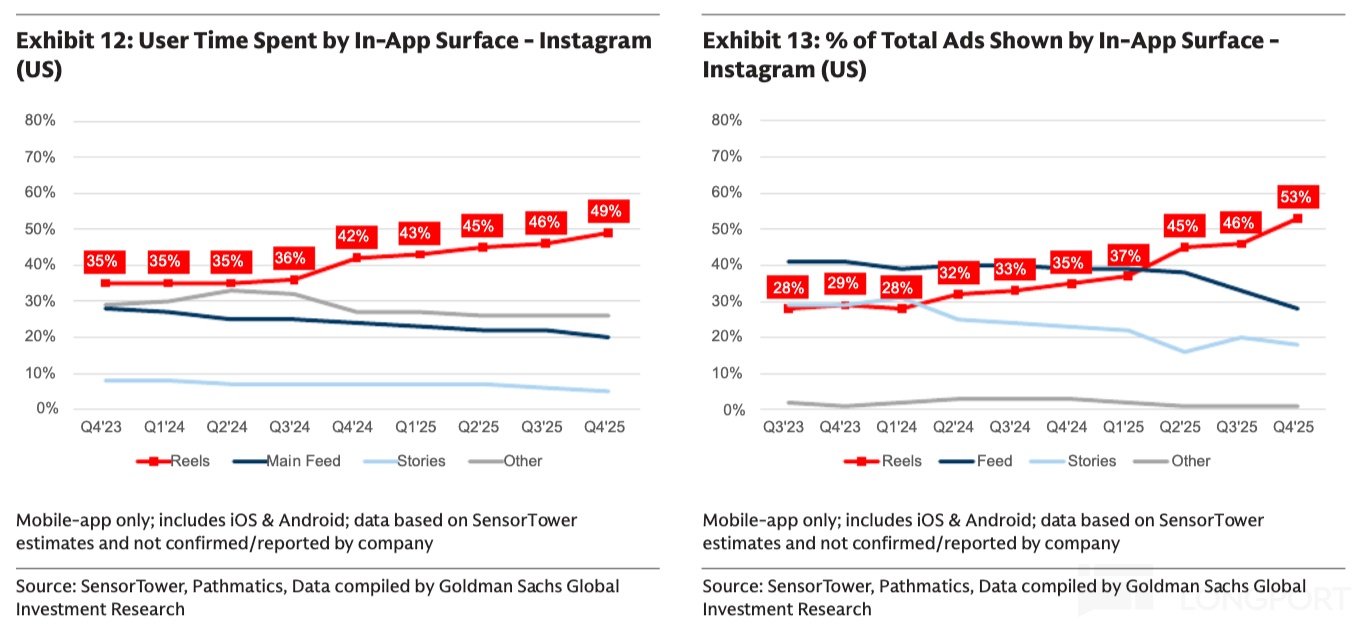
Another is rising Reels share of time, which naturally lifts impressions per user, as daily Reels posts now exceed 30% and have doubled YoY. This kept per-capita impressions accelerating.
2) Ad price
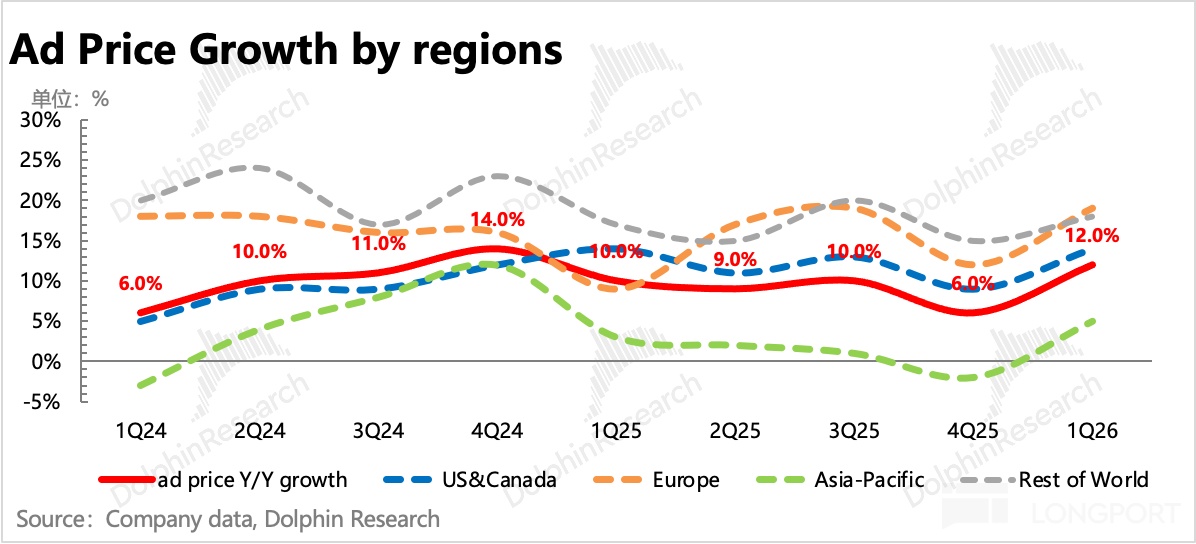
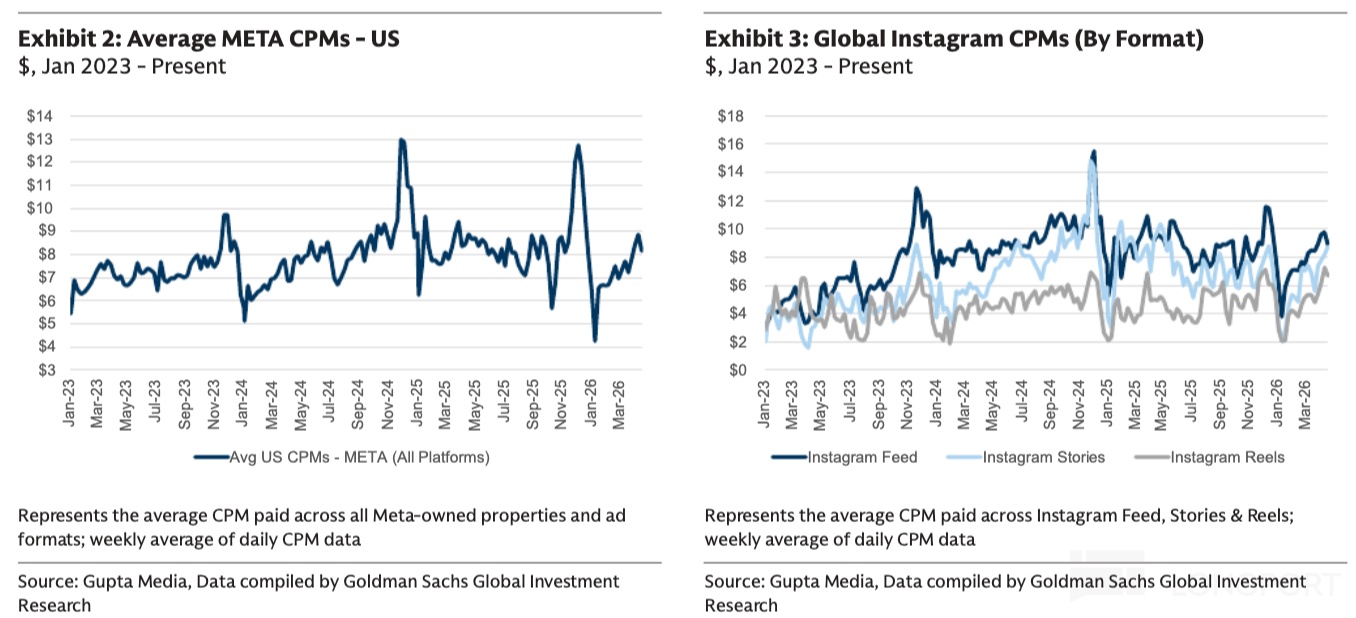
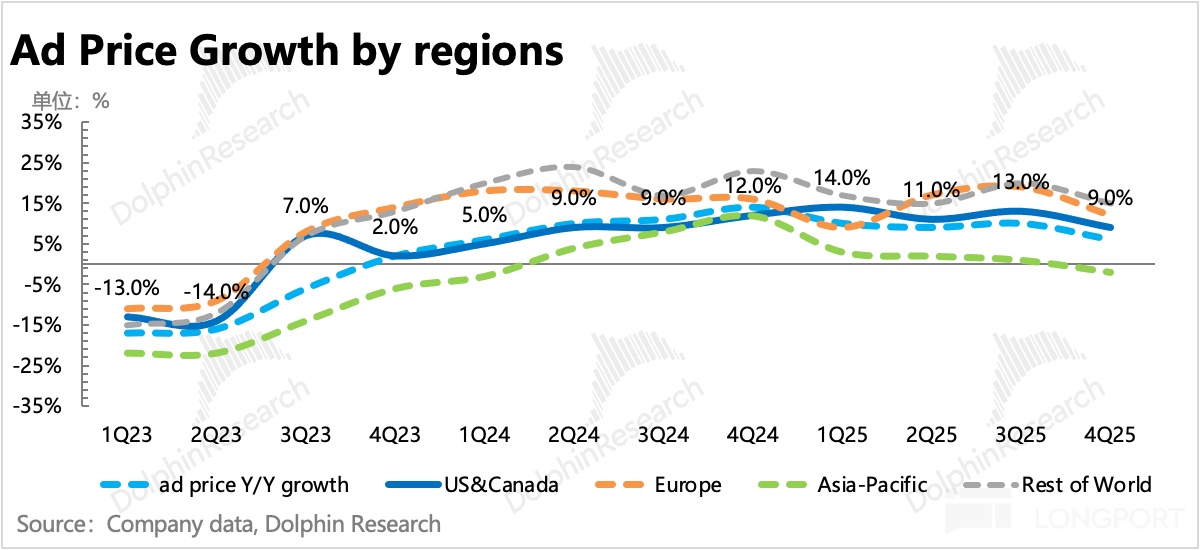
Ad pricing rose 12% in Q1, marking a rebound. Historically, higher short-video mix depresses average price, but after nearly three years of evolution, Reels eCPM continues to climb.
On Instagram, CPM is about $7, already ~80% of Feed and Stories. Feed and Stories CPMs are trending lower, reflecting user preference for short video and advertisers’ acceptance of its traffic and conversion efficacy. New monetization also helps: Threads commercialization is rolling out to more regions, and WhatsApp Status ads now reach hundreds of millions of daily viewers.
2) VR: still in contraction
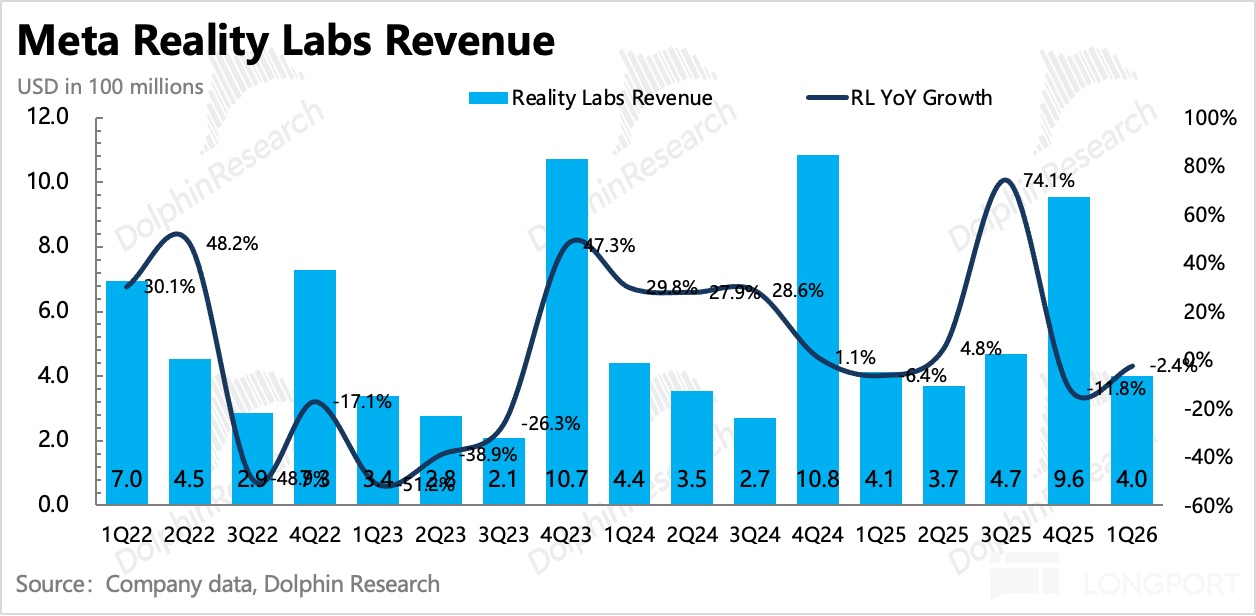
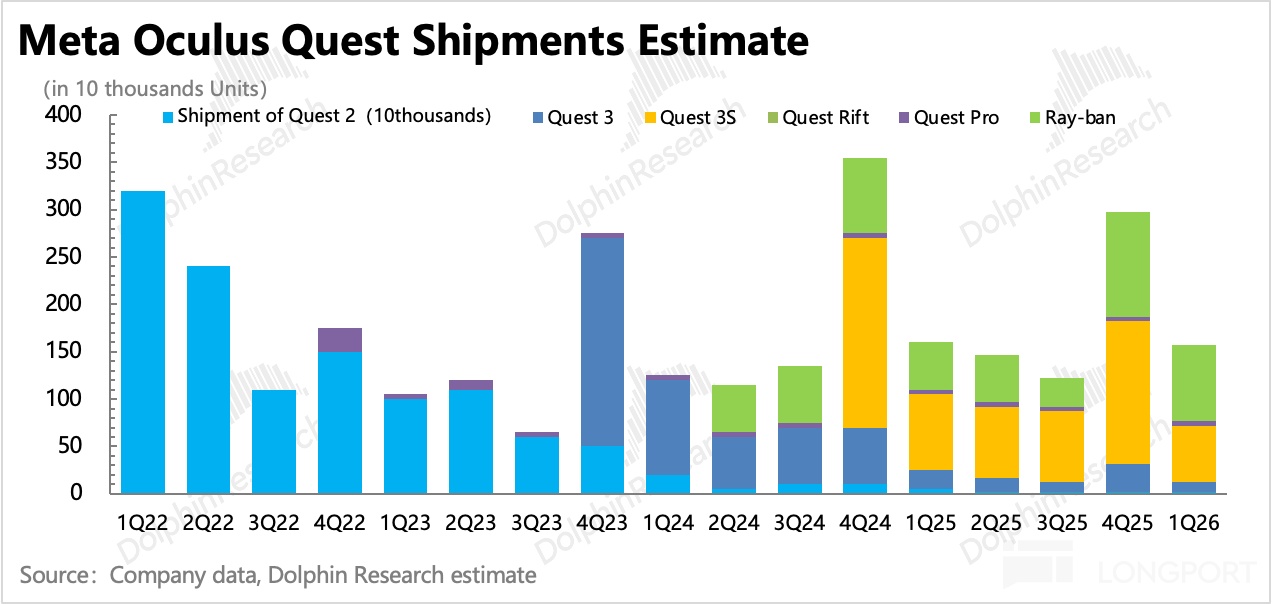
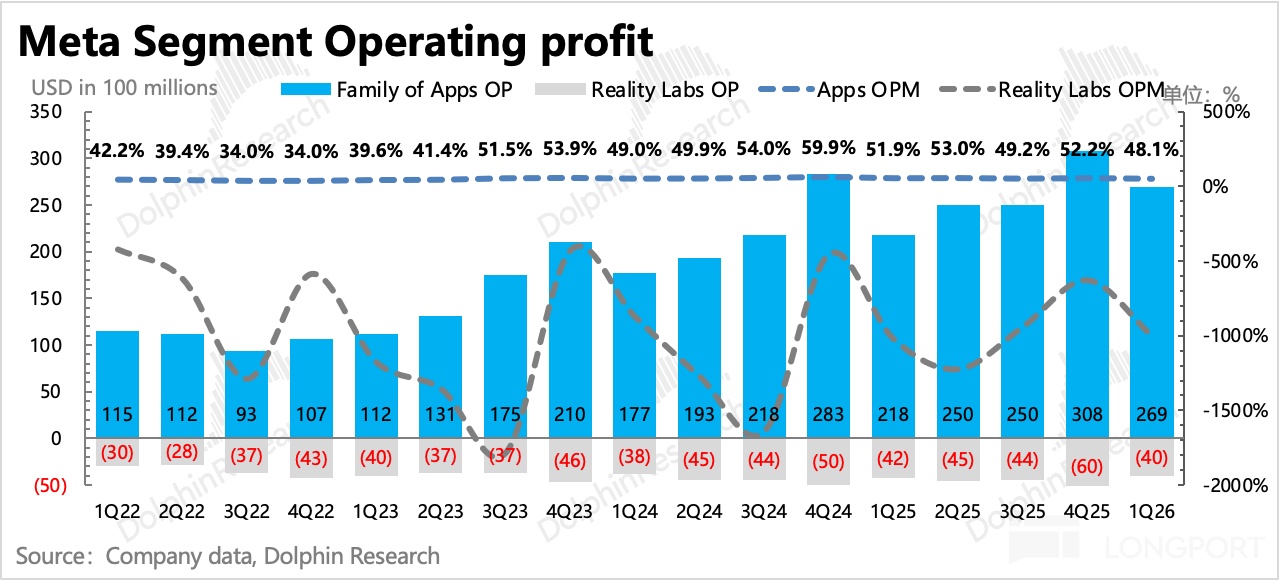
Reality Labs revenue was $0.4bn in Q1, down 2.4% YoY on weaker Quest sell-through. AI glasses DAU tripled YoY, and Meta launched Ray-Ban Meta optical glasses for all-day wear in Q1.
Management will focus further on AI glasses while trimming overall RL spend to contain losses (last quarter guided a $3bn cut in 2026), prioritizing AI models and applications.
II. Layoff chatter vs. rising AI spend
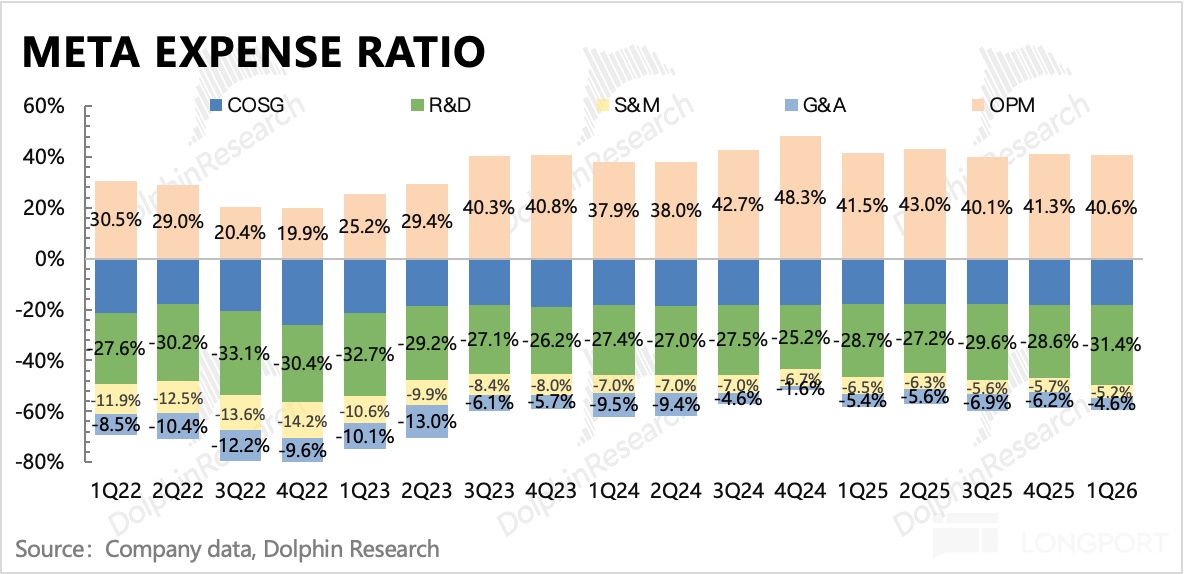
Q1 total Opex rose 35%, with growth decelerating QoQ, allowing OP to hold up as OPM slipped only 70bps. Full-year Opex/Capex guides, however, suggest Q1 was an outlier.
Still, management pledged positive full-year OP growth, which at the floor implies ~25% revenue growth. That frames the path for the rest of the year.
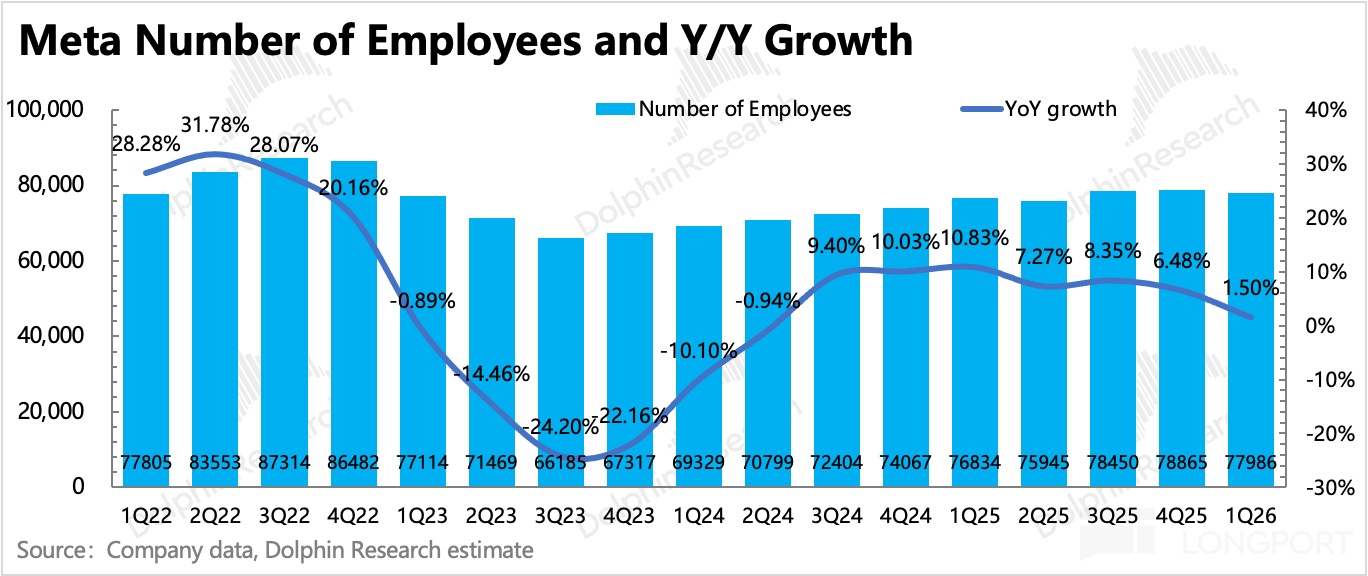
Headcount fell by 879 QoQ as a layoff cycle begins. Rumor pegs 2026 cuts at ~20%, or ~15k roles, but despite the downsizing, Opex guidance was not reduced and Capex was raised, disappointing investors.
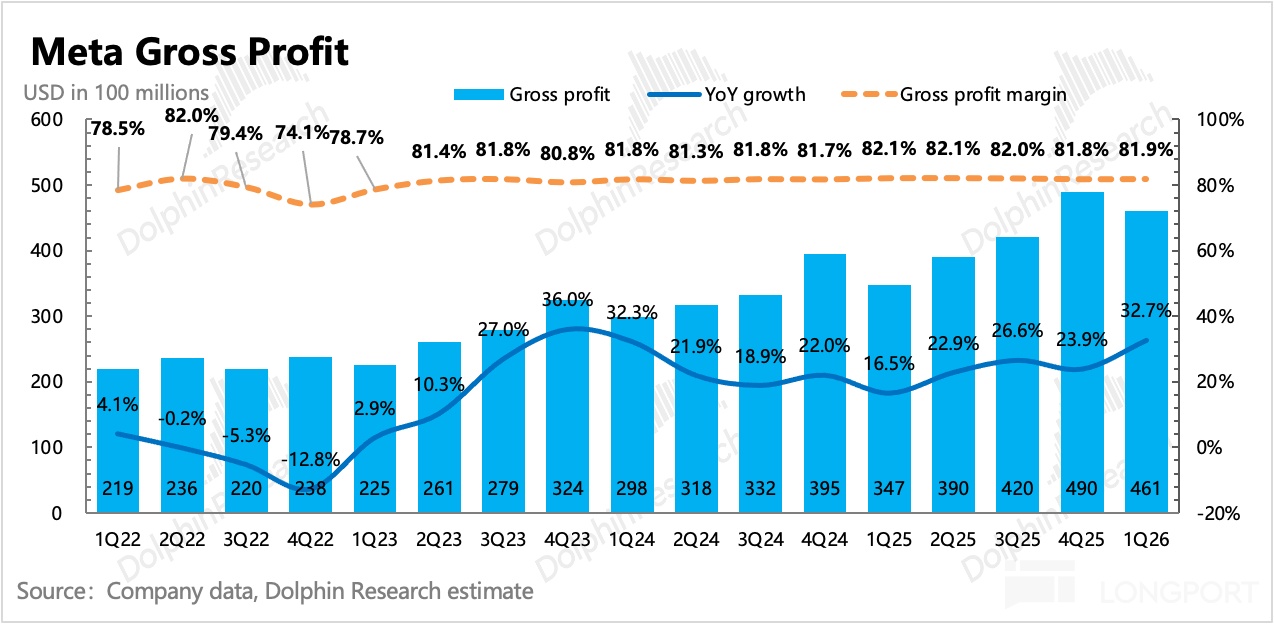
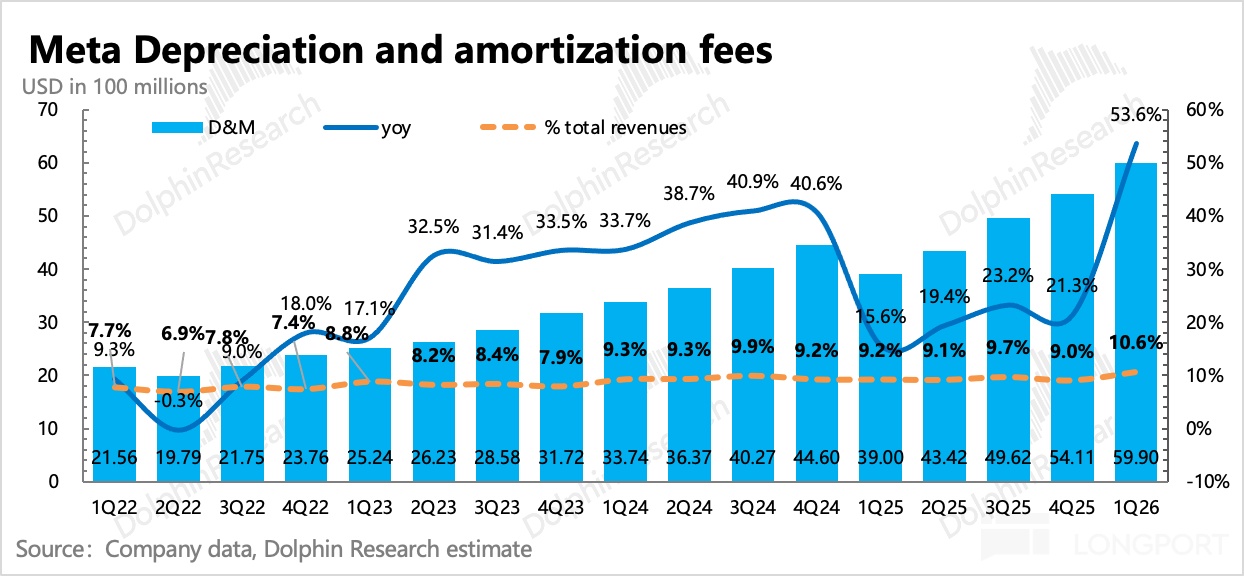
R&D rose 46%, G&A 15%, and S&M 5%. Strong +33% revenue growth largely offset the 35% Opex expansion at the consolidated level.
By segment, RL’s loss margin improved while ad margins contracted by nearly 400bps YoY. Mix and investment both played a role in the delta.
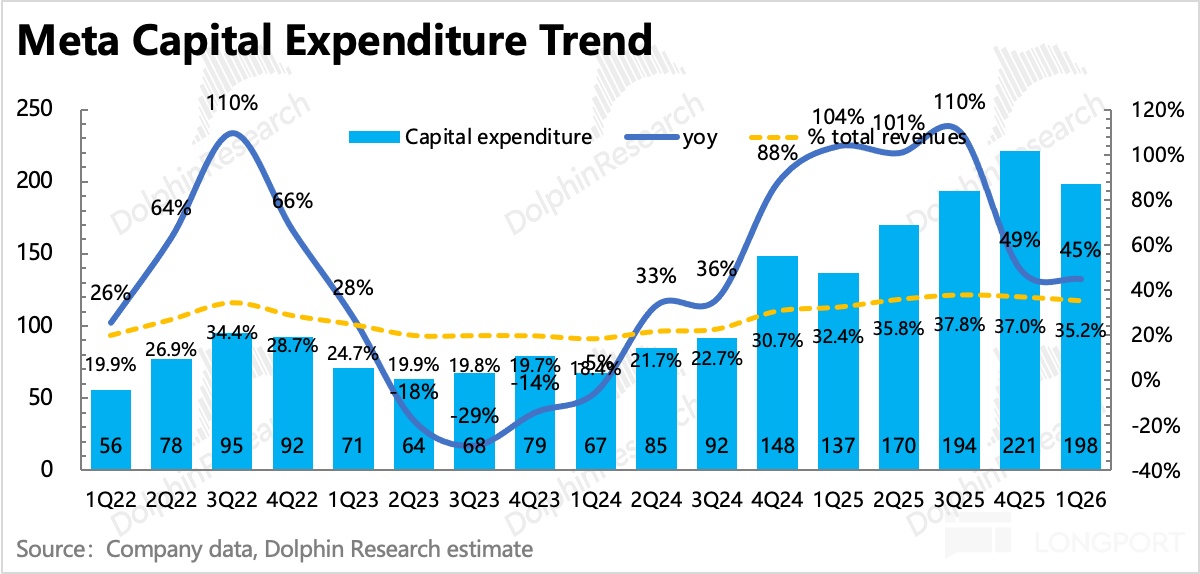
Q1 Capex was $19.8bn, down more than $2bn QoQ, but full-year 2026 Capex guidance was lifted from $115-135bn to $125-145bn. That signals Q1 was temporary and spend will remain heavy ahead.
<End here>
Dolphin Research 'Meta' archive:
Earnings season (past year)
Oct 30, 2025 call notes: Meta (Trans): Compute deployed on arrival; no excess to worry about
Oct 30, 2025 earnings take: Meta: AI spend pedal to the floor; faith now at risk?
Deep dives
Dec 1, 2025: From 'AI darling' to 'big spender' overnight — can Meta fight back?
Risk disclosure and disclaimer: Dolphin Research Disclaimer and General Disclosures





The copyright of this article belongs to the original author/organization.
The views expressed herein are solely those of the author and do not reflect the stance of the platform. The content is intended for investment reference purposes only and shall not be considered as investment advice. Please contact us if you have any questions or suggestions regarding the content services provided by the platform.