

AAPL: AI Gap, Storage Price Hikes — Still Steady?

AAPL reported FY26 Q2 (quarter ended Mar 2026) after the US close on May 1 (Beijing time). Key takeaways below.
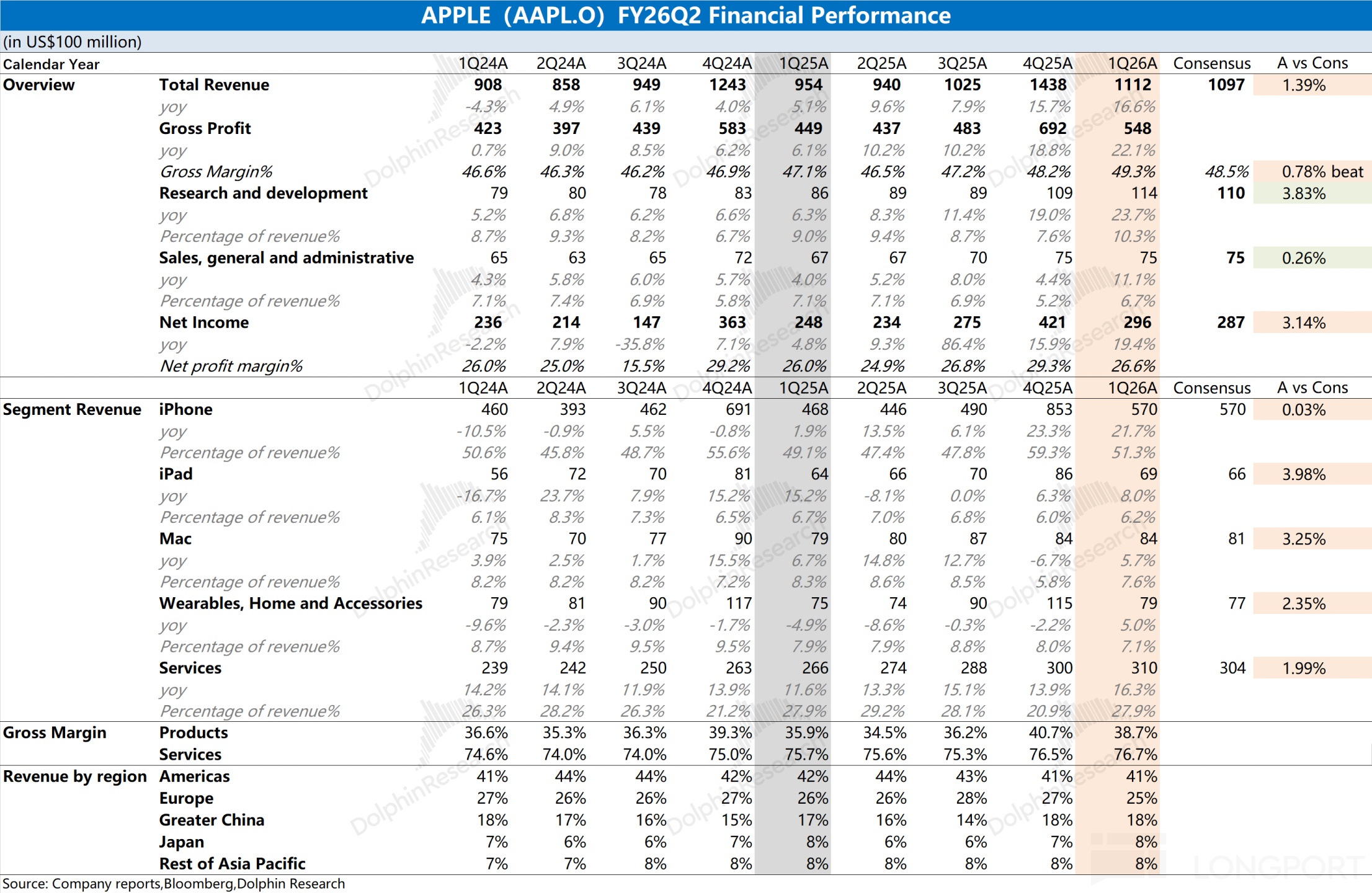
1) Headline results: $Apple(AAPL.US) posted revenue of $111.2bn (+16.6% YoY), beating consensus ($109.7bn). Growth was driven by iPhone and Services.
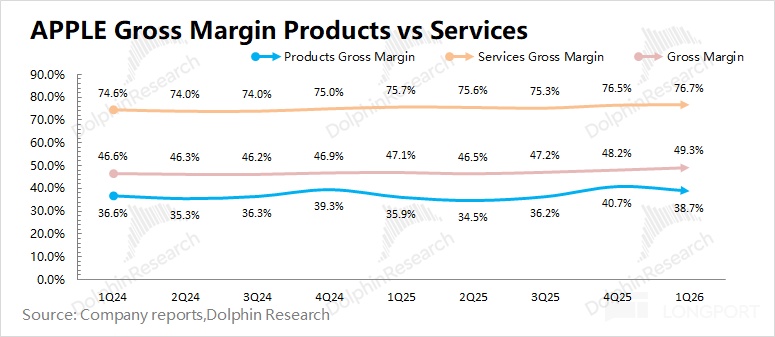
Gross margin (GPM) was 49.3%, up 220bps YoY, above consensus (48.5%). Services GPM rose to 76.7%, while Hardware GPM was 38.7% (+280bps YoY). Hardware GPM expansion reflected higher iPhone 17 volumes and USD weakness vs. CNY, among other factors.
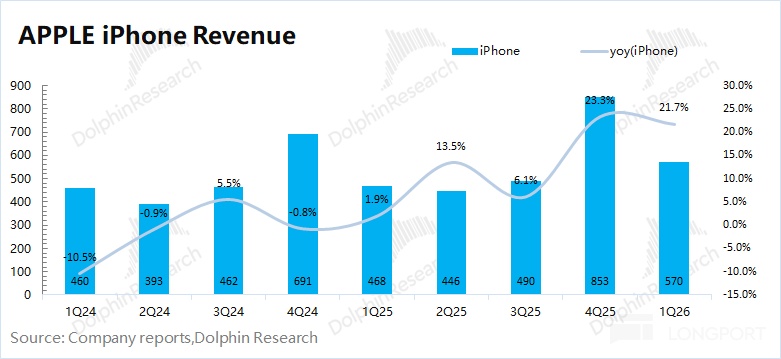
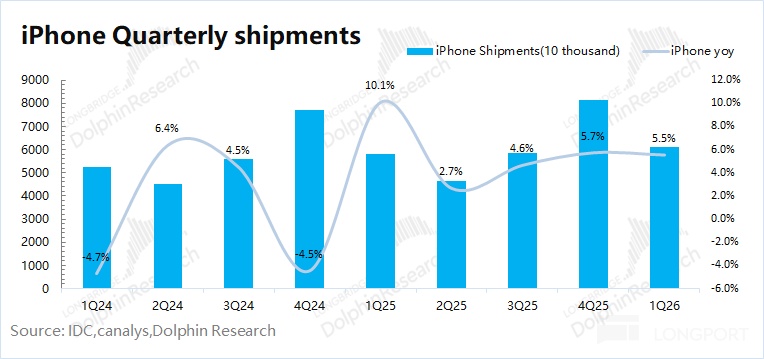
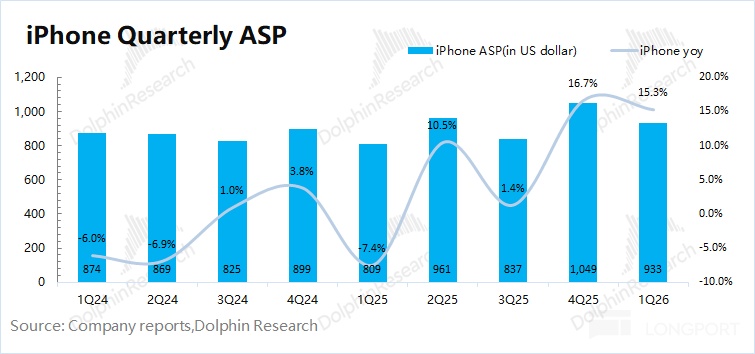
2) iPhone: revenue of $57.0bn (+21.7% YoY), in line with consensus ($57.0bn). Growth was fueled by strong iPhone 17 demand in China and USD/CNY tailwinds. We estimate iPhone shipments rose ~5.5% YoY, with ASP up ~15.3% YoY.
3) Hardware ex-iPhone: all categories grew to varying degrees. iPad revenue rose 8% YoY, helped by M5 Pro and A16 models. Apple launched MacBook Neo at a $599 entry price, broadening the addressable base and returning Mac to growth this quarter.
4) Services: revenue reached $31.0bn (+16% YoY), beating consensus ($30.4bn). With a 76.7% GPM, Services generated 43% of company GP on 28% of revenue.
5) Revenue by region: the Americas remained the core, sustaining a 40%+ mix with 12% YoY growth. Greater China was the best performing region, aided by state subsidies on iPhone 17 256GB, lifting Mainland China iPhone shipments by 33% YoY (IDC).
Dolphin Research View: iPhone 17 is on fire. Watch whether the new Siri can close the AI gap.
Apple delivered a solid quarter, with both revenue and GPM above expectations. The outperformance was driven by iPhone 17 and USD weakness vs. CNY.
1) Top-line growth: primarily from iPhone 17 sell-through. iPhone rose 22% YoY, with China iPhone shipments up 33% YoY. Despite limited innovation, iPhone 17 achieved notable success in China, where the 256GB model benefited from state subsidies and took share from Android brands.
2) Margin expansion: despite memory price headwinds, Hardware GPM rose YoY on iPhone scale, USD/CNY tailwinds, and lower tariff costs. With a focus on mid-to-high-end devices, Apple is less exposed to memory inflation and can better absorb the cost pressure vs. peers.
Beyond this quarter, management guided next-quarter revenue +14–17% YoY ($107.1–110.0bn), and GPM of 47.5–48.5%. iPhone remains the primary growth driver next quarter. Despite sharp memory cost inflation, the margin guide underscores strong supply-chain execution.
Outside the print, the market is focused on several items.
a) CEO transition: Apple announced leadership changes: Tim Cook will step down as CEO on Sep 1 to become Executive Chairman, with John Ternus, SVP of Hardware Engineering, becoming CEO.
The new CEO’s hardware pedigree aligns with next-gen smartphone and AI device competition. Cook remaining as Executive Chairman helps ensure policy continuity and a smooth strategy transition.
The market broadly views the transition as long-planned, with no major strategic shift expected. Apple will continue to balance hardware and Services, leveraging vertical integration and supply-chain strengths to sustain growth. Watch management’s commentary in upcoming investor communications.
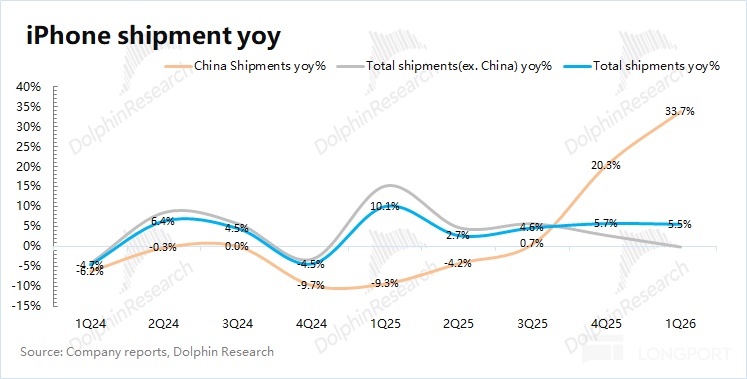
b) China recovery: the rebound this quarter was led by stronger iPhone sales in China. By contrast, iPhone shipments outside China were roughly flat YoY.
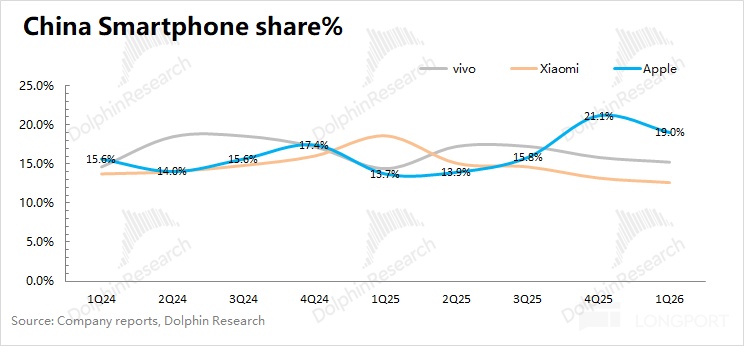
iPhone 17 performed well in China in part because memory inflation weighs less on iPhone economics. Additionally, state subsidies on iPhone 17 256GB intensified competitive pressure on Android brands. iPhone share in China reached 19% this quarter, up 530bps YoY.
c) Memory inflation mitigation: 1) sign LTAs for memory to lock in cost, using scale to secure favorable pricing and pre-build inventory buffers. 2) Advance in-house baseband while reducing costs in non-memory components. 3) Optimize product mix and consider selective price actions to lift blended ASP. The next-quarter GPM guide suggests Apple can mitigate memory inflation via supply-chain control.
Apple’s current mkt cap is $3.98tn, implying ~31x PE on FY26 net income (assuming revenue +14%, GPM 48.4%, tax rate 17.5%). Versus the historical 25x–40x range, the stock sits slightly below the midpoint.
Near-term results are strong on iPhone 17 momentum. On memory inflation, Apple can dilute or absorb cost pressure through LTAs, supply-chain management, and mix optimization.
That said, recent strength does not dispel concerns about sustained high growth, keeping valuation within the historical band. With AI and LLMs advancing, the market is looking for breakthroughs in AI or a new Siri to unlock mid-to-long-term upside.
Apple’s vast hardware installed base offers a meaningful buffer period. But without timely AI progress, it may face intensifying competition. Recent reports suggest OpenAI plans an AI phone that goes beyond the traditional 'app mode'.
Overall, Apple’s near-term print is solid, underpinned by iPhone 17 strength and best-in-class supply-chain management, preserving clear moat advantages. Beyond this steady execution, investors want innovation that can re-rate the stock above its traditional range. Management changes also signal a willingness to evolve, so watch guidance and strategy updates.
For Dolphin Research’s detailed read-through of Apple’s results, see below.
I. Apple’s core remains strong
1.1 Revenue: in FY26 Q2 (1Q26), Apple reported revenue of $111.2bn (+16.6% YoY), beating consensus ($109.7bn). All segments grew, led by an acceleration in iPhone.
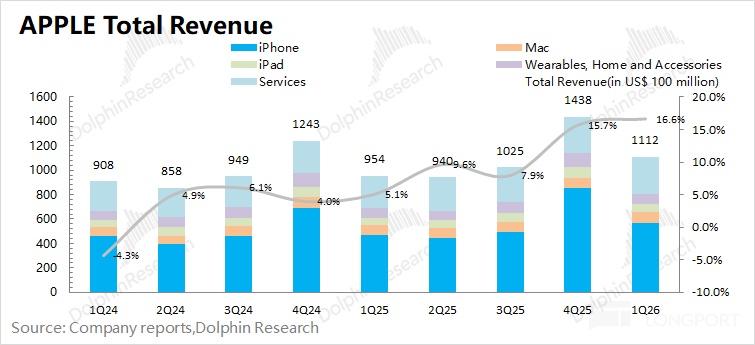
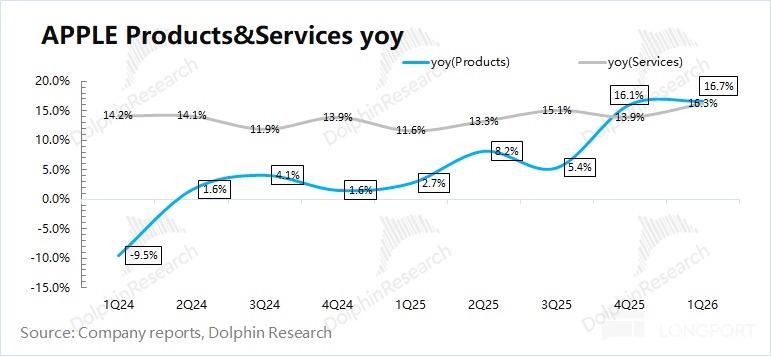
By segment: Hardware revenue grew 16.7% YoY, primarily on iPhone strength. iPhone has delivered 20%+ growth for two straight quarters on iPhone 17 momentum.
Services revenue grew 16.3% YoY, sustaining double-digit growth. The resolution of Alphabet’s lawsuit reduced overhang, and with broader AI model integration, growth should continue even if App Store growth holds in the single digits.
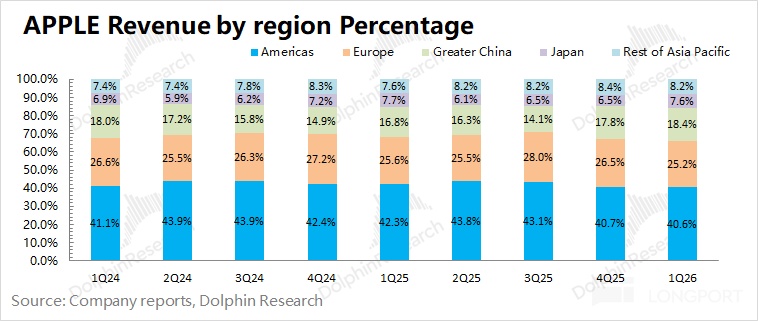
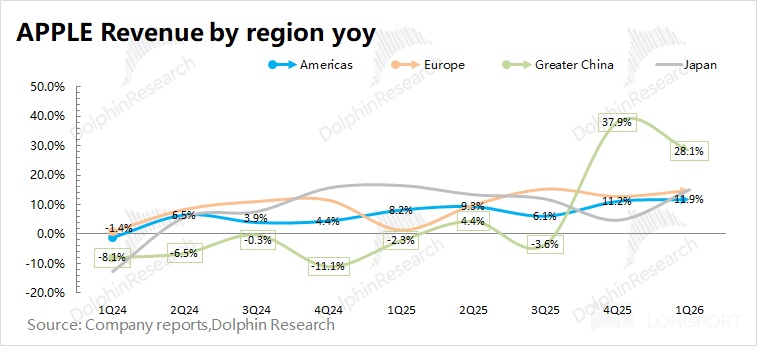
By region: all posted YoY growth. The Americas, Europe, and Greater China are the three largest contributors. The Americas kept a 40%+ mix, up 12% YoY, and Europe grew 14.7%.
Greater China led with 28% growth, as state subsidies on iPhone 17 256GB directly drove a 33% YoY increase in Mainland iPhone sales.
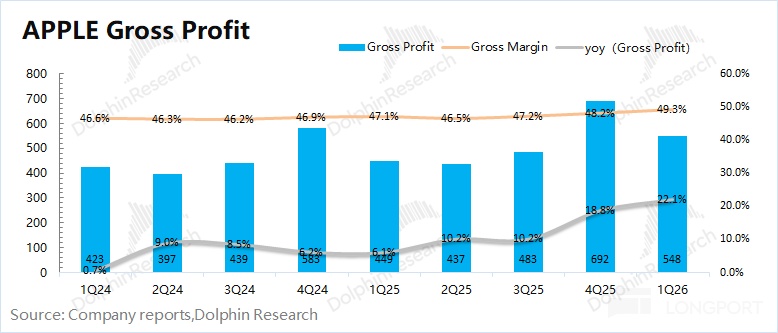
1.2 Margins: FY26 Q2 (1Q26) GPM was 49.3%, up 220bps YoY and ahead of consensus (48.5%). Margin gains were driven by both Hardware and Services.
Breaking out: Services GPM climbed to 76.7%, while Hardware GPM rose to 38.7% YoY, helped by iPhone 17 scale, lower tariff costs, and USD weakness vs. CNY.
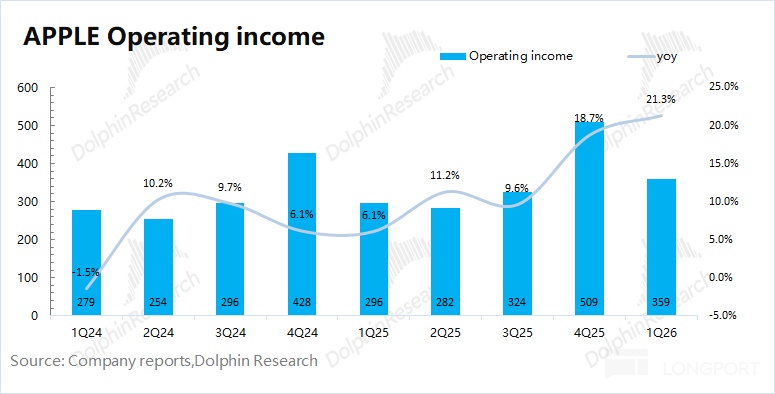
1.3 Operating profit: FY26 Q2 (1Q26) OP was $35.9bn (+21% YoY). Growth reflected both revenue expansion and higher GPM.
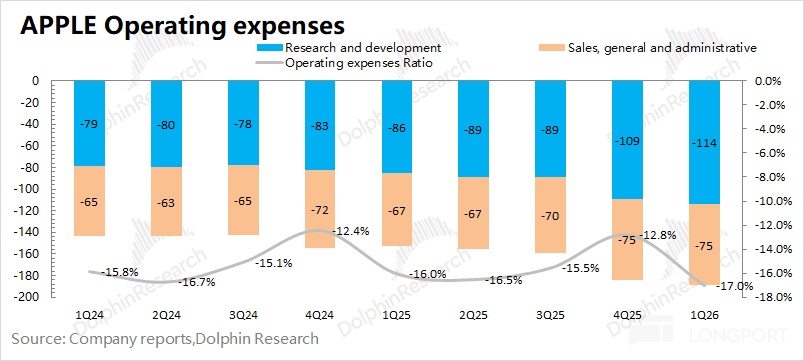
Opex ratio was 17%, up 100bps YoY, as Apple increased R&D across products and services, with R&D up 23% YoY this quarter.
Capex was $1.97bn, down 36% YoY, modest vs. peers deploying tens of billions per quarter on AI. Apple’s capex remains low as it lacks external DC biz.
Apple is investing in AI, but much of it runs through R&D rather than capex, given in-house silicon and no third-party DC footprint. R&D growth is accelerating, though the dollar amount remains small vs. hyperscalers’ chip purchases.
II. iPhone: China-led outperformance against the market
FY26 Q2 (1Q26) iPhone revenue was $57.0bn (+21.7% YoY), in line with consensus ($57.0bn). Growth was driven by iPhone 17 strength in China and USD/CNY tailwinds.
Dolphin Research analyzes volume vs. price to gauge the key drivers this quarter.
1) Shipments: per IDC, the global smartphone market fell 5% YoY in 1Q26. Apple’s shipments rose ~5.5% YoY, outperforming the market.
Shipment growth came mainly from Mainland China, where iPhone 17 256GB benefited from state subsidies and lifted iPhone sales by 33% YoY. The broader China market declined 3.6% YoY, making Apple the best performer there.
2) ASP: triangulating revenue and shipments, iPhone ASP was ~$933, up ~15% YoY. China benefited from iPhone 17 mix and FX tailwinds on both revenue and pricing.
III. Hardware ex-iPhone: back to growth
3.1 Mac
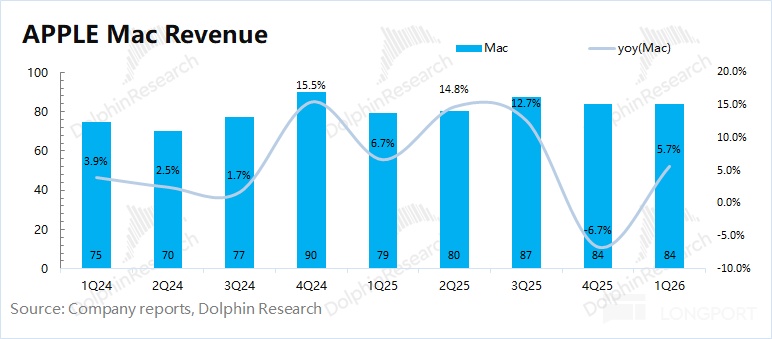
FY26 Q2 (1Q26) Mac revenue was $8.4bn (+5.7% YoY), ahead of consensus ($8.1bn).
Per IDC, global PC shipments rose 3.8% YoY, while Apple’s PC shipments grew 12.7% YoY, outperforming the market. We estimate Mac ASP at $1,355, down ~6% YoY.
Apple launched MacBook Neo (from $599, expanding the user base), M5 MacBook Air, and M5 Pro/M5 Max MacBook Pro, with Neo seeing strong reception.
3.2 iPad
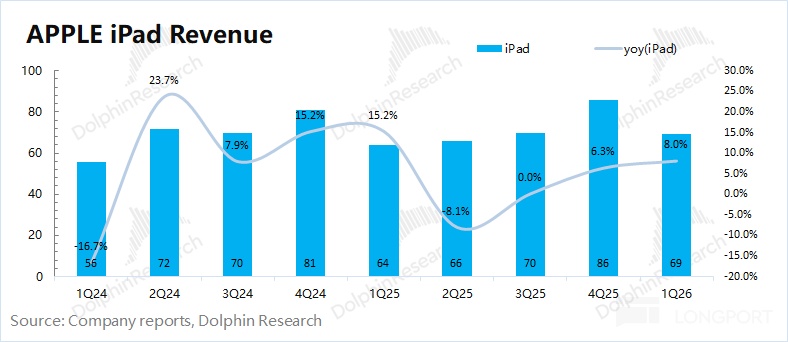
FY26 Q2 (1Q26) iPad revenue was $6.9bn (+8% YoY), beating consensus ($6.65bn), driven by M5 Pro and A16 models.
Over half of iPads sold this quarter were to new users. iPad delivered double-digit growth in EMs such as India, Mexico, and Thailand.
3.3 Wearables and other hardware
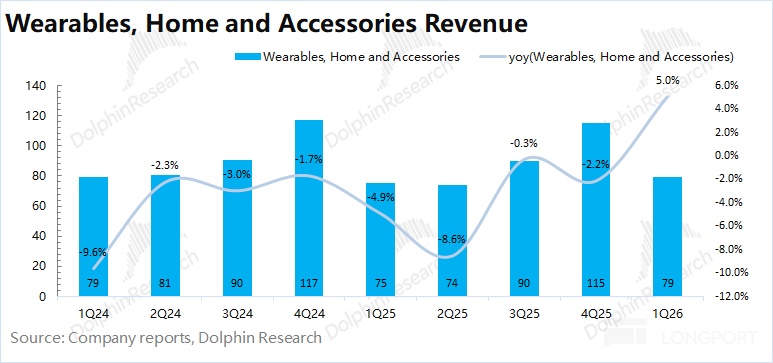
FY26 Q2 (1Q26) Wearables & Other revenue was $7.9bn (+5% YoY), slightly above consensus ($7.7bn), led by wearables and accessories.
IV. Services: ecosystem moat intact; eyes on new Siri
FY26 Q2 (1Q26) Services revenue was $31.0bn (+16% YoY), beating consensus ($30.4bn). Despite allowing external links in the US App Store, Services maintained double-digit growth, underscoring the ecosystem moat.
Services GPM was 76.7% and continued to rise. With a 28% revenue mix, Services generated 43% of company GP.
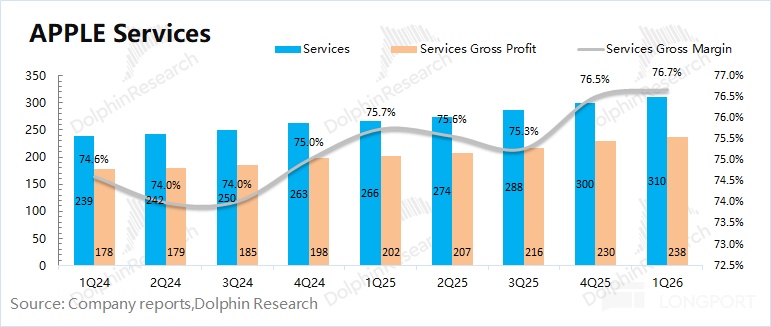
Services hit all-time highs across both developed and emerging markets, with record revenue in ads, music, payments, and cloud. App Store added a new ad slot in search results, and Apple Maps ads (focused on local merchants) will launch this summer in the US and Canada.
Apple Intelligence now integrates dozens of features including vision AI and real-time translation. Apple confirmed the new Siri will launch within the year.
Apple views AI as a capability rooted in on-device silicon and edge processing, emphasizing privacy-first. With R&D growth outpacing the company’s overall growth, AI spend represents incremental investment.
The resolution of Alphabet’s lawsuit removes a Services overhang. Given Apple’s ecosystem control, even if App Store settles into single-digit growth, Services should still deliver double-digit growth overall.
After procuring 'Gemini' services, Apple deepened its software partnership with Alphabet. Gemini will provide trillion-parameter models and technical support, while compute will rely on on-device processing and Apple’s private cloud. If the new Siri lands well this year, it could both enhance AI utility and expand the growth runway.
Dolphin Research archives on Apple:
Jan 30, 2026 call takeaways: 苹果(纪要):新版 Siri 将与谷歌合作,公司依然不放弃自研
Jan 30, 2026 earnings review: iPhone 炸场、Gemini 助攻,苹果 AI 时代真来了?
Oct 31, 2025 call takeaways: 苹果(纪要):加大 AI 投入,明年推出新版 Siri
Oct 31, 2025 earnings review: 苹果:iPhone 稳住 C 位,AI 何时露真容?
Sep 10, 2025 event review: 苹果:iPhone“小打小闹” 撑场面,AI 大招还得憋?
Aug 1, 2025 call takeaways: 苹果(纪要):资本开支增长主要来自于 AI 相关投资
Aug 1, 2025 earnings review: 苹果:AI 难产,还得靠 iPhone 救场
Risk disclosure and disclaimer: 海豚君免责声明及一般披露
The copyright of this article belongs to the original author/organization.
The views expressed herein are solely those of the author and do not reflect the stance of the platform. The content is intended for investment reference purposes only and shall not be considered as investment advice. Please contact us if you have any questions or suggestions regarding the content services provided by the platform.
