

 Rate Of Return
Who wins and who loses in the food delivery war? This local life report from QuestMobile is worth a look.

I've been researching AI recently and haven't paid much attention to e-commerce and instant retail for a while. Today, I saw the 2026 Local Life Consumption Insight Report released by QuestMobile in a group chat and found it quite interesting.
A lot of the information is expected, for example, both Taobao and JD.com saw over 10% year-on-year growth in user frequency in 2026; but there are also many surprising data points, such as the Dianping app's user scale growth rate slowing down to 11.4% year-on-year, and the DouShengSheng app's daily active user scale already approaching 16 million.
I originally thought that after a year of flash sale wars, many companies would shift their focus and investment towards AI. Under various factors, the local life sector should gradually calm down, and Meituan's pressure would slowly decrease. Unexpectedly, the intensity of industry competition hasn't lessened, especially under the surprise attacks from Douyin, the largest short position in Hengke. Meituan's pressure is not small.
The report has a lot of content. I'll share some data and information:
The title of QM's article is quite 'eye-catching': 'QuestMobile 2026 Local Life Consumption Insight Report: User Mindset Upgrades, Instant Retail Moves Towards a 'Comprehensive Consumption Portal', Alibaba, JD.com, and Meituan are Stuck in a Trench War, Douyin is Busy Stealing the Show...'
The core view of the full text is: subsidy reduction has not lowered the intensity of competition; instead, it has plunged these platforms into a 'trench war' of close combat and fighting for every inch of ground. The battle in the local consumption market has extended from food delivery to group buying, fresh retail, and full-category instant consumption. Although Meituan leads in market share, the year-on-year growth rates of many indicators are lower than those of Taobao and JD.com. In the in-store group buying sector, 'DouShengSheng' has emerged as a dark horse, with DAU approaching 16 million, stealing the spotlight from Meituan.
Below are the relevant research data and specific viewpoints:
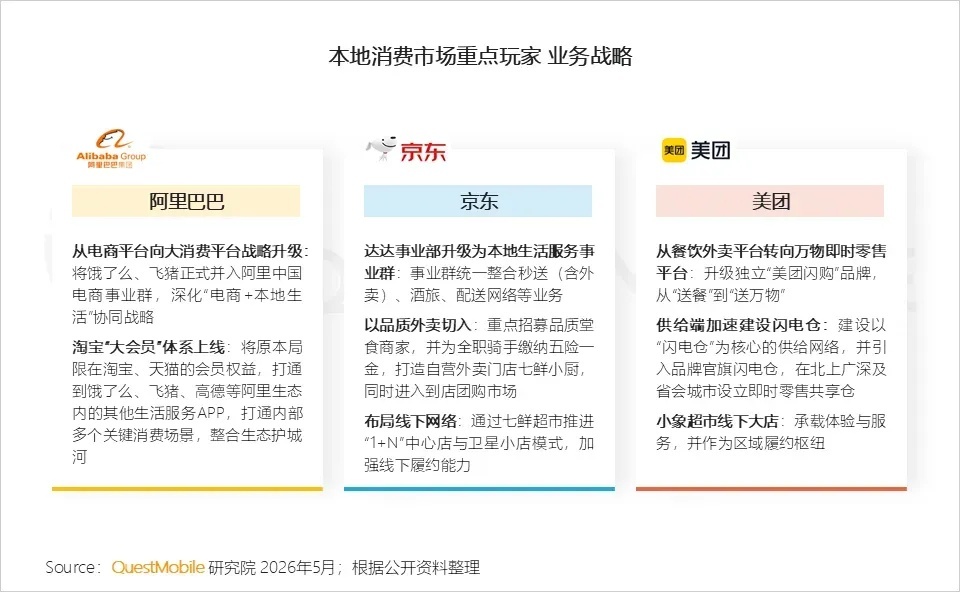
1. The strategic paths of the three giants in the local consumption market have clearly diverged: Alibaba relies on ecosystem synergy to build a 'big consumption platform'; JD.com focuses on quality food delivery and self-operated stores; Meituan, as the defender, builds flash warehouses to strengthen offline fulfillment capabilities.
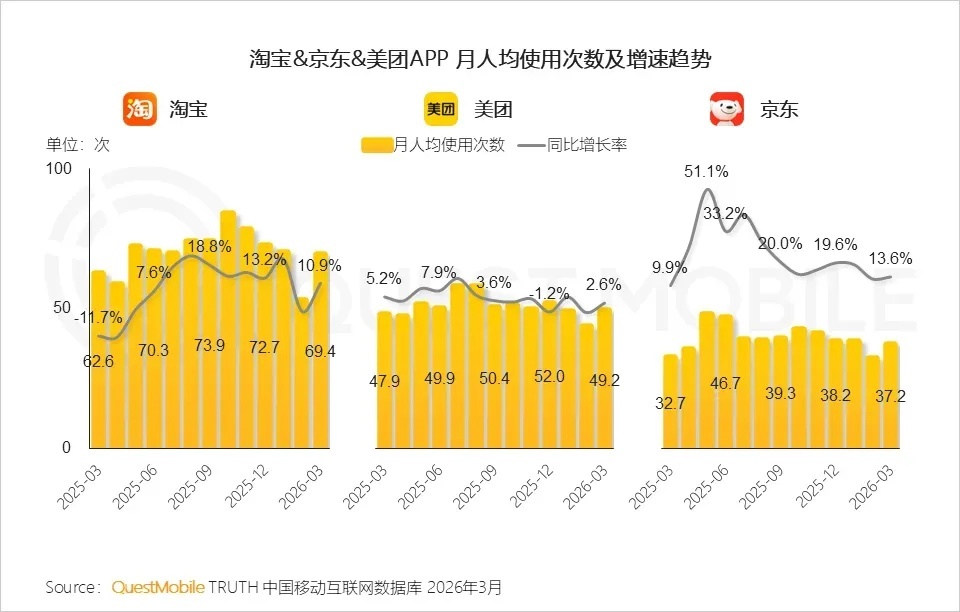
2. The penetration of food delivery services has reshaped user behavior patterns on e-commerce platforms, allowing Taobao and JD.com's main sites to maintain over 10% year-on-year growth in user frequency in 2026, while the competitive pressure on Meituan continues to increase.
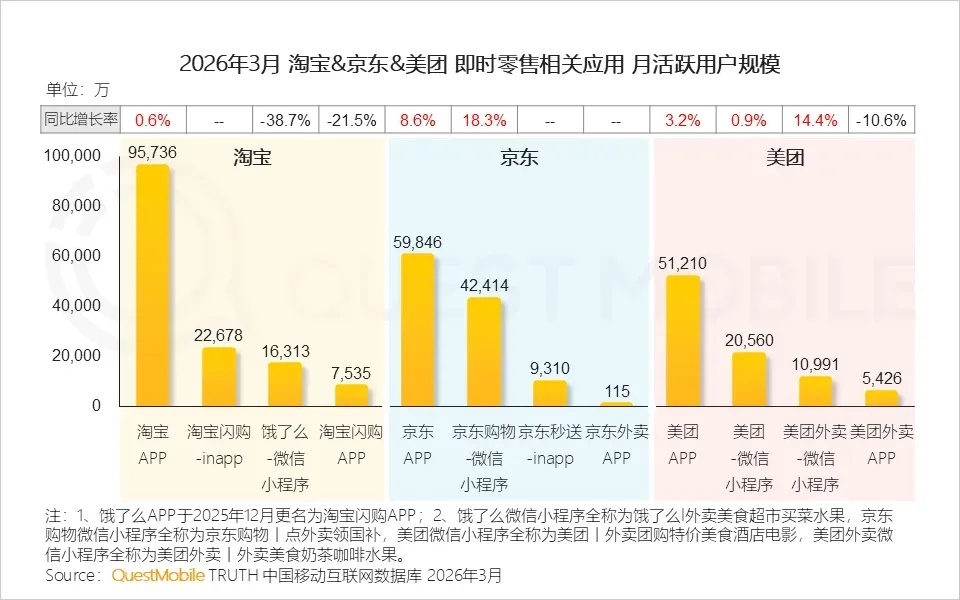
3. After a year of subsidy wars, infrastructure expansion, and M&A integration, the instant retail market structure has shifted towards multi-polar competition. Traffic on traditional independent food delivery platforms has generally declined, and user demand is migrating from single food delivery scenarios to comprehensive consumption platforms.
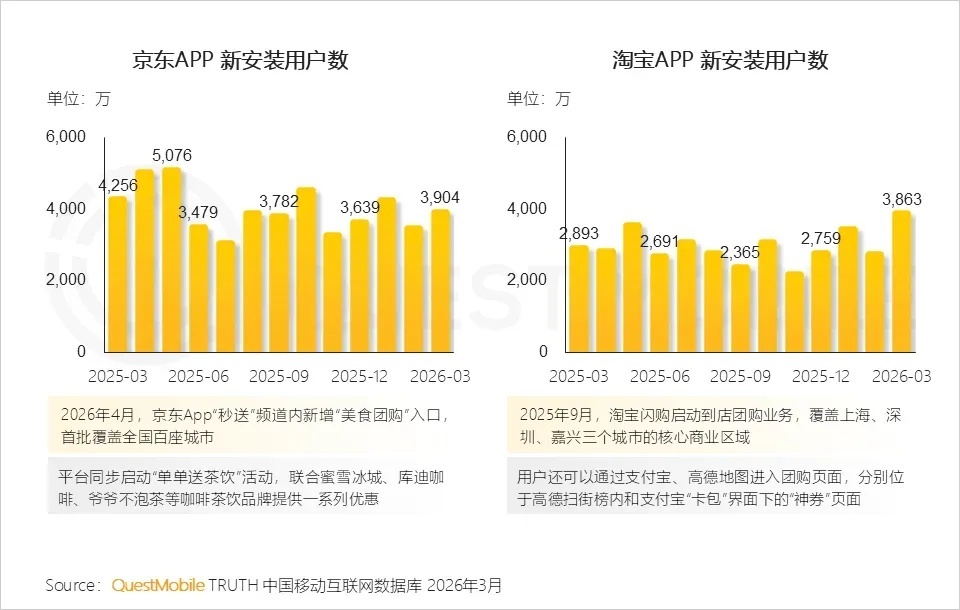
4. The instant retail business has effectively activated user growth, causing significant increases in new users for the Taobao and JD.com apps in some months. Building on this, both are further increasing their bets on the in-store group buying track, creating a full-scenario closed loop for local life to leverage new business increments.
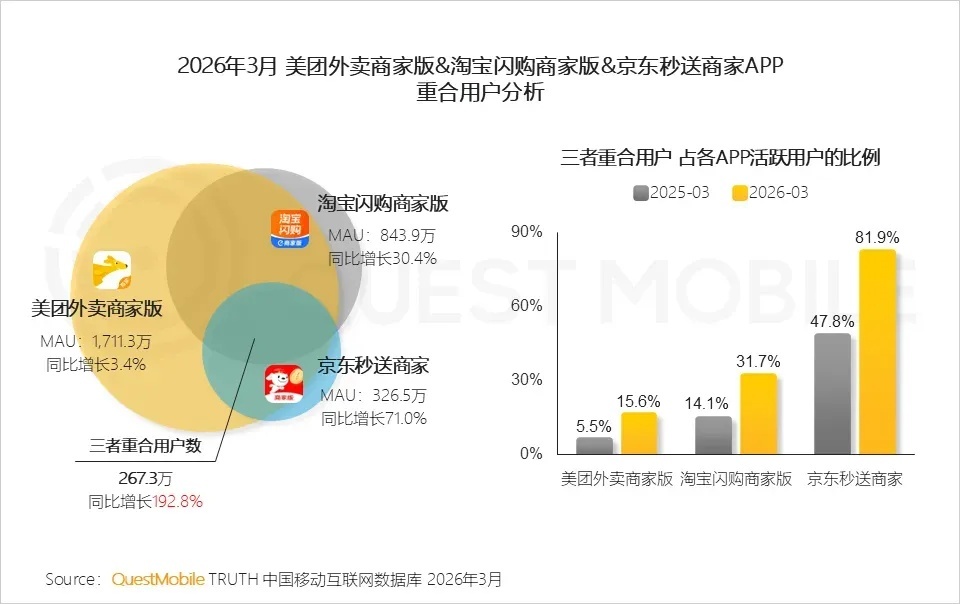
5. Meituan's growth on the merchant side is approaching its ceiling. A large number of merchants are opening stores on all three platforms simultaneously. Taobao Flash Sale's merchant-side MAU grew 30.4% year-on-year in March this year, reaching 8.439 million. Omni-channel operation has become the standard strategy for merchants.
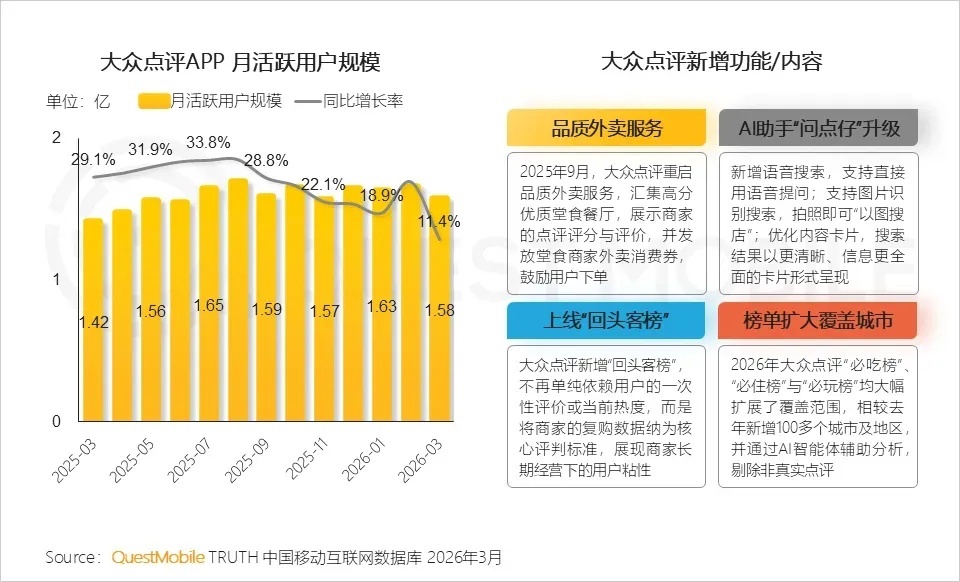
6. The pressure on Dianping app's traffic growth is becoming apparent, with the year-on-year growth rate of its user scale dropping to 11.4%. To break through the bottleneck, the platform is shifting towards value deepening, restarting quality food delivery services, upgrading its AI assistant, and launching a 'Returning Customer List', focusing on improving service quality and intelligent experience.
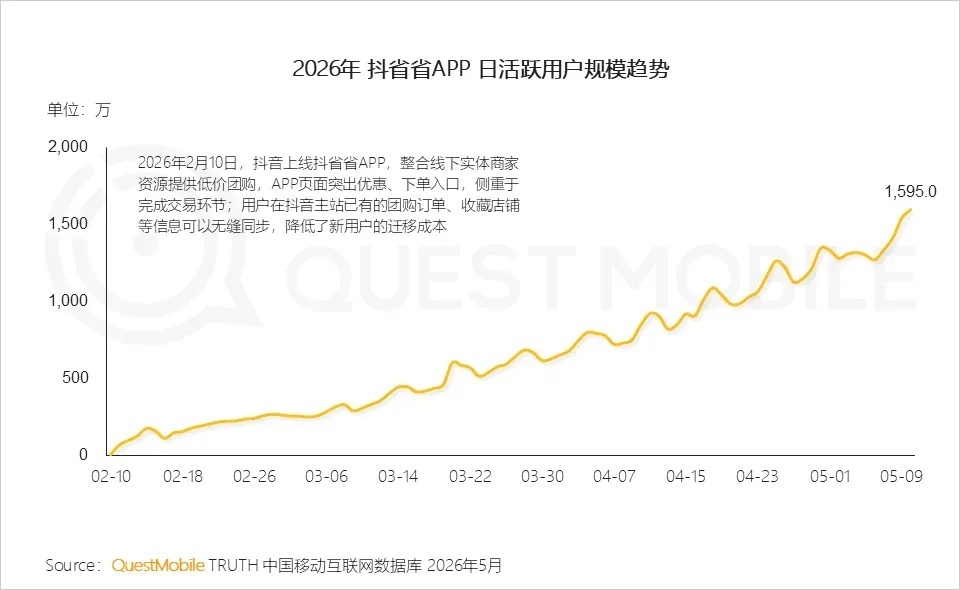
7. Douyin uses its main app as a traffic engine and content seeding ground, while DouShengSheng serves as an independent transaction platform to meet planned consumption needs, completing the entire consumption chain from interest stimulation to transaction completion. On May 10th, the DouShengSheng app's daily active user scale had already approached 16 million.
Overall, the report seems pessimistic about Meituan, positive about Taobao, JD.com, and DouShengSheng, and pessimistic about when the entire industry will return to normal. Personally, I agree with the overall viewpoint.
Combined with the previous LatePost report on Douyin's in-store business:
Douyin's in-store GTV grew nearly 60% in 2025, exceeding 800 billion. The gap between Douyin and Meituan in in-store business was already less than 25% in 2025. Douyin's local life goal is to surpass Meituan's in-store business in transaction volume in 2026.
Overall, Meituan is currently under significant pressure. The pressure on its core business is visible, while the invisible pressure lies in AI. The core business needs to defend against competition from multiple rivals simultaneously, which will also occupy Meituan's investment focus on AI.$Alibaba(BABA.US) $JD.com(JD.US) $MEITUAN(03690.HK)
The copyright of this article belongs to the original author/organization.
The views expressed herein are solely those of the author and do not reflect the stance of the platform. The content is intended for investment reference purposes only and shall not be considered as investment advice. Please contact us if you have any questions or suggestions regarding the content services provided by the platform.
