

Global Electric Off-Road Motorcycle Market: The Electrification of Off-Road Racing Accelerates Expansion, with Clear Structural Growth Trends

Electric off-road motorcycles are a category of motorcycles that combine electric technology with off-road performance. They are powered by electricity and offer advantages such as environmental friendliness, energy efficiency, and low noise, while retaining the powerful performance and ability to handle complex terrains of traditional off-road motorcycles. Electric off-road motorcycles are typically equipped with high-performance electric motors and battery packs, providing strong power output and long-lasting range. Their suspension systems and tire designs are also optimized for off-road driving to tackle rough roads and difficult terrain conditions, primarily used for off-road sports and outdoor adventures.
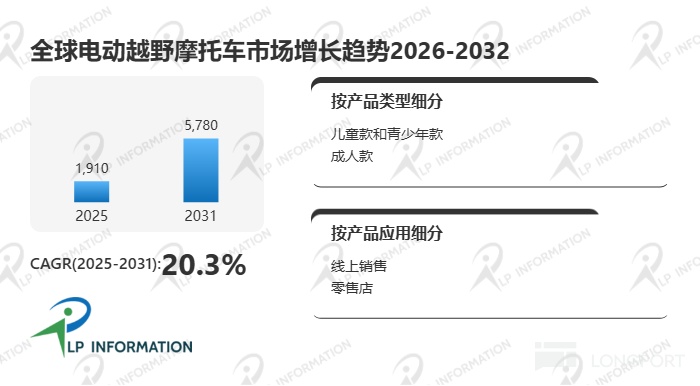
According to preliminary research data from LP Information, the global electric off-road motorcycle market size was approximately $1.91 billion in 2025 and is expected to achieve continuous growth by 2032 (with the specific size increasing as electrification penetration rises). The industry's compound annual growth rate (CAGR) is expected to remain at a high level during the 2026–2032 period. Overall, the market is in a critical transition window from the "early performance validation stage" to the "scaled commercial expansion stage."
I. Industry Chain Structure: Deep Integration of Electric Drive Systems and Off-Road Vehicles
The electric off-road motorcycle industry chain can be divided into three main segments: "core components — vehicle manufacturing — channels and end applications."
Upstream core components include power battery systems (lithium battery packs and BMS management systems), electric drive systems (motors, electronic controls, reducers), frame materials (aluminum alloy/composite materials), suspension systems, off-road tires, and lightweight structural components. Among these, battery energy density and motor torque output capability directly determine the upper limit of vehicle performance and are the core sources of value.
The midstream consists of vehicle manufacturers responsible for vehicle design, powertrain integration, chassis tuning, off-road performance optimization, and vehicle testing and validation. This segment emphasizes the dual engineering capabilities of "electrification + off-road performance," with products highly dependent on platform development and vehicle system integration capabilities.
The downstream comprises sales and application markets, mainly including off-road sports, outdoor adventures, professional competitions, training institutions, and high-end leisure consumption markets. Retail channels still dominate, but online direct sales are gradually increasing.
II. Market Landscape: Europe Dominates the High-End Market, China Accelerates Catching Up
The global electric off-road motorcycle market exhibits a clear pattern of regional and brand concentration.
Europe, leveraging its mature motorcycle culture and stringent environmental policies, holds the largest global market share, approximately 45%, and has established a technological lead in the high-performance electric off-road segment.
North America follows closely, accounting for about 33% of the market, driven primarily by off-road culture and outdoor sports demand, with high acceptance for high-power, long-range products.
The Asia-Pacific region accounts for about 19%, with the Chinese market showing rapid growth, and local companies having clear advantages in electric drive systems and vehicle cost control.
In terms of competitive landscape, global key players include Triumph Motorcycles, Yamaha, BMW Motorrad, Stark Future, and QiuLong Technology, among others. The top five players collectively hold about a 70% market share, indicating a high level of industry concentration.
The overall market presents a coexistence pattern of "traditional motorcycle giants + emerging electric off-road brands."
III. Regional Analysis: Demand Driven by Both Policy and Sports Culture
The European market, driven by carbon emission policies and outdoor sports culture, shows a clear trend of electric off-road products replacing fuel-powered models, coupled with a mature competition system that boosts demand for high-end products.
The North American market, relying on vast off-road terrains and a mature consumer market, focuses electric off-road motorcycles mainly on sports and leisure scenarios, gradually extending into professional competitions.
The Asia-Pacific market is in a rapid introduction phase. China has significant cost advantages in vehicle manufacturing and supply chains, while Japan and South Korea focus more on high-end technology and refined products.
Emerging markets (such as parts of Southeast Asia and the Middle East) primarily use electric off-road motorcycles for outdoor entertainment and light off-road applications, with substantial future growth potential.
IV. Industry Policies and External Environment: Electrification Transition as the Core Driving Force
Globally, transportation electrification and carbon reduction policies are accelerating the shift from fuel-powered to electric off-road motorcycles.
Europe continues to tighten emission standards for fuel-powered motorcycles, prompting the gradual phase-out of high-emission models.
Some states in North America implement electrification incentive policies for off-road and recreational vehicles, alongside increasing demand for low-noise, low-emission equipment.
China and the Asia-Pacific region promote technological upgrades for electric two-wheelers and light off-road vehicles through policies supporting the new energy industry chain.
Additionally, battery safety standards, vehicle certification systems, and adjustments to off-road competition rules are indirectly influencing product design directions in the industry.
V. Market Drivers: Performance Upgrades and Consumption Upgrades Jointly Drive Growth
The growth of the electric off-road motorcycle market primarily stems from the following core drivers:
First, advancements in power battery technology enhance range capability and output performance, gradually enabling electric off-road models to replace fuel-powered ones.
Second, increasing consumer preference for low noise, low maintenance costs, and environmental performance boosts the penetration of electric products in leisure and sports markets.
Third, sustained growth in off-road sports and outdoor adventure consumption, particularly in Europe and North America, forms a stable demand base.
Fourth, the high-torque output characteristic of electric motors gives electric off-road vehicles advantages in acceleration and adaptability to complex terrains, enhancing product appeal.
VI. Market Constraints: Range and Cost Remain Key Bottlenecks
Despite clear market growth, the industry still faces multiple constraints:
First, battery range and charging convenience still limit applications in long-distance off-road scenarios.
Second, the high cost of high-performance batteries and electric drive systems makes vehicle prices significantly higher than some fuel-powered models.
Third, off-road scenarios demand extremely high reliability, and electric systems still require further validation under extreme conditions (high temperature, mud, water, impact).
Fourth, the maintenance system and after-sales network are not yet fully mature, affecting the long-term user experience.
VII. Industry Development Opportunities: High Performance and Intelligence as New Growth Points
The copyright of this article belongs to the original author/organization.
The views expressed herein are solely those of the author and do not reflect the stance of the platform. The content is intended for investment reference purposes only and shall not be considered as investment advice. Please contact us if you have any questions or suggestions regarding the content services provided by the platform.
