

Root canal treatment: Under a microscope, missed root canals and fine anatomical structures can be clearly seen, with the success rate increasing from 70% to over 95%.

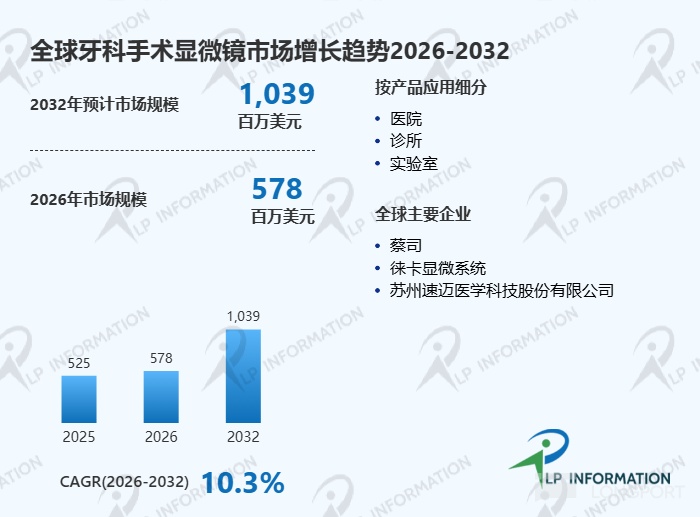
According to preliminary research by LP Information, the global market size for dental surgical microscopes is estimated to be approximately $525 million in 2025, and is expected to grow to $1.039 billion by 2032, with a compound annual growth rate (CAGR) of 10.3% during the period 2026–2032.
This report will also analyze the impact of current U.S. tariff policies and various countries' differentiated trade measures on the high-end medical device supply chain, regional market structure, and industry competition landscape.
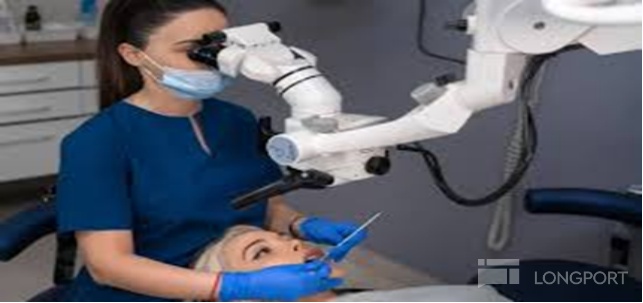
A dental surgical microscope is a crucial high-end medical device used in oral clinical and microsurgical procedures. Through a high-magnification optical amplification system, coaxial illumination system, and precise mechanical arm structure, it enables high-definition visualization and minimally invasive operation support for dental structures, pulp, root canals, and periodontal tissues. This equipment can significantly enhance surgical field clarity and operational precision, and is widely used in clinical scenarios such as microscopic root canal therapy, dental restoration, periodontal surgery, implant restoration, and complex retreatment. It is one of the key pieces of equipment driving the development of modern oral medicine towards refinement and minimally invasive techniques.
From the perspective of the industrial chain structure, the upstream mainly includes suppliers of core components such as high-precision optical glass, lens assemblies, LED light source systems, mechanical support arms, sensors, and imaging chips. The midstream consists of dental surgical microscope manufacturers responsible for optical system integration, structural design, and medical certification. The downstream includes hospital dental departments, chain dental clinics, specialized oral medical institutions, and teaching and research units. The entire industrial chain heavily relies on precision optical manufacturing capabilities and the medical device registration system.
In terms of market structure, the global dental surgical microscope industry exhibits a competitive landscape characterized by "high-end concentration + accelerated mid-range localization." International companies represented by ZEISS, Leica Microsystems, and Olympus Corporation have long dominated the high-end market, holding significant advantages in optical precision, imaging quality, and brand recognition. Meanwhile, Chinese companies such as Suzhou Sumai Medical Technology Co., Ltd. and Shanghai Born Dental Technology Co., Ltd. are accelerating their technological catch-up, gradually expanding their mid-range market share through product upgrades and cost advantages. Currently, the combined market share of the top five global manufacturers exceeds 83%, indicating a high level of industry concentration, but regional market competition is gradually intensifying.
Regarding the industry's policy environment, global medical device regulatory systems continue to tighten. The European and American markets primarily rely on the FDA and CE certification systems, imposing strict requirements on optical precision, clinical safety, and long-term reliability. In China, under the framework of the "Regulations on the Supervision and Administration of Medical Devices," registration approval and quality system supervision are being strengthened, while the localization of high-end medical equipment is encouraged. Driven by policies, high-end oral equipment is accelerating its development towards standardization and normalization.
In terms of market drivers, first, the global awareness of oral health is increasing, driving the demand for refined treatments, with the penetration rates of microscopic root canal therapy and minimally invasive dental surgery continuously rising. Second, the trend towards digitalization in dental care is evident, with functions such as imaging recording, 4K video systems, and digital case management becoming key focuses for equipment upgrades. Third, the consumption upgrade in high-end dental services is significant, with the expansion of chain oral institutions driving centralized procurement demand for equipment. Additionally, the need to optimize doctors' occupational health and operational efficiency further increases the adoption rate of microscopic equipment.
However, the industry still faces certain obstacles. First, the high unit price of dental surgical microscopes creates a procurement barrier for small and medium-sized clinics. Second, the learning curve for operating the equipment is relatively long, imposing higher requirements on doctor training systems. Third, the limited budgets of primary healthcare institutions restrict the speed of equipment penetration into these areas. Furthermore, intensified competition from low-cost alternative devices and domestic mid-range products also impacts the market structure.
From the perspective of development opportunities, the dental surgical microscope industry is entering a stage of "clinical popularization + technological integration." On one hand, as the concept of microscopic dentistry gradually gains popularity worldwide, equipment is expanding from high-end specialized hospitals to chain clinics. On the other hand, the integration of AI image analysis, digital imaging systems, and cloud-based case management will drive equipment upgrades towards intelligent platforms. Simultaneously, the rapid improvement of oral healthcare infrastructure in emerging markets (such as Southeast Asia, India, and Latin America) provides sustained growth space for the industry.
By product type:
- Mobile Dental Surgical Microscopes
- Fixed Dental Surgical Microscopes
By clinical application scenario:
- Root Canal Treatment
- Restorative Treatment
- Periodontal/Surgical Procedures
- Other Applications
By channel:
- Direct Sales
- Distribution
By application end-user:
- Hospitals
- Clinics
- Laboratories and Teaching Institutions
Main regions/countries covered in this report:
Americas (United States, Canada, Mexico, Brazil)
Asia-Pacific (China, Japan, South Korea, Southeast Asia, India, Australia)
Europe (Germany, France, United Kingdom, Italy, Russia)
Middle East & Africa (Egypt, South Africa, Israel, Turkey, Gulf Countries)
Major companies covered in this report include:
International and regional key manufacturers such as ZEISS, Leica Microsystems, Olympus Corporation, Global Surgical Corporation, Seiler Instrument Inc., CJ-Optik, and Suzhou Sumai Medical Technology Co., Ltd.
The copyright of this article belongs to the original author/organization.
The views expressed herein are solely those of the author and do not reflect the stance of the platform. The content is intended for investment reference purposes only and shall not be considered as investment advice. Please contact us if you have any questions or suggestions regarding the content services provided by the platform.
