

A $244 billion "industrial behemoth," its CAD software is still growing steadily at 6.2%

I. Steady Growth in the Global CAD Software Market Size, with Industrial Digitalization as the Core Driver
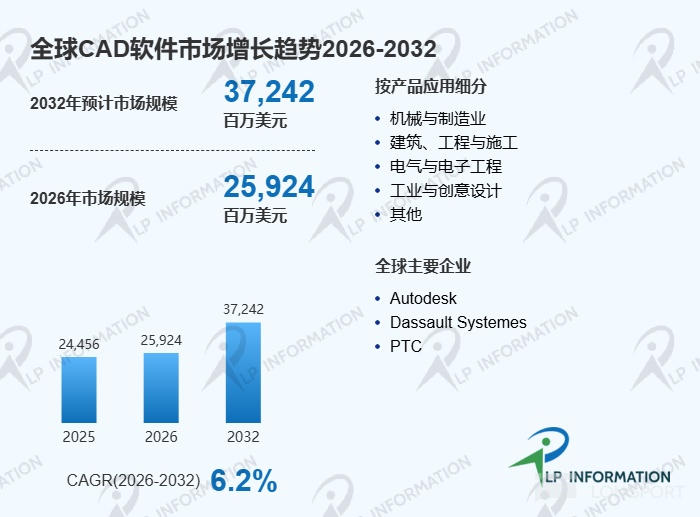
According to data from market research firm LP Information, the global CAD software market size was approximately $24.456 billion in 2025, and is projected to grow to $37.242 billion by 2032, with a compound annual growth rate (CAGR) of about 6.2% from 2026 to 2032. Overall, the CAD software industry has transitioned from an early-stage high-speed penetration phase to a development cycle characterized by "steady growth + structural upgrading" in parallel. Its growth logic is shifting from user expansion to technological upgrades and deep industry integration.
As a core tool for engineering design digitalization, CAD (Computer-Aided Design) software is deeply embedded in key industrial chain segments such as construction, mechanical manufacturing, automotive, aerospace, electronics, and industrial design. It undertakes important functions ranging from conceptual design and structural modeling to engineering drawing output and collaborative design, and is gradually extending into Product Lifecycle Management (PLM) systems.
II. Industry Chain Structure: A Complete System from Foundational Computing Power to Industrial Digitalization Ecosystem
The CAD software industry chain can be divided into three levels: upstream, midstream, and downstream:
Upstream Foundational Layer: Primarily includes operating system platforms, cloud computing infrastructure, Graphics Processing Units (GPUs), geometric modeling kernels, database systems, and AI algorithm frameworks. Among these, high-performance computing capabilities and graphics rendering power directly determine the complex modeling and real-time interactive experience of CAD software.
Midstream Software Layer: Consists of core CAD software vendors, responsible for providing functional modules such as 2D/3D modeling, parametric design, simulation interfaces, collaborative design, data management, and industry-specific solutions. This layer is also gradually evolving towards cloud-based CAD platforms and AI-assisted design systems.
Downstream Application Layer: Covers industry clients in construction engineering, industrial manufacturing, automotive, aerospace, electronics & semiconductors, and creative design. As industrial digitalization advances, CAD software is being upgraded from a point design tool to a collaborative platform that spans R&D, engineering, and production.
III. Market Landscape: Coexistence of Market Concentration and Rise of Local Players
The current global CAD market exhibits a highly concentrated landscape, with international giants still holding dominant positions, including Autodesk, Dassault Systemes, Siemens Digital Industries Software, PTC, and Bentley Systems.
Leveraging mature product portfolios, long-term industry accumulation, and ecosystem development, these vendors hold core market shares in high-end manufacturing, aerospace, and complex engineering fields.
Simultaneously, localization trends in regional markets are accelerating. Chinese vendors such as Glodon, ZWSOFT, and Empyrean are making continuous breakthroughs in architectural design, industrial software, and Electronic Design Automation (EDA), gradually building substitution capabilities in the mid-range market and certain niche segments.
Overall, the global market presents a dual-layer competitive structure: "international giants dominate the high-end, while local firms penetrate the mid-range and niche segments."
IV. Industry Policy Environment: Dual Drivers of Digital Industry and Self-Reliance
Globally, industrial software has become a critical infrastructure for the digital transformation of manufacturing. Governments in multiple countries are promoting the indigenization of industrial software and industrial upgrading.
European and American markets focus on advancing Industry 4.0, smart manufacturing, and digital twin system construction, emphasizing the integration of CAD with CAE/PLM systems. They also impose higher requirements on data security and the industrial software supply chain.
China continues to implement policies related to "Domestic Replacement of Industrial Software" and "Made in China 2025," encouraging the self-reliant development of core industrial software, thereby providing long-term policy dividends and market space for local CAD software enterprises.
V. Market Drivers: Manufacturing Upgrading and Cloud Transformation Jointly Fuel Growth
The growth of the CAD software market primarily stems from the following core drivers:
First, the global manufacturing industry is moving towards higher-end and precision development. The increasing complexity of product design demands higher capabilities in 3D modeling, simulation design, and collaborative design.
Second, the acceleration of digitalization in construction and infrastructure, with deep integration of BIM (Building Information Modeling) and CAD, significantly enhances engineering design efficiency.
Third, the proliferation of cloud computing and SaaS models is driving the transformation of CAD software from on-premise deployment to cloud-based collaboration, lowering the entry barrier for enterprises and improving cross-team collaboration efficiency.
Furthermore, AI technology is reshaping the design process. Functions such as automatic model generation, intelligent structural design optimization, and parametric recommendations are gradually being implemented, enhancing design efficiency and innovation capabilities.
VI. Market Constraints: High Switching Costs and Ecosystem Barriers Remain Prominent
Despite the vast market potential, CAD software still faces certain development constraints.
On one hand, high-end CAD software involves high learning and migration costs. Once enterprises establish usage habits, switching becomes difficult, leading to strong path dependency in the market.
On the other hand, the ecosystem barriers in industrial software are significant. CAD often needs deep integration with CAE, CAM, and PLM systems, forming a complex software suite that poses a high barrier for new entrants.
Additionally, the high-end market still heavily relies on core geometric modeling engines and patented technologies, sustaining the technological barriers.
VII. Industry Development Opportunities: Convergence of Cloud CAD, AI Design, and Industrial Internet
Future growth opportunities in the CAD industry are concentrated in three directions:
First, the continuous expansion of Cloud CAD and subscription-based models further strengthens the trend of software-as-a-service, driving the market's transition from one-time licensing to recurring revenue.
Second, AI-driven design (AIGC+CAD) is becoming a new growth point, reducing design costs and enhancing innovation efficiency through intelligent modeling and automatic optimization.
Third, the integration of the Industrial Internet and Digital Twin systems is upgrading CAD from a design tool to a core entry point for industrial data, playing a more important role in smart manufacturing systems.
In the long term, CAD software is evolving from a "design tool" into "industrial digitalization infrastructure," with its strategic value continuously increasing.
VIII. Conclusion: From Tool Software to the Hub of Industrial Digitalization
In summary, the global CAD software market has entered a mature growth stage. However, driven by technological upgrades, cloud transformation, and AI empowerment, the industry still possesses stable expansion space. Future competition will no longer be confined to the functional level but will revolve around platform ecosystems, industry solution capabilities, and industrial data integration capabilities.
In this process, vendors with ecosystem-building capabilities and deep industry understanding will continue to expand their advantages. Meanwhile, the indigenization of industrial software and the restructuring of global supply chains will further reshape the market competitive landscape.
The copyright of this article belongs to the original author/organization.
The views expressed herein are solely those of the author and do not reflect the stance of the platform. The content is intended for investment reference purposes only and shall not be considered as investment advice. Please contact us if you have any questions or suggestions regarding the content services provided by the platform.
