

The CAGR of pure electric refrigerated trucks is as high as 54.5%! New energy is revolutionizing the cold chain transportation track.

I. Global Refrigerated Truck Market Steadily Expands, Cold Chain Logistics Becomes Core Growth Engine
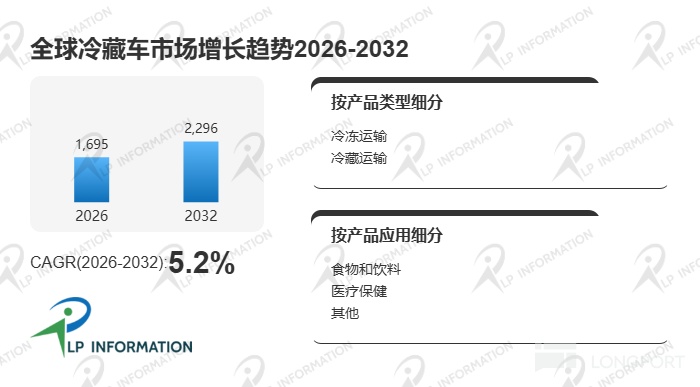
According to market research firm LP Information, the global refrigerated truck market size in 2025 is approximately 1,614 million USD, and is expected to grow to 2,296 million USD by 2032, with a compound annual growth rate (CAGR) of about 5.2% from 2026 to 2032. Against the backdrop of an accelerating global cold chain logistics system, refrigerated trucks, as core transportation equipment, are being upgraded from "supporting equipment" to "rigid infrastructure."
From the perspective of supply and demand structure, global refrigerated truck production in 2025 is about 55,000 units, with an average price of about 30,000 USD per unit, and the industry's overall gross profit margin is about 30%. With rising food safety standards, expansion of pharmaceutical cold chains, and increasing penetration of fresh food e-commerce, demand for refrigerated trucks continues to grow, showing clear regional differentiation characteristics.
II. Industry Chain Structure: Collaborative System from Refrigeration Core to Complete Vehicle System
The refrigerated truck industry chain mainly consists of three segments: upstream components and materials, midstream vehicle manufacturing, and downstream cold chain applications.
Upstream Segment mainly includes refrigeration units, compressor systems, insulation materials (such as polyurethane foam materials), vehicle chassis, temperature control sensors, and IoT modules. The technical level of the refrigeration system directly determines the vehicle's energy efficiency and stability, making it the segment with the highest technological barrier in the industry chain.
Midstream Segment comprises refrigerated truck and trailer manufacturers, responsible for body design, insulation structure integration, refrigeration system matching, and vehicle assembly. This is the core value-bearing segment of the industry chain.
Downstream Segment covers food and beverage, fresh food e-commerce, chain catering, pharmaceutical logistics, and third-party cold chain transportation companies. With increasing cold chain penetration, refrigerated trucks are gradually becoming important equipment for urban distribution and cross-regional trunk line transportation.
III. Market Landscape: Global Competition Coexists with Regional Leaders
The current global refrigerated truck market competition landscape is characterized by "Europe and America dominance + Asia rapid catch-up."
In the international market, companies represented by Wabash National, Schmitz Cargobull, Great Dane Trailers, Gray & Adams, and Krone Commercial Vehicle Group occupy the high-end market, possessing clear advantages in refrigeration efficiency, vehicle body structure design, and global service networks.
In the Chinese and Asia-Pacific markets, local manufacturers represented by companies such as CIMC Vehicles, Zhengzhou Hongyu Special Purpose Vehicle Co., Ltd., and Henan Bingxiong Special Vehicle Manufacturing Co., Ltd. are rapidly emerging, possessing strong cost advantages and delivery capabilities in the mid-to-low-end market and regional logistics.
Overall, the industry presents a stratified competitive landscape of "international brands dominating high-end cold chain + local enterprises covering regional distribution."
IV. Industry Policy Environment: Stricter Cold Chain Standardization and Food & Drug Regulation
Globally, the development of the refrigerated truck industry is highly dependent on cold chain regulatory policies and food and drug safety standards.
Europe and America are continuously strengthening food safety traceability systems and pharmaceutical cold chain regulations, imposing higher requirements for temperature monitoring, transportation records, and compliance certification, while also promoting low-carbon transportation and the application of new energy cold chain vehicles.
China is steadily advancing the construction of its cold chain logistics system, explicitly proposing to improve the entire cold chain network "from production sites to consumption terminals," and encouraging the upgrading of cold chain equipment and the construction of digital supervision systems, providing long-term policy support for the refrigerated truck industry.
V. Market Drivers: Diversified Cold Chain Demand Drives Industry Growth
The growth of the refrigerated truck market is primarily driven by the following core factors:
First, the rapid development of fresh food e-commerce and instant retail has led to a continuous increase in low-temperature distribution demand, driving growth in demand for urban refrigerated delivery vehicles.
Second, the expansion of pharmaceutical cold chains, especially the transportation of vaccines, biologics, and high-value-added drugs, has significantly increased the demand for high-precision temperature-controlled vehicles.
Third, the expansion of the prepared food, chain catering, and frozen food industries is driving the cold chain transportation system towards standardization and scale.
Furthermore, stricter food safety regulations and rising consumer demands for freshness are transforming cold chain transportation from a "cost item" to a "mandatory option."
VI. Market Obstacles: Cost Pressure and Uneven Infrastructure
Despite the broad market prospects, the industry still faces multiple challenges.
On one hand, the manufacturing cost of refrigerated trucks is high, with significant investments in refrigeration systems, insulation materials, and intelligent monitoring systems, leading to vehicle prices higher than those of ordinary logistics vehicles.
On the other hand, incomplete cold chain infrastructure in some developing regions leads to insufficient vehicle utilization, constraining the release of market scale.
Additionally, energy price fluctuations and rising operational and maintenance costs also put pressure on the profitability of cold chain transportation companies.
VII. Industry Development Opportunities: New Energy and Intelligence Reshape Industry Structure
Future growth opportunities for the refrigerated truck industry are concentrated in three directions:
First, new energy refrigerated trucks (especially pure electric and hybrid models) are accelerating their penetration in the urban distribution sector, becoming an important path to reduce carbon emissions and operational costs.
Second, the popularization of IoT and digital temperature control systems is gradually enabling full-process visualization and real-time monitoring of cold chain transportation, improving transportation safety and transparency.
Third, integrated cold chain service models are emerging, with increasing collaboration between vehicle manufacturers and logistics service providers, driving the industry's transformation from "equipment sales" to "solution services."
VIII. Conclusion: From Equipment Manufacturing to Intelligent Cold Chain Ecosystem
Overall, the global refrigerated truck market is in a stable growth cycle. Its core logic has shifted from mere vehicle expansion to being driven by the enhancement of cold chain system capabilities and technological upgrades.
Future industry competition will increasingly revolve around new energy technology, intelligent temperature control systems, total lifecycle cost control, and cold chain network synergy capabilities. As the cold chain logistics system continues to improve, refrigerated trucks will no longer be just transportation tools, but important temperature-controlled infrastructure connecting production and consumption.
The copyright of this article belongs to the original author/organization.
The views expressed herein are solely those of the author and do not reflect the stance of the platform. The content is intended for investment reference purposes only and shall not be considered as investment advice. Please contact us if you have any questions or suggestions regarding the content services provided by the platform.
