

The Irreversible Hardcore Driver of Electrification: Medium-to-Long-Term Investment Thesis and Vertical Integration Strategy in the Automotive Lithium-ion Battery Industry

According to the latest preliminary research data from market research firm LP Information, the global electric vehicle battery market size in 2025 is approximately $114.37 billion. With the continuous increase in the penetration rate of new energy vehicles worldwide, the market size is expected to further expand by 2032. The industry will maintain a high growth rate range during the 2026–2032 period, showing a development trend of long-term growth and structural upgrading in parallel.
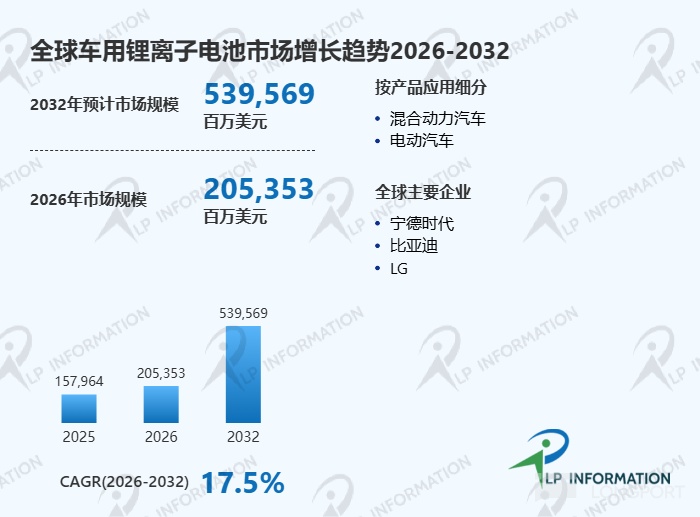
Against the backdrop of accelerating global energy transition and automotive electrification, electric vehicle batteries have evolved from a single component to a core strategic link that determines vehicle performance, cost structure, and industry competition landscape.
I. Industry Chain Structure: Deep Integration of Resource and Manufacturing Ends
The electric vehicle battery industry chain can be divided into three major systems: "upstream resources — midstream manufacturing — downstream application."
The upstream mainly includes key mineral resources such as lithium, cobalt, nickel, manganese, and graphite, as well as core materials like electrolytes, separators, cathode and anode materials, copper foil, and aluminum foil. This segment is significantly influenced by global resource distribution, geopolitics, and price cycles, and is the main source of industry cost fluctuations.
The midstream is the core manufacturing segment, covering cell design and manufacturing, module and battery pack integration (PACK), battery management system (BMS), and thermal management system development. It is the most concentrated area for technological competition and economies of scale.
The downstream is the vehicle application market, mainly including battery electric vehicles (BEV) and hybrid electric vehicles (HEV). Automakers are strengthening their control over the core supply chain through vertical integration, in-house battery R&D, and long-term strategic procurement agreements.
II. Market Structure and Growth Logic
The growth of the global electric vehicle battery market is primarily driven by three major factors:
First, the continuous increase in the penetration rate of new energy vehicles, with the global automotive industry accelerating its shift from fuel-driven to electric-driven, creating sustained rigid demand.
Second, rapid iteration of vehicle platforms, with high energy density, high safety, and fast-charging capabilities becoming mainstream technological directions, driving battery system upgrades and increased value per vehicle.
Third, the ongoing promotion of "dual carbon" policies in various countries and increasingly stringent carbon emission regulations, making electrification an irreversible trend in the global automotive industry.
Against this backdrop, the electric vehicle battery market is not only expanding in scale but also entering a technology-intensive upgrade phase.
III. Product Structure and Technology Roadmap Evolution
In terms of product structure, lithium-ion batteries remain the absolute mainstream in the current market, while Ni-MH batteries still have some existing applications in the hybrid field, but their share continues to decline.
Lithium-ion batteries are mainly divided into two major routes: lithium iron phosphate (LFP) and ternary lithium (NCM/NCA):
LFP batteries are expanding rapidly in the mid-to-low-end vehicle and commercial vehicle markets due to their cost advantages and high safety; ternary lithium batteries, with their higher energy density, still dominate the high-end passenger car and long-range vehicle markets.
In terms of structural form, prismatic batteries remain mainstream, while cylindrical and pouch routes continue to evolve in some automaker platforms.
Meanwhile, CTP (cell-to-pack), CTC (cell-to-chassis), large cylindrical cells, and semi-solid/solid-state batteries are becoming the next-generation technological directions. High-voltage fast-charging systems and structural innovations are reshaping the industry's competitive logic.
IV. Competitive Landscape and Analysis of Leading Manufacturers
The global electric vehicle battery market is highly concentrated, with leading companies occupying the major share, showing a clear "oligopoly + regionalized competition" pattern.
Representative companies include:
CATL, BYD, LG Energy Solution, Panasonic, Samsung SDI, AESC, etc.
Data shows that the combined market share of the top five global battery companies has exceeded 60%, with industry concentration continuing to increase.
Chinese companies have significant advantages in production capacity scale, cost control, and supply chain integrity; Japanese and Korean companies maintain competitiveness in high-end technology, material systems, and global vehicle customer support; European and American companies are accelerating the construction of local battery industry chains through policy support to improve supply security and industrial independence.
V. Analysis of Industry Barriers
The electric vehicle battery industry has high entry barriers, mainly reflected in the following aspects:
1. Technology Barriers
The battery system involves multi-dimensional technology systems such as material formulation, electrochemical design, safety control, and thermal management, with long R&D cycles and fast iteration speeds.
2. Scale and Cost Barriers
Power batteries have significant economies of scale, and capacity utilization directly affects unit cost.
3. Customer Certification Barriers
Automaker certification cycles are long and standards are strict. Once entering the supply system, replacement costs are high.
4. Supply Chain Resource Barriers
The stability of upstream key mineral resources and material supply directly affects a company's long-term competitiveness.
VI. Changes in Regional Market Patterns
In terms of regional distribution, China remains the world's largest electric vehicle battery production and consumption market, accounting for about 70% of the global market share.
European and American markets are accelerating the construction of localized supply chains, attracting battery companies through policy subsidies and industrial investment.
Japan and South Korea, relying on long-term technological accumulation, still hold important positions in the global high-end market.
Meanwhile, Southeast Asia, India, the Middle East, and Latin America are becoming emerging growth markets and will be important directions for the global battery industry's capacity layout in the future.
VII. Market Challenges and Risk Factors
Although the industry has strong long-term growth certainty, it still faces multiple challenges:
- Phased overcapacity and price competition pressure
- Fluctuations in upstream raw material prices
- Uncertainty in technology roadmap switching (e.g., solid-state batteries)
- Changes in international trade policies and tariffs
- Continuously tightening battery safety regulations
These factors will continue to affect the industry's profit structure and corporate operating stability.
VIII. Outlook on Future Development Trends
The future development directions of the electric vehicle battery industry will include:
First, accelerated breakthroughs in high energy density and fast-charging technology, driving up the value of batteries per vehicle;
Second, accelerated integration of battery system design (CTP/CTC trend is evident);
Third, solid-state batteries and next-generation chemical systems gradually entering the industrialization window;
Fourth, parallel development of globalized capacity layout and localized supply systems;
Fifth, battery recycling and material closed-loop systems becoming the second growth curve for companies.
In the long run, industry competition will shift from "scale competition" to "technology + system capability competition." Companies with cost control capabilities, technological iteration capabilities, global customer systems, and resource integration capabilities will occupy a core advantage in the next industrial cycle.
The copyright of this article belongs to the original author/organization.
The views expressed herein are solely those of the author and do not reflect the stance of the platform. The content is intended for investment reference purposes only and shall not be considered as investment advice. Please contact us if you have any questions or suggestions regarding the content services provided by the platform.
