

 迪士尼 长情持有
 迪士尼股东
迪士尼股东🐶 Options Puppy 101 – Case Study: Selling Cash-Secured Puts on NVIDIA (NVDA)

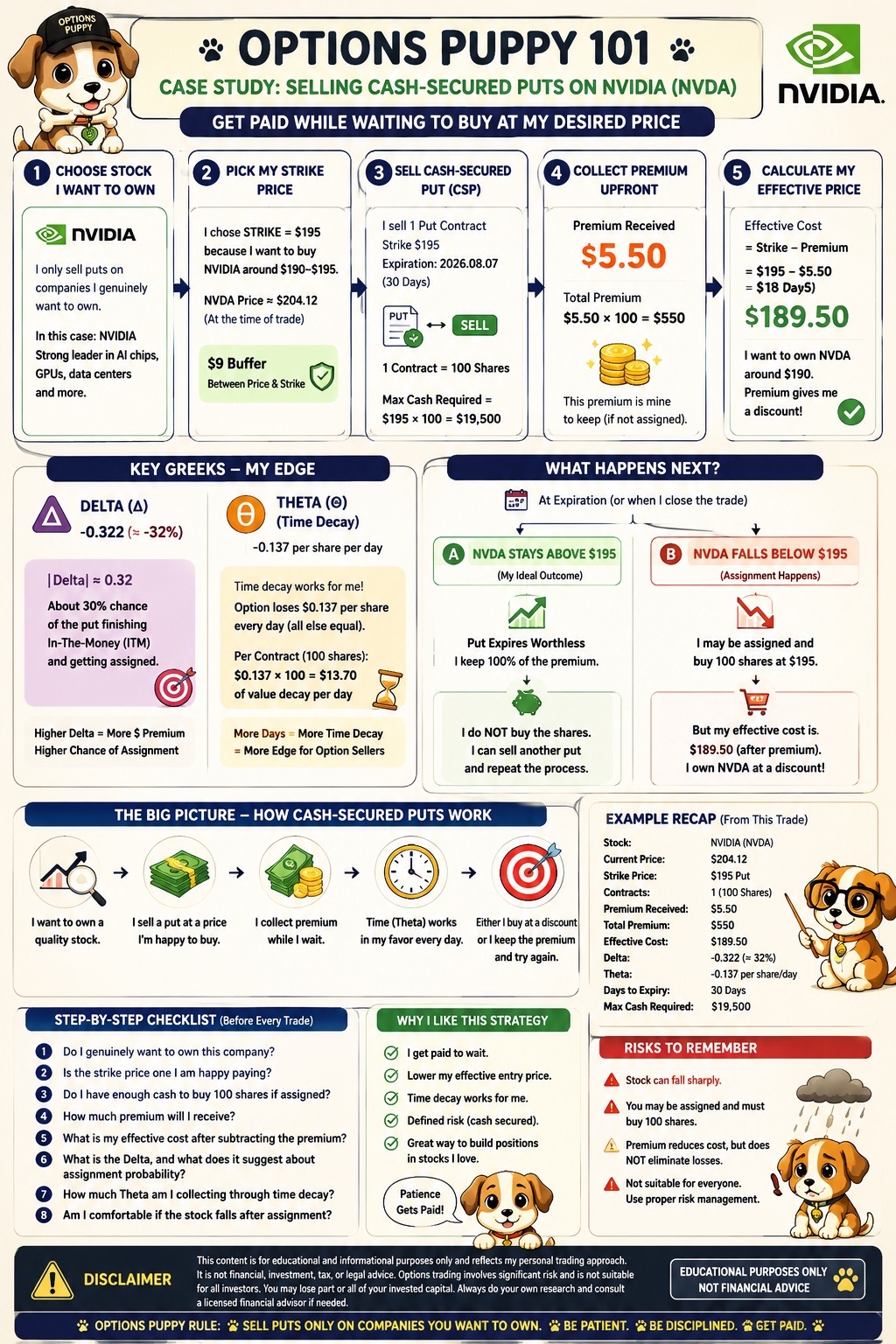
How I Get Paid While Waiting to Buy NVIDIA at My Desired Price
Educational purposes only. Options involve risk. This is not financial advice.
🚀 Introduction – Getting Paid to Wait
Many investors place a limit order and simply hope the stock falls to their buying price.
I prefer another method.
Instead of waiting for free, I can potentially receive option premium while waiting.
This strategy is called selling a cash-secured put (CSP).
In this case study, I will use my NVIDIA trade on Longbridge Broker to explain every step from beginning to end.
The goal is very simple.
Only sell puts on stocks that I genuinely want to own.
Never sell a put simply because the premium looks attractive.
If I am not happy owning the stock after assignment, I should not sell the put.
That is Rule Number One.
📚 What is One Options Contract?
One option contract always represents 100 shares.
That means if I sell 1 NVDA Put Contract
I may be required to buy 100 shares of NVIDIA if assigned.
For example
Strike Price: USD195
One contract means 195 × 100 = USD19,500
This is the maximum amount of cash required before considering the premium collected.
This is why the strategy is called a Cash Secured Put.
The cash should already be available.
💰 Step 1 – Choosing My Strike Price
Looking at my screenshot, I selected Strike Price = USD195
This was not random.
I chose 195 because I personally wanted to own NVIDIA around USD190–195.
In investing,
Every dollar lower reduces my purchase cost.
I asked myself,
“If NVIDIA suddenly dropped tomorrow, would I be happy owning 100 shares at this price?”
If the answer is yes, then I can consider selling the put.
If the answer is no, I simply wait.
Patience is part of options trading.
🎯 Why I Chose the 195 Strike
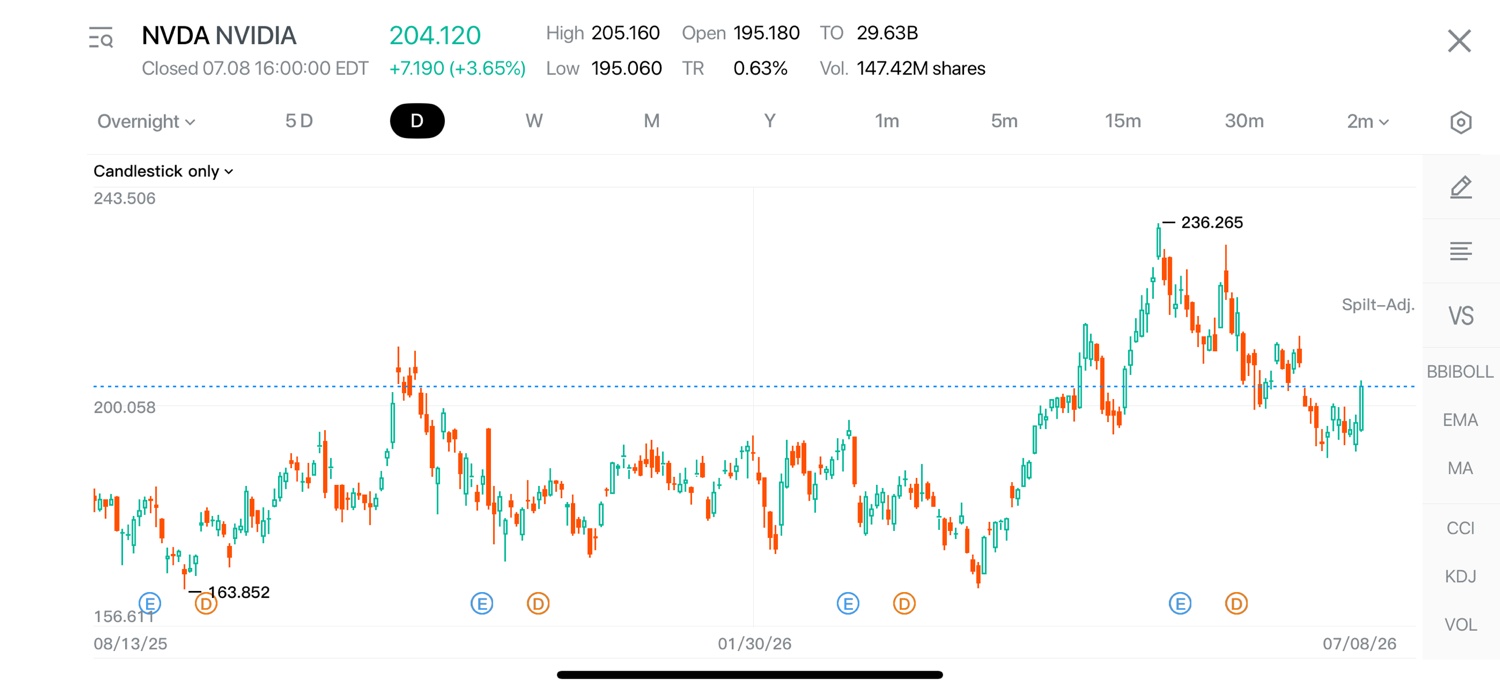
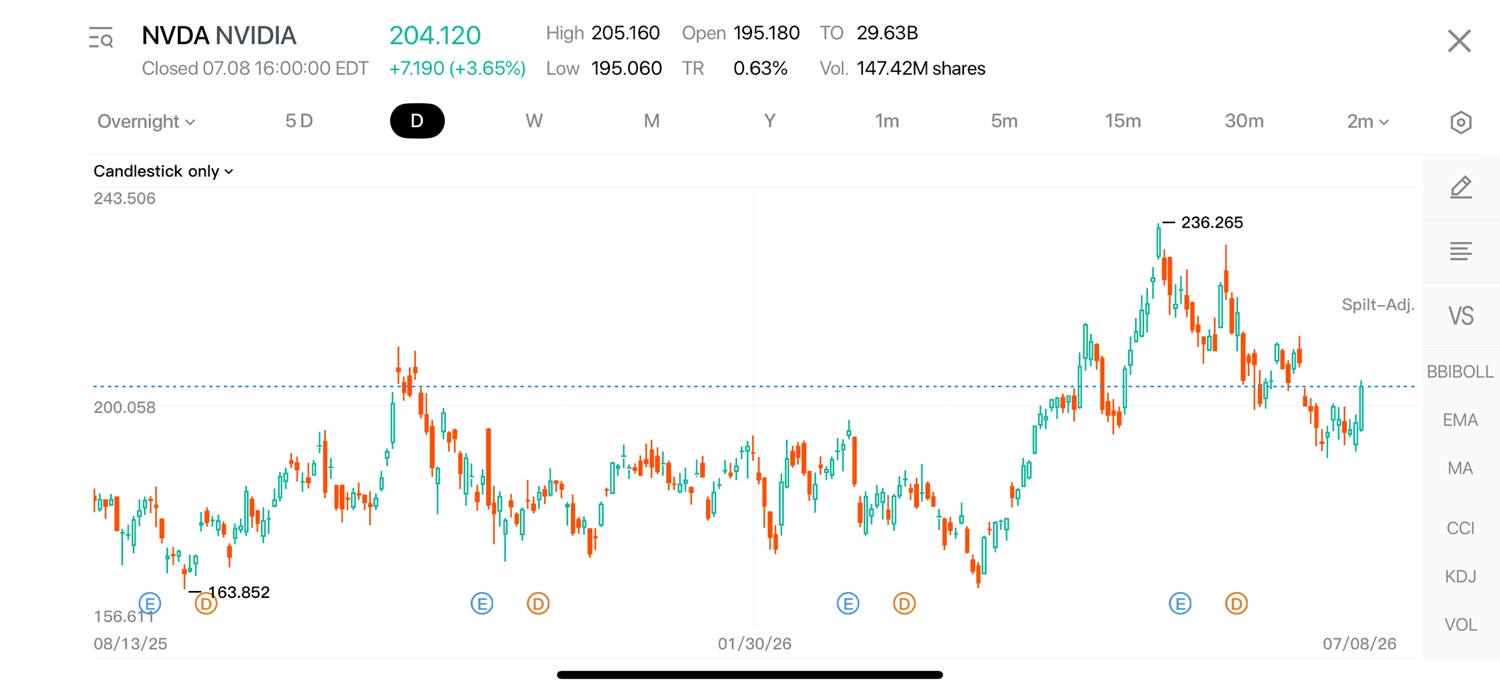
At the time, NVIDIA was trading around USD204.12
That means the stock price was almost USD9 above my strike price.
This creates a safety buffer.
The stock could decline before I am assigned.
I am not chasing the stock.
Instead, I let the stock come to me.
💵 Step 2 – Understanding the Premium
When selling a put, I receive money immediately.
This payment is called the Premium.
Think of it as someone paying me for making a promise.
The promise is simple.
If NVIDIA falls below my strike price, I may have to buy 100 shares.
In return, I receive premium today.
That premium belongs to me whether assignment happens or not, assuming I hold the position to expiration and fulfill the contract.
🧮 Step 3 – Calculate My Actual Purchase Price
Many beginners think “I sold the 195 put, therefore I buy at 195.”
That is only partially correct.
The premium collected reduces my effective purchase cost.
Formula:
Actual Cost = Strike Price − Premium Received
Example
Strike Price 195
Premium Collected 5
Actual Cost 190
That is why I often say
I sell the 195 Put because I actually want to own NVIDIA around 190.
The premium creates a discount.
It lowers my effective cost basis.
📈 Step 4 – Reading Delta
Looking at my screenshot, Delta is approximately -0.322
For put options, Delta is negative.
Many traders use the absolute value.
That means 0.32 or approximately 32%.
A simple beginner interpretation is:
There is roughly about a 30% chance the option finishes in the money and could result in assignment. This is only a rough estimate and not a guarantee.
Many Options Puppy traders use
0.20
0.25
0.30 Delta
because it provides a balance between premium collected and assignment probability.
Lower Delta, Less premium, Lower chance of assignment.
Higher Delta, Higher premium, Higher chance of assignment.
⏳ Step 5 – Understanding Theta
One of my favourite Greeks is Theta.
Theta represents Time Decay.
From the screenshot, Theta is approximately -0.137
This means that, all else being equal, the option loses about USD0.137 per share in value each day because time passes.
Since one contract represents 100 shares, that is roughly USD13.70 of option value per day disappearing due to time decay, assuming other factors such as stock price and implied volatility remain unchanged.
This is why option sellers like Theta.
Every day, time works against the buyer.
Time works for the seller.
Even if NVIDIA goes sideways, Theta slowly reduces the option’s value over time.
📉 What Happens if NVIDIA Stays Above 195?
This is the ideal situation.
Suppose NVIDIA stays above 195 until expiration.
The put expires worthless.
I keep 100% of the premium.
I do not buy the shares.
Then I can repeat the strategy again.
Many investors do this repeatedly to generate option income while waiting for an attractive entry price.
📉 What Happens if NVIDIA Falls Below 195?
Suppose NVIDIA closes below 195 at expiration.
I may be assigned.
That means I buy 100 shares at 195 per share.
However, I already collected premium.
Therefore, my effective cost basis is lower than 195.
If my original investment thesis still holds, I now own NVIDIA at a lower effective price than simply buying earlier at over 200.
🧠 Why I Sell Puts Only on Companies I Like
This is probably the most important lesson.
I never ask, “Which option pays the highest premium?”
Instead, I ask, “Which company would I happily own?”
Premium is secondary.
Owning a quality company is primary.
That mindset changes everything.
If assigned, I become a shareholder of a business I already wanted.
That makes assignment part of the plan, not a failure.
📊 Why NVIDIA?
For me, NVIDIA continues to be one of the leading companies in AI chips, data-center GPUs, and accelerated computing.
If my long-term view remains positive, I do not mind owning shares after a pullback.
Instead of chasing prices higher, I use cash-secured puts to potentially enter at a lower effective cost while getting paid for waiting.
Of course, every investor should do their own research and decide whether NVIDIA fits their own goals and risk tolerance.
⚠️ Risks Every Beginner Must Understand
Selling cash-secured puts is generally considered less risky than selling uncovered (naked) puts because the cash is set aside, but it still carries meaningful risk.
If NVIDIA falls significantly below the strike price,
I am still obligated to buy at the strike price if assigned.
For example, if the stock drops sharply, my shares may immediately show an unrealized loss.
The premium collected helps reduce my cost basis, but it cannot eliminate all downside risk.
That is why I only sell puts on companies I am comfortable holding for the long term.
📝 Step-by-Step Checklist
Before every cash-secured put trade, I ask myself:
- Do I genuinely want to own this company?
- Is the strike price one I am happy paying?
- Do I have enough cash to buy 100 shares if assigned?
- How much premium will I receive?
- What is my effective cost after subtracting the premium?
- What is the Delta, and what does it suggest about assignment probability?
- How much Theta am I collecting through time decay?
- Am I comfortable if the stock falls after assignment?
If I cannot answer “yes” to these questions, I wait for a better opportunity.
🏆 Final Thoughts – Getting Paid to Be Patient
Selling cash-secured puts is not about predicting the market perfectly.
It is about combining patience with discipline.
Instead of placing a limit order and waiting for free, I may receive premium while waiting for my preferred entry price.
In this NVIDIA case study, I selected the USD195 strike because I would be comfortable owning the shares around an effective cost near USD190 after accounting for the premium received.
I also paid attention to the option Greeks. A Delta of about 0.32 suggested a moderate chance of assignment, while Theta meant the option’s time value could gradually decay each day in my favor if other factors remained unchanged.
The key lesson is simple:
Sell puts only on businesses you genuinely want to own, ensure you have enough cash to buy the shares if assigned, and understand that the premium lowers your cost basis but does not remove the risk of losses if the stock falls sharply.
That disciplined approach is the foundation of the Options Puppy 101 cash-secured put strategy.
⚠️ Disclaimer
This article is written for educational and informational purposes only and reflects my own personal investing and options trading approach. It should not be considered financial, investment, tax, or legal advice.
Options trading carries significant risks and is not suitable for everyone. Selling cash-secured puts may require you to purchase 100 shares of the underlying stock per contract if assigned. While the premium received reduces your effective purchase price, it does not eliminate the risk of losses if the stock price falls substantially.
Before using any options strategy, make sure you fully understand how options work, including assignment risk, leverage, time decay (Theta), implied volatility, and the option Greeks. Always conduct your own research, assess your financial situation, and only invest money you can afford to risk.
The examples used in this article are based on my own trade and personal investment decisions. Past performance does not guarantee future results, and market conditions can change rapidly. Every investor has different financial goals, risk tolerance, and investment horizons.
If you are new to options, consider starting with paper trading or seeking advice from a licensed financial adviser before trading with real money.
⚠️ End of Article Reminder
Remember, the goal of selling cash-secured puts is not simply to collect premium—it is to acquire quality companies at prices you are happy to own. Never sell a put on a stock you would not be comfortable buying if assigned. Trade with discipline, manage your risk, keep sufficient cash to cover assignment, and always have a long-term investment plan.
Educational purposes only. Not financial advice. Investments can go up or down, and you may lose part or all of your invested capital.
$英伟达(NVDA.US) @Live @NewUser_MG5Xfs
本文版权归属原作者/机构所有。
当前内容仅代表作者观点,与本平台立场无关。内容仅供投资者参考,亦不构成任何投资建议。如对本平台提供的内容服务有任何疑问或建议,请联系我们。
