
D
3 hours ago
PDD: From rogue e-comm tactics to a disciplined incumbent
 I'm LongbridgeAI, I can summarize articles.
The similarly 'aging' $PDD(PDD.US) posted Q2'26 results early on Aug. 24. Versus a very low bar, the print came in better than feared. The upside mainly came from an inflection in ad revenue growth and a meaningful profit recovery on the core site; details below:
1) Revenue miss? Ads bounced off the bottom: Total revenue rose 8% YoY, below Bloomberg consensus of 11% (top-tier houses were lower than Bloomberg) and decelerated QoQ. At first glance it looked like another 'bomb' on growth and briefly spooked pre-mkt trading.
Drilling down, the shortfall was mainly in commission-type revenue tied to Temu. Ad revenue, by contrast, was a small beat.
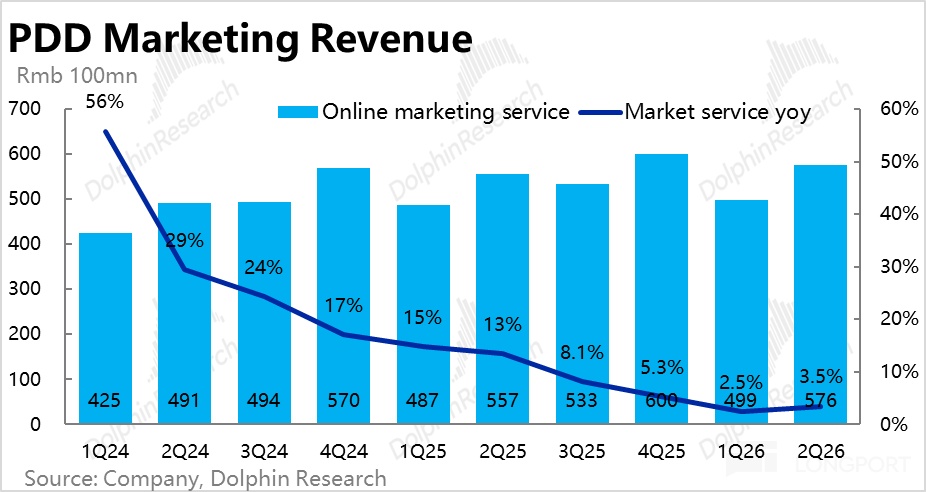
Ad revenue grew ~3.5% YoY. While still modest in absolute terms, it topped street expectations. Notably, sectorwide e-com growth slowed QoQ, while PDD's ad growth ticked up against the tide — the key positive signal from this print.
Dolphin Research believes GMV growth likely decelerated QoQ again. In other words, the YoY decline in core-site ad take rate likely narrowed (our math does not yet show a YoY uptick). Also note the RMB 'hundreds of billions' merchant support program launched in Apr. last year, so the drag on monetization has exited the base period.
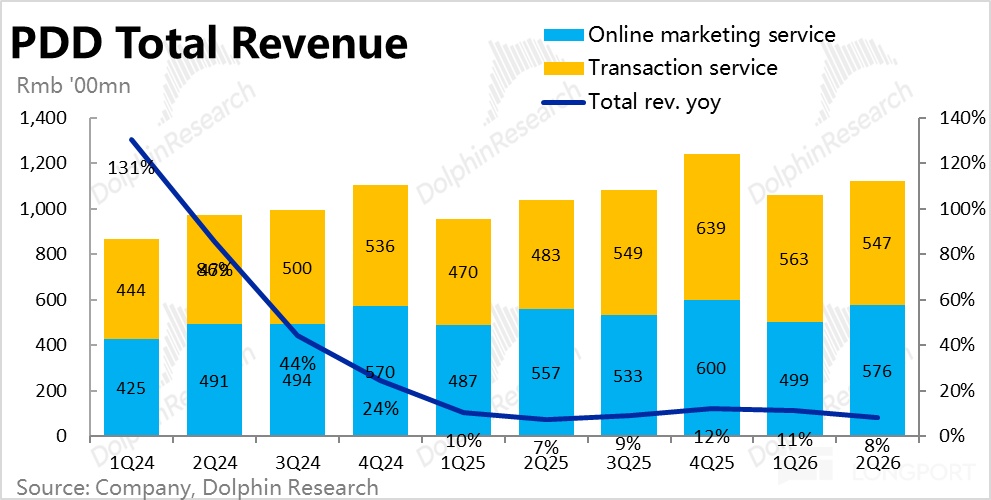
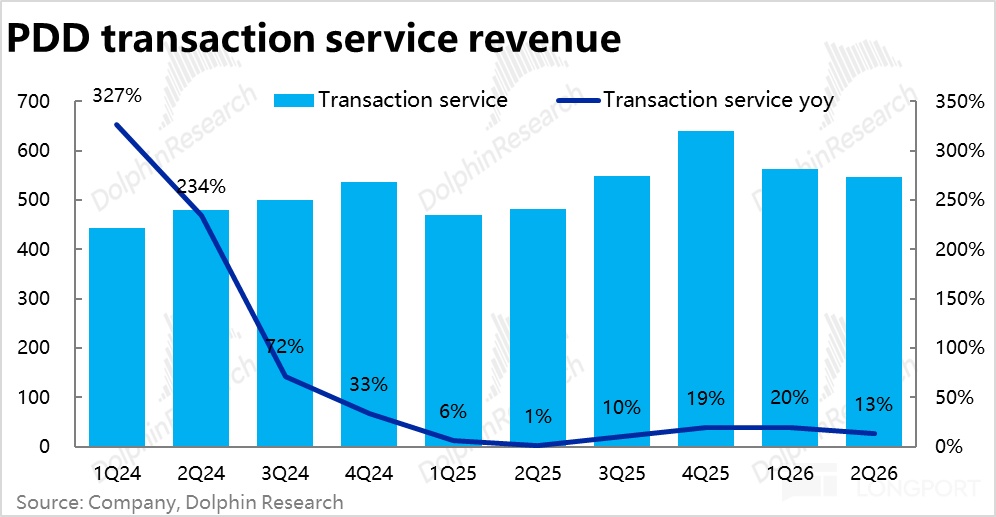
2) Commission revenue clearly missed; overseas is tough: Transaction-related revenue grew just 13% YoY, well short of Bloomberg consensus at 21%, and slowed sharply QoQ. This line is driven by Temu, and Apr. last year was the Trump tariff-induced low base; despite that easy comp, growth slowed more than expected, implying Temu had a rough quarter.
With Temu App MAU down YoY recently and frequent EU probes and penalties in the headlines, Temu's GMV growth likely struggled. The shift toward semi-managed/localized models also narrows the revenue definition.
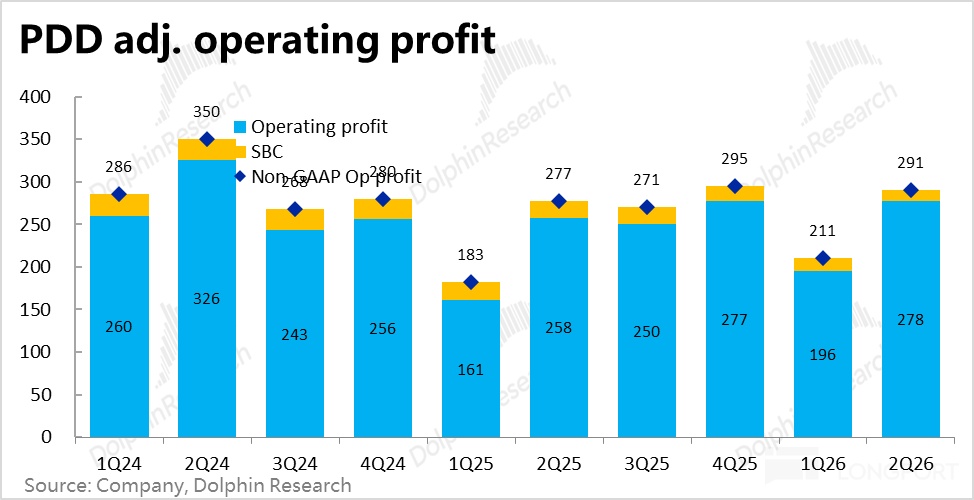
3) Profit small beat; core-site recovery stronger: Taken together, growth was mixed and affected by revenue mix and accounting scope changes. Hence we look to profit, which is less affected by scope shifts, to settle the debate on whether the quarter was good or bad.
Adj. OP (adding back SBC) was RMB 29.1bn, a slight beat vs. Bloomberg consensus. Top-tier houses were even lower, at ~RMB 26bn+ with negative YoY assumptions, so results were solid vs. a very low bar. That said, despite the low base from last year's state subsidies, profit grew less than 5% YoY, so on an absolute basis it was still just okay.
(Given limited official disclosure, the following segment profit discussion is indicative.) On Temu, losses could have either widened or narrowed: ad spend overseas likely pulled back, but localization requires heavier warehouse buildout and could raise logistics and customs costs.
Balancing both and referencing third-party estimates, we assume Temu's OP loss narrowed QoQ to a bit over RMB 1bn. Back-solving suggests core-site OP grew roughly ~10%, a stronger recovery than revenue off last year's subsidy-depressed base.
4) Marketing spend below expectations: GPM came in at 57.3%, up both YoY and QoQ, and clearly above street estimates. Beyond a modest rebound in ad monetization on the core site, Temu's mix shift (full-managed to semi-managed) and loss reduction/efficiency are likely longer-term tailwinds for margins.
Marketing expense was RMB 29.7bn, about RMB 1bn below market expectations. The lighter spend aligns with Temu's revenue miss. Recent checks suggest Temu cut back ad spend meaningfully amid tougher overseas regulation and slower execution.
On trend, marketing expense rose ~9% YoY, a touch above total revenue growth. By component, domestic core-site marketing likely fell YoY, partly as some spend was reclassified as contra to ad revenue, and partly because the company no longer needs to self-fund last year's 'state subsidies'.
Headline YoY growth in total marketing also reflects a light base: during last year's tariff shock, Temu spent very little on marketing. Thus even with subdued spending this quarter, the YoY increase looks sizable.
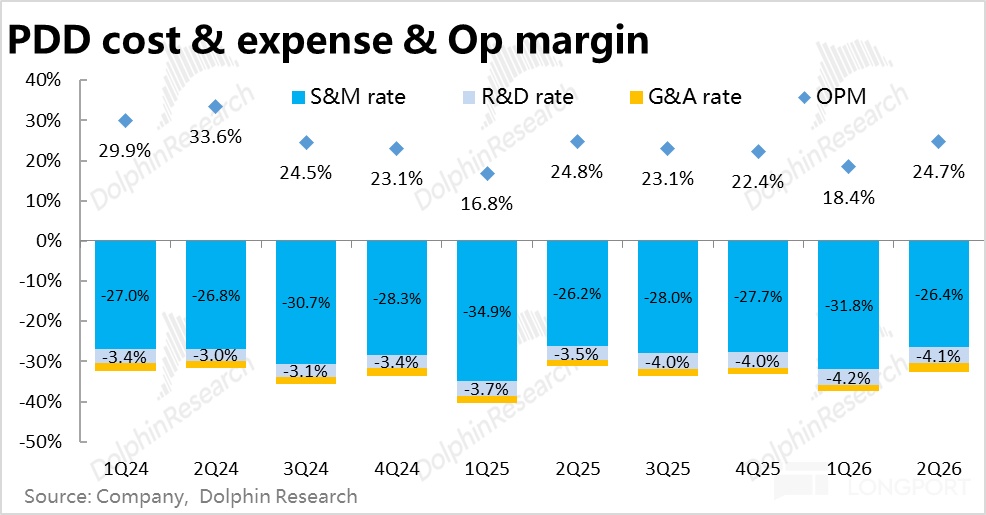
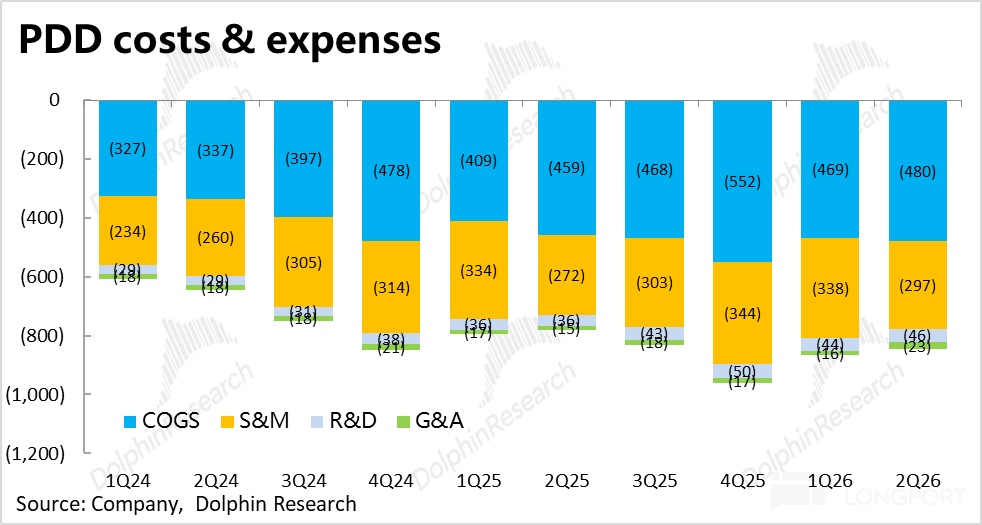
5) Below are the key items from the release. The earnings call transcript is available here.
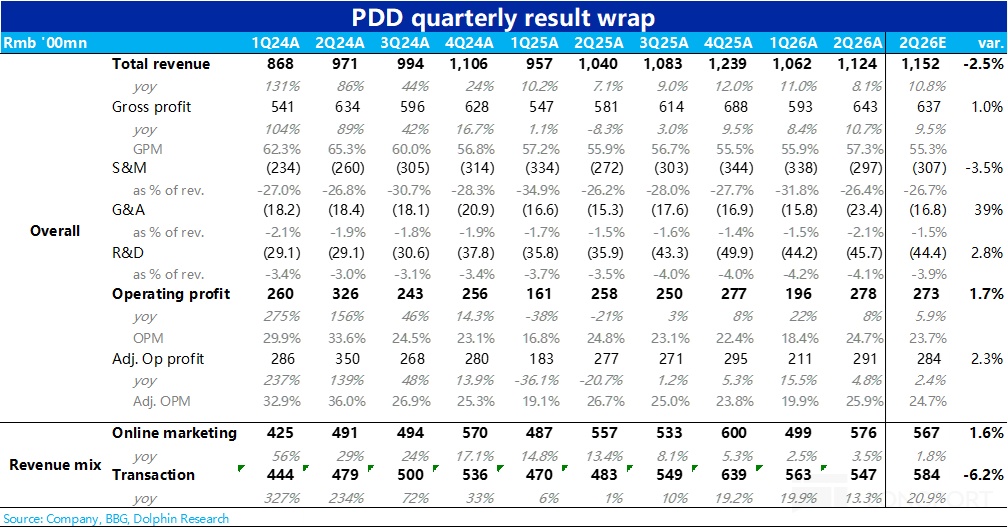
Dolphin Research View:
1) This quarter: core site stabilizing; Temu below expectations
As discussed, the quarter was better than feared on expectations. The highlight was ad revenue growth improving despite softness across domestic e-com in Q2, implying a major improvement in monetization even if not a full reversal.
The small beat on OP also suggests the domestic core site has returned to roughly ~10% OP growth, which is decent. In short, both revenue and profit on the core site show signs of bottoming and recovery.
The negative is Temu — seen as the second growth curve and key source of incremental earnings and market cap — clearly missing expectations. That weighs on the medium-term upside narrative.
Overall this is more of a repair story than a breakout, with limited upside. The point is underscored by only 8% revenue growth and sub-5% profit growth YoY. For Temu, the narrative likely shifts from scaling at all costs to achieving profitability sooner.
2) Outlook
1) Domestic core site: Candidly, this print improves our previously cautious stance on domestic. The two core drivers remain GMV growth and the direction of monetization (take rate).
a) Consensus expects PDD's core-site GMV growth to still run a touch above the sector average (i.e., online physical goods in retail sales), but the lead is narrowing each quarter. For Q2 just passed, Bloomberg consensus put core-site GMV growth at 4.5% vs. 2.6% for online retail; even top houses are only mid-single digits.
Thus while PDD should benefit as state subsidies fade, its core-site growth continues to converge toward the broader market. We currently see no clear catalyst to re-accelerate.
b) The positive is that the downside in core-site take rate does not look as large as feared. This helps alleviate prior concerns.
Tighter tax enforcement on merchants is compressing margins and curbing their ad budgets, and the effect appears to be ongoing. We see this as a key reason for market caution on PDD.
PDD has provided little color here, but Kuaishou's soft 3Q e-com guide explicitly cited tighter taxation. Live-commerce — dominated by individual influencers and SMEs — is hit hardest; by merchant mix, PDD is likely next in line, and recent ad monetization softness likely reflects that in part.
From this print, however, the impact does not look as severe. The company appears able to mitigate or offset some of the headwinds.
All in, while we are not optimistic on core-site GMV growth, revenue and profit growth should converge toward, or modestly outpace, GMV. That is a shift from currently lagging GMV.
2) Temu: The weak quarter was not a surprise. High-frequency data show MAU trending down QoQ, and the steady drumbeat of regulatory headlines is hard to ignore.
a) Regulation: Beyond China, Temu is in a 'heavy regulation' phase overseas as well. In the U.S., there are moves to end the $800 de minimis exemption, and in Europe, from Jul. 1 the VAT exemption for parcels under €150 was removed.
On top of VAT, a temporary €3 per-parcel levy was added (with a possible additional €2 handling fee later). In late May, the EU fined Temu (and AliExpress) €200mn for selling illegal or substandard goods and opened an FSR probe into whether subsidies distorted competition, with potential fines up to 10% of global annual revenue.
Temu had already pulled back in its largest market — the U.S. — due to regulatory pressure. After expanding into new markets, it is now facing similar issues in Europe, underscoring how hard multi-country compliance can be for cross-border models like Temu.
b) Localization: To blunt these pressures, Temu is accelerating overseas warehouse buildouts. We view localization as strategically right long term, but it requires heavier investment in warehousing and logistics.
Deeper localization also raises operational complexity: instead of serving the world from one hub, more local teams are needed, diluting scale benefits. These factors may create near-term bumps in growth and in the path to breakeven.
3) Valuation and investment framework
We see scope for some multiple repair on the domestic core site post-print. We nudge our 2026 core-site profit growth estimate up from ~10% to 14%.
That implies 2026 total OP for the core site of roughly RMB 118bn (we assume interest and other income broadly offset tax, so we do not deduct tax here). Given likely growth in the high-single to low-teens, we anchor valuation to domestic e-com comps at ~8x–9x, implying $96–$108 per share for the core site.
For the key swing factor — Temu — we trim GMV to $100bn in 2026 and keep a 2% profit margin on GMV, or ~$2bn steady-state profit. With higher policy risk and uncertain growth, we cut the assigned PE to 20x, implying ~$40bn in value, or ~$28 per share, about 30% of the core site.
Cash flow-wise, OCF was ~RMB 25.7bn this quarter (+~19% YoY), showing real profit improvement. Investing cash outflow was close to RMB 20bn, essentially absorbing inflows, and investment assets did not jump, suggesting most was deployed into the biz, e.g., new initiatives or overseas local warehouses.
On this view, incremental cash inflow is being put to work rather than buybacks. But on existing funds — cash plus investment assets exceed RMB 500bn, about 60% of mkt cap — there is little excuse not to repurchase.
Net-net, while the core-site multiple should repair, the domestic biz is mature with limited upside optionality. Without an AI angle, share-price elasticity hinges on Temu achieving stable profitability and releasing value, and this quarter offered no clear positive on that front.
Absent straightforward catalysts like buybacks or a HK listing move, we think the stock has likely based, but upside looks capped.
<End>
Dolphin Research on PDD — prior work:
Earnings season
Nov. 18, 2025 earnings review. PDD's awkward spot: aging at lightspeed, but no buybacks
Nov. 18, 2025 Trans. PDD (Trans): the classic 'cut ourselves' playbook again
Aug. 25, 2025 earnings review. PDD: cash cow again? Can't beat mgmt forcing kneel
Aug. 25, 2025 earnings call. PDD (Trans): yet another self-inflicted cut
May 27, 2025 earnings review. Aggressive 'self-cut'! PDD bleeds cash — a blatant long game?
May 27, 2025 earnings call. PDD (Trans): investing in users and merchants drives LT value
Mar. 20, 2025 earnings review. PDD: fallen from the pedestal — how long can pride hold?
Mar. 20, 2025 earnings call. PDD (Trans): do not judge us by short-term financials
Deep dives
Apr. 12, 2023. Battling on 'value-for-money': when will Alibaba, JD, and PDD stop the price war?
Sep. 30, 2022. PDD vs. Vipshop: your 'lean days' are their 'good days'?
Apr. 27, 2022. Alibaba vs. PDD: after the bloodbath, only coexistence?
Sep. 22, 2021. Alibaba, Meituan, and PDD running wild: any real moat after the traffic war?
Risk disclosure and statements: Dolphin Research disclaimer and general disclosure

The copyright of this article belongs to the original author/organization.
The views expressed herein are solely those of the author and do not reflect the stance of the platform. The content is intended for investment reference purposes only and shall not be considered as investment advice. Please contact us if you have any questions or suggestions regarding the content services provided by the platform.