

Coherent vs. China's 'Yi-Zhong-Tian' trio: Who really has the edge?
 I'm LongbridgeAI, I can summarize articles.
In the prior piece ‘Coherent: After a market-cap halving, was the ‘all-rounder’ in optical modules unfairly punished?’, Dolphin Research traced how Coherent evolved from a materials company into an optical-communications heavyweight and unpacked its biz. mix. It also contrasted selling chips vs. selling modules from both financial and supply-chain angles.$Coherent Corp.(COHR.US)
This piece continues with four questions:
1. Can the high GPMs of optical chips and modules be sustained?
2. Why is the industry moving toward vertical integration?
3. As the most vertically integrated player, where is Coherent's alpha in selling modules?
4. Why does its GPM lag behind the leading China peers?
1) Summary: High GPMs in optical chips and modules are hard to sustain; the industry may head toward vertical integration
Laser-chip vendors sit closest to scarce upstream inputs, and EML’s double-epitaxy flow creates a high technical barrier. As a result, they have enjoyed outsized GPMs. Module makers’ high GPMs do not come from ‘assembly’ per se but from leverage upstream and downstream. Upstream, leaders use scale and prepayments to lock in tight laser chips and DSPs to ensure delivery in shortage; downstream, they co-define specs one to two generations ahead, then use large capacity to take multi-SKU, high-volume orders and earn a premium.
Dolphin Research’s take: near term, shortages give both groups strong visibility on margin lift. But rapid shifts in technology pathways create uncertainty, so whether high GPMs persist is still a question mark. Laser-chip vendors: at 1.6T, the roadmap is pivoting to CW with silicon photonics, lowering the barrier for light sources and enabling domestic suppliers to enter. Looking further out to 3.2T/6.4T, architectures remain debated, so it is unclear if EML’s process moat carries to the next node. On supply, leaders keep adding capacity and upstream materials are seeking substitutes, which should lower costs as laser-chip supply loosens. Lower light-source cost, in turn, benefits module makers downstream.
Module makers: structurally, since manufacturing process itself is not the bottleneck, the market worries that under CPO, the optical engine gets packaged onto the switch substrate and module makers’ value compresses to assembly. We will dive deeper in subsequent notes into how roadmap shifts reallocate value across chip and module vendors.
Industries with low overall barriers tend toward vertical integration, and optical comms shows this very clearly:
a) Chip vendors moving downstream into modules, e.g., Lumentum’s acquisition of Cloud Light both adds revenue and prepares for NPO/CPO validation downstream. b) Module vendors moving upstream into chips, mainly silicon photonics, while laser chips remain largely outsourced, e.g., Innolight’s in-house SiPh and Eoptolink’s Alpine deal. c) Electro-optical convergence: Marvell’s purchase of LITE reflects verticalization in optics and further integration of electrical and optical comms.
2) What alpha does Coherent have in modules?
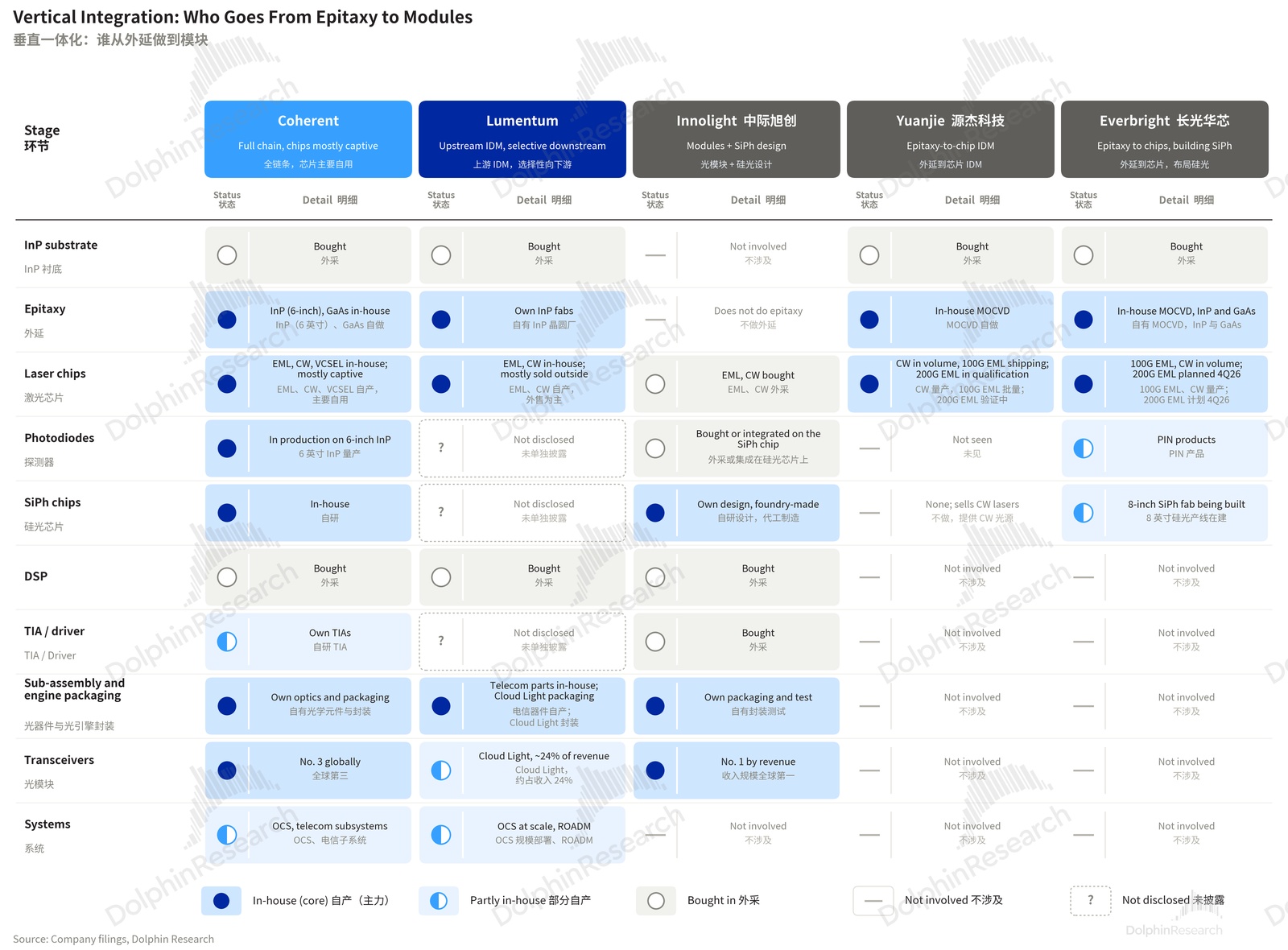
The chart shows Coherent is currently the most vertically integrated, spanning epitaxy, chips, components, modules and systems. This extends its materials-first DNA and consistent downstream buildout. Lumentum is also entering modules from upstream with deep integration. Chinese peers show clearer upstream–downstream division, with lower integration overall.
When baseline entry barriers are not high, vertical integration first scales volume and fills capability gaps across hardware steps. That reduces the risk of being bottlenecked or sidelined at any single node. Over time, as supply–demand tightness normalizes, deeper vertical integration should deliver cost leverage.
1. Technology: multiple routes, deep reserves
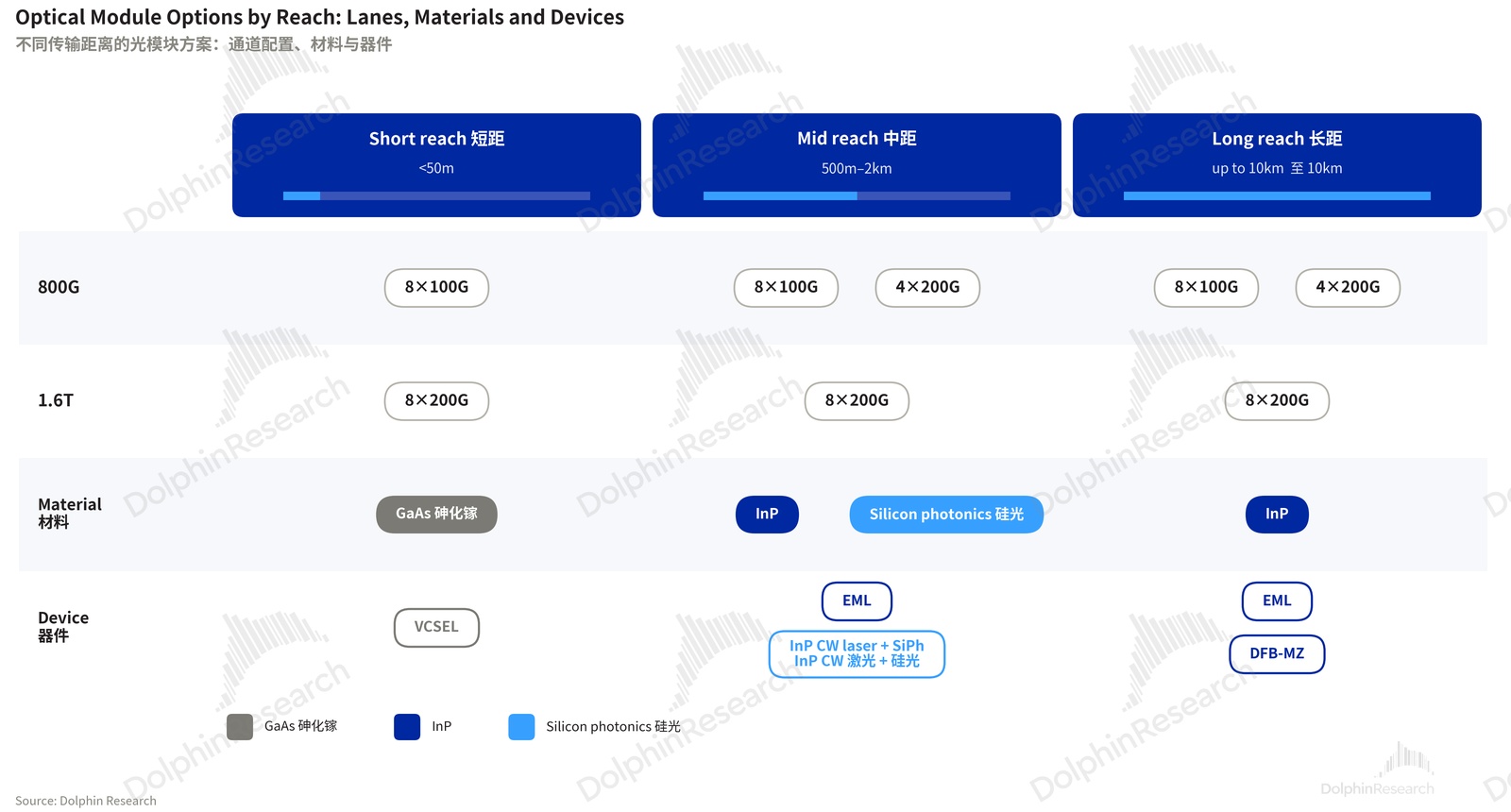
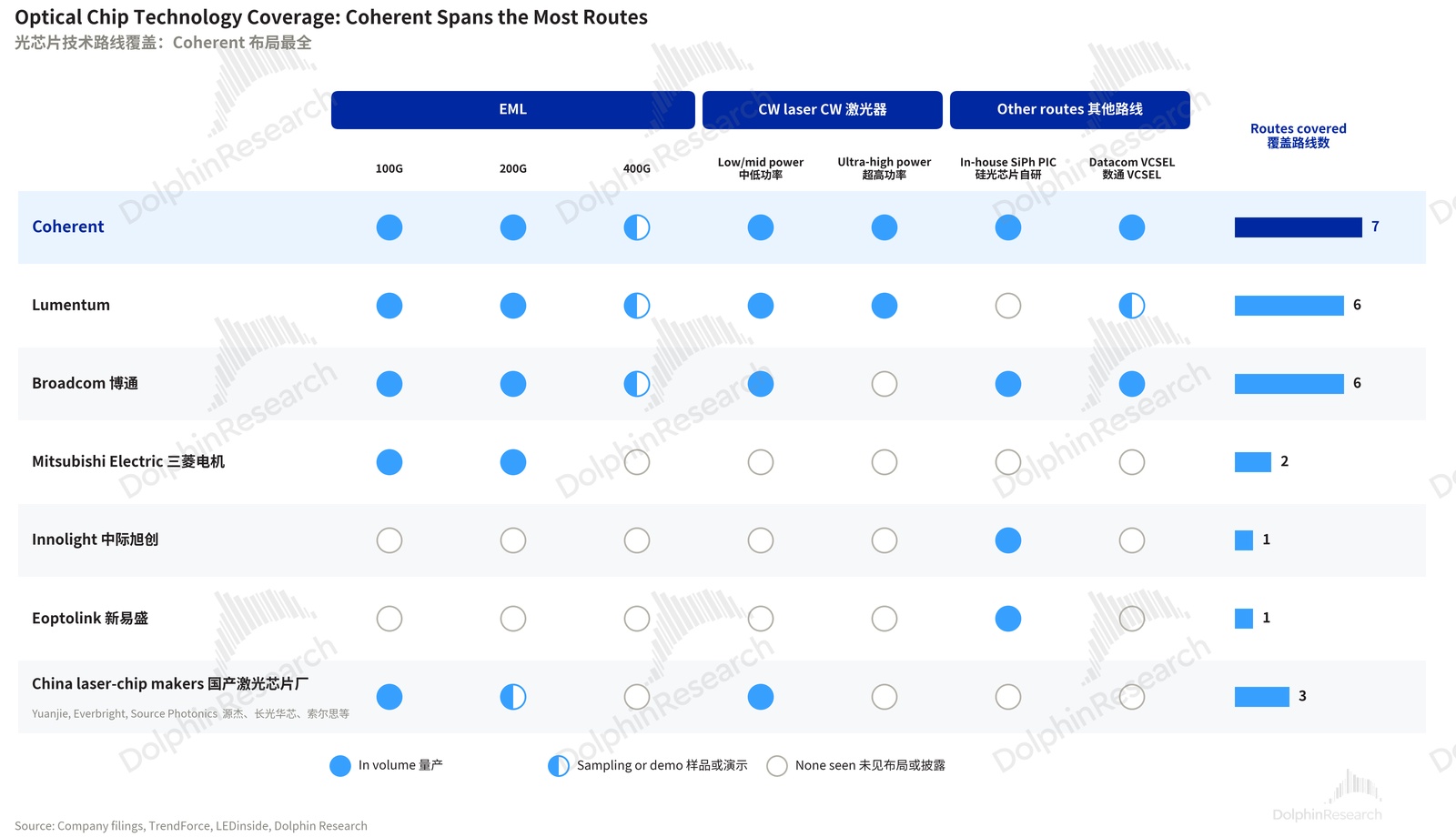
Because lasers retain meaningful barriers, top-down vertical integration tends to be smoother. Epitaxy (especially EML’s second epitaxy) and laser-chip processes are the hardest capabilities to build, requiring years of know-how, yield ramp, and customer quals. Coherent has second-epitaxy capability and has invested in self-developed laser chips for years. Its technical reserve spans nearly all mainstream routes:
EML: As noted in LITE coverage, EML is the more challenging route, with domestic vendors constrained by second-epitaxy bottlenecks. While 100G EML has broken through, 200G EML self-sufficiency is still below 5%. Coherent launched 200G EML as early as Sep 2022, and 400G EML is in the pipeline.
CW: In ultra-high-power CW (UHP CW) for external light sources (ELS) in CPO, the market is essentially a duopoly between LITE (~60%) and Coherent (~40%). At OFC 2026, Coherent showcased a 400mW CW laser targeting both CPO and SiPh pluggable use cases. Even if CPO raises concerns about module makers’ value compression, Coherent, as one of two key external light-source suppliers, remains a CPO beneficiary — a core differentiator vs. pure module vendors.
Other routes: The company runs parallel bets, covering SiPh circuits and 200G GaAs VCSEL. Management guides that initial 1.6T ramps will be led by EML and SiPh platforms, with VCSEL-based designs ramping in 2H26.
That said, during today’s tightness, supply trumps technology and, once speeds meet spec, downstream largely takes whatever ships. The value of the tech reserve shows more in the next-gen product battles. In our view, tech leadership is the calling card to end customers. Demand from AIDC for higher interconnect speeds is a given; only the path is uncertain.
Thus, when 3.2T/6.4T/12.8T modules scale later on, whichever route wins, vendors leading on multiple paths will likely pass quals first, ship at scale, and capture premium from tech dividends. In short, the breadth of COHR’s reserve reduces the odds it gets caught flat-footed by a route change.
2. Supply: first to upgrade InP wafers to 6-inch amid the shortage
COHR’s key supply move in the shortage was to upgrade InP wafers from 3-inch to 6-inch ahead of peers. Starting Aug 2025, its 6-inch InP lines in Sherman, TX and Järfälla, Sweden entered mass production (the world’s first 6-inch InP wafer platform). They are already producing EMLs, CW lasers and photodiodes, with yields consistently above the legacy 3-inch lines.
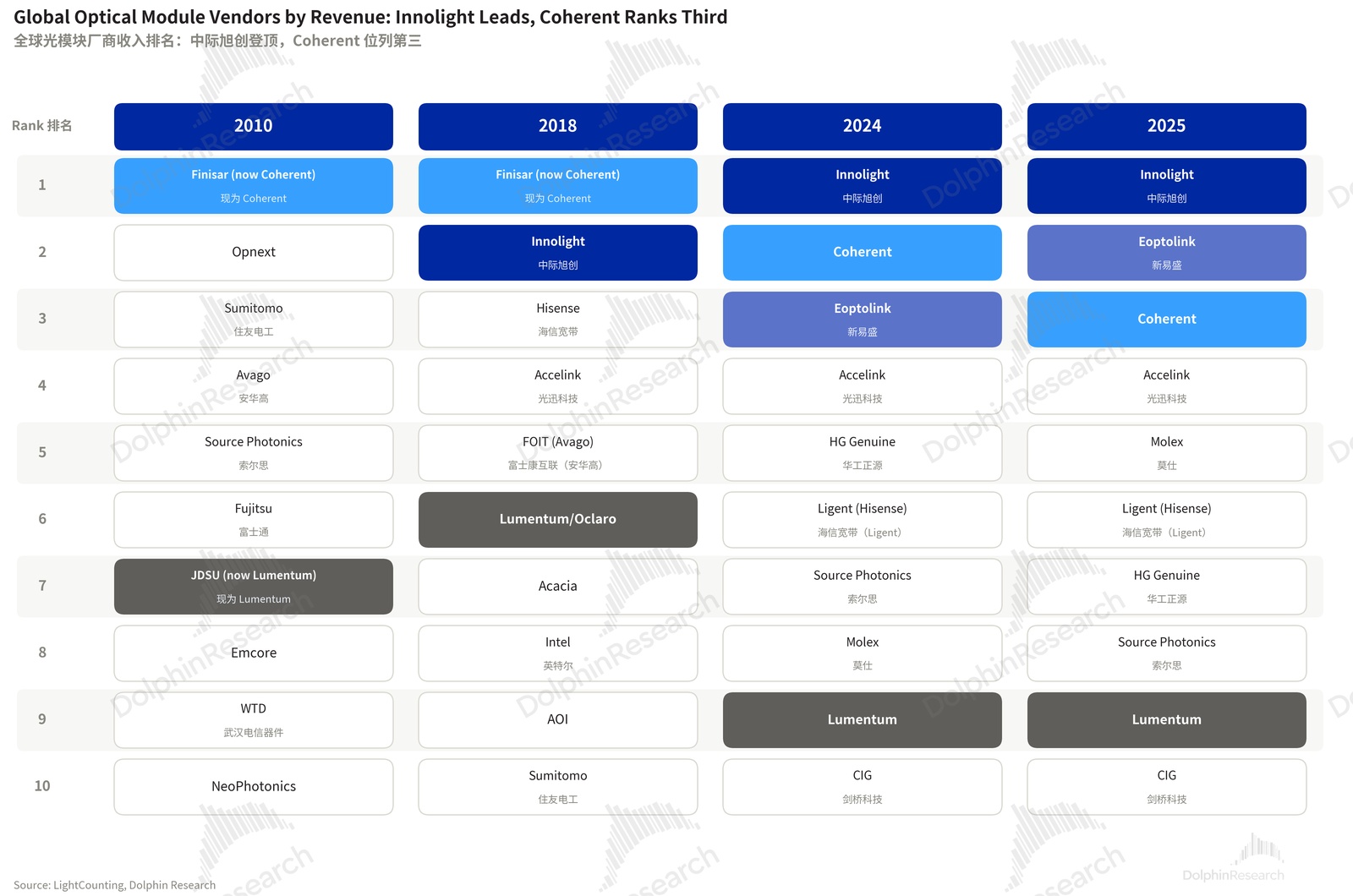
The core benefit of 6-inch is cost: from the same wafer, chip output is roughly 4x that of 3-inch, taking unit cost to below half. On capacity, while laser-chip nameplate was not disclosed, InP capacity expansion was: FY24–FY25 to ~3x, with a planned 2x by end-2026 achieved one quarter early, and another >1x by end-2027. As the mega fab in Texas ramps 6-inch InP, COHR’s internal supply should expand further, easing upstream constraints on its own businesses. As a result, Coherent’s module revenue scale remains top three globally, as shown below.
3. Downstream: customers lock in capacity via equity
Customer ties run deep at COHR. Most notably, NVIDIA invested $2.0bn in Mar 2026, alongside multi-billion-dollar purchase commitments and future capacity access; LTAs run through the end of the decade, and FY2027 is largely booked.
4. Committed to vertical integration, so why is GPM still lagging?
Despite COHR’s edge in integration, technology and supply, these have not yet translated into reported margins. China leaders Innolight and Eoptolink, which largely outsource laser chips, post higher GPM than Coherent. Because Industrial carries higher GPM than the corporate average, COHR’s optical comms (Data Center & Telecom) GPM is below the blended level, making the gap vs. the two China leaders even wider on a like-for-like basis.
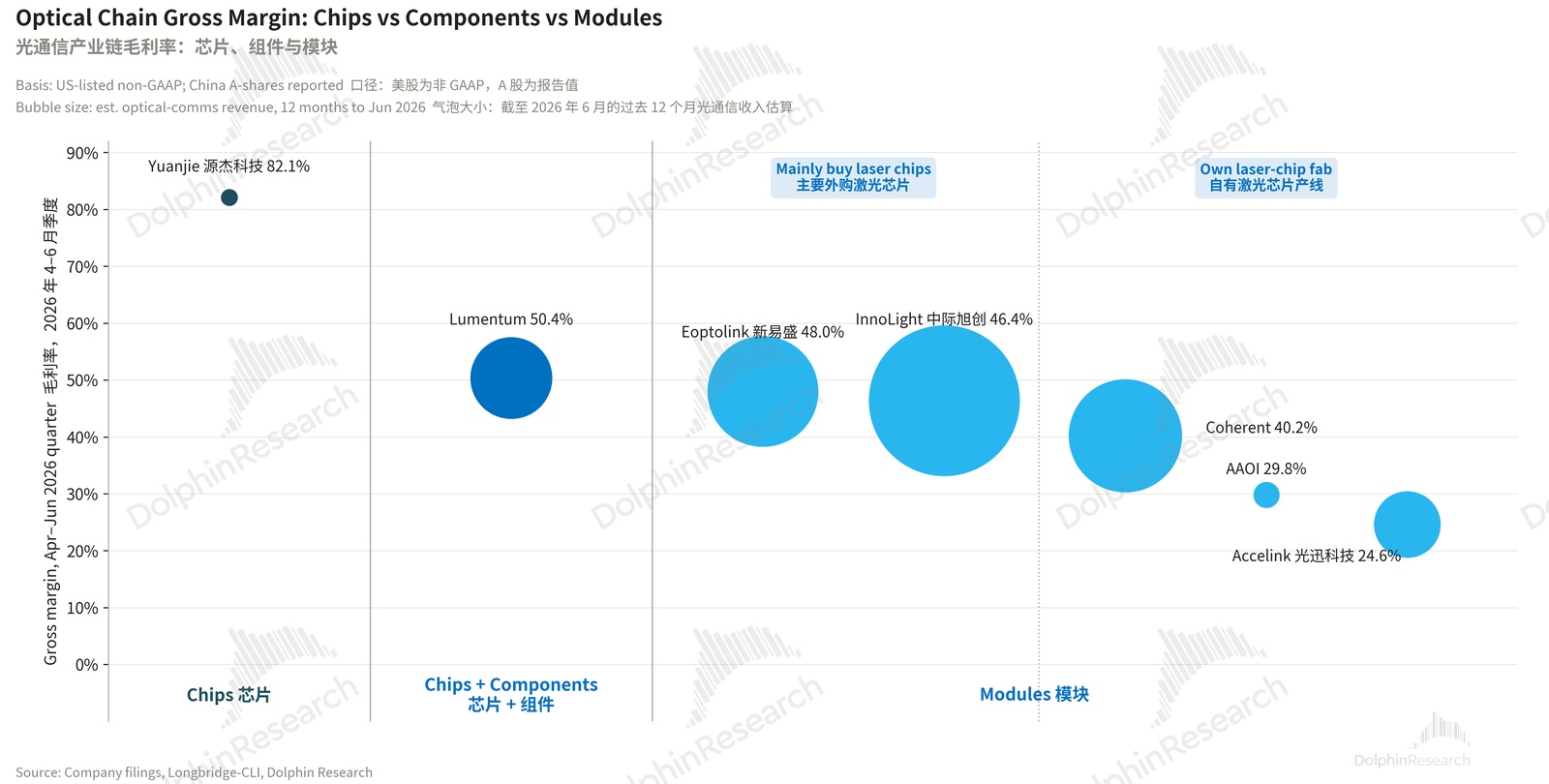
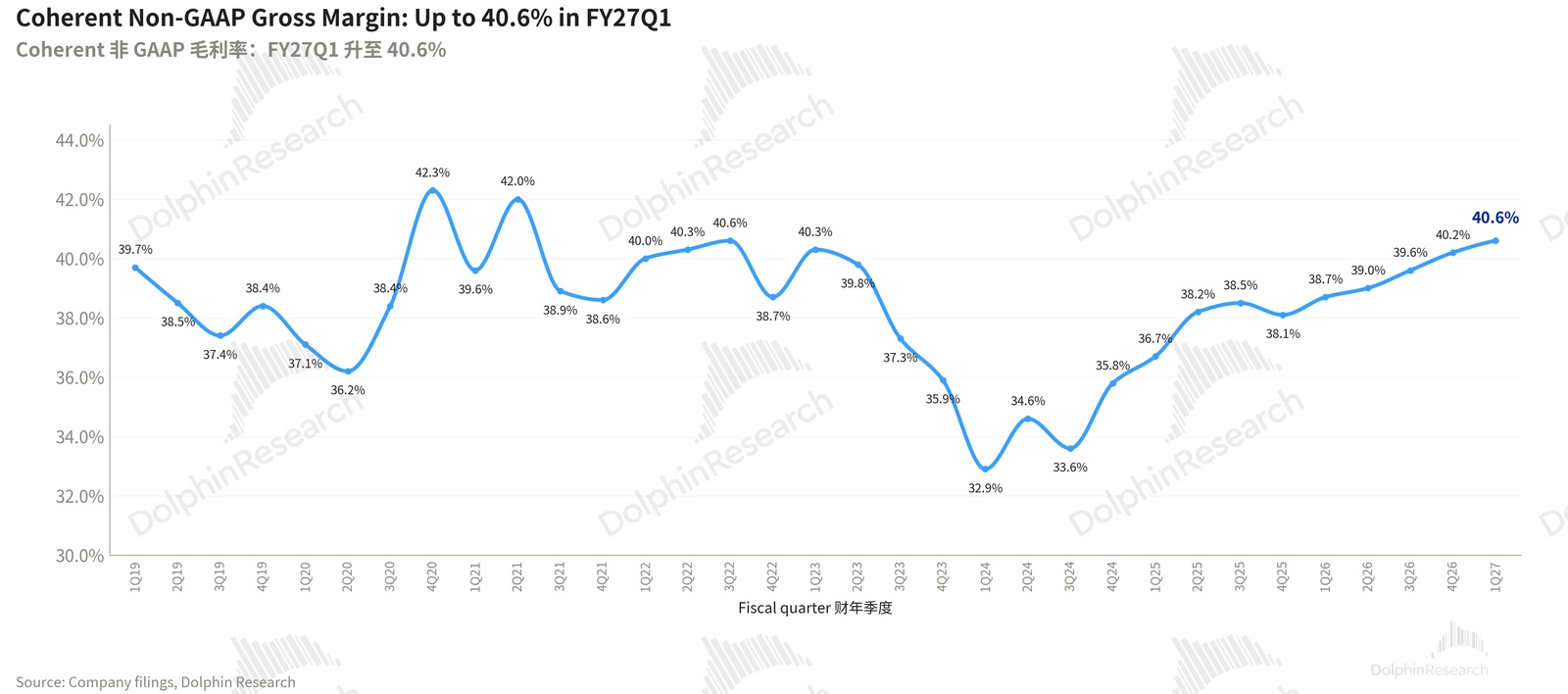
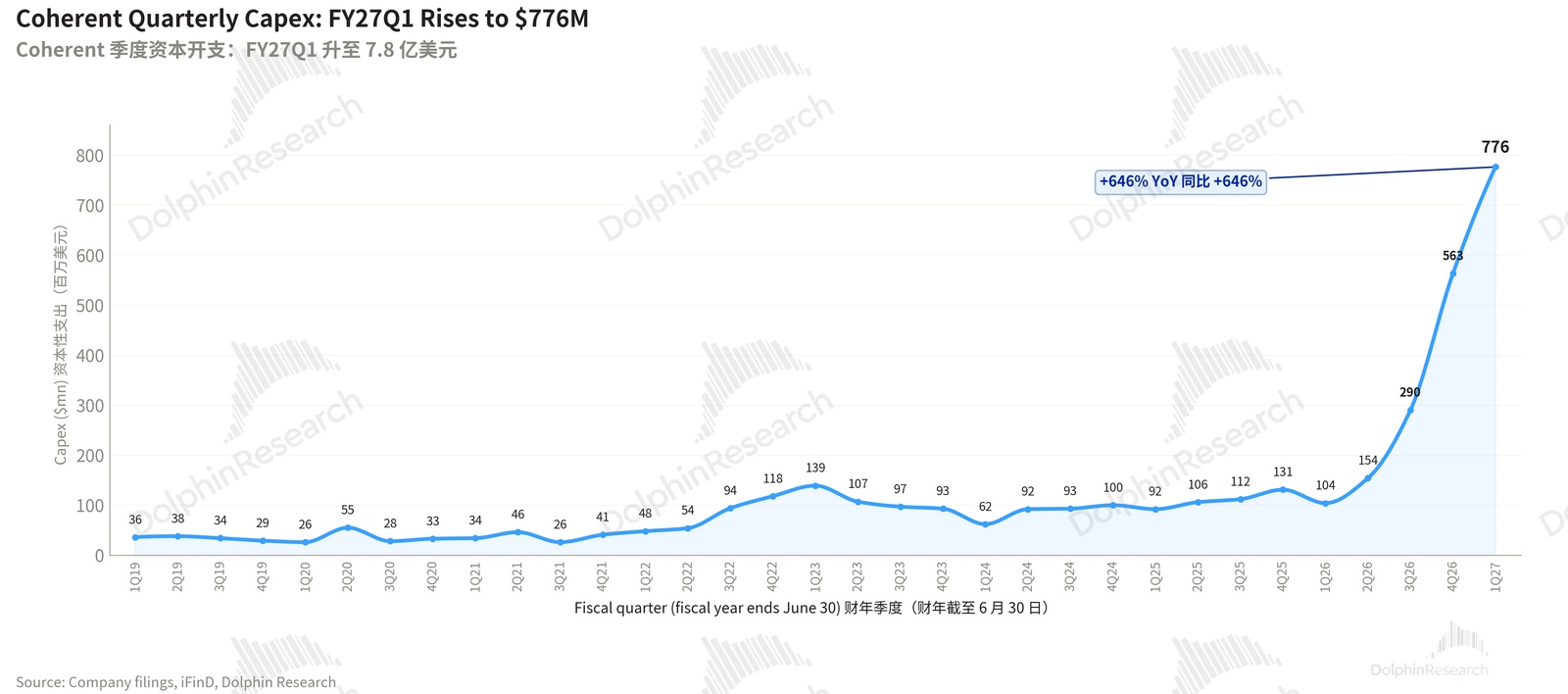
Based on management commentary, we see three drivers: yields and product costs in modules still have room to improve; pricing optimization started late and only showed clearly in optical comms after supply tightened, with full effects yet to flow through GPM; and legacy sites/low-margin lines from past M&A are still being rationalized, with 30+ sites sold or shut over six quarters. As Industrial mix keeps declining, corporate GPM should converge toward the optical comms segment. We will track the 6-inch ramp’s contribution to optical-communications GPM and the cadence of capex (new-capacity depreciation lands before revenue, pressuring margins during ramps).
Longer term, whether the company reaches its >45% GPM goal hinges on converting vertical integration into a cost advantage in optical comms.
In upcoming reports, we will focus on how roadmap shifts reprice value between chip and module vendors and cover Coherent’s NPO/CPO outlook. Stay tuned! <End>
Risk disclosure and statement: Dolphin Research Disclaimer and General Disclosure
The copyright of this article belongs to the original author/organization.
The views expressed herein are solely those of the author and do not reflect the stance of the platform. The content is intended for investment reference purposes only and shall not be considered as investment advice. Please contact us if you have any questions or suggestions regarding the content services provided by the platform.