EBITDA Explained: A Guide to Operating Performance
EBITDA measures core operating profitability by adjusting for interest, taxes, and non-cash charges.
TL;DR: Earnings Before Interest, Taxes, Depreciation, and Amortization (EBITDA) is a cornerstone of financial analysis. It strips away non-operating variables to reveal a company’s raw earning power. While it facilitates peer-to-peer comparisons, its "non-GAAP" nature requires investors to balance its insights against actual cash flow reality.
For investors looking to assess how well a company is performing at its core, understanding EBITDA is essential.
What Is EBITDA?
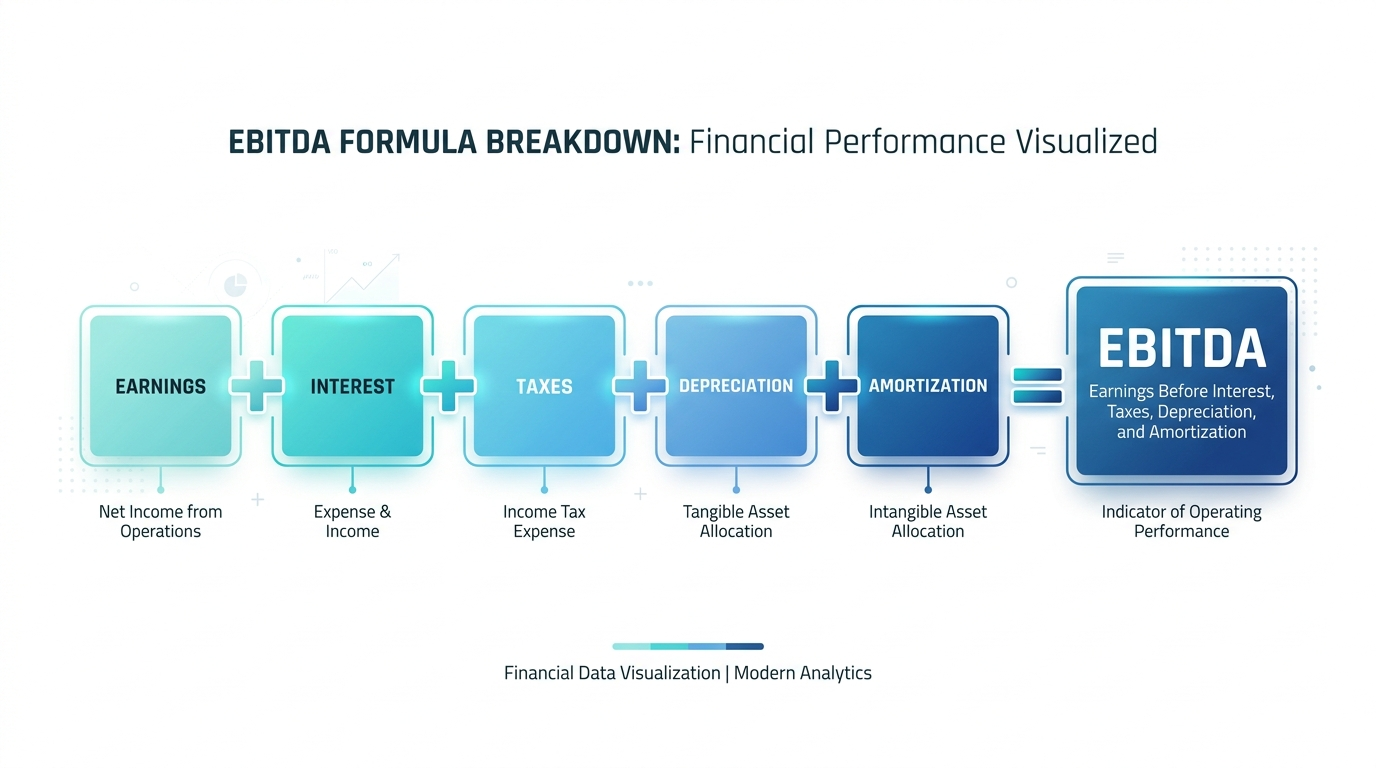
EBITDA measures a company's profitability from its core operations, before the effects of financing decisions, tax environments, and accounting methods are applied. The acronym breaks down as follows:
E — Earnings (Net Income)
B — Before
I — Interest
T — Taxes
D — Depreciation
A — Amortization
By removing these items, EBITDA focuses purely on how well a company generates profit from the day-to-day running of its business. Two companies in the same industry might carry very different levels of debt, operate in different tax jurisdictions, or use different accounting methods for their assets. EBITDA cuts through those differences to provide a more comparable view of operating performance.
A Brief History
The metric gained widespread use in the 1980s during leveraged buyouts (LBOs), when investors needed a consistent way to assess whether a company could generate enough cash flow to service debt. It has since become a standard tool in mergers and acquisitions (M&A), credit analysis, and equity valuation.
How to Calculate EBITDA
Investors typically derive EBITDA using two methodologies, both of which utilize data found directly on the income statement:
Formula 1 (from Net Income):
EBITDA = Net Income + Interest + Taxes + Depreciation + Amortization
Formula 2 (from Operating Income):
EBITDA = Operating Profit (Earnings Before Interest and Taxes, or EBIT) + Depreciation + Amortization
While both paths lead to the same result, the second formula is often favored for its efficiency, as it starts with the operating profit figure already calculated by the company.
Breaking Down Each Component
Understanding why each item is added back gives you deeper insight into what EBITDA is actually measuring:
Interest: Companies finance themselves differently. Some rely heavily on debt; others prefer equity. Adding back interest removes the impact of financing decisions so you can compare operational performance across businesses regardless of their capital structure.
Taxes: Tax rates vary by country, region, and company structure. Removing taxes allows for more consistent comparisons across different jurisdictions.
Depreciation: This non-cash expense accounts for the gradual wear and tear of physical assets (like machinery). Because no actual cash leaves the company for this entry, it is restored to reflect available liquidity.
Amortization: Similar to depreciation, this covers the write-down of intangible assets (like patents). It is likewise added back to focus on current cash-generating potential.
Tip: You can find all the figures needed to calculate EBITDA on a company's income statement, which is published as part of its regular earnings reports.
EBITDA Margin: Measuring Efficiency
Once you have the EBITDA figure, you can take it a step further by calculating the EBITDA margin, which expresses operating profitability as a percentage of total revenue:
EBITDA Margin = EBITDA ÷ Total Revenue × 100
This standardization is a powerful equalizer. It allows you to compare a multi-billion dollar conglomerate against a smaller rival. If Company A has a 20% margin and Company B has a 10% margin, Company A is significantly more efficient at turning sales into operating profit, regardless of their difference in total scale.
What Is a Healthy EBITDA Margin?
Benchmarks vary by industry. Capital-intensive sectors like manufacturing or telecommunications tend to have lower margins, while software or financial services firms may report higher ones. Rather than relying on a single threshold, always compare a company's EBITDA margin against direct industry peers rather than in isolation.
How EBITDA Is Used in Investing
Company Valuation and EV/EBITDA Multiples
In valuation, EBITDA is perhaps most famous for its role in the Enterprise Value to EBITDA (EV/EBITDA) ratio. This multiple helps determine if a company is fairly priced relative to its peers:
EV/EBITDA = Enterprise Value ÷ EBITDA
For example, if a company has an enterprise value of USD 500 million and EBITDA of USD 50 million, its EV/EBITDA multiple is 10x. Whether that is considered high or low depends on the industry and the prevailing market environment.
Investors can use tools like the Longbridge stock screener to look up financial data and valuation metrics across Singapore and US markets, making it easier to apply EBITDA-based comparisons in practice.
Cross-Company Comparisons
Because EBITDA removes the effects of tax jurisdictions, capital structures, and accounting policies, it is useful for comparing companies across different countries or ownership structures, making it relevant for investors with multi-market exposure.

Debt Coverage Analysis
Lenders often look at a company's debt-to-EBITDA ratio to evaluate its ability to repay borrowings. A lower ratio suggests the company can more comfortably service its debt, while a very high ratio may signal financial stress. This metric is especially relevant when assessing companies in sectors with significant borrowing, such as real estate investment trusts (REITs).
You can track the latest financial data and news for companies you follow through the Longbridge News page and access in-depth research through Dolphin Research.
EBITDA Variations You Should Know
As EBITDA has grown in use, several variations have emerged to address specific needs:
Adjusted EBITDA
Companies sometimes report an "Adjusted EBITDA" that removes one-time items such as legal settlements, restructuring charges, or asset impairments to show a cleaner view of ongoing performance. Be aware that what qualifies as "non-recurring" can be subjective, so always review the company's reconciliation notes.
EBIT (Earnings Before Interest and Taxes)
EBIT, also known as operating profit, is EBITDA minus depreciation and amortization. It is useful when comparing companies where fixed asset scale and depreciation charges are relatively similar.
EBITDAR
This variation adds back rent or restructuring costs on top of EBITDA. It is commonly used in industries such as aviation, hospitality, and retail, where lease obligations represent a major cost component.
Trailing Twelve Months (TTM) EBITDA
Also known as Last Twelve Months (LTM) EBITDA, this figure covers the most recent 12-month period regardless of fiscal year. It gives an up-to-date view of earning power and is commonly used in M&A analysis.
The Limitations of EBITDA
Despite its utility, EBITDA is not a panacea. Relying on it exclusively can lead to "high-interest traps" or a misunderstanding of a company's solvency:
It Is Not Cash Flow
A common misconception is that EBITDA equals free cash flow. It does not. EBITDA ignores capital expenditures, changes in working capital, and actual debt repayment obligations. A company can have strong EBITDA but still face cash flow problems if it must invest heavily in equipment or infrastructure.
It Can Be Manipulated
EBITDA is a non-Generally Accepted Accounting Principles (non-GAAP) metric, so companies have some discretion in how they present it. Adjusted EBITDA can be shaped to tell a more favourable story. The United States Securities and Exchange Commission (SEC) requires public companies to reconcile non-GAAP metrics back to a standard GAAP figure like net income in official filings and earnings releases.
It Ignores the Cost of Debt
A high EBITDA does not automatically mean a company is financially healthy. If a business carries significant debt, much of its operating earnings may go directly toward interest payments. Always look at EBITDA alongside the debt-to-EBITDA ratio for a fuller picture.
Tip: Use EBITDA as a starting point, not a final answer. Pair it with free cash flow, net income, and balance sheet data to build a comprehensive view of any company you are evaluating.
Frequently Asked Questions
Is EBITDA the same as cash flow?
No. EBITDA is an accounting proxy for profitability. It fails to account for taxes paid, interest paid, or the cash required for capital investments (CapEx). Free cash flow is a more accurate measure of the actual cash a business generates and has available after maintaining its operations.
What is a good EBITDA multiple?
EBITDA multiples vary widely by industry and market conditions. A software company may trade at a higher multiple than a traditional manufacturer due to growth expectations and asset-light business models. Always compare multiples within the same sector and use them alongside other valuation tools.
Why do companies report Adjusted EBITDA?
Adjusted EBITDA removes one-off items to present a view of ongoing operational performance. While this can be useful, it requires careful scrutiny, as companies have flexibility in deciding what counts as non-recurring. Review the reconciliation notes in any earnings report to understand exactly what has been excluded.
Can EBITDA be negative?
Yes. A negative EBITDA indicates that a company is incurring losses even before accounting for interest, taxes, and non-cash expenses. This is typically seen in businesses facing deep financial distress, or in early-stage, high-growth companies that have yet to achieve sustainable operating scale.
How does EBITDA relate to company valuation?
Analysts apply an industry-specific multiple to a company's EBITDA to estimate its enterprise value. For instance, if a sector trades at 8x EBITDA and a company reports USD 20 million in EBITDA, the estimated enterprise value would be around USD 160 million. This is a standard starting point in M&A and equity research.
Conclusion
EBITDA is a foundational pillar of financial analysis, offering a transparent view of operational health by stripping away structural and tax-related complexities. For the modern investor navigating global markets, it remains a vital tool for benchmarking and valuation.
However, a balanced perspective is key. EBITDA reveals the strength of the engine, but it doesn't tell you how much fuel (cash) is left in the tank. To build a truly resilient portfolio, pair your EBITDA analysis with a thorough review of balance sheet health and actual cash flow.
To deepen your understanding of financial metrics and investment analysis, explore more resources at Longbridge Academy. You can also access comprehensive market data and investment tools by downloading the Longbridge App.