
Options Backtesting Longbridge: A No-Code Workflow Guide
Discover how a no-code workflow simplifies options backtesting, from building strategy rules to interpreting historical performance data responsibly.
TL;DR: A no-code options backtesting workflow lets traders apply a defined strategy to historical data without writing programming scripts themselves, using a structured build-test-iterate cycle. On Longbridge, this is done through the Skill toolkit, which connects an AI assistant to market data, options chains and server-side quantitative scripts. The process helps surface a strategy's historical strengths and weaknesses, but results are based on past data only and do not indicate how a strategy will perform in future market conditions.
Options trading involves more moving parts than a simple buy-and-hold stock position: strike prices, expiry dates, implied volatility, and the Greeks (delta, gamma, theta, and vega) all shift constantly. Testing a strategy's logic against historical data, commonly known as options backtesting, has traditionally required coding skills to pull option chains, simulate fills, and calculate performance metrics. A no-code workflow changes that equation by allowing traders to define rules and review historical outcomes through guided interfaces rather than custom scripts. The sections below cover how options backtesting works, what a no-code approach looks like in practice, and what traders need to understand before relying on historical simulations to refine their thinking.
What Is Options Backtesting and Why It Matters
Options backtesting is the process of applying a defined set of trading rules to historical market data to see how a strategy would have performed over a past period. Unlike stock backtesting, which deals with a single price series, options backtesting involves an entire chain of strikes and expirations that shift constantly, according to Longbridge Academy. This added complexity is precisely why structured testing matters: a strategy that looks sound in theory can behave very differently once implied volatility, assignment risk, and time decay are factored in.
How Backtesting Differs From Simple Stock Testing
A stock backtest typically only needs historical open, high, low, close, and volume data. An options backtest must also account for the specific contract traded at each point in time, including strike, expiry, and the implied volatility prevailing at that moment. Reconstructing these details accurately is what separates a meaningful simulation from a rough approximation.
Common Pitfalls That Skew Results
Several recurring issues can distort backtest outcomes if left unchecked. Overfitting occurs when a strategy is tuned so precisely to historical data that it fails once applied to new, unseen periods. Ignoring transaction costs such as commissions and bid-ask spreads can also inflate apparent profitability, while testing only favourable market regimes (for example, a sustained uptrend) may hide how a strategy behaves during sharp reversals.
Tip: Review results across more than one market cycle, including a period with a significant drawdown, rather than relying on a single favourable stretch of history.
How a No-Code Workflow Changes the Backtesting Process
A no-code workflow for options backtesting replaces manual data wrangling and script writing with a guided, interface-driven process. Instead of writing code to pull historical option chains, traders select parameters (such as the underlying, strategy type, and exit rules) through forms or conversational prompts, and the system handles the underlying data retrieval and calculations.
What "No Code" Means in Practice
In a no-code setting, a trader might describe a strategy in plain language, for example specifying an entry signal, a target expiry window, and a profit-taking rule, and the platform translates that into a backtest run. Longbridge's Skill toolkit illustrates this approach: it connects AI assistants to Longbridge market data, including US and HK option chains with implied volatility and the Greeks, as described on Longbridge's developer platform. Backtests themselves run as server-side quantitative scripts against historical K-line (candlestick) data, which an AI assistant can draft from a plain-language description (Longbridge quant documentation). These scripts set commission and slippage to zero by default, so traders need to enter realistic cost assumptions for the results to be meaningful (Longbridge backtest documentation). This lowers the technical barrier for traders who understand strategy logic but lack software development experience, though traders should confirm what historical data a given test actually draws on.
Who May Find a No-Code Approach Useful
Traders newer to systematic testing, as well as those who prefer to focus on strategy design rather than data engineering, tend to find no-code tools more accessible. That said, a no-code interface does not remove the need to understand what is being tested; traders still need a clear grasp of options mechanics, including how intrinsic value and exercise probability affect outcomes near expiry, to interpret results sensibly.
The Build-Test-Iterate Framework for Options Strategies
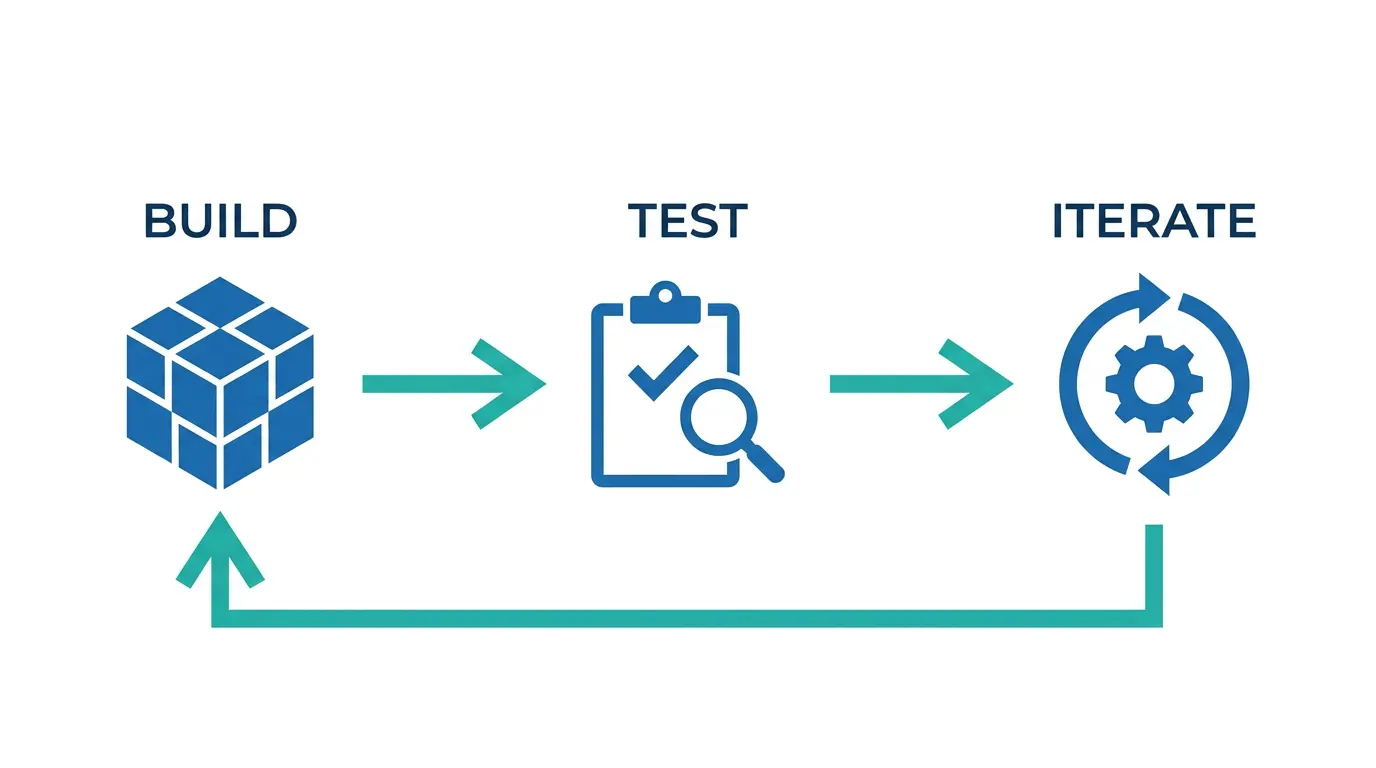
Longbridge Academy frames options backtesting around a disciplined three-phase cycle: build, test, and iterate, designed to reduce guesswork and reliance on hindsight, according to Longbridge Academy. Each phase serves a distinct purpose in validating strategy logic before any capital is committed.
Phase 1: Build — Defining Strategy Rules
The build phase involves specifying precise, testable rules: which strike and expiry to target, what triggers an entry, and what conditions define an exit. Vague rules produce unreliable results, while precise rules give a trader something concrete to test, per the same Longbridge Academy guide. This phase covers structural choices such as single-leg positions, vertical spreads, neutral strategies like iron condors and straddles, and income-generating approaches such as covered calls.
Phase 2: Test — Running the Simulation
Once rules are defined, the testing phase applies them against historical option chains. The amount of historical data needed varies by strategy complexity: simpler strategies may only need three to five years of data, while more complex multi-leg strategies benefit from ten years or more to capture a range of market cycles, as noted by Longbridge Academy.
Phase 3: Iterate — Refining the Approach
The final phase involves systematically varying parameters, such as strike delta or days to expiry, to see how sensitive the strategy is to small changes. This step helps distinguish a potentially durable edge from a result driven by a narrow set of historical coincidences.
Essential Data Inputs for Reliable Options Backtesting
The quality of a backtest depends heavily on the quality of the underlying data. Missing or inaccurate inputs, such as using a present-day option chain as a stand-in for historical data, can produce misleading conclusions.

Historical Options Chain Data and Implied Volatility
A proper options backtest requires the specific contract identifier used at each historical point, including the underlying, strike, expiry, and the implied volatility available at that time. Simulating entries and exits without accurate historical implied volatility can meaningfully understate the risk embedded in a strategy, since volatility directly affects option pricing and the probability of assignment.
Strike Selection, Delta, and Time to Expiry
Strike selection is often expressed in terms of delta, a measure of how sensitive an option's price is to movements in the underlying asset. Traders commonly reference delta thresholds when defining entry rules, and understanding how these thresholds relate to exercise probability is covered in more depth in guides on in-the-money option exercise and assignment. Time to expiry, typically measured in days to expiry, also shapes how quickly theta decay erodes an option's time value.
Reading and Interpreting Your Backtest Results
Once a backtest has run, the output needs careful interpretation rather than a simple glance at total returns.
Core Metrics to Review
Standard metrics include total profit or loss, win rate, average profit per trade, average loss per trade, maximum drawdown, and profit factor, as outlined by Longbridge Academy. For strategies that collect premium upfront, such as credit spreads, maximum drawdown is more informative when measured against the full position value rather than just the credit received, since losses in adverse scenarios can exceed the initial credit by a meaningful margin.
Statistical Validation Beyond Raw Returns
Some traders apply statistical checks, such as a z-score, to assess whether observed performance is consistent with expectations rather than driven by a handful of outlier trades. According to Longbridge Academy's guide on statistics in options backtesting, a z-score between -2 and +2 generally suggests that observed performance aligns with simulated expectations, rather than being shaped by extreme outlier trades.
Hypothetical example (for illustration purposes only, not investment advice): Suppose a trader backtests a covered call approach on a hypothetical "Stock A" over a five-year window and observes a positive average return. This illustrative result reflects only that specific historical period and set of assumptions; it does not indicate how the same strategy would perform going forward or under different market conditions.
Moving From Backtest to Live Trading Responsibly
A completed backtest is a starting point for further validation, not a final verdict on a strategy's viability.
Why Paper Trading Is a Necessary Bridge
Forward-testing a strategy with simulated funds, commonly known as paper trading, allows traders to observe how a strategy behaves in current market conditions before committing real capital. As explained in Longbridge's guide to options paper trading practice platforms, this step helps traders quantify a strategy's risk-return profile under live, forward-looking conditions rather than solely historical ones.
Exploring Products and Tools on Longbridge
Traders can review the range of instruments available, as Longbridge provides options trading access in US markets alongside other asset classes detailed on the products overview page. For tracking historical and current price movements across markets, the market data services page offers tools for monitoring quotes relevant to strategy research.
Conclusion
Options backtesting gives traders a structured way to examine how a defined strategy would have behaved against historical data, using a build-test-iterate cycle that helps surface strengths, weaknesses, and sensitivity to key parameters. A no-code workflow lowers the technical barrier to this process by replacing custom scripting with guided interfaces, though it does not replace the need to understand options mechanics, data quality considerations, and the statistical limits of historical simulation. Pairing backtesting with forward-looking paper trading remains an important step before committing real capital to any strategy.
The choice of financial instruments depends on your investment objectives, risk tolerance, market outlook, and experience level. Regardless of the method selected, it is essential to fully understand its mechanics, risk characteristics, and execution rules, while maintaining a robust risk management plan. You can learn more about investment strategies through the Longbridge Academy or by downloading the Longbridge App.
Frequently Asked Questions
Related Courses
Getting Started with Options
Contracts, Quotes, and the Four Basic Positions
Option Prices and the Greeks
Why Option Prices Rise and Fall
Common Options Market Indicators
Understanding Volatility and Market Sentiment
Option Buying Strategies
Buying Options: Choosing Contracts and Managing Risk
Option Selling Strategies
Collecting Premium While Managing Risk
Stock-and-Option Strategies
A Stock Has Two Directions. Options Have More.