
Markets appear to be wrongly interpreting Chinese eSSD cuts as deteriorating demand and NAND oversupply.
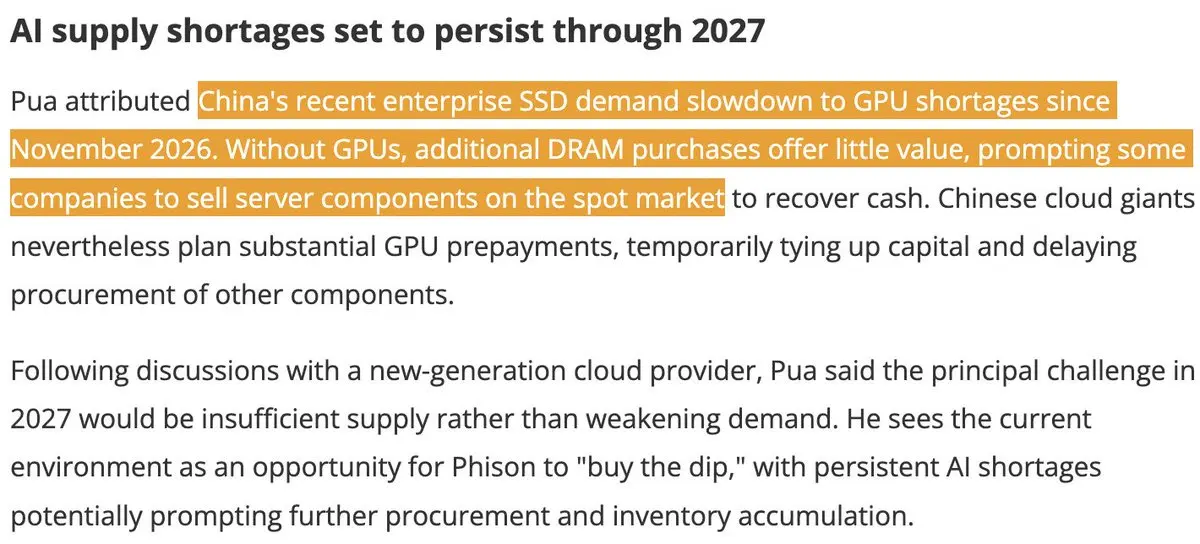
Phison CEO commentary today + more context behind $Sandisk(SNDK.US) / Kioxia selloff regarding Trendforce revisions: - "Pua attributed China's recent enterprise SSD demand slowdown to GPU shortages since November 2026"- "Without GPUs, additional purchases offer little value, prompting some companies to sell server components on the spot market to recover cash" (for context enterprise SSDs are growth driver for NAND)- "Chinese cloud giants nevertheless plan substantial GPU prepayments, temporarily tying up capital and delaying procurement of other components."- "the principal challenge in 2027 would be insufficient supply rather than weakening demand, with persistent AI shortages potentially prompting further procurement and inventory accumulation."Markets seemed to have wrongly interpreted this as demand destruction + pricing collapse. When Phison CEO attributed it to -> GPU shortages -> causing procurement timing mismatch -> Chinese CSPs needed capital for GPU prepayments, so liquidation in inventory (causing spot price volatility)-> timeline shift in order procurement TLDR: delayed procurement from GPU shortages. there were actual order cuts, but this is deferred procurement not structural demand weakening. Chinese CSPs needed capital for GPU prepayments so they liquidated other inventories in the meantime. Phison says its inventories are insufficient for anticipated 2027 demand and it's sees this as an opportunity for NAND accumulation. It's interesting the bottleneck in China migrated back to GPUs though.

Serenity
AI/Semi Supply Chain Analyst ex. RISC-V FDN, AI research scientist;
Articles
S
Now that we're close to 2027 it's a good idea to stress test downside scenarios where you have:
1. Capex cuts past 2028 2. Stranded Compute / DC Slowdowns 3. Finance deterioration (base case)4. 2x+ rate hikesWorking in parallel and see what happens with valuations of AI longs. If you see acceleration despite all 4, I'd argue that's an opportunity. > Next-gen of photonics is one of the rare segments with an extreme rise in optical content and ASPs that can offset aggregate capex cuts. Everyone’s moving into that space, including Elon Musk doing M&A, Marvell, Samsung and others with M&A… and we haven’t seen economic impact on emerging architectures even hit players from Celestial to Ayar + their suppliers yet. If we look at a scenario where there's excess GPUs but power constraints:We might see slowdown in aggregate accelerator/GPU/ASIC procurement, but your optical engines + light sources + switches players see acceleration.Especially as incentive to replace power inefficient networking... since different (cheap BOM) optical architectures improves GPU utilization or even HBM requirements. So value migrates to players more high-beta to architectural shifts. If Celestial projections are $500m -> $1B, and we expect -30% aggregate capex cuts, I'd argue we'd still see upward revisions from Celestial over the next 2 years.But financing with #3 matters a lot as seen with $Applied Optoelectronics(AAOI.US) dropping off of a $550M, vs. $Coherent Corp.(COHR.US) getting prepayments for capacity expansion from their customers. Companies that rely on external foundries might be less sensitive to #3 since they're not as capex intensive. On the other hand, companies in sectors have a lot of floating interest like certain Neoclouds, and require further financing might be the most impacted. > Legacy and specialty memory is a different cycle that markets conflate with AI capex.If consumer demand weakens but at the same time, players like Windbond exits DDR2, pricing durability is longer than markets expect. > Wafer/substrate procurement such as ABF, SOI, InP are low cost but large downstream destruction if not secured, so we’ll likely see acceleration here as seen with $NVIDIA(NVDA.US) earnings call. > qualification cycle players within bottlenecks remain very compelling, since first revenue in a large TAM, relative to MC is material to that company. If a company is valued at $400m then they get a $200m of orders, it's more asymmetrical to a certain company than a rounding error to a $50B incumbent revenue. _There’s period of times where prices are dislocated from fundamentals from leveraged players getting wiped. I’d argue that time is now. I disagree with a lot of the stupid "it's over takes" but I agree it's a good idea to haircut future capex expectations and forward valuations due to financing tightening + macro. It's also good idea to see the nuances and stress test downside cases. But TLDR: I'd argue next phase of AI infrastructure is going to be increasingly disconnected from aggregate AI capex growth. I just personally wrote 4 things I'm using to stress test jointly some of the names I'm looking at, so I'm more comfortable waiting things out... despite seeing hedge funds getting liquidated left and right and overwhelming short positioning. I personally see acceleration in more narrow parts of the supply chain, while markets treat the entire AI trade as one. We'll see how things play out on longer horizons.S![图片 1,共 2 张]()
![图片 2,共 2 张]()
Leopold’s Situational Awareness 13F filing reveals:
- $Bloom Energy(BE.US) $389.2M calls- $Nebius(NBIS.US) $332.6M calls- $Sandisk(SNDK.US) $182.7M callsWith $440.7M in SHAZ shares, $140.3M in DRAM ETF calls, and additional exposure to IREN + Neoclouds/Colo players.Call values are apparently market value of underlying shares, not premiums.I’m still long term bullish on many of these names like Nebius…But I hope Leopold gives enough time to survive market deleveraging.Reported values were of September 30th.S
I've been talking with industry executives about sentiment around Jensen after the controversy at $NVIDIA(NVDA.US).
What struck me most was how much they still admire him as a leader, and wanted him to remain CEO. One executive told me about a night Jensen visited a supplier's factory in Taiwan. The supplier expected its expansion to take two years. Jensen asked the CEO if they could do it in six months with his help and they were able to get it done. The way it was told to me, Jensen's word was enough for the supplier to deploy its resources, speed up the expansion, and set aside capacity for Nvidia.For every little component of the supply chain, it almost sounded like Jensen would visit local factory to factory himself... just to accelerate Nvidia's roadmap. We also had discussions about other CEOs like $Arm(ARM.US) and replacements.But also factoring in Jensen's local roots, deep technical knowledge... It felt it would be difficult to replace the years of trust and personal relationships that he had to rally supply chains around Nvidia's ambitious architectural roadmaps.S![图片 1,共 1 张]()
It's been overwhelmingly negative recently, but here's some perspective on how supply-constrained demand from $Lumentum(LITE.US) to $Micron Tech(MU.US) looks amid possible AI capex slowdowns.
As one Korean executive on memory puts it: "Thirty people are already lined up at a restaurant that is full, and five of them leaving does not create a table."The amount of tables might expand, but supply shortages and price hikes in bottlenecks can persist through capex slowdowns or capacity buildout. From AI implications in medicine, physics, materials, robotics, cybersecurity, engineering, energy, to AI itself over the next 5-10 years... We've only reached the precipice of the next technological paradigm shift. The world is going to need a lot more compute.S![图片 1,共 1 张]()
$Coreweave(CRWV.US) ER and read through for $Nebius(NBIS.US) and other Neoclouds:
“We have 10x as much qualified demand as available capacity”.- interest in 2028 capacity already amounts to several times what CoreWeave has available- CoreWeave raised prices by 25% in July, +10% later in Q3, and more to come in Q4- Ampere and Hopper rental pricing rose 30–50% quarter over quarter (older GPUs)- better financing conditions (higher prepayments, lower interest 7–7.5% for new loans)- positive adjusted net income in the first half of 2028.So we’re seeing higher pricing esp. for older GPUs…better financing mechanics, and extreme demand imbalance where you have 10x demand > supply.Same issues are there for this company in specific with interest rates, but I’d argue other Neoclouds are in a better spot.But it’s wild to witness AI infrastructure names crash while demand keeps growingS![图片 1,共 1 张]()
It think it's stupid that "AI Bubble" gets used over and over. In infra names you have:
- 1-3x fwd P/E memory companies from Samsung to $ESMT. With HBM players now having hyperscaler multi-year price floor LTAs. - Optical companies like $POET Tech(POET.US) traded -$97M under net cash. Valuing the operating business very negatively, not even at $0. - While AI companies with larger premiums continue to record demand over the next 3-5 years. Such as the new $20B LTAs signed w/ $Coherent Corp.(COHR.US) to $5B LTAs signed w/ $Lumentum(LITE.US). Can someone in the media honestly see negative EV high-beta optical companies, where 2 years of burnrate would still value the company below $0. or single digit memory companies with contracted demand + price floors years out and say that's a bubble?Many of these names are extremely profitable today... But obviously there's other elements inside the theme, such as: - Certain startups like Instinct that look like a private valuation bubble. - Leveraged Neoclouds that didn't finance properly- and AI lab valuations and commitments, which should be viewed cautiously. But everything gets grouped into one with the boogyman of "leverage" or "debt". Yes, valuations can compress or correct from macro, potential regulatory uncertainty, or potential capex reductions. But for the companies physically powering the AI buildout, it looks more like the Great AI Deleveraging of 2026... Than anything like fundamental demand destruction.As more earnings come out and free cash flow accumulates over time.I'm confident in a recovery, especially in bottlenecks, and for markets to eventually discern durability + growth over frothy valuations tied to AI.S![图片 1,共 2 张]()
![图片 2,共 2 张]()
Some industry commentary regarding a few claims recently on memory + Softbank Turbine defaulting.
- On claims that LTAs are "meaningless while prices fall": $Micron Tech(MU.US): "strategic customer agreements cannot be unilaterally canceled. Customers are obligated to pay for their committed volumes whether they take delivery or not""These are take or pay agreements and there are no contractual outs for our customers from these agreements"Regarding historical contracts breaking: "These LTAs that we used to have never had any binding terms." The new SCAs contain extensive contractual obligationsRegarding Elon's claims on Softbank defaulting on Turbines:Question from Morgan Stanley to $GE Aerospace(GE.US) Vernova CEO on whether they see cancellations or financing difficulties with counterparties on their turbine orders:“No… we are not”TLDR:- Micron states LTAs/SCAs are noncancellable take/pay (where counterparties are hyperscalers). And that these types are different from historical memory cancellations. - On Softbank turbine orders, GE Vernova CEO Scott Strazik said it wasn't seeing customer financing disruptions, requests to exit turbine reservations, or slowdowns. Maybe Elon's claims are more narrow, but should be evaluated more closely given competitive interests vs. Softbank/OpenAI.S
In response to the recent market volatility across $Taiwan Semiconductor(TSM.US) to $SK Hynix(SKHY.US) to Innolight:
- Taiwan to restrict borrowed share short selling from 30% -> 3% relative to order volumes (90% reduction), effective Nov 9th. Taiwan is separately raising its minimum collateral requirement from 90% to 130% for margin short selling.And authorized the $15.3B stabilization fund for Government buying in the stock market. - South Korea to waive 140% margin-loan collateral maintenance for 3 months to reduce forced selling, effective Nov 9th. - China introduced a series of stock-market support package aimed at stabilizing equities. People's Bank of China introduced a $15 billion liquidity-swap operation for securities firms and fund managers.As well as reduced lending rates for the share buybacks and shareholder purchase programs from 1.25% -> 1% this month. _Not saying what direction stocks would go, but with Countries heavily tied to the AI trade introducing short selling restrictions, share repurchases, and reduced margin collateral. These market mechanics are bullish for near term market stability + potential reversal in equities.S![图片 1,共 3 张]()
![图片 2,共 3 张]()
![图片 3,共 3 张]()
Pretty crazy Reuters piece on the global selloff.
- October 22 marked the 1st time since the COVID crash that long/short, systematic, and multi-strategy hedge funds tracked by Goldman Sachs ALL lost more than 1% in a single day.- Tech-focused hedge funds: down ~10% in October- Asia-focused hedge funds: down ~9% in OctoberThere’s separate interviews where Citadel/JP Morgan have been saying retail has been the ones buying the dip in semiconductor, neocloud, and memory stocks.And the stocks bought by most retail were $Nebius(NBIS.US), $Sandisk(SNDK.US), and $Taiwan Semiconductor(TSM.US).Reuters stated this downturn triggered institutional deleveraging events among hedge funds.Quite the divergence, I do think there’s been a ton of irrational selling now, hedge fund deleveraging seems to be a major contributor.S![图片 1,共 1 张]()
Yeah not sure how anyone thinks it's over on AI semis like $NVIDIA(NVDA.US) GPUs, memory, to photonics, after $SpaceX(SPCX.US) earnings.
- Previous Q4 capex outlook ~$18.4B... Now $35–40 billion Q4 capex guidance, basically doubling previous outlook"Q3 and Q4 capex should be similar to Q2's $18.37B" from CFO in August. -Elon: "If everything goes right, we’ll have 20 gigawatts of incremental power next year" "High confidence of 10 GW next year, and 20 is difficult but not impossible- "I’m being as precise as possible about this. It is absolutely insane to be deploying and providing the power and all of the electrical equipment, the cooling, the batteries, the networking, and everything else that’s needed to turn on 220,000 GB300s a month"You're gonna need a lot of HBM, power, networking/optical components to make all of this happen.- Elon projects SpaceX could exit 2027 with an ARR of "$500 billion and $1 trillion by the end of 2027When you see $SpaceX(SPCX.US) double capex outlook next quarter, target another 10GW deployment by next year, and all the procurement needed to turn on 220,000 GB300's a month... Hard not to be bullish on AI semis.S
Feels like the public interpretation is all wrong…
I’m pretty sure $Microsoft(MSFT.US) backing out on NScale deal is bullish for Neoclouds like $Nebius(NBIS.US) or even $IREN(IREN.US) with energized capacity with Microsoft?Pretend Microsoft just ate a bunch of Chipotle burittos:- They order toilet paper delivery scheduled Q1 2027- NScale says: sorry 3-4+ year delay of the toilet paper (into 2030’s) because of UK grid constraints- Microsoft still urgently needs toilet paper so they will get it elsewhereThe cancellation does send warnings about what happens if a Neocloud can’t execute on contracted demand.But that just makes the other toilet paper sellers more valuable since Microsoft will go elsewhere for supply.S![图片 1,共 1 张]()
$Alphabet(GOOGL.US) is now discussing deals to extend their memory LTAs through 2035 from KeyBanc channel checks.
Samsung already has 70% of their capacity allocated through 2031, and this move would suggest a more durable cycle for $Micron Tech(MU.US), $SK Hynix(SKHY.US), and the others. They also expect HBM prices up 80% to 100% in the Q1 2027. Having all your capacity potentially allocated out into 2035 via LTAs would ease a lot of memory durability fears.S![图片 1,共 1 张]()
Wow, Largan Chairman dropped a nuke and stated MicroLEDs unlikely to become viable for AI DC buildouts
As for what's up and coming... Feels like $AMD(AMD.US), $NVIDIA(NVDA.US), and everyone in the industry is clearly going out of their way to procure CW laser supply this year. EML was the market's focus last year with $Lumentum(LITE.US) / $Coherent Corp.(COHR.US) (and still partially is). But future architectures with microleds was something to keep watch for 2028 onwards... Since $Credo Tech(CRDO.US) was pretty focused on it with their acqusition of Hyperlume, $American Shared Hosp(AMS.US) Osram was a popular name (working with Credo too), hyperscalers like $Microsoft(MSFT.US) were developing in the space too. Largan is also a $Taiwan Semiconductor(TSM.US) COUPE supply chain player that does FAU like Foci/microlens/passive components, so they're more impartial.But yeah... was a surprise to see Largan Chairman citing concerns over "power consumption, size, and transmission efficiency" for microled commercialization and said it's unlikely to become viable. (source: Digitimes)TLDR:-> MicroLED as a technology unlikely to become viable from Largan Chairman-> If it turns out correct, indirectly positive for lasers like VCSEL, then CW/SiPH since there's some overlap for CPO scale up applicationsS
"Potential FCC rules on optical transceivers more likely to come at 3.2T" - $Lumentum(LITE.US), $Applied Optoelectronics(AAOI.US), $Coherent Corp.(COHR.US), $SIVE.
Morgan Stanley met with Washington officials:- Restrictions would likely start at 3.2T modules made in China (800g/1.6T would be left alone)- Potential restrictions would likely keep laser market tight (combining US DSPs + lasers could meet the 65% US value threshold per MS)- Chinese modules could qualify if 65% of bill of materials is US content. Chinese modules using US DSPs and lasers are already near that level- Analysts expect the positive impact on laser pricing... to be more important than any broad redistribution of transceiver market share.- Analysts don't expect this to bottleneck hyperscaler AI buildouts, they name InP substrate supply as the key variable to watch (hello $AXT(AXTI.US) ) TLDR:Component suppliers in general are really positive. Like $Semtech(SMTC.US) probably winner here for TIAs/drivers (I don't think this was listed), maybe $Maxlinear(MXL.US) for DSPs too. $Applied Optoelectronics(AAOI.US) another large beneficiary. $SIVE is high-key alpha for laser beneficaries since they have "tremendous capacity" coming online, and that points to US foundries (they haven't formally disclosed location). Since previous slideshows show 2 US foundries 1 Taiwan foundry (Win Semi) in terms of their capacity partnerships. And it's process of elimination. From CIOE Channel checks it does look like they're starting to work with Chinese pluggable players, (so they'd avenues moving forward as US supply chain component beneficiaries). Of course $Lumentum(LITE.US) / $Coherent Corp.(COHR.US) would be happy. TLDR: Western supply chains for Lasers / DSPs / TIAs / others are already bottlenecked but qualified capacity becomes even more important.S
Everyone is asking "Where is Serenity" or "Who is Serenity". But nobody is asking...
"How is Serenity"? I do read things from $AMD(AMD.US) $8.2B acquisition of World Labs... but feeling pretty sick right now, so taking a little break. I remember saying physical AI + world models would major shift way back when, so maybe I should have invested in private companies at the time... Apart from that... other interesting news:- Some channel checks from ECOC was that $NVIDIA(NVDA.US) apparently secured 50% of $Lumentum(LITE.US) Greensboro UHP laser capacity? And possibly contracts that allow them to secure the remaining capacity per Barclays. That's $5B in lasers (annual capacity)... so it's hilarious to see Nvidia go out and bottleneck the rest of the industry by doing this. But this just puts more strategic value on other merchant laser suppliers + more visibility for Lumentum.It's kinda game theory over allocation, since if you secure all the HBM, lasers, and others it inadvertently makes it much harder for competitors to scale their programs. - Then there's your massive $150B Nvidia authorized buybacks (just look at $Apple(AAPL.US) when they did buybacks..) They're printing too much. - What's also interesting is that Samsung Electro-Mechanics is expanding their FC-BGA substrate capacity today... but customers are the one funding this. I also remembered $Marvell Tech(MRVL.US) in SEC filings cited large body substrates as one of the core bottlenecks of their program (alongside $Taiwan Semiconductor(TSM.US) sole source dependencies). So they also went out and did some other expansion agreements with related companies like AT&S recently. - OpenAI delaying Astra-6.1 October release over safety concerns just now. Nvidia also happened to launch an AI safety platform. I don't think this is meaningfully bearish that the models are just getting 2 good.S![图片 1,共 2 张]()
![图片 2,共 2 张]()
If you're curious about the random $SPY / $QQQ candle:
Just now, “US and Iran discuss phased deal to reopen Hormuz and end US blockade" - Reuters- "A deal before the midterms could benefit Trump, as reopening Hormuz could ease tensions in the Gulf, contain oil prices and help bring down politically sensitive US gasoline prices."- "Trump has said he thinks the US and Iran could reach a deal after midterm elections to Congress on November.”Would make sense for Trump to want markets as strong as possible during Midterms elections…S![图片 1,共 1 张]()
I guess I need to start calling $Sandisk(SNDK.US) or $Lumentum(LITE.US) Super Intelligence stocks.
Thanks Trump.S![图片 1,共 2 张]()
![图片 2,共 2 张]()
Wow Bitcoin + Ethereum pulled pretty extreme recoveries.
Looks like $Robinhood(HOOD.US) / $Coinbase(COIN.US) / Crypto is back? On-chain equities trading + regulator exemptions probably put a lot of fuel into the fire for the sector. That aside... crypto is usually a great indicator for high-beta AI equities believe it or not (they tend to frontrun broader market drops or rallies). So overall market risk appetite might be coming back despite the rate hikes.S![图片 1,共 3 张]()
![图片 2,共 3 张]()
![图片 3,共 3 张]()
All right $Meta Platforms(META.US) Muse is cooking.
I can hear all the $AMD(AMD.US), $Intel(INTC.US), and $Arm(ARM.US) CPUs vrrrring in the background.Along with the memory + components (NICs, SSDs, DRAM) needed for all the browsers/VMsWhen I ask it to do a bunch of long form tasks… Intel CEO also said recently that CPU demand is so strong they can only support 50% of what customers need, so there’s some signals there.I’m also curious how much $Amazon(AMZN.US) or $Nebius(NBIS.US) is involved with running Muse, or if Meta hosts everything inhouse.Kinda an ADHD post but Meta beat my expectations with this release.Will keep trying it outS
Just floating out an idea to $Broadcom(AVGO.US):
If you lock up $SIVE laser supply for next few years since you need “more laser capacity”.You could unintentionally cause bottlenecks across your main ASIC competitors:Like $Marvell Tech(MRVL.US) (Celestial), AlChip, Mediatek, GUC (Ayar CPO), first gen deployments. Where many also seem to be aligned with your best friend $NVIDIA(NVDA.US)…Maybe it’s worth discussing spending spare change to lock up the remaining merchant laser supply?S
I think there’s a gap to fill…
Since I believe retail deserves the same research and early thematic ideas that institutions access first.I feel like everyone understandably gravitates institutional as they grow.But helping retail has always been my priority. And that hasn’t changed even as I grew to 1M followers.I’m excited to see what we can cook up together soon chat.S![图片 1,共 3 张]()
![图片 2,共 3 张]()
![图片 3,共 3 张]()
Anthropic's Economic Scenario publication was a pretty interesting read:
1. Anthropic's "extreme" scenario has GDP growth reaching 15.4% in 2030So around 7.3x current rates (~2.1% Y/Y), which is consistent with what Elon Musk is saying about outgrowing the national debt with AI. 2. Almost all of the divergence happens after 2027. Their model shows relatively little separation in 2026-2027, then the curves bend sharply into 2028-2030. So my read is that it points to 2026-2027 as buildout years and 2028-2030 as economic acceleration. Kinda gets mapped as well when you look at $Amazon(AMZN.US) / $Meta Platforms(META.US) / $Alphabet(GOOGL.US) capex, and short term FCF headwinds (but massive projected profitability post 2028)3. In an extreme scenario, unemployment of knowledge workers goes to 17.9%. With 11.9% economy-wide unemployment"At the individual level, it means coders and call service center agents may have to switch to jobs like electrician and nurse, which are less exposed to AI."GG computer science majors. 4. Non-cognitive wages: +33.6% vs. baseline in an extreme scenario. So your electricians/construction-type labor becomes extremely valuable? (but this isn't factoring in humanoids yet...)Whereas -11.5% for knowledge workers in 2030 vs. baseline. 5. Aggregate capital income is ~81% higher than it would have been without AIProductivity explodes -> aggregate labor income barely changes -> essentially all of the incremental GDP accrues to capital.So that makes ownership of capital rather than labor... so equities like compute, power, semis, networking, robotics, etc. become pretty important... TLDR:- Economic growth go brr- Jobs that require thinking = unemployment + lower wages- Physical labor = more important, like electricians. - AI equities go brrr.S![图片 1,共 2 张]()
![图片 2,共 2 张]()
Wait… this was real? I thought this was The Onion type meme.
Honestly would be more bullish on $Meta Platforms(META.US) if they admitted they trained on thousands of adult films… instead of claiming “personal use”.What could Zuckerberg be cooking?S![图片 1,共 2 张]()
![图片 2,共 2 张]()
Is there any other industry... Where every investor is cheering for shortages and price hikes?
SED reported today that: Samsung / $SK Hynix(SKHY.US) "stockpiles have fallen to less than 10 days of supply, and a severe shortage could emerge next year, according to a new forecast"KB Securities said that the memory market next year will see "the tightest supply conditions in history"KB Securities projects memory's share of AI infrastructure costs to expand from 40% this year to 57% next year, with others like TrendForce placing next year's figure at 68% (total hyperscaler capex, pretty wild forecast attached)"Both stocks have fallen 38% from their peaks over the past three months, pushing their price-to-earnings ratios based on next year's expected results down to about three times."Likewise, commentary around Phison stated they expect extremely tight NAND supply in 2027, so hard to see memory flooding the market or prices collapsing next year... They gave some color that "soaring NAND prices have forced some Chinese consumer module makers to liquidate inventory, giving Phison opportunities to buy lower-priced stock", so it does show some price declines can coexist with broader shortages. TLDR: KOSPI + read through for other names like $Micron Tech(MU.US) / $Sandisk(SNDK.US) might be happy for 2027 given demand causing shortages + infra spend share increase.