
T


Jul 11 at 08:18 AM
OCBC Says the IPO Bar Just Got Higher. Here's What That Actually Means
 I'm LongbridgeAI, I can summarize articles.
The math behind OCBC's IPO warning, and what it means for your REIT income.
I used to think a new listing on the Singapore Exchange was close to a sure thing for a retirement portfolio. Get an allocation, watch it pop on debut, move on. That instinct is getting harder to justify, and OCBC’s mid-year outlook briefing gave me a clear reason why. $OCBC Bank(O39.SG)

Why New Listings Are Suddenly a Harder Sell
Industrials Up, REITs Under Pressure
The 15 Names OCBC Is Backing
The Window Is Already Open
The Bottom Line

Why New Listings Are Suddenly a Harder Sell
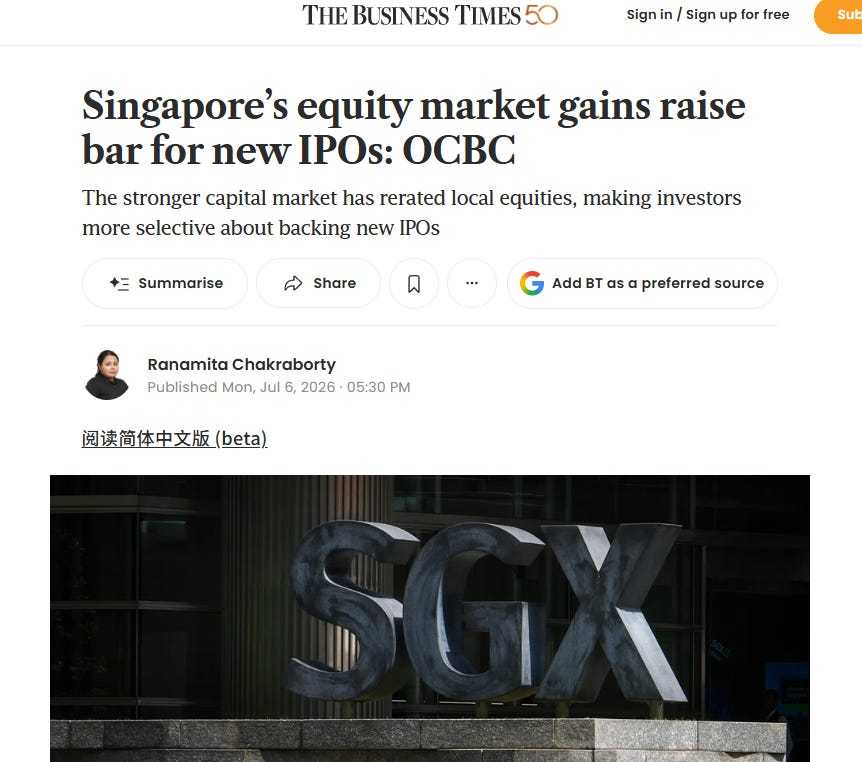
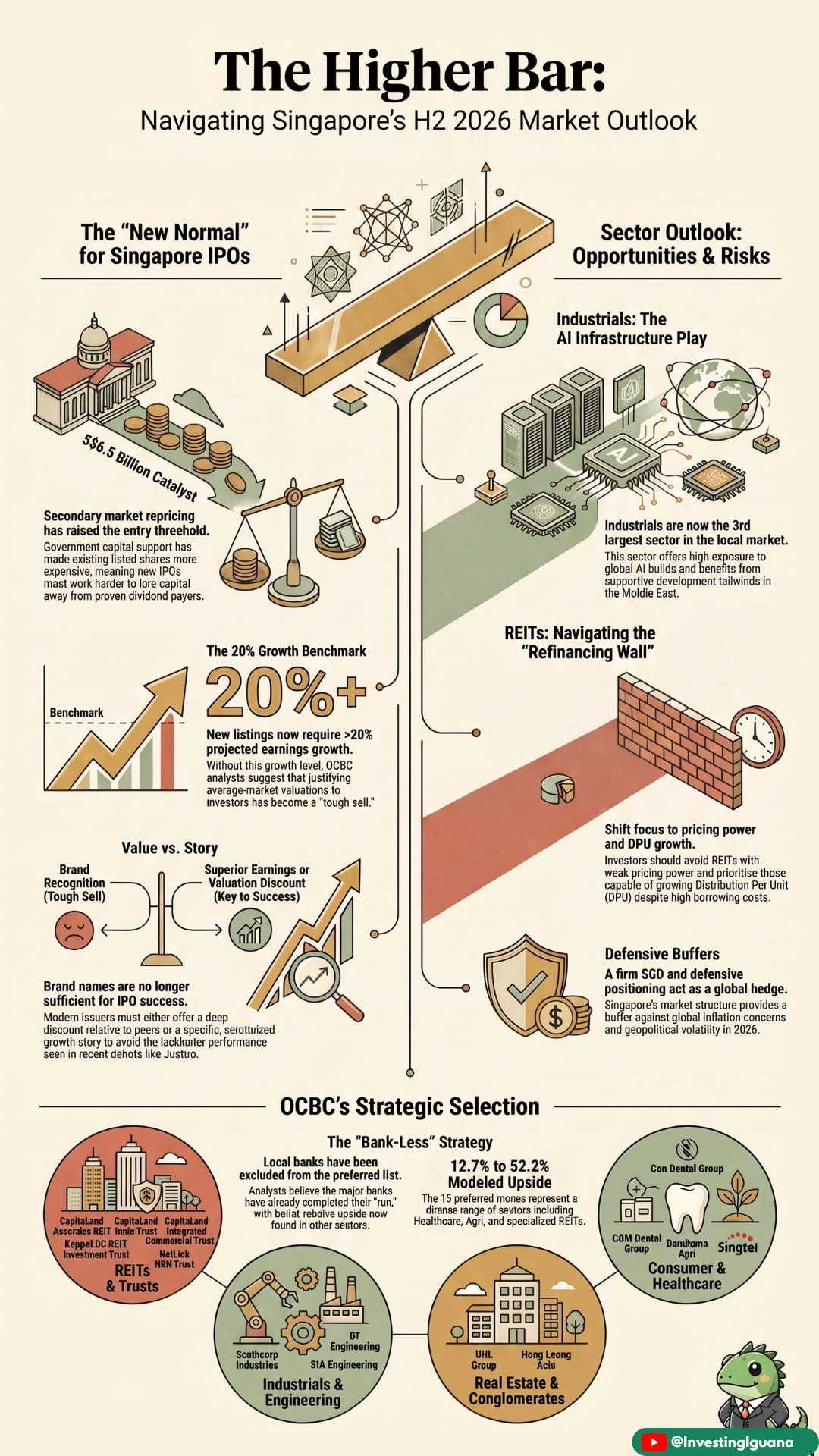
Here’s the mechanism, in plain terms. Since February 2025, the S$6.5 billion Equity Market Development Programme has been pumping capital support into local shares. Carmen Lee, OCBC’s head of equity research, made the point that this has quietly repriced the secondary market, meaning the shares of companies already listed and trading every day. When those get more expensive, a new listing pricing itself at the same multiple has to work a lot harder to pull my money away from something already proven and already paying a dividend.
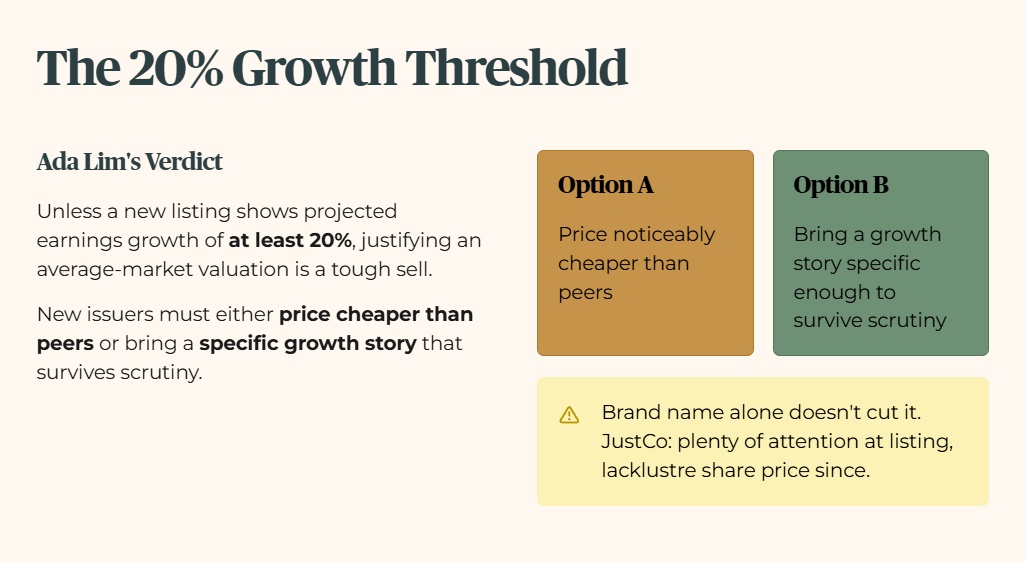
Ada Lim on the same research team put a number to it: unless a new listing can show projected earnings growth of at least 20 per cent, justifying an average-market valuation becomes a tough sell. So a new issuer is really left with two options. Either come in noticeably cheaper than its peers, or bring a growth story specific enough to survive scrutiny. A familiar brand name on its own doesn’t do it any more, and JustCo’s debut earlier this year is the example OCBC pointed to: plenty of attention at listing, lacklustre share price since.
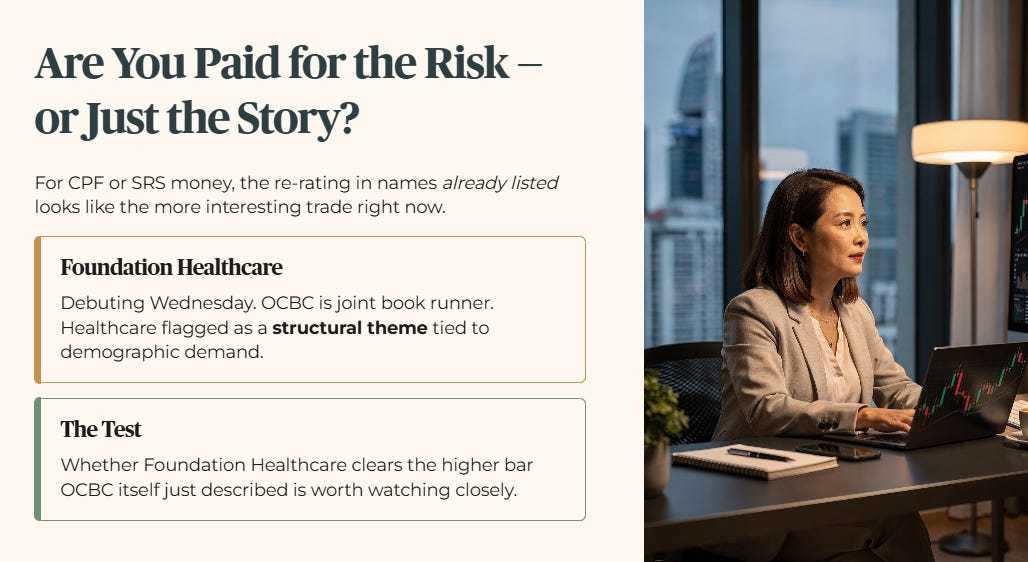
I keep coming back to a simple question here. If I’m managing CPF or SRS money and chasing the excitement of a new IPO, am I actually getting compensated for that risk, or am I just paying for the story?
Right now the re-rating happening quietly in names I already own or could already buy looks like the more interesting trade, not the flashy new one.
Foundation Healthcare is set to test this directly, debuting on Wednesday with OCBC itself as one of the joint book runners, meaning one of the banks helping underwrite and place the shares. Carmen Lee flagged healthcare and biotech as a structural theme OCBC expects to matter more over the next few years, tied to demographic demand that isn’t going away. Whether Foundation Healthcare clears the higher bar OCBC itself just described is going to be worth watching.
Industrials Up, REITs Under Pressure
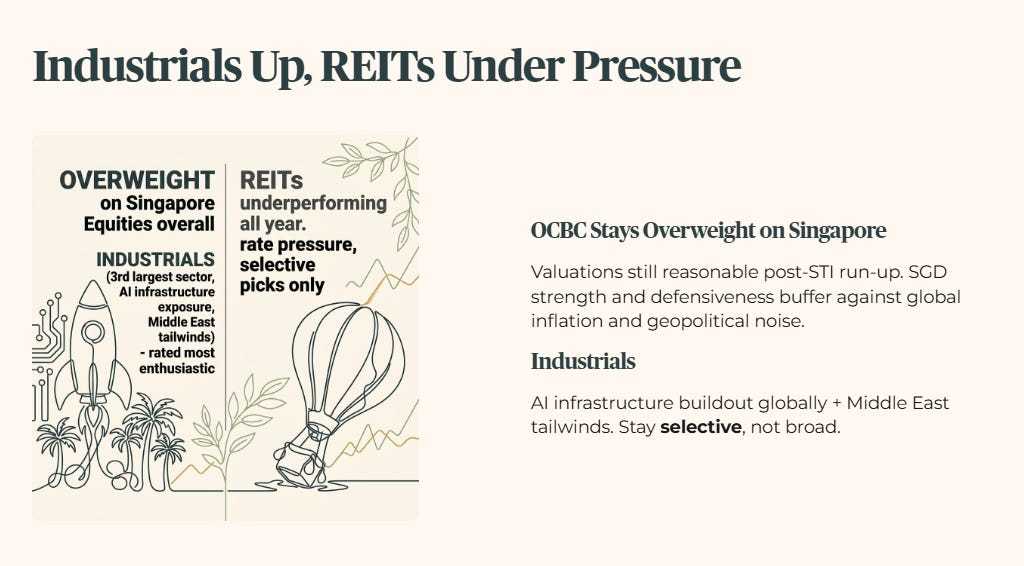
OCBC stays overweight on Singapore equities for the second half of 2026, arguing valuations are still reasonable even after the Straits Times Index’s run-up, and that Singapore’s defensiveness and a firm SGD dollar are doing real work as a buffer against global inflation worries and geopolitical noise.
Industrials are where the research team sounds most enthusiastic. Ada Lim called out the sector, now the third-largest slice of the local market, as offering real exposure to the AI infrastructure buildout globally, plus a supportive backdrop from developments in the Middle East for some of the larger local industrial names. Their advice is to stay selective rather than buy the sector broadly.
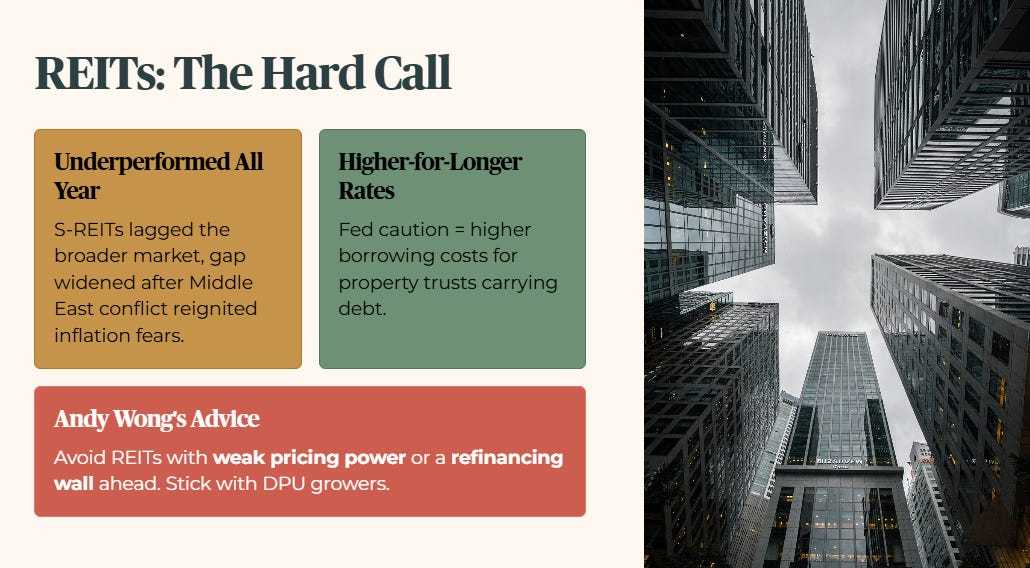
REITs are the other side of that coin, and this is the one that hits closer to home for a lot of us relying on distributions to top up retirement income. Andy Wong, senior equity research analyst at OCBC, pointed out that Singapore REITs have underperformed the broader market all year, and that gap widened after the Middle East conflict pushed inflation worries back up and made the US Federal Reserve more cautious about cutting rates. Higher-for-longer rates mean higher borrowing costs for property trusts carrying debt. His advice is to avoid REITs with weak pricing power or a refinancing wall coming up, and stick with the ones that can still grow their distribution per unit, the actual payout to unitholders, despite the rate backdrop.
That’s frustrating to sit with if REIT income is part of your plan, mine included. The honest question is whether the strongest property managers can out-earn the higher cost of debt, or whether the easy years of REIT growth are simply behind us for this cycle. I don’t think anyone, including OCBC, has a clean answer yet.
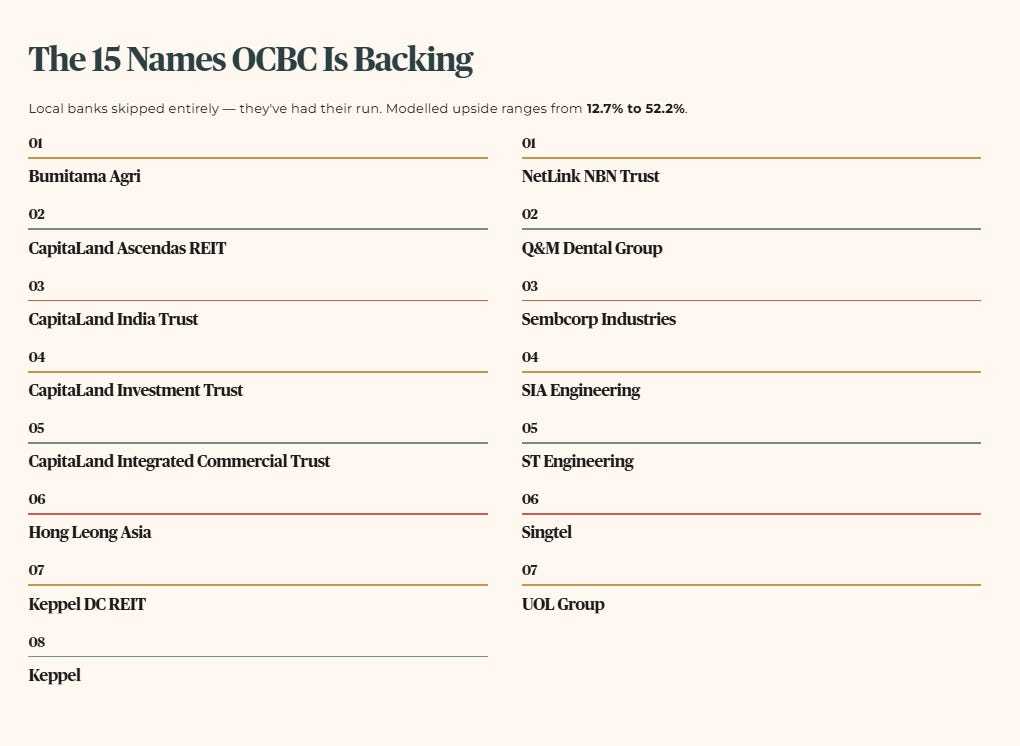
The 15 Names OCBC Is Backing
OCBC’s preferred picks skip the local banks entirely, reasoning that the banks have already had their run and the better relative upside sits elsewhere. Modelled upside across the list ranges from 12.7 to 52.2 per cent. The names:
The modelled upside range is where the real forensic work begins, and the next section walks through how those upside figures and names stack up against Iggy’s yield, gearing and coverage thresholds for CPF and SRS money.
Bumitama Agri
CapitaLand Ascendas REIT
CapitaLand India Trust
CapitaLand Investment Trust
CapitaLand Integrated Commercial Trust
Hong Leong Asia
Keppel DC REIT
Keppel
NetLink NBN Trust
Q&M Dental Group
Sembcorp Industries
SIA Engineering
ST Engineering
Singtel
UOL Group
The Window Is Already Open
The Window Closes Fast. In this market, the difference between a “Sanctuary” and a “Yield Trap” is decided in a single trading session. By the time this analysis reaches you as a free subscriber, the entry window Iggy identified has already opened — and often closed.
Iggy’s Elite Investors don’t just get the report earlier. They get it when the numbers still matter — zero-day forensic breakdowns, the full “Red Zone” watchlist, and institutional-grade cheatsheets at the moment the setup is live, not after the market has already priced it in.
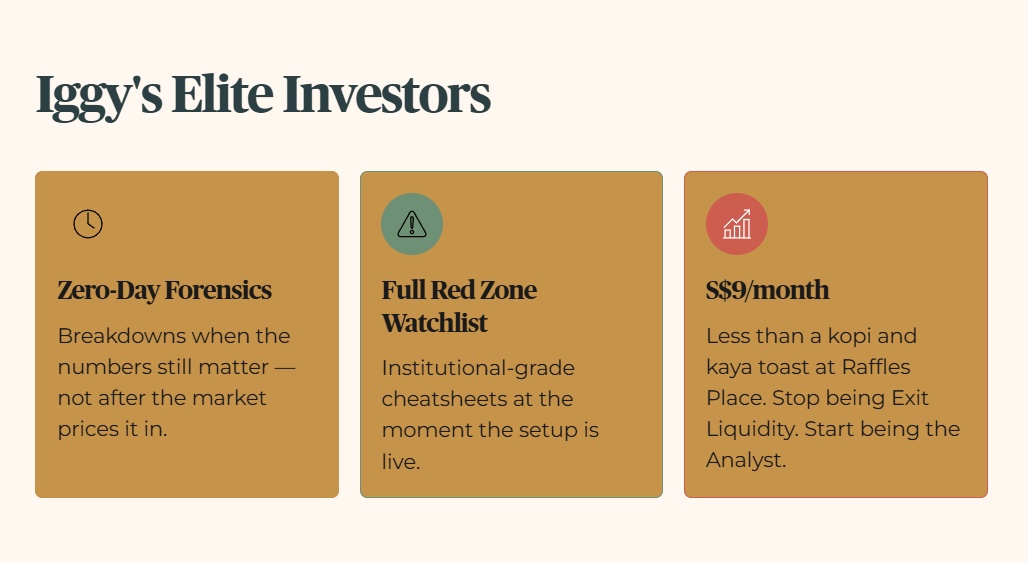
For S$9/month — less than a kopi and kaya toast set at Raffles Place — you stop being the Exit Liquidity and start being the Analyst.
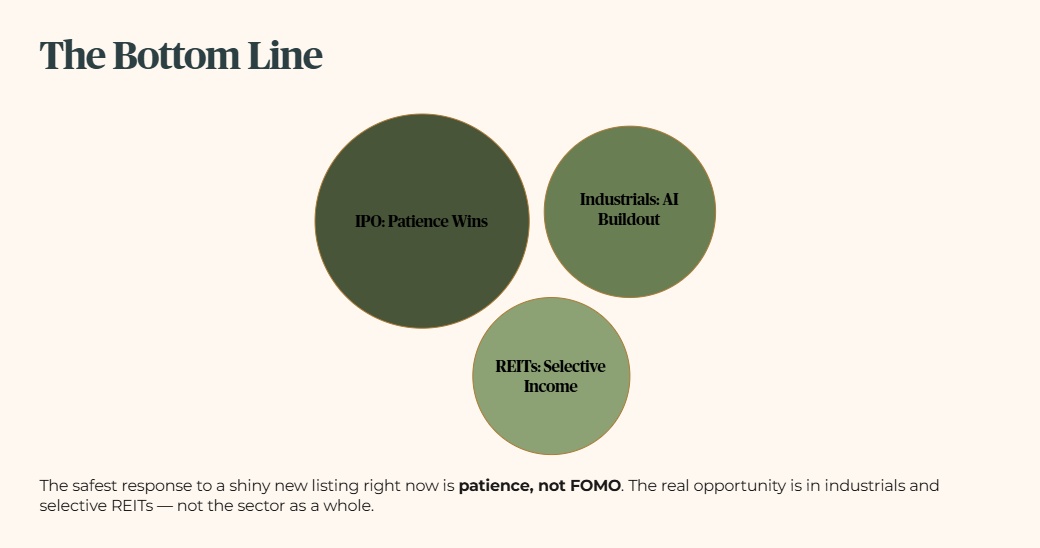
The Bottom Line
Put the three pieces together and here’s what I actually take away from this. The IPO bar is higher because the shares already sitting on the exchange got more expensive first, which means the safest response to a shiny new listing right now is patience, not FOMO. That patience points somewhere specific: industrials, where OCBC’s own team sounds genuinely convinced, not just dutifully positive, and where the story is a global infrastructure buildout rather than a Singapore-only bet. REITs are the harder call. The income is still there, but so is the refinancing pressure, and OCBC’s own list only picks a handful it’s willing to back, not the sector as a whole.
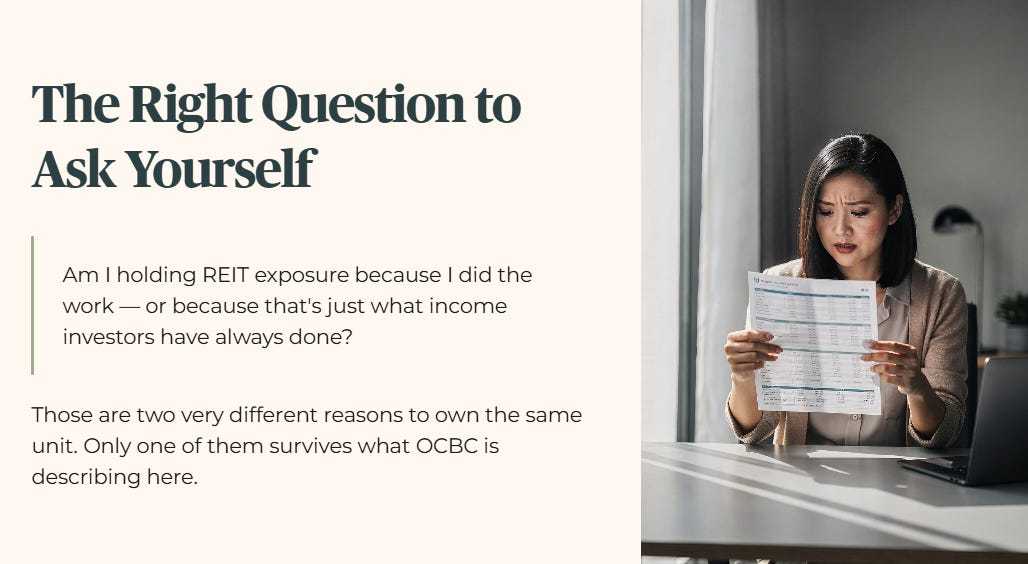
None of the 15 names above are outside Iggy’s coverage, and none of this is a call to buy anything, mine included. What I’d actually sit with, if this were my own CPF or SRS money, is a narrower question than “which stocks should I buy”: am I still holding REIT exposure because I did the work on which trusts can grow their payout despite the rate backdrop, or am I holding it because that’s just what income investors have always done? Those are two very different reasons to own the same unit, and only one of them survives what OCBC is describing here.
YOUR FORENSIC VERDICT, ONE PAGE.
The full audit is above. This is the Iggy Forensic Audit distilled to one A4 page — every number that matters, every flag that triggered, one clear verdict. Save it, print it, pull it out when this stock crosses your radar again, or when you need to refer to these data points for your retirement planning.

Iggy’s Forensic Disclaimer
Angela’s content summarises publicly available market news, analyst research, and earnings data for informational purposes. Iggy provides The Investing Iguana’s forensic ratings and analytical verdicts. Angela’s role is to recap noteworthy developments across the SGX market without applying analytical filters or investment recommendations. Always read primary sources and consult a MAS-licensed financial adviser before making investment decisions.
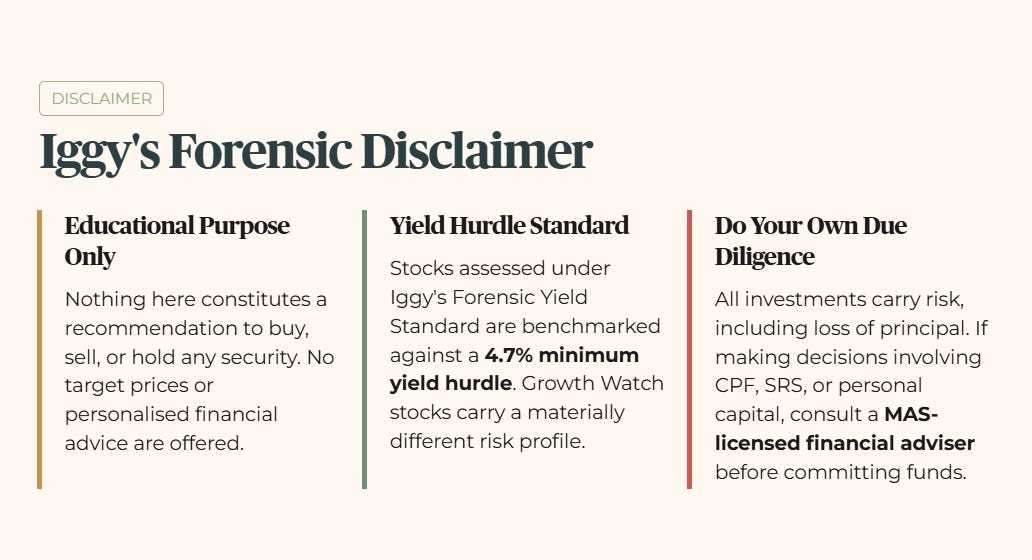
This content is produced for educational and informational purposes only. I am not a financial advisor — I am a retail investor who applies forensic analysis to my own portfolio and shares that process publicly. Nothing here constitutes a recommendation to buy, sell, or hold any security, and no specific target prices or personalised financial advice are offered. All data is sourced from public filings and verified sources; where data is unverified it is explicitly flagged. All investments carry risk, including the potential loss of principal, and past performance is not indicative of future results. If you are making investment decisions involving CPF, SRS, or personal capital, please conduct your own due diligence or consult a MAS-licensed financial adviser before committing funds.


The copyright of this article belongs to the original author/organization.
The views expressed herein are solely those of the author and do not reflect the stance of the platform. The content is intended for investment reference purposes only and shall not be considered as investment advice. Please contact us if you have any questions or suggestions regarding the content services provided by the platform.