

Daily Lesson | Investing Lessons from Berkshire Hathaway’s Latest Portfolio
 I'm LongbridgeAI, I can summarize articles.
Yesterday, we covered how to read Form 13F. As it happens, Berkshire Hathaway filed its latest quarterly holdings report on November 16.
The investment giant, long associated with Warren Buffett, attracts plenty of attention whenever its portfolio changes.
But this time, instead of simply looking at what Berkshire bought, let’s compare what it added, what it trimmed, and what it left untouched to see how its portfolio has changed.
As of September 30, Berkshire reported 30 holdings worth approximately $304.2 billion in its Form 13F filing.
Some positions grew substantially. Others were reduced. And several of its largest holdings remained unchanged.
Additions: The Standout Wasn’t a Tech Stock — It Was a Homebuilder
One of Berkshire’s most notable additions this quarter was Lennar, a major US homebuilder.
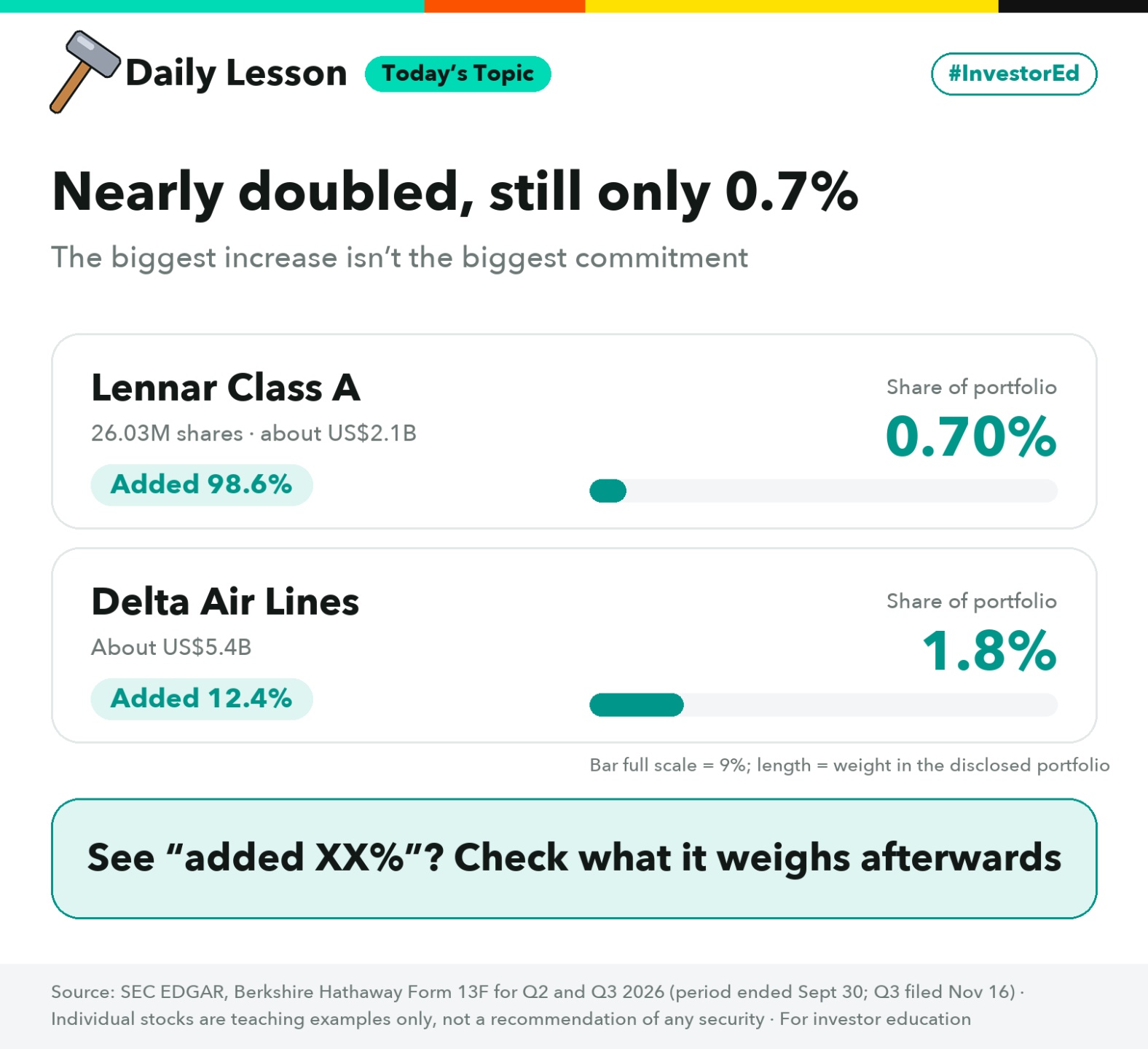
Berkshire increased its Lennar Class A position by approximately 98.6%, bringing its holdings to about 26.03 million shares, worth roughly $2.1 billion at quarter-end.
Why is this worth paying attention to?
Because Berkshire’s investments in residential construction weren’t limited to Lennar.
On May 31, 2026, Berkshire announced an agreement to acquire another US homebuilder, Taylor Morrison, for $72.50 per share in cash. The acquisition was completed on July 24.
Looking at these two investments together, we can see that Berkshire committed capital to the residential construction industry.
But if you focus only on the size of the increase and conclude that Berkshire is making a huge bet on Lennar, you may be overlooking another important number:
Although Berkshire nearly doubled its Lennar Class A holdings, the position accounted for just 0.7% of its disclosed 13F stock portfolio.
That’s still a relatively small position compared with Berkshire’s largest stock holdings.
So when you see an institution sharply increase its stake in a company, the percentage change alone doesn’t tell the whole story. You also need to consider how much of the portfolio the position represents afterward, and whether the institution has other investments in the same industry.
Another notable addition was Delta Air Lines.
Berkshire increased its share count by approximately 12.4% during the quarter. By September 30, the position was worth about $5.4 billion, representing roughly 1.8% of its disclosed stock portfolio.
One is a homebuilder; the other is an airline. They operate in very different industries, but both are sensitive to the economic cycle.
Housing demand is influenced by mortgage rates and household income, while air travel depends on consumer spending and business travel.
That raises an interesting question: Is Berkshire positioning for opportunities in cyclical industries, or does it see attractive valuations and competitive strengths in these particular companies?
Form 13F can’t tell us the answer. What it does reveal is that Berkshire allocated very different amounts of capital to the two investments.
The takeaway isn’t simply which stocks Berkshire bought more of. It’s how much weight each investment carries in the portfolio — and whether the underlying business justifies that allocation.
Trims: Two Financial Stocks, Very Different Cuts
Now let’s look at the positions Berkshire reduced.
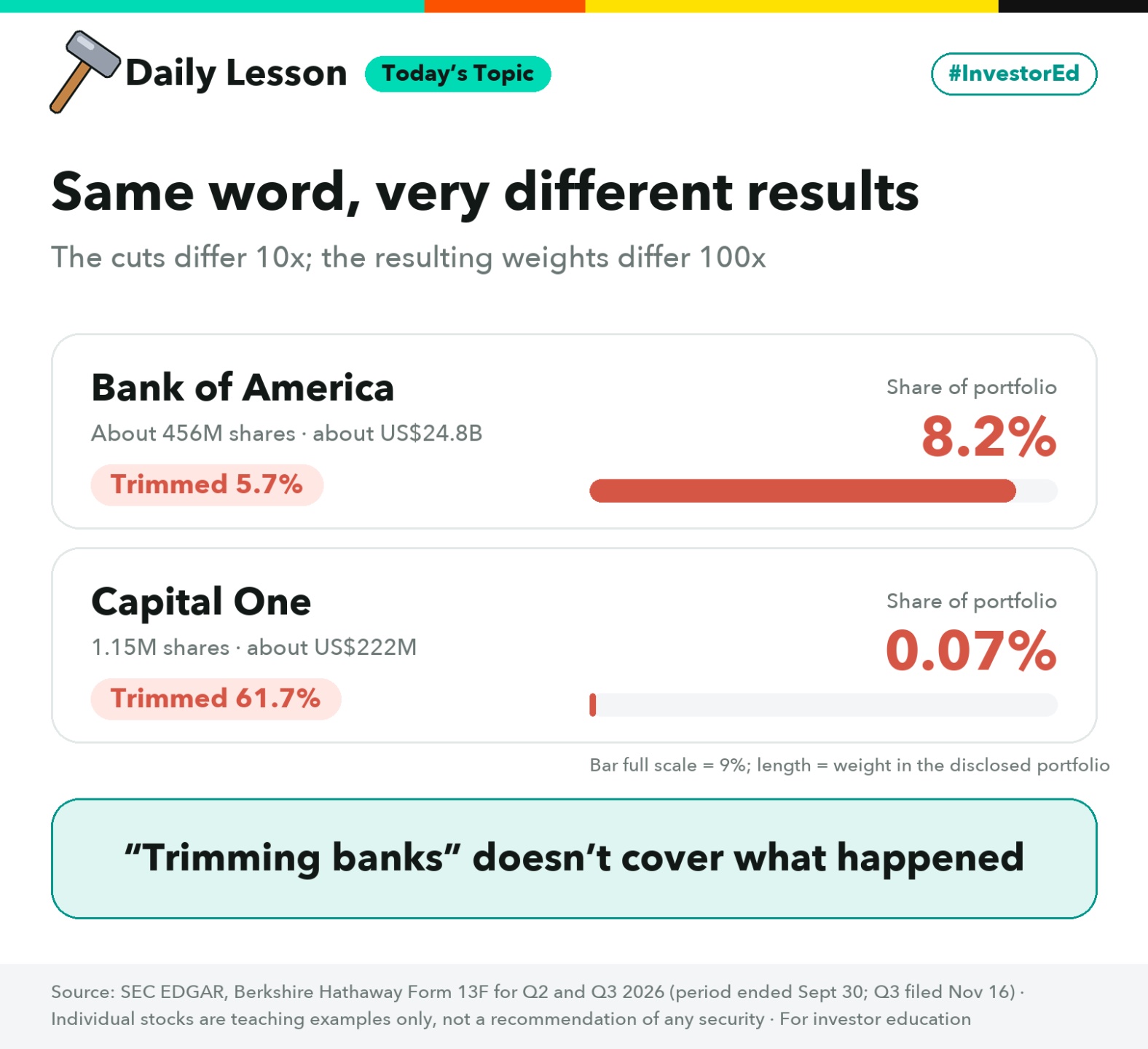
Its stake in Bank of America fell by approximately 5.7%, leaving about 456 million shares worth roughly $24.8 billion at quarter-end.
Meanwhile, Berkshire cut its position in Capital One by approximately 61.7%, leaving just 1.15 million shares valued at around $222 million.
Both companies operate in financial services, but their remaining positions are vastly different.
Bank of America still accounted for approximately 8.2% of Berkshire’s disclosed stock portfolio, while Capital One represented only 0.07%.
So a headline saying Berkshire “trimmed financial stocks” barely tells the story.
Based on their remaining positions, Bank of America continued to be one of Berkshire’s major stock holdings, while Capital One had become a relatively small investment.
In total, six reported positions saw reductions in share count during the quarter.
Besides Bank of America and Capital One, Berkshire also reduced its holdings in VeriSign by approximately 34% and Kroger by around 10%.
VeriSign operates critical infrastructure for internet domain-name registries, while Kroger is one of the largest supermarket operators in the United States. The two businesses operate in very different industries.
A reduction in holdings could reflect a change in the institution’s assessment of a company, a portfolio adjustment, or opportunities elsewhere.
Form 13F doesn’t explain the motivation behind the trades. But the figures do help investors distinguish between positions that remain important and those that have been scaled down significantly.
For example, if you want to evaluate whether a bank is an attractive investment, asking why an institution reduced its position shouldn’t be the end of your research.
You would still need to examine the bank’s earnings, loan quality, deposit costs, capital position, and valuation at its current share price.
An institution’s trading activity can provide a research lead, but it isn’t an investment conclusion.
Unchanged: The Biggest Holdings Still Anchor the Portfolio
Here’s another striking detail from Berkshire’s latest filing: despite the additions and reductions, the share counts of several major holdings remained unchanged.
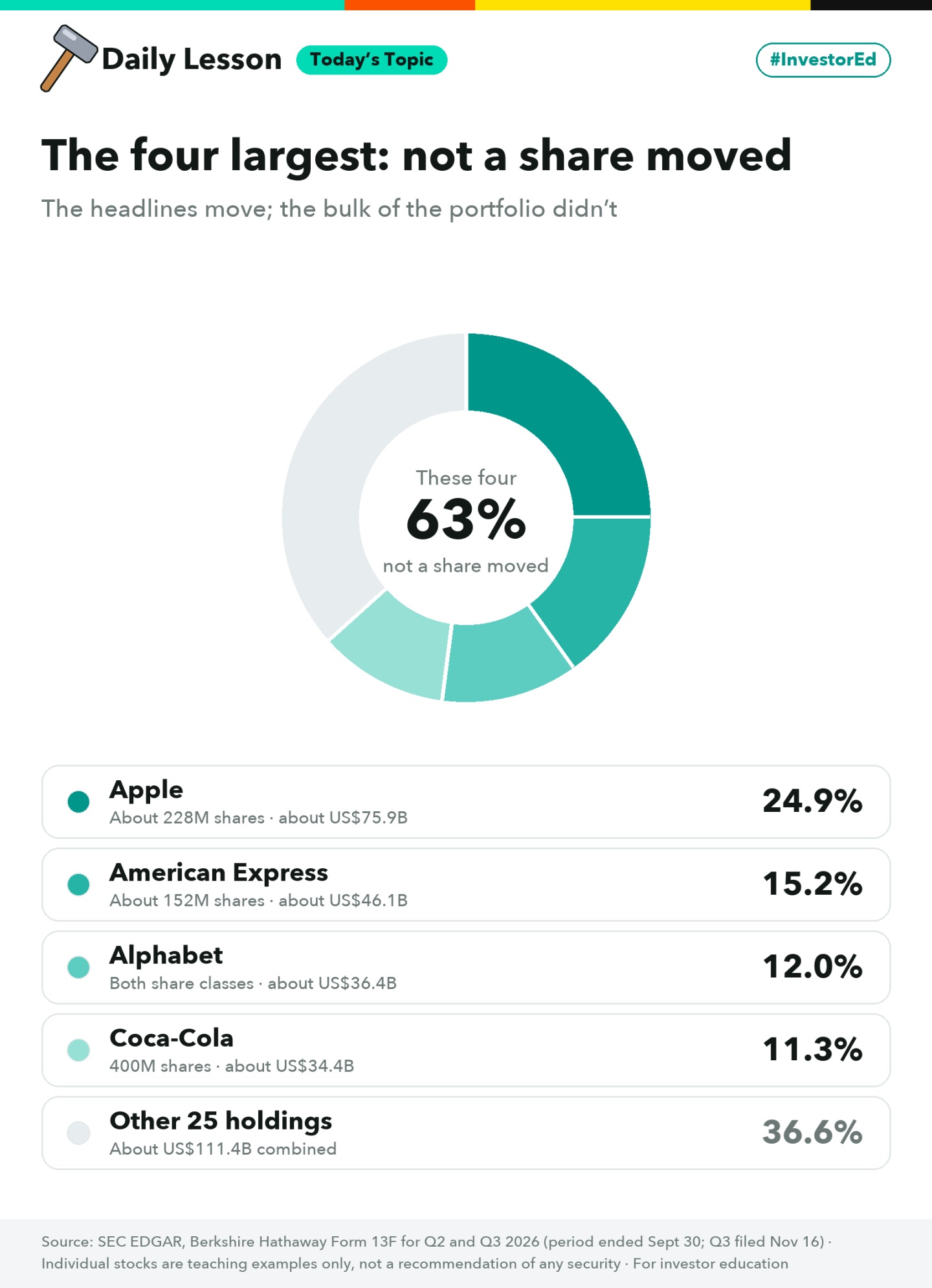
- Apple: Approximately 228 million shares, worth $75.9 billion.
- American Express: Approximately 152 million shares, worth $46.1 billion.
- Coca-Cola: 400 million shares, worth $34.4 billion.
- Alphabet: No change in either share class, with a combined value of approximately $36.4 billion.
Together, these four companies accounted for roughly 63% of Berkshire’s disclosed stock portfolio.
That figure deserves more attention than the percentage increase in any single stock.
Consider the contrast.
Berkshire nearly doubled its Lennar holdings during the third quarter, but Lennar still represented only about 0.7% of the disclosed stock portfolio.
Apple, on the other hand, saw no increase in its share count, yet it accounted for nearly 25% of the portfolio.
If Apple’s share price moved by 10%, all else being equal, that alone could change the value of Berkshire’s disclosed stock portfolio by approximately 2.5%.
A 10% move in Lennar, by comparison, would affect the portfolio by only about 0.07%.
That illustrates an important distinction:
How eye-catching a trade is and how much it matters to the overall portfolio are two very different things.
Now compare Bank of America with American Express.
Berkshire reduced its Bank of America holdings during the quarter but left American Express unchanged.
Both companies operate in financial services, yet Berkshire treated the two positions differently.
This is why we shouldn’t assume that an institution has turned bearish on an entire sector simply because it reduced its stake in one company.
To understand its portfolio, we need to look at how capital is allocated across individual businesses, not just group stocks under broad industry labels.
And an unchanged share count doesn’t necessarily mean an institution intends to hold a stock forever.
Berkshire, for example, reduced its Apple holdings over several quarters in 2024. One quarter without a change doesn’t prove that a position will remain untouched indefinitely.
But the latest filing does reveal one clear pattern:
While Berkshire adjusted some positions, most of the value in its disclosed stock portfolio remained concentrated in a handful of major holdings.
So, What Can We Actually Learn from Berkshire?
Put Berkshire’s latest holdings side by side, and several contrasts stand out.
Lennar: Share count increased by nearly 100%, yet the position represented just 0.70% of the disclosed portfolio.
Bank of America: Share count fell by 5.7%, but the position still represented 8.16% of the portfolio.
Capital One: Share count dropped by more than 60%, leaving a portfolio weight of just 0.07%.
Apple, American Express, Coca-Cola, and Alphabet: Their share counts remained unchanged, yet together they accounted for more than 60% of the disclosed stock portfolio.
Viewed together, these numbers tell us far more than a headline about Berkshire adding to or trimming a particular stock.
A large percentage increase doesn’t necessarily mean a large portfolio allocation. A reduction doesn’t mean a holding is no longer important. And no trading activity doesn’t mean a position has little influence on the portfolio.
That’s why learning from a great investor involves more than watching which stocks they buy.
Imagine Berkshire allocates less than 1% of its disclosed stock portfolio to Lennar. You see that it has nearly doubled its position and decide to put 30% of your own investment account into the same stock.
Even though you’ve bought the same company, the concentration risk you’re taking is completely different.
So the next time you see news about an institution changing its holdings, look beyond the headline and examine three things:
How much did the share count change? What percentage of the portfolio does the position represent afterward? And how important is it compared with the institution’s other major holdings?
The real lesson isn’t to copy a famous investor’s stock picks. It’s to understand how much weight each investment carries in a portfolio.
Today's quiz
Next question: Doubling both: which moves your account more? (Assume both stocks are in your account and everything else is equal.)
A. The one that was 1%
B. The one that was 10%
C. The effect is the same
D. It depends on the share price

Scroll down to the poll at the end of the post and cast your vote. We’ll reveal the answer in the next lesson.
🎁 Vote, comment, earn rewards
- Pick the correct answer in the poll: 88 Task coins
- Pick the correct answer and tell us in the comments which number you look at first when an institution changes a holding, and why (at least 15 words): 188 Task coins
Poll closes Wed, 18 Nov, 6pm SGT. We'll reveal the answer and the number of winners in our next post. Rewards will be credited within 7 working days. One entry per account. Comments must relate to today's topic. T&Cs apply.
Sources: US Securities and Exchange Commission (SEC) EDGAR, Berkshire Hathaway’s Form 13F filings for the second and third quarters of 2026 (third-quarter filing submitted November 16, 2026, reporting holdings as of September 30, 2026); Berkshire Hathaway’s third-quarter 2026 quarterly report; for the acquisition of Taylor Morrison, Taylor Morrison Home Corporation’s Forms 8-K dated May 31, 2026 and July 24, 2026. Berkshire’s 2024 Form 13F filings were also referenced for the historical reduction in Apple holdings.
Note: All holdings data in this article reflects positions reported as of September 30, 2026, and does not represent Berkshire Hathaway’s current or real-time portfolio. Form 13F does not disclose individual trade dates, execution prices, or the reasons behind investment decisions. No conclusions are drawn here about the timing, prices, or motivations of any particular transaction. Greg Abel has served as Berkshire Hathaway’s chief executive officer since 2026, and Form 13F does not identify who made each investment decision. Accordingly, this article does not attribute individual portfolio changes to Warren Buffett or any other person. The companies discussed are presented solely as educational examples and do not constitute recommendations of any security, institution, or investment strategy.
Disclaimer: This content is provided for investor education purposes only and does not constitute investment advice, an offer, or a recommendation to buy or sell any security. Investing involves risk. Please make investment decisions carefully. The author and publisher accept no liability for any direct or indirect losses arising from reliance on this content.
The copyright of this article belongs to the original author/organization.
The views expressed herein are solely those of the author and do not reflect the stance of the platform. The content is intended for investment reference purposes only and shall not be considered as investment advice. Please contact us if you have any questions or suggestions regarding the content services provided by the platform.
Author's posts
View moreDaily Lesson | Anthropic Lists Today. The Market’s Open, So Why Can’t I Trade Yet?
$83 is just the IPO price. But what price will you actually pay when trading begins?
146 likes · 34 repliesAnthropic Starts Trading Today. More Than 20 Leveraged ETFs Are Lining Up: Beware the “2X Long” Trap
SpaceX ended four months where it started, yet its 2X long ETF lost a fifth. The answer is one word in the name: Daily.12 likesDaily Lesson | Anthropic’s IPO Price Range Is Still $70–$78. So Why Are Reports Pointing Higher?
Oversubscribed, upsized, greenshoe — what do these IPO headlines actually mean for investors?
191 likes · 20 replies