

Daily Lesson | Anthropic Lists Today. The Market’s Open, So Why Can’t I Trade Yet?
 I'm LongbridgeAI, I can summarize articles.
Yesterday, we covered two terms that often appear in IPO news: raising the offering price and upsizing. As it turns out, Anthropic did both.
On November 18 (US Eastern Time), Anthropic officially priced its IPO at $83 per share, above its earlier expected range of $70–$78. The company also increased the offering from 825 million shares to 980 million shares.
Now comes the moment many investors have been waiting for: the first day of trading.
Anthropic is expected to begin trading on Nasdaq on November 19 under the ticker ANT.
The US stock market normally opens at 9:30 a.m. Eastern Time. During US standard time, that's 10:30 p.m. Beijing time.
But if you open your trading app right at 9:30, ready to buy Anthropic, you might notice something strange.
The US market is already open. So why isn't ANT trading yet?
It's not necessarily a problem with your trading app. A stock making its market debut has a different opening process from one that's already listed.
Why Doesn't a New Stock Open With the Rest of the Market?
Let's start with a question.
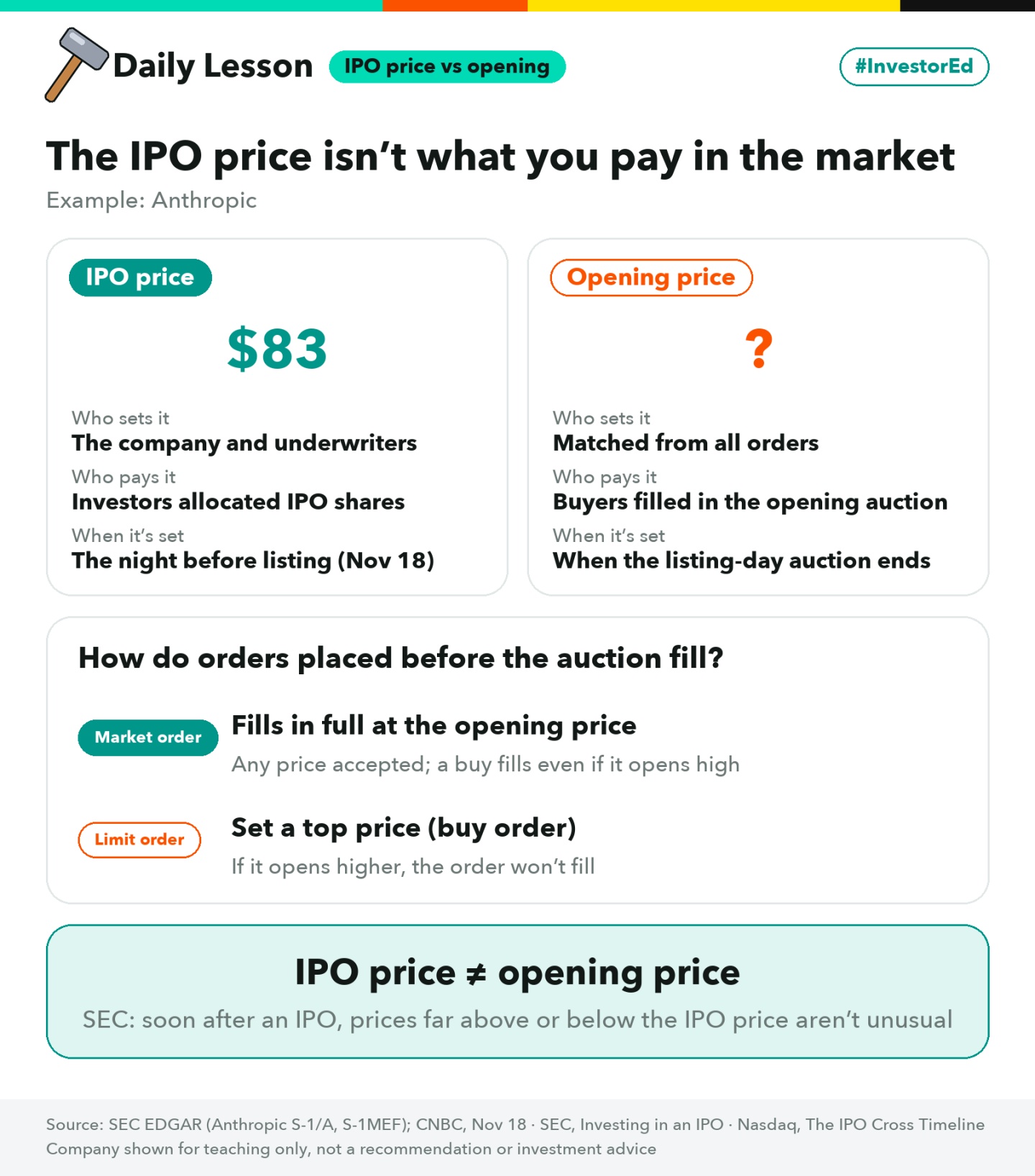
Anthropic's IPO price is $83. Does that mean its first trade on Nasdaq will also happen at $83?
Not necessarily.
The $83 IPO price is what investors who received shares in the offering pay. It was determined by Anthropic and its underwriters before the stock began trading.
But once the shares reach the public market, buyers may be willing to pay $90, $100, or even more. Others might only be willing to offer $75.
Sellers have their own prices in mind, too.
So whose price should the first trade use?
Buyers and sellers first place their orders, and Nasdaq uses those orders to determine the opening price.
Nasdaq has a special opening auction for IPOs called the IPO Cross.
Until that process is complete, the stock doesn't automatically start trading just because the 9:30 a.m. opening bell has rung.
What Happens Before a New Stock Starts Trading?
Think of it as four simple steps.
Step 1: Investors Place Orders, but No Trades Happen Yet
Buyers enter the prices they're willing to pay, while sellers enter the prices they're willing to accept.
For example, someone might offer to buy at $90, while someone else wants to sell at $100.
These orders wait until the opening auction. Investors can also change or cancel their orders within the permitted time.
Step 2: Nasdaq Shows Where the Stock Might Open
As buy and sell orders come in, Nasdaq calculates an indicative opening price.
Think of it this way: If the stock opened right now, roughly what price would it trade at?
That number isn't fixed. As orders change, the indicative price changes too.
Step 3: Not Ready to Open? Keep Waiting
Even with orders coming in, the stock doesn't start trading immediately.
Nasdaq first allows time for more buy and sell orders to arrive.
The indicative opening price is displayed for at least 10 minutes. After that, the lead underwriter and Nasdaq still need to confirm that the opening requirements are met.
If everything is ready, the stock can open. If not, it keeps waiting.
That's why a newly listed stock doesn't necessarily start trading at 9:30 a.m. Its actual opening time depends on the orders and whether the opening requirements have been met.
Step 4: One Opening Price, and Trading Begins
Once everything is ready, Nasdaq uses the buy and sell orders to determine an opening price.
Say that price is $100.
All orders successfully filled in the opening auction trade at the same price — $100.
After that first round of trades, the stock moves into regular trading.
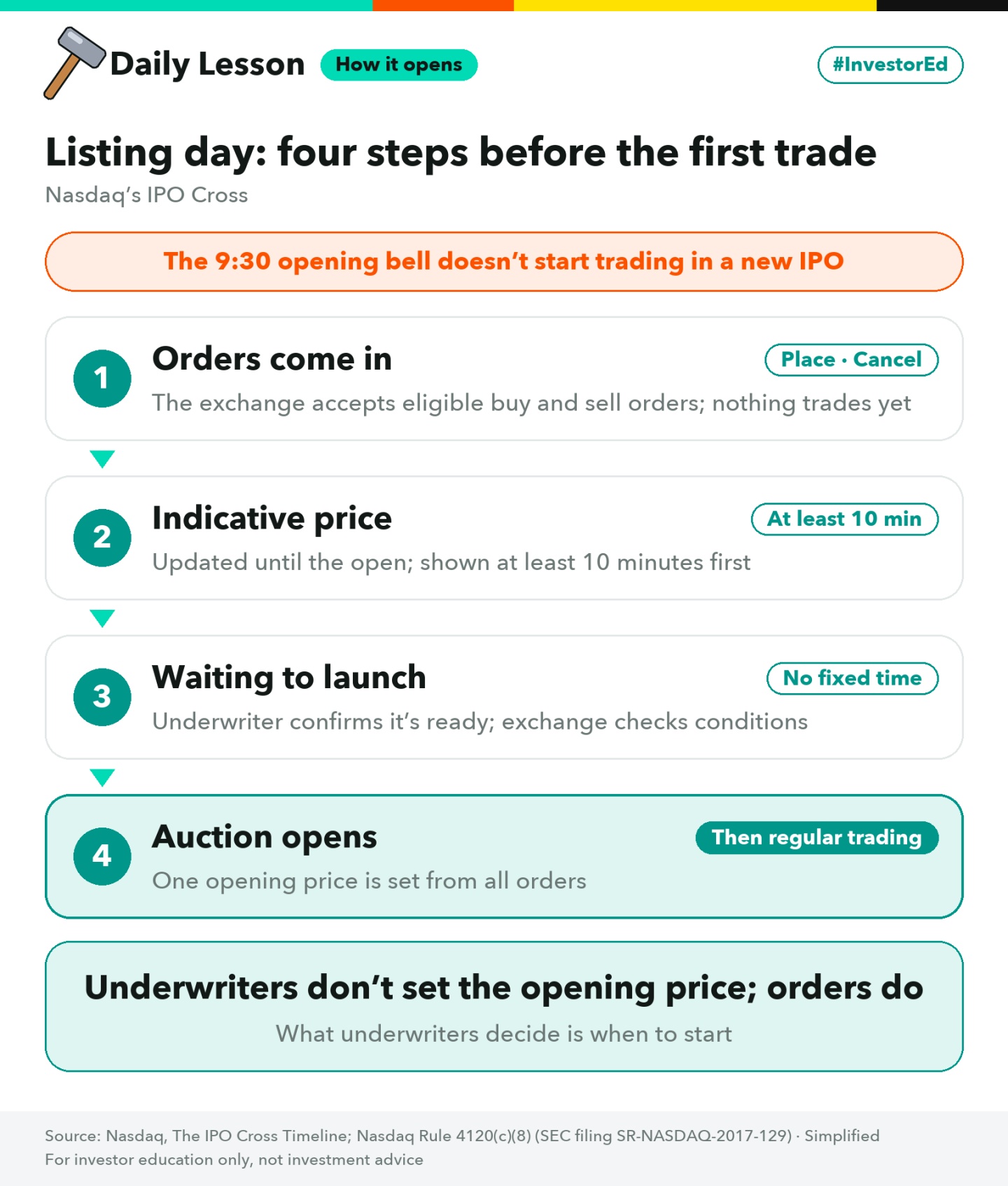
The key point: Underwriters help determine when the IPO opening process can proceed, but they don't get to choose the opening price. Nasdaq calculates it from investors' orders.
So How Is the First Trade Price Actually Calculated?
You don't need to memorize complicated trading rules.
Just remember one core principle:
Nasdaq looks for a price that allows the largest possible number of shares to trade.
Here's a simple example.
Before a new stock opens, buyers and sellers have submitted orders at different prices.
If the opening price is too high, there may not be enough buyers willing to pay it.
If the price is too low, there may not be enough sellers willing to accept it.
So Nasdaq looks for a price that matches as many buy and sell orders as possible.
If several prices would allow the same maximum trading volume, the exchange considers additional factors, such as the difference between buy and sell quantities, rather than choosing a price at random.
The result is the opening auction price.
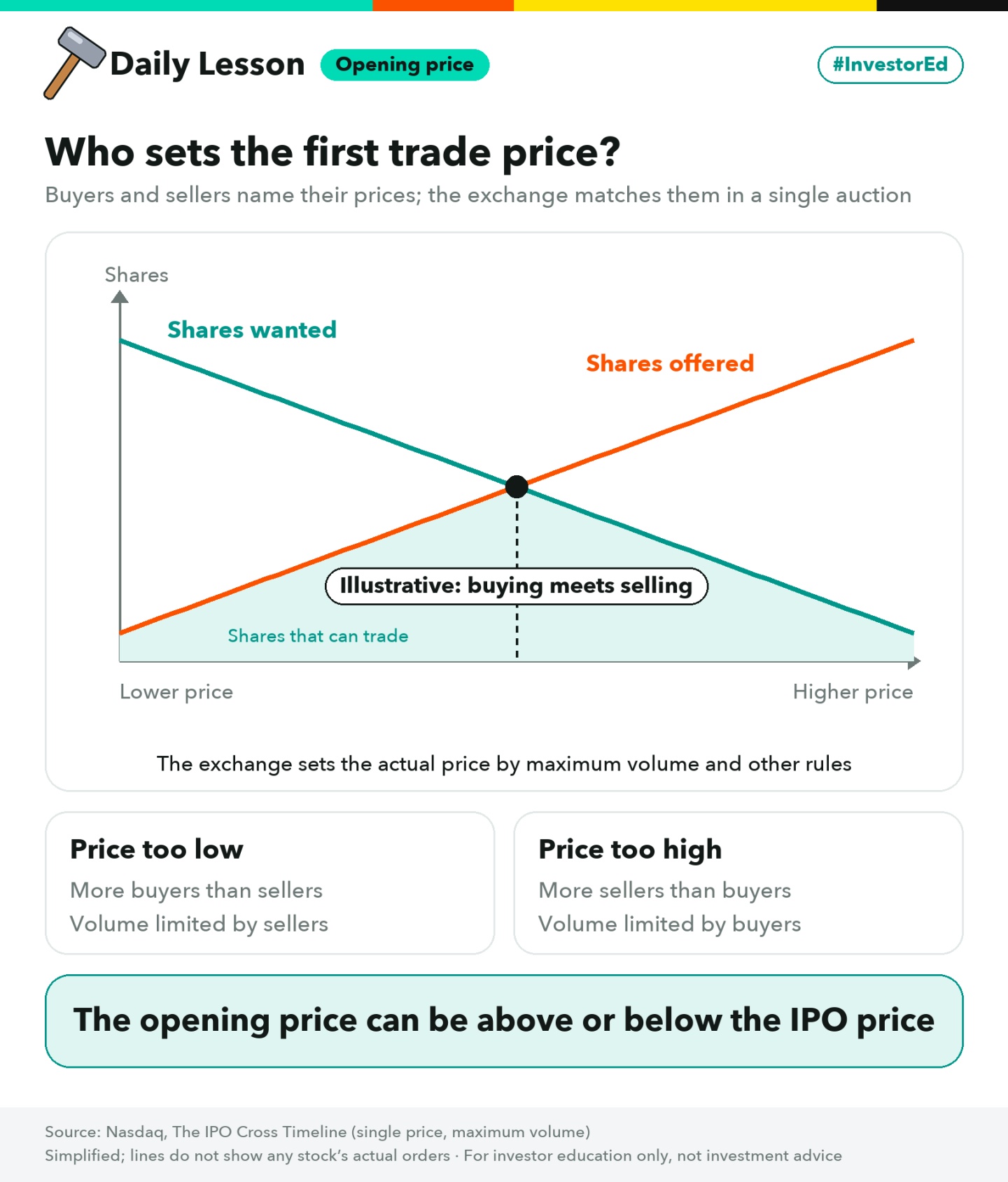
So $83 is Anthropic's IPO price, but its first trade on Nasdaq could happen above or below $83.
And even after the opening price is set, not every order placed beforehand will necessarily be filled.
Whether your order goes through depends on its type, its price, and the rules of your broker and the exchange.
Thinking About Buying Anthropic Tonight? Here's What to Know
For individual investors, three things matter more than remembering the term IPO Cross.
First, Don't Assume You Can Buy at $83
The $83 figure is Anthropic's IPO price.
If you didn't receive shares in the IPO and plan to buy through your broker after the stock lists, the price you pay will depend on the market.
For example, suppose Anthropic opens at $100.
An investor who received IPO shares at $83 and someone who buys at $100 have a $17 difference in entry price.
Same stock, but two very different entry prices.
And it can work the other way, too.
If the stock opens at just $75, investors who received shares at $83 would immediately be sitting on an $8 paper loss per share.
Second, the Indicative Price Isn't a Guaranteed Trading Price
Suppose your trading app shows an indicative opening price of $95.
You see that number and get ready to place an order.
But as more orders come in, the final opening price could end up at $105.
The indicative price can give you a sense of where the stock might open, but it doesn't guarantee you'll be able to buy at that price.
Third, Know the Difference Between Market Orders and Limit Orders
This is especially important on an IPO's first trading day.
Imagine you want to buy 100 shares of Anthropic, and the most you're willing to pay is $100 per share.
With a market order, you're asking to buy at the best available market price, without setting a maximum price you're willing to pay.
If your order successfully participates in the opening auction, it will execute at the final opening price.
So if the stock opens at $110, you could end up paying $110 per share — even though you originally had $100 in mind.
Now compare that with a $100 buy limit order.
That simply means:
Above $100, I won't buy.
If the stock opens at $95, your order may be filled at $95.
But if it opens at $110, your limit order won't execute at $110 because that exceeds your maximum price.
Of course, there's a trade-off.
A limit order controls the highest price you're willing to pay, but it doesn't guarantee you'll get the shares.
If the market stays above your limit, or there aren't enough sellers to fill your order, you might not buy any shares at all.
One more thing to remember: not every broker allows individual investors to participate in an IPO opening auction. Some may also restrict which order types can be used on a stock's first trading day.
Before placing an order, check your broker's instructions to see whether your order can join the opening auction or will only be submitted after regular trading begins.
Is Buying as Early as Possible Always Better?
Not necessarily.
A high-profile IPO like Anthropic's can attract a large number of orders before trading begins.
As those orders come in, the indicative opening price may move sharply. The actual market price can also fluctuate significantly once trading starts.
But a hot IPO and a high opening price don't mean the stock will keep rising.
Some investors want to get in on the very first trade.
Others prefer to wait until trading begins, watch how the stock price and trading volume develop, and then decide whether to participate.
Both approaches come with their own opportunities and risks.
What matters is that you don't let fear of missing out push you into paying more than you're comfortable with.
Now, back to Anthropic's debut.
If the US market opens at 9:30 a.m. and ANT still hasn't recorded its first trade, there's no need to be surprised.
The exchange is still working out the stock's opening price.
Here's the distinction to remember:
$83 is the IPO price. The opening auction determines the first market trading price. And what you actually pay depends on how and when your order executes.
Those prices aren't necessarily the same.
Understanding the difference can help you avoid surprises on a new stock's first trading day.
Today's quiz
Next question: You're planning to buy a newly listed US stock. Its expected opening price is around $100, and $100 is the most you're willing to pay per share. Which order would best suit your plan?
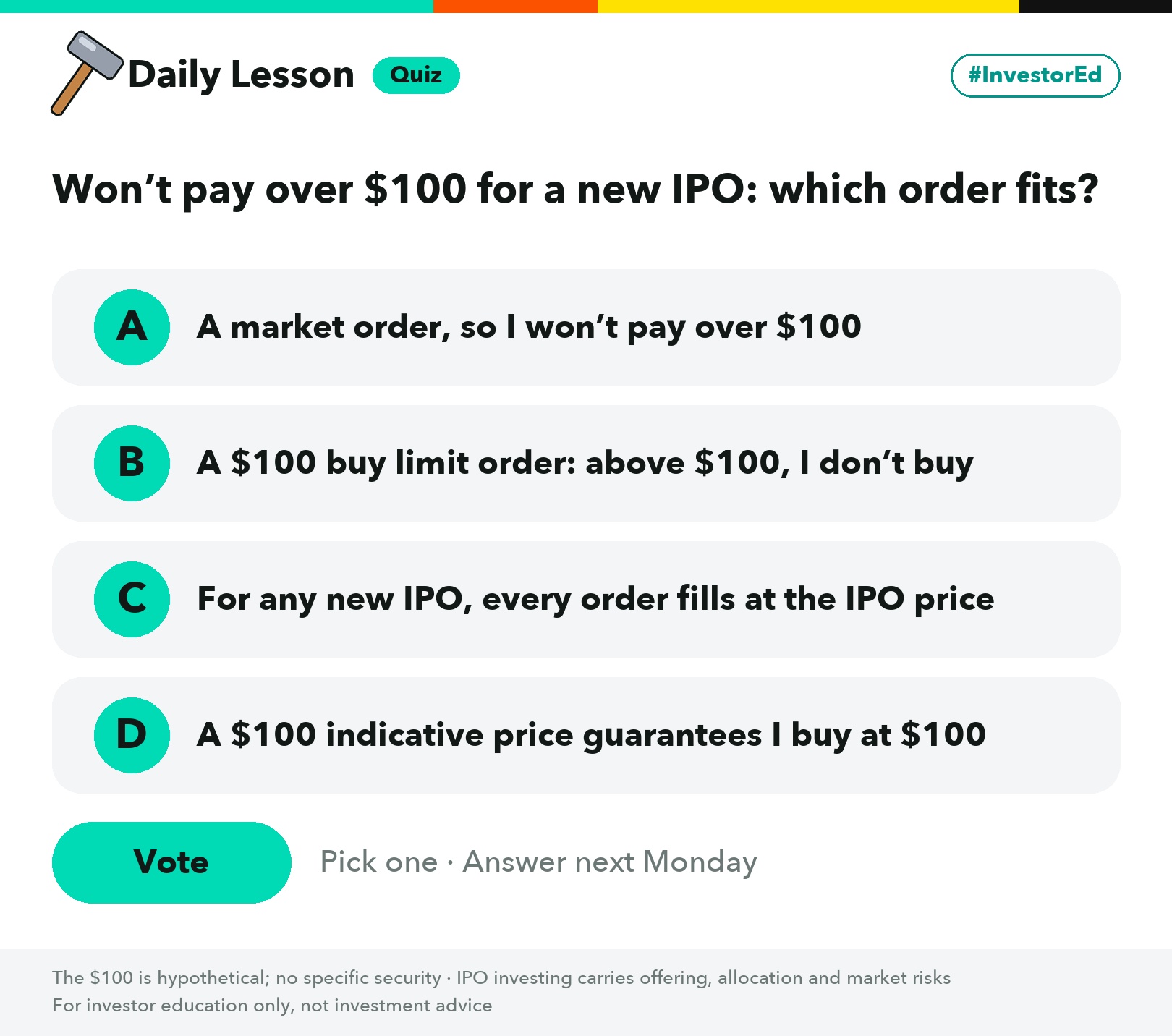
Scroll down to vote. We'll reveal the answer next Monday.
🎁 Vote, comment, earn rewards
- Pick the correct answer in the poll: 88 Task coins
- Pick the correct answer and tell us in the comments which step of a new stock's opening process was new to you, and why (at least 15 words): 188 Task coins
Poll closes Mon, 23 Nov, 6pm SGT. We'll announce the number of winners together with the answer. Rewards will be credited within 7 working days. One entry per account. Comments must relate to today's topic. T&Cs apply.
Disclaimer: This content is provided for investor education purposes only and does not constitute investment advice, an offer, or a recommendation to buy or sell any security. Investing involves risk. Please make investment decisions carefully. The author and publisher accept no liability for any direct or indirect losses arising from reliance on this content.
The copyright of this article belongs to the original author/organization.
The views expressed herein are solely those of the author and do not reflect the stance of the platform. The content is intended for investment reference purposes only and shall not be considered as investment advice. Please contact us if you have any questions or suggestions regarding the content services provided by the platform.
Author's posts
View moreAnthropic Starts Trading Today. More Than 20 Leveraged ETFs Are Lining Up: Beware the “2X Long” Trap
SpaceX ended four months where it started, yet its 2X long ETF lost a fifth. The answer is one word in the name: Daily.12 likesDaily Lesson | Anthropic’s IPO Price Range Is Still $70–$78. So Why Are Reports Pointing Higher?
Oversubscribed, upsized, greenshoe — what do these IPO headlines actually mean for investors?
191 likes · 20 repliesDaily Lesson | Investing Lessons from Berkshire Hathaway’s Latest Portfolio
Some positions grew, others were cut, and the biggest holdings barely changed. What matters most?
37 likes · 8 replies