

 Rate Of Return
The most important capital to maintain a winning trade

“ Whether you can keep a relaxed mindset is an important indicator to evaluate if a positively expected trading system suits you.”

Hong Kong stocks performed poorly this week, with the $Hang Seng Index HSI.HK$ down 2.31% weekly, and the $Hang Seng Tech Index down 1.72%.
In U.S. pre-market trading, $Tesla CB1519$ rose nearly 2%. On Thursday, Tesla's annual shareholder meeting finally kicked off. With the approval of a $56 billion compensation package and the company's relocation to Texas, Musk, who won the shareholder battle, made a bold statement: Tesla will become the world's most valuable company within five years, with a future market cap potentially exceeding $33 trillion—equivalent to 10 times the current size of $Apple AAPL$.
This week, the major indices of the Hong Kong and A-share markets were once again outperformed by the major U.S. stock indices.
A friend shared a joke:
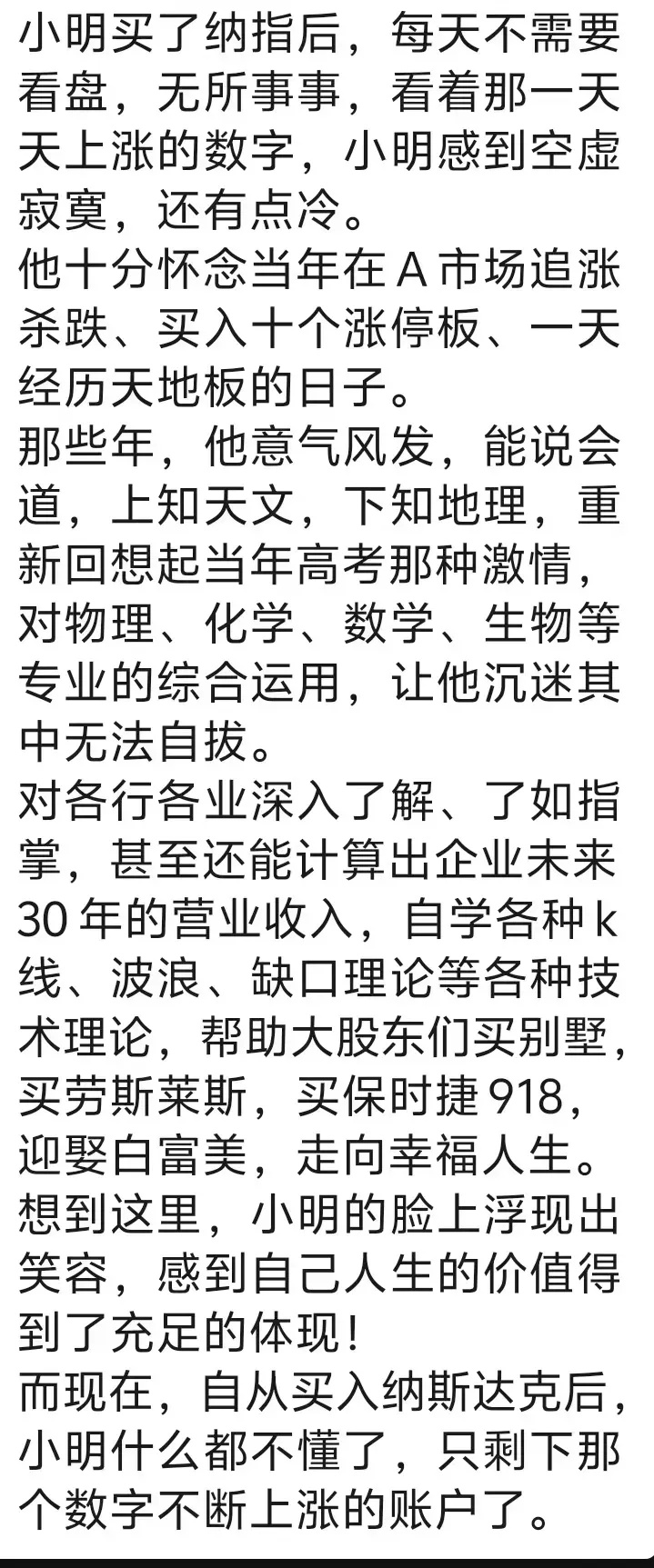
The joke tells us: 1. In the mature U.S. stock market, staying consistently profitable might only require buying index funds of major indices at low levels and holding them long-term; but it's not so easy in the A-share market.
2. Frequent trading and chasing trends can only make major shareholders consistently profitable.
Everyone wants to be a consistently successful investor, but most people do things that are completely opposite to achieving that.
Today, let’s share the most important capital for consistent trading success, as recently learned from an article by Twelve Young Master, hoping it will inspire and benefit your investment journey.
01—The Most Important Capital for Consistent Trading Success
"Shanghai Twelve Young Master" once wrote in an article:
Success requires capital, and the capital needed for trading success comes from three aspects: first, physical capital; second, psychological capital; third, monetary capital.
Among these three, monetary capital is the least important, because the size of the principal is not the decisive factor in making big money—at most, a smaller principal may take a few more years to achieve success. The real core of success does not lie in the size of the funds.
The most important lesson I’ve learned from years of trading experience is: Making money in trading has little to do with money itself. Profit is just a byproduct, naturally generated by consistently following the right trading rules. To achieve this goal, psychological capital is the most important.
This passage tells us that the most important capital for consistent trading success is psychological capital.
Thus, how to maintain good psychological capital and keep a relaxed mindset during investment and trading is the key to differentiating between investors.
From this perspective, whether you can keep a relaxed mindset is an important indicator to evaluate if a positively expected trading system suits you.
02—How to Maintain Good Psychological Capital
So, how can we maintain good psychological capital? We just need to think in reverse:
What makes our mindset unrelaxed during investment and trading? Then, avoiding or controlling these things can help us maintain good psychological capital.
The biggest factor that makes investment and trading stressful is pressure. Heavy pressure distorts operations, causing investors to violate important trading principles and plans.
Even the "Speculator King" Livermore couldn’t keep his trading undistorted under the heavy pressure of being chased by creditors after his third bankruptcy.
Eventually, he chose to file for bankruptcy to relieve the pressure, which allowed him to make a comeback with a small credit line and later repay all his debts.
Therefore, the first step to maintaining good psychological capital is to identify and address the biggest source of pressure in your investment and trading.
However, everyone’s source of pressure is different, so targeted solutions are needed.
For example, if the pressure comes from a lack of confidence in yourself or your strategy, making you hesitant to enter trades, you can use simulated trading to practice following the strategy’s entry and exit rules. Gradually, through simulation, you can build confidence in the strategy and your ability to adhere to it.
If the pressure comes from significant losses earlier, you can start by only investing funds you can afford to lose while setting risk control principles that suit your strategy and tolerance—for example, limiting single-trade losses to no more than 2% of your total account balance and monthly losses to no more than 6%—ensuring losses remain within your control.
If the pressure comes from positions that are too large relative to your account size and risk tolerance, reduce your positions to a level that lets you sleep peacefully. For instance, it’s generally recommended that beginners avoid overnight positions exceeding 20% of their total account balance.
If the pressure comes from being unable to withstand the volatility of the market, leading to frequent emotional roller coasters, start by studying short-term or swing strategies to learn how to endure small drawdowns without suffering large ones.
In summary, understanding your source of pressure and finding ways to relieve it is the only path to maintaining good psychological capital and a necessary factor for consistent trading success.
It suddenly occurred to me that the correct trading principles strictly followed by every successful investor are also important factors in reducing their trading pressure.
For example, Buffett’s principles: no leverage, no shorting, and most importantly, never invest in what you don’t understand.
I hope my sharing helps you. See you in the next article.
Special Note: This article only shares Wealth Mom’s trading system philosophy and investment logic and does not constitute any investment advice. If individual stocks are mentioned, they are not recommendations. The stock market is risky; invest cautiously and rationally!
The copyright of this article belongs to the original author/organization.
The views expressed herein are solely those of the author and do not reflect the stance of the platform. The content is intended for investment reference purposes only and shall not be considered as investment advice. Please contact us if you have any questions or suggestions regarding the content services provided by the platform.
