

 Rate Of Return
The invincible position of swing trading strategy

“ Sharing what is the breakout point of a swing market and how to find it.”

U.S. stocks opened flat today, with the Dow Jones Industrial Average (.DJI.US) up 0.01%, the Nasdaq Composite (IXIC) up 0.07%, and the S&P 500 (GSPC) up 0.04%.
Tesla (TSLA) rose nearly 2%, as Elon Musk stated that mass production of autonomous driving and Optimus would mark the end of the "short era." Additionally, several state-owned enterprises in Shanghai have ordered Model Y for corporate use.
In the previous half-year summary, Cai Ma said: The key to becoming a long-lasting trader is controlling losses and achieving "no loss."
Because in the long run, success or failure is not determined by a single outcome but by the manifestation of countless probabilities.
This tells us that what keeps long-lasting investors invincible is their commitment to high-probability actions while managing risks for low-probability events.
High-probability actions align with their investment strategies, so different strategies have different high-probability scenarios—different paths to invincibility.
Recent practice of "Shanghai Twelve Young Masters'" swing strategy has helped Cai Ma understand the invincibility of swing strategies and how to achieve it.
01—The Invincibility of Swing Strategies
"Shanghai Twelve Young Masters'" swing strategy places great emphasis on entry points,
because analysis doesn’t lose money, but executing a swing strategy requires setting a stop-loss at the point where the strategy fails, plus considering transaction fees—meaning you start losing money the moment you enter.
The "Twelve Young Masters'" swing strategy is a system designed to avoid losses, emphasizing entry at the "breakout point,"
What is a "breakout point"?
It’s the critical point where the market accelerates. Trading at this point ensures that even if you misjudge the subsequent trend, you likely won’t lose money. This is what the "Twelve Young Masters" call "seeing accurately."
This means a "breakout point" must meet three conditions:
1. The market must break out shortly after entry,
2. Even if it doesn’t break out, there’s room to move the stop-loss to breakeven.
3. Even if there’s no room for breakeven, the stop-loss at the strategy-failure point is minimal.
From Cai Ma’s compilation of "Shanghai Twelve Young Masters'" trading statistics over the past five years in the article Cai Ma’s Weekly Summary 140: The Height of Masters, we can see how they achieved this.
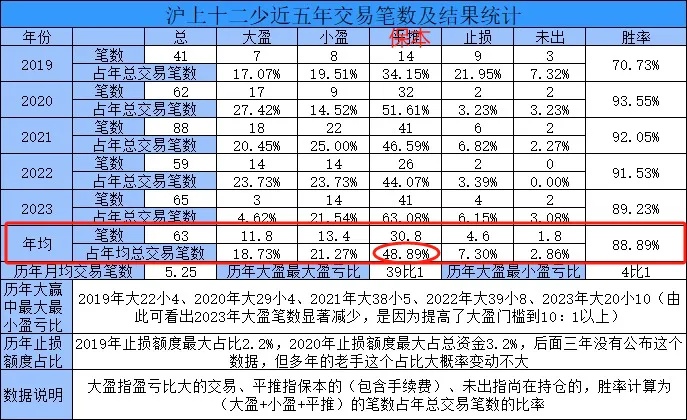
The table shows that, on average, the "Twelve Young Masters" break even on 5 out of 10 trades, stop-loss on 1, achieve big wins on 2, and small wins on 2. Their win rate—where not losing counts as winning—reaches 90%.
This is the invincibility of swing strategies:
Those who stick to this system may frequently hit breakeven or stop-loss (beginners stop-loss more often than breakeven, while veterans breakeven more often than stop-loss), but it doesn’t matter because breakeven means no loss, stop-loss means small losses, and once you hold a trade that doesn’t hit breakeven/stop-loss, it becomes a big winner.
Thus, the key to using this strategy lies in training your ability to "see accurately" (not predicting whether the market will rise or fall, but accurately identifying entry points where even if you’re wrong, you likely won’t lose money) and consistently executing the trading system.
In the beginning, even if you only "see accurately" one type of trading signal that fits the swing strategy, just patiently wait for that one. Simultaneously, keep training to advance, enabling yourself to "understand" and "see accurately" more market conditions.
Also, understand that not every understood condition is worth trading—only opportunities with high reward-to-risk ratios are worth it.
02—How to Find Breakout Points
How to find breakout points? There are two methods:
1. Learn how masters classify the characteristics of breakout points/key points and methods to judge trend strength.
2. Observe the pre-breakout patterns of familiar products/hot stocks and summarize the rules yourself.
For the first method, revisit Cai Ma’s previous article ;
For the second, we can observe Tesla (TSLA), which recently broke out, and its pre-breakout characteristics:
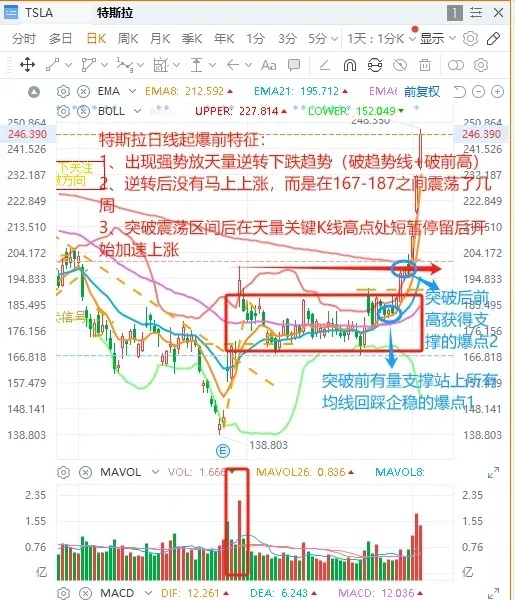
As shown, Tesla had two breakout points before this week’s surge.
As one of the frequently tracked U.S. stocks, Cai Ma mentioned to a friend last week at Breakout Point 1 about wanting to buy Tesla’s overnight options but ultimately succumbed to the fear of overnight option risks.

This week, I could only watch helplessly as my friend’s Tesla options surged 10x.
In summary, hindsight makes breakout points clearer, but in the moment, certainty is elusive—overcoming fear of failure/risk and having confidence in yourself and the stock is crucial to executing the trade.
Both methods for finding breakout points must be used together—learn and practice more to master them quickly. Let’s encourage each other~
After my second pregnancy, my energy has waned significantly. To save time and energy, this is my last post on Longbridge—a farewell gift.
See you in the future. Wishing all my followers smooth and profitable investment journeys ahead..
Disclaimer: This article shares Cai Ma’s trading system philosophy and investment logic, not investment advice. Any mentioned stocks are not recommendations. The market is risky—invest wisely and rationally!
The copyright of this article belongs to the original author/organization.
The views expressed herein are solely those of the author and do not reflect the stance of the platform. The content is intended for investment reference purposes only and shall not be considered as investment advice. Please contact us if you have any questions or suggestions regarding the content services provided by the platform.
