

Options Primer: Pay for a 'right to choose', making the investment world more flexible

Beyond stocks, funds, and bonds, a flexible and powerful investment tool is gradually entering the vision of ordinary investors—options. Many people find it a bit complex when they first encounter it, but the underlying logic is actually simple: pay for a 'right to choose'. Once you understand this sentence, you've taken the first step into the world of options.
1. What are options?
Options are financial derivatives that grant the holder the right, but not the obligation, to buy or sell an underlying asset (such as stocks, indices, commodities, etc.) at a predetermined price on or before a specified future date.Note that it's a 'right,' not an 'obligation.'
In simple terms, options are about paying for the right to decide whether to buy or sell in the future.
Understanding the definition is just the beginning; you must also grasp the four core elements of options: underlying asset, premium, expiration date, and strike price.
For example: On June 1, you give me $10, and I promise that within the next month, you have the right to buy a phone from me for $100. Whether the market price of the phone rises to $150 or falls to $80, you can choose whether to buy it.
Breaking it down with the example:
- The phone you want to buy from me is the underlying asset;
- The $10 you give me is the fee for buying the 'right to choose,' known professionally as the premium;
- If we agree on a one-month period starting June 1, the expiration date is July 1;
- We agree that regardless of whether the market price of the phone rises or falls, you can execute the deal at $100, so this $100 is the strike price.
2. Types of Options
1. By Direction of Right
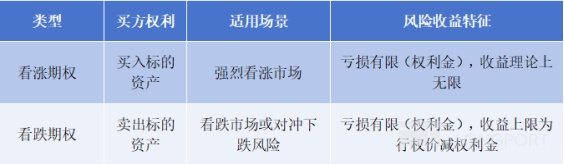
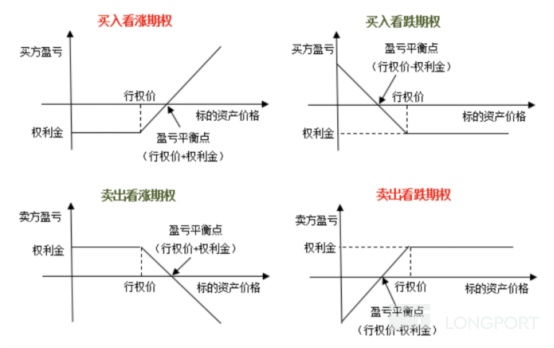
Here are two basic types of options explained with real-life examples:
Suppose you find a house worth $1 million, but you don't have enough funds and need a year to gather the money. You pay $100,000 to the seller, Lao Wang, agreeing that you have the right to buy the house for $1 million in a year.
If the house price rises to $1.2 million in a year, you'll exercise your right, buy the house for $1 million, and save $200,000. If the price falls to $950,000, you can choose to forfeit the right, losing only the $100,000 premium.
This is a call option, representing the right to buy an asset.
Conversely, suppose you need to sell your car in a month but worry about price drops. You pay $2,000 to Lao Li, agreeing that regardless of market prices, Lao Li will buy your car for $30,000 in a month.
If the market price drops to $25,000, you can exercise your right and sell for $30,000, making a profit. If the price rises to $35,000, you can forfeit the right, losing only the $2,000 premium.
This is a put option, representing the right to sell an asset.
From these examples, we can see that options are essentially a zero-sum game: one party's profit is another's loss. In options trading, the buyer pays the premium for the right to choose, while the seller collects the premium and bears the corresponding obligation—simply put, the seller must comply with the buyer's decisions after taking the money.
2. By Exercise Time
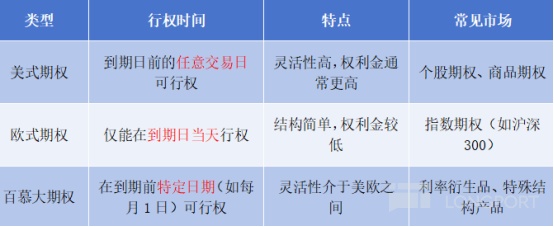
3. By Trading Venue
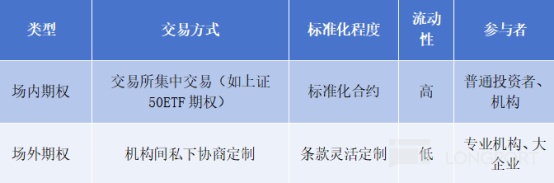
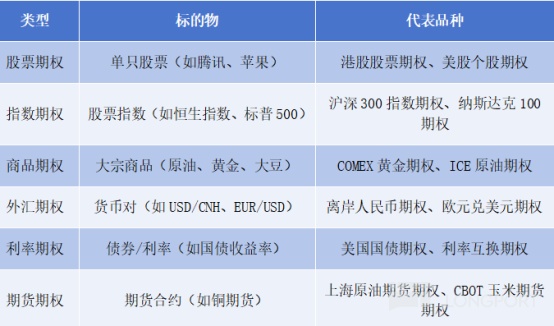
4. By Underlying Asset
3. The Appeal of Options
1. Leverage (Small Capital, Big Returns): Pay a small premium for significant potential gains;
2. Flexible Risk Hedging (Insurance): Use options to protect existing positions, such as buying puts to hedge against declines;
3. Rich Strategy Combinations (Versatility): Combine call/put options with different strike prices and expiration dates (e.g., covered calls, straddles, butterflies) to adapt to bull, bear, or volatile markets;
4. Lock in Future Prices (Pre-negotiation): Options allow you to lock in buy or sell prices, providing certainty for future trades, especially useful for institutions or long-term investors;
5. Limited Risk Exposure (Buyer): The buyer's maximum loss is capped at the premium, preserving upside potential while avoiding unlimited losses;
6. Volatility Pricing Power: Option prices reflect market expectations of volatility, allowing investors to profit from volatility strategies (Vega) independent of directional bets.
4. Risks of Options
1. Time Decay (The Longer, the Worse): For buyers, time erodes value daily; as expiration nears, options depreciate even if the underlying price doesn't move;
2. Volatility Changes (Unmet Expectations): If the market expects high volatility but reality is calm, option prices can plummet even if the direction is correct;
3. Seller's Potential Risks (Limited Gains, Unlimited Losses): Sellers collect premiums but face massive losses if markets move sharply, potentially triggering margin calls;
4. Liquidity Risk (Hard to Exit): Some options are illiquid, with wide bid-ask spreads, making it hard to close positions;
5. Leverage Amplifies Risk (Fast Gains, Faster Losses): Leverage can magnify profits but also losses, leading to sharp account fluctuations if overused.
Conclusion: Options Are Tools, Not Magic
Options themselves are neutral tools; their value depends on the user's knowledge and risk control. Used well, they protect and amplify; used poorly, they can backfire.
Learning options is like acquiring a 'magic skill' in finance. But remember: behind the magic lies logic, discipline, and awareness. Approach options with caution and respect for risk.
$Tesla(TSLA.US) $NVIDIA(NVDA.US) $Apple(AAPL.US) $Alphabet - C(GOOG.US) $POP MART(09992.HK) $Amazon(AMZN.US)
The copyright of this article belongs to the original author/organization.
The views expressed herein are solely those of the author and do not reflect the stance of the platform. The content is intended for investment reference purposes only and shall not be considered as investment advice. Please contact us if you have any questions or suggestions regarding the content services provided by the platform.
