

The waves of the great nation's economy keep coming, China's 'chip' becomes the new focus

Two consecutive days of national-level major events have concluded successfully, starting with the SCO meeting followed by a grand military exercise. The events came one after another, but the financial market was affected by concerns over the overheating of A-shares, showing relatively volatile performance. The momentum of Hong Kong stocks also weakened, with a strong wait-and-see atmosphere.
Speaking of the new developments at the SCO meeting, the organization has expanded to 10 member states, covering over 37 million square kilometers of Eurasia with a combined GDP exceeding $23 trillion. In 2024, China-SCO regional trade volume reached $890 billion, with core areas including energy, electromechanical products, and cross-border logistics. The country advocates multilateral openness and has clearly identified AI technology and regional economic integration as strategic directions for this year, focusing on chips, robotics, smart manufacturing, and technical standard-setting.
Sure, why have chip stocks been falling continuously? First, let’s look at the meeting’s proposals: member states are focusing on AI chips, robotics, and automated manufacturing, advancing the development of multimodal large models and specialized chips. Some analysts believe that the mainland chip industry will enter a consolidation phase where the weak are eliminated and the strong survive.
Coincidentally, Alibaba proposed investing over 300 billion in chip and other AI businesses in the future, with a focus on foundry services. This raises the question: if development proceeds as outlined, more cloud and chip businesses could be exported to SCO countries. Meanwhile, companies like Xiaomi and Huawei are leading the market in AI terminals, prompting funds to shift focus from chip manufacturing to these tech firms.
What are the potential opportunities?
- Alibaba: Dual breakthroughs in cross-border e-commerce and AI cloud services
• Cross-border e-commerce: SCO member states cover emerging markets like Southeast Asia and the Middle East. Alibaba International Digital Commerce Group (AIDC) saw a 29% YoY revenue growth in Q1 2025, driven mainly by cross-border businesses (e.g., Lazada, Trendyol). Its annual active buyers reached 903 million, with GMV hitting 8.32 trillion and monetization rate rising to 6.93%, indicating optimized cross-border transaction efficiency.
• AI + cloud services: Alibaba Cloud revenue continues to grow (Q2 2025: 33.4 billion RMB, up 26% YoY), with AI technology applied in smart grids and cross-border logistics (e.g., digital scheduling of China-Europe freight trains), enhancing regional energy management and supply chain efficiency.
- Tencent: Ecosystem empowerment and payment scenario expansion
• Payments and fintech: WeChat’s monthly active users reached 1.411 billion. Tencent’s fintech business revenue (Q2 2025: 55.5 billion RMB) can penetrate SCO regional e-commerce and SME service scenarios through cross-border payment solutions.
• AI technology implementation: The Hunyuan large model is already used for ad recommendation optimization (marketing service revenue up 20% YoY to 35.8 billion RMB) and AI customer service in social ecosystems, further meeting regional enterprises’ smartization needs.
- Xiaomi: Synergistic layout of smart hardware and NEVs
• Smartphones and IoT devices: Q2 2025 smartphone shipments hit 42.4 million units, with a 14.7% market share. SCO countries (e.g., India, Russia) are traditional strongholds. The IoT platform connects 989 million devices, with smart home appliance revenue up 66.2% YoY, aligning with regional smart home trends.
• NEVs and AI applications: Xiaomi SU7 series delivered 81,300 units in Q2 2025, up 197.7% YoY, potentially expanding into SCO markets under green energy policies. HyperOS (731 million MAUs) AI features can integrate with regional smart city infrastructure.
In summary, Alibaba, Tencent, and Xiaomi can seize opportunities through:
• Technology exports: Integrating regional supply chains with AI chips, cloud computing, and smart manufacturing
• Ecosystem synergy: Multi-dimensional linkages like cross-border e-commerce + logistics (Alibaba), payments + social scenarios (Tencent), smart hardware + cars (Xiaomi)
• Localized partnerships: Engaging in regional infrastructure projects (e.g., digitalization of China-Kyrgyzstan-Uzbekistan railway) and technical standard-setting
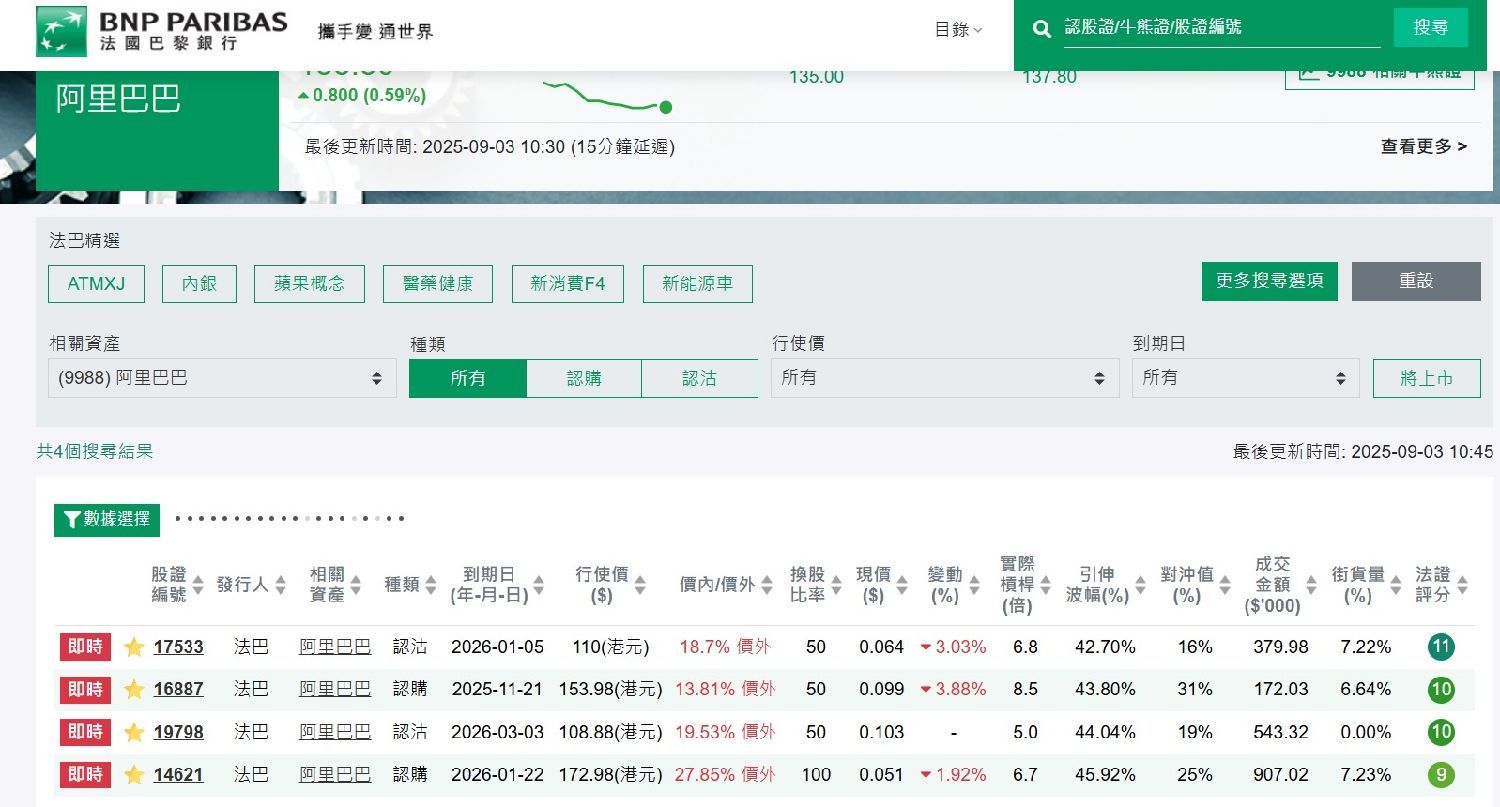
Recently, due to Alibaba’s sharp stock price rise, bull warrants couldn’t keep up with market demand, leading to tight supply. Short-term traders can consider CALL warrants like 16887, offering 8x leverage and low street supply. 16887 terms
$BABA-W(09988.HK)
The copyright of this article belongs to the original author/organization.
The views expressed herein are solely those of the author and do not reflect the stance of the platform. The content is intended for investment reference purposes only and shall not be considered as investment advice. Please contact us if you have any questions or suggestions regarding the content services provided by the platform.
