

$POP MART(09992.HK) There have been too many ghost stories about Pop Mart recently.
Pop Mart's Q3 net profit was 3.7 billion, and the full-year net profit for 2025 is expected to be around 12 billion RMB, which is basically an open secret. Based on the current market cap, the 2025 P/E ratio is 23.8x; if calculated based on the Q3 net profit of 3.7 billion, the dynamic P/E ratio is 19x.
Even if the net profit growth rate in 2026 is only 35%, the full-year net profit for 2026 would still be at least 16.2 billion RMB, corresponding to a current P/E ratio of 17.6x.
Wind's consensus earnings estimate is even higher than mine, at around 17 billion RMB in profit expectations, and this is still the result of some research reports not being updated based on Q3 performance expectations.
As of last night, from October 21 to October 22, 18 brokerages issued research reports, 15 of which provided target price guidance.
Even JPMorgan, which was the first to turn bearish, raised its target price from 300 yuan to 320 yuan and then to 350 yuan yesterday. So, in terms of value, are all the analysts in the market wrong, or is the market wrong?
I think neither is wrong, because the market is often counterintuitive in the short term. For large institutions, their average holding period is over 12 months, so they hardly feel short-term fluctuations. For some foreign investment banks, it's a no-brainer to short squeeze the bullish warrants first and then push the cost even lower.
The market is never wrong; the only ones wrong are those who follow short-term emotions. There's no yardstick for judging a company's value based on short-term fluctuations. When a stock rises, people are bullish on the company's future and can swallow any big story. When a stock falls, they think the whole market is full of ghost stories. But after all the ups and downs, the company's fundamentals haven't changed much.
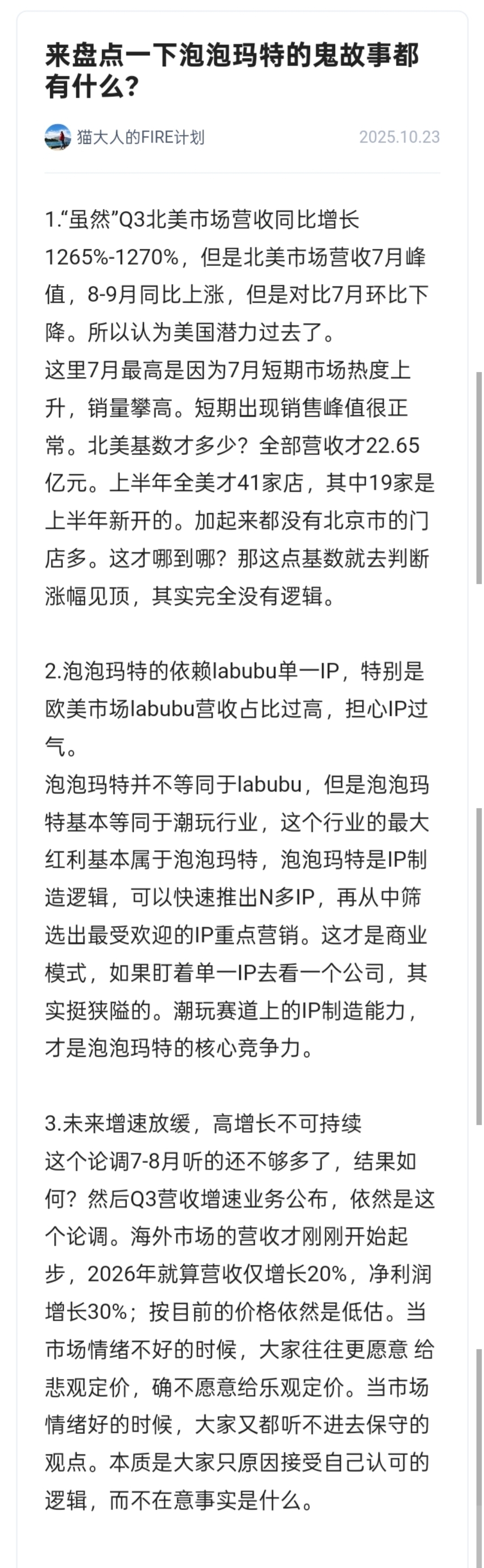
Let's take stock of Pop Mart's ghost stories. (Due to word limits, see the image.)
Graham likened the market to an extremely emotional "Mr. Market." He shows up every day with a quote: sometimes he's optimistic and offers a high price; other times he's pessimistic and offers a low price. The investor's task is not to be swayed by his mood swings but to take advantage of them.
Rising stocks increase risk rather than reduce it, and falling stocks reduce risk rather than increase it.
Let’s encourage each other.
 Long Image
The copyright of this article belongs to the original author/organization.
The views expressed herein are solely those of the author and do not reflect the stance of the platform. The content is intended for investment reference purposes only and shall not be considered as investment advice. Please contact us if you have any questions or suggestions regarding the content services provided by the platform.
