

Pinduoduo 3Q25 Review: No Surprises


Nothing new.
3Q25 revenue was 108.27 billion, up 9% YoY, compared to the 7% growth in the previous quarter, indicating a recovery from the trough.
Adjusted operating profit was 27 billion, up 1.2% YoY, a significant improvement compared to the over 20% decline in the previous two quarters, with a margin of 25%, which has returned to normal levels. Adjusted net profit, due to 8.5 billion in interest income, reached 31.4 billion, up 14% YoY.
The deviation between revenue, operating profit, and my forecast was within 3%, so no surprises. The low base effect officially started in Q3, and going forward, growth rates and profit margins will continue to improve marginally.
The inflection point in fundamentals has just begun, while the inflection point in the stock price started a quarter earlier.
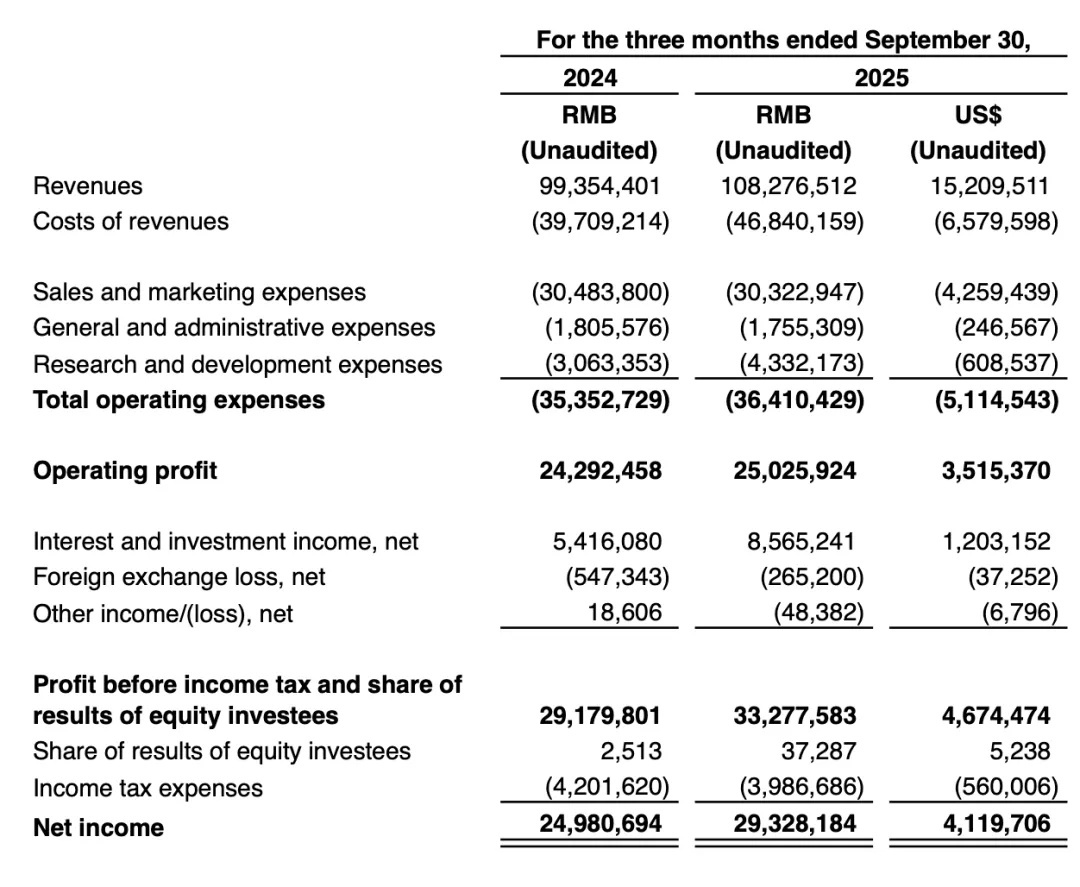
1. Revenue growth rebounded, but domestic e-commerce is still reducing fees. Total revenue was 108.27 billion, up 9%, with online marketing and transaction commission revenue growing by 8.1% and 9.9%, respectively. Online marketing mainly consists of domestic advertising, with Q3 growth of 8.1%, lower than Q2's 13.4%, while GMV growth should be above 15%, indicating that fee rates are still declining—if there's anything below expectations, it's here. Transaction commissions include e-commerce, Duoduo Grocery, and TEMU, with TEMU accounting for about 70%. Growth over the past three quarters was 6%/1%/9.9%, mainly dragged down by lower e-commerce commissions and TEMU's shift from full to semi-trust. Going forward, the impact of these two factors will be significantly reduced, and commission revenue growth will converge with TEMU's GMV performance, albeit slightly lower.
2. Gross margin was 56.7%, stable with a slight sequential increase. Gross profit also includes domestic and international TEMU. Domestic was hurt by lower commissions, while international benefited from an increase in semi-trust. Compared to Q2's 55.9%, it improved by 0.8%. Going forward, it may stabilize around 56%, with domestic possibly declining slightly further due to continued merchant incentives, but TEMU can improve with economies of scale.
3. Sales expenses were 30.3 billion, down 0.5% YoY, indicating TEMU's efficiency is improving. The increase in sales expenses can be attributed entirely to TEMU. Domestic sales expenses were 12-15 billion per quarter, with little change, while TEMU's Q3 expenses increased by only 3 billion sequentially. With the U.S. resuming listings in July, marketing expenses increased accordingly. Under normal trends, this increase is already conservative. Domestic and international sales expenses will increase slightly further in Q4. Management and R&D expenses saw little change, at 5-6 billion per quarter, growing less than 10%, with minimal impact on profits compared to sales expenses.
4. TEMU's losses widened slightly sequentially. I was initially concerned about TEMU's Q3 losses, but management has proven to be prudent. Due to the U.S.-China tariff conflict, TEMU paused marketing from April to June and resumed in July. This had opposite effects on Q2 and Q3 profits: in Q2, U.S. marketing expenses disappeared overnight, but revenue declined gradually, so profits improved; in Q3, marketing expenses surged overnight, but revenue lagged, so losses increased. This aligns with the changes in sales expenses.—Amid uncertain external conditions, TEMU is no longer aggressively expanding, and the timeline for reducing losses may be brought forward.
5. Operating profit was 25 billion, adjusted to 27 billion, better than market expectations. If the assumptions about TEMU are correct, the adjusted operating profit for the domestic business has been around 30 billion for the past two quarters, with slight improvement in Q3 and a margin of about 43%—also stable. The financial impact of state subsidies, agricultural support, and ecosystem feedback has persisted for a year, and there's no need to worry about worse scenarios. Earnings forecasts have also become clearer.
6. Investment income remains strong. The Nasdaq rose 9% in Q3, and I initially expected the company's return to be 10%, translating to 5-6 billion in investment income. The actual figure was 8.5 billion, suggesting a return of over 15%. With this boost, adjusted net profit reached 31.4 billion, though this number is less important. For Q4, it should be lower, but the full-year figure should still exceed 20 billion, just enough to cover taxes.
7. The tax rate issue. The effective tax rate in Q3 was 12%, compared to 13.6% in Q2. Theoretically, it should be above 15%, so part of it was likely deferred to Q4. For the full year, the impact is minimal, but Q4 forecasts will need to account for higher taxes.
In the earnings report, management's exact words were:
We will take on greater social responsibility and continue to work for the broader public interest and the long-term development of the entire e-commerce ecosystem.
We will continue to increase support for merchants, drive industry upgrades, and achieve sustainable platform growth.
Q3 revenue growth continued to slow, reflecting changing competitive dynamics and external uncertainties.
As we roll out more merchant support programs and ecosystem investments, financial performance may continue to show quarterly fluctuations.
Still nothing new, but at least they didn’t mention “aging management or lack of competitiveness” again. I don’t expect any incremental information from the upcoming earnings call, and investors seem numb to it by now.
At this point, Pinduoduo is arguably at its most comfortable.
Domestic e-commerce has fought the low-price battle, and competitors have retreated, leaving Pinduoduo’s market position solid. Lower commissions to reward merchants have also been implemented. Duoduo Grocery now stands alone as the leading player after Meituan’s exit. TEMU has passed its three-year survival test, and U.S.-EU tariffs are settled, so it can now grow steadily. The worst is over for all businesses, and any future catalysts are more likely to drive upside.
From an investor psychology perspective, the worst is also behind us, but is there much optimism? Not really—a 10x P/E doesn’t reflect any optimism. When the market becomes optimistic about Pinduoduo again, that’s when caution is warranted.
But for the stock to break out of its range, it needs earnings support. Still, I’m optimistic that Pinduoduo’s profit surge isn’t far off.
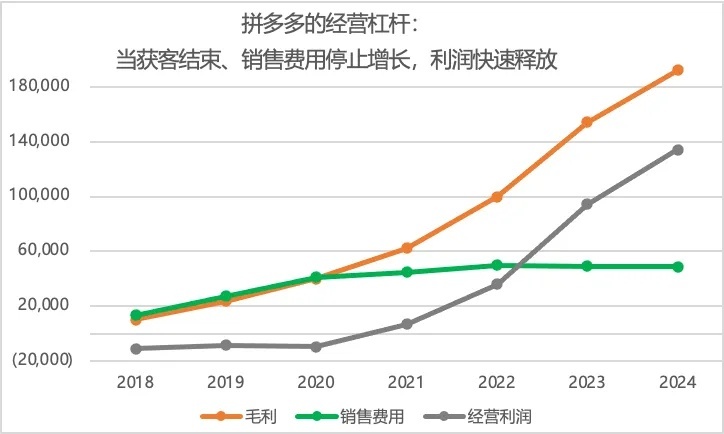
Looking at Pinduoduo’s domestic e-commerce financials, the inflection point came in 2021, when sales expenses were 44.8 billion and subsequently stabilized below 50 billion. Meanwhile, revenue continued to grow rapidly, and profits surged from 6.8 billion in 2021 to 130 billion in 2024. The key was that after the customer acquisition phase, sales expenses didn’t need to increase further, while revenue growth from repeat purchases drove rapid profit expansion. TEMU will likely follow this pattern, possibly in 2026-2027. TEMU’s MAU has already reached 520 million, so that day will come sooner or later.
The copyright of this article belongs to the original author/organization.
The views expressed herein are solely those of the author and do not reflect the stance of the platform. The content is intended for investment reference purposes only and shall not be considered as investment advice. Please contact us if you have any questions or suggestions regarding the content services provided by the platform.
